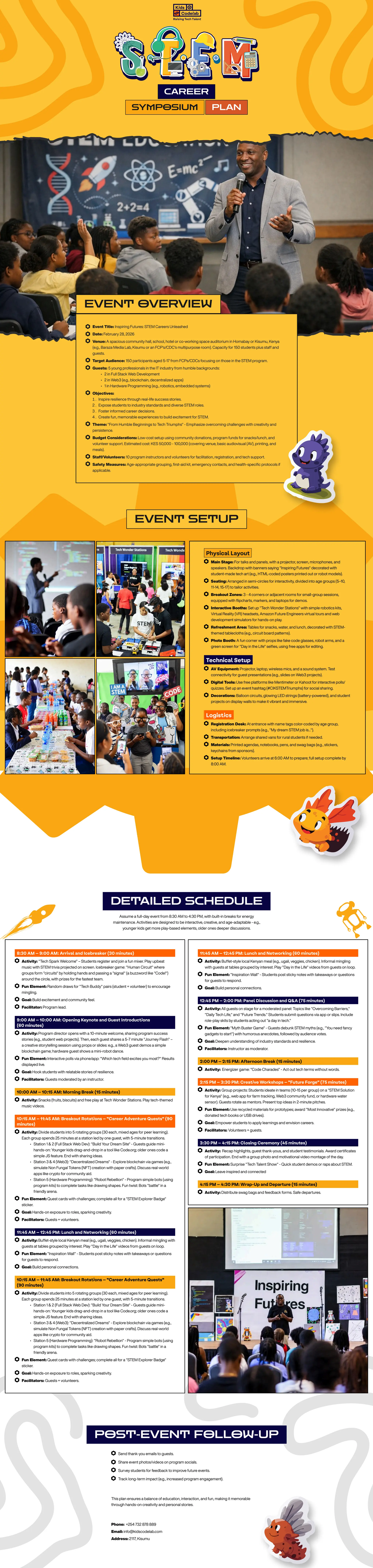
Event Title: InspiringFutures: STEM Careers Unleashed
Date: February 28, 2026
Venue: A spacious community hall, school, hotel or co-working space auditorium in Homabay or Kisumu, Kenya
(e.g., Baraza Media Lab, Kisumu or an FCP’s/CDC’s multipurpose room). Capacity for 150 students plus staff and
guests.
Target Audience: 150 participants aged 5-17 from FCPs/CDCs focusing on those in the STEM program.
Guests: 5 young professionals in the IT industry from humble backgrounds:
2 in Full Stack Web Development
2 in Web3 (e.g., blockchain, decentralized apps)
1 in Hardware Programming (e.g., robotics, embedded systems)
Objectives:
Inspire resilience through real-life success stories.
Expose students to industry standards and diverse STEM roles.
Foster informed career decisions.
Create fun, memorable experiences to build excitement for STEM.
Theme: "From Humble Beginnings to Tech Triumphs" - Emphasize overcoming challenges with creativity and
persistence.
Budget Considerations: Low-cost setup using community donations, program funds for snacks/lunch, and
volunteer support. Estimated cost: KES 50,000 - 100,000 (covering venue, basic audiovisual (AV), printing, and
meals).
Staff/Volunteers: 10 program instructors and volunteers for facilitation, registration, and tech support.
Safety Measures: Age-appropriate grouping, first-aid kit, emergency contacts, and health-specific protocols if
applicable.
Event oVERVIEW
Physical Layout
Main Stage: For talks and panels, with a projector, screen, microphones, and
speakers. Backdrop with banners saying "Inspiring Futures" decorated with
student-made tech art (e.g., HTML-coded posters printed out or robot models).
Seating: Arranged in semi-circles for interactivity, divided into age groups (5–
10,
11-14, 15-17) to tailor activities.
Breakout Zones: 3 - 4 corners or adjacent rooms for small-group sessions,
equipped with flipcharts, markers, and laptops for demos.
Interactive Booths: Set up "Tech Wonder Stations" with simple robotics kits,
Virtual Reality (VR) headsets, Amazon Future Engineers virtual tours and web
development simulators for hands-on play.
Refreshment Area: Tables for snacks, water, and lunch, decorated with STEM-
themed tablecloths (e.g., circuit board patterns).
Photo Booth: A fun corner with props like fake code glasses, robot arms, and a
green screen for "Day in the Life" selfies, using free apps for editing.
Technical Setup
AV Equipment: Projector, laptop, wireless mics, and a sound system. Test
connectivity for guest presentations (e.g., slides on Web3 projects).
Digital Tools: Use free platforms like Mentimeter or Kahoot for interactive polls/
quizzes. Set up an event hashtag (#CIKSTEMTriumphs) for social sharing.
Decorations: Balloon circuits, glowing LED strings (battery-powered), and student
projects on display walls to make it vibrant and immersive.
Logistics
Registration Desk: At entrance with name tags color-coded by age group,
including icebreaker prompts (e.g., "My dream STEM job is...").
Transportation: Arrange shared vans for rural students if needed.
Materials: Printed agendas, notebooks, pens, and swag bags (e.g., stickers,
keychains from sponsors).
Setup Timeline: V
olunteers arrive at 6:00 AM to prepare; full setup complete by
8:00 AM.
8:30 AM – 9:00 AM: Arrival and Icebreaker (30 minutes)
Activity: "Tech Spark Welcome" – Students register and join a fun mixer. Play upbeat
music with STEM trivia projected on screen. Icebreaker game: "Human Circuit" where
groups form "circuits" by holding hands and passing a "signal" (a buzzword like "Code!")
around the circle, with prizes for the fastest team.
Fun Element: Random draws for "Tech Buddy" pairs (student + volunteer) to encourage
mingling.
Goal: Build excitement and community feel.
Facilitator: Program lead.
9:00 AM – 10:00 AM: Opening Keynote and Guest Introductions
(60 minutes)
Activity: Program director opens with a 10-minute welcome, sharing program success
stories (e.g., student web projects). Then, each guest shares a 5-7 minute "
Journey Flash" –
a creative storytelling session using props or slides: e.g., a Web3 guest demos a simple
blockchain game; hardware guest shows a mini-robot dance.
Fun Element: Interactive polls via phone/app: "Which tech field excites you most?" Results
displayed live.
Goal: Hook students with relatable stories of resilience.
Facilitators: Guests moderated by an instructor.
10:00 AM – 10:15 AM: Morning Break (15 minutes)
Activity: Snacks (fruits, biscuits) and free play at Tech Wonder Stations. Play tech-themed
music videos.
10:15 AM – 11:45 AM: Breakout Rotations – "Career Adventure Quests" (90
minutes)
Activity: Divide students into 5 rotating groups (30 each, mixed ages for peer learning).
Each group spends 25 minutes at a station led by one guest, with 5-minute transitions.
Station 1 & 2 (Full Stack Web Dev): "Build Your Dream Site" - Guests guide mini-
hands-on: Younger kids drag-and-drop in a tool like Code.org; older ones code a
simple JS feature. End with sharing ideas.
Station 3 & 4 (Web3): "Decentralized Dreams" - Explore blockchain via games (e.g.,
simulate Non Fungal Tokens (NFT) creation with paper crafts). Discuss real-world
apps like crypto for community aid.
Station 5 (Hardware Programming): "Robot Rebellion" - Program simple bots (using
program kits) to complete tasks like drawing shapes. Fun twist: Bots "battle" in a
friendly arena.
Fun Element: Quest cards with challenges; complete all for a "STEM Explorer Badge"
sticker.
Goal: Hands-on exposure to roles, sparking creativity.
Facilitators: Guests + volunteers.
11:45 AM – 12:45 PM: Lunch and Networking (60 minutes)
Activity: Buffet-style local Kenyan meal (e.g., ugali, veggies, chicken). Informal mingling with
guests at tables grouped by interest. Play "Day in the Life" videos from guests on loop.
Fun Element: "Inspiration Wall" - Students post sticky notes with takeaways or questions
for guests to respond.
Goal: Build personal connections.
10:15 AM – 11:45 AM: Breakout Rotations – "Career Adventure Quests"
(90 minutes)
Activity: Divide students into 5 rotating groups (30 each, mixed ages for peer learning).
Each group spends 25 minutes at a station led by one guest, with 5-minute transitions.
Station 1 & 2 (Full Stack Web Dev): "Build Your Dream Site" - Guests guide mini-
hands-on: Younger kids drag-and-drop in a tool like Code.org; older ones code a
simple JS feature. End with sharing ideas.
Station 3 & 4 (Web3): "Decentralized Dreams" - Explore blockchain via games (e.g.,
simulate Non Fungal Tokens (NFT) creation with paper crafts). Discuss real-world
apps like crypto for community aid.
Station 5 (Hardware Programming): "Robot Rebellion" - Program simple bots (using
program kits) to complete tasks like drawing shapes. Fun twist: Bots "battle" in a
friendly arena.
Fun Element: Quest cards with challenges; complete all for a "STEM Explorer Badge"
sticker.
Goal: Hands-on exposure to roles, sparking creativity.
Facilitators: Guests + volunteers.
11:45 AM – 12:45 PM: Lunch and Networking (60 minutes)
Activity: Buffet-style local Kenyan meal (e.g., ugali, veggies, chicken). Informal mingling
with guests at tables grouped by interest. Play "Day in the Life" videos from guests on loop.
Fun Element: "Inspiration Wall" - Students post sticky notes with takeaways or questions
for guests to respond.
Goal: Build personal connections.
12:45 PM – 2:00 PM: Panel Discussion and Q&A (75 minutes)
Activity: All guests on stage for a moderated panel: Topics like "Overcoming Barriers,"
"Daily Tech Life," and "Future Trends." Students submit questions via app or slips. Include
role-play skits by students acting out "a day in tech."
Fun Element: "Myth Buster Game" - Guests debunk STEM myths (e.g., "You need fancy
gadgets to start") with humorous anecdotes, followed by audience votes.
Goal: Deepen understanding of industry standards and resilience.
Facilitators: Instructor as moderator.
2:00 PM – 2:15 PM: Afternoon Break (15 minutes)
Activity: Energizer game: "Code Charades" - Act out tech terms without words.
2:15 PM – 3:30 PM: Creative W
orkshops – "Future Forge" (75 minutes)
Activity: Group projects: Students ideate in teams (10-
15 per group) on a "STEM Solution
for Kenya" (e.g., web app for farm tracking, Web3 community fund, or hardware water
sensor). Guests rotate as mentors. Present top ideas in 2-minute pitches.
Fun Element: Use recycled materials for prototypes; award "Most Innovative" prizes (e.g.,
donated tech books or USB drives).
Goal: Empower students to apply learnings and envision careers.
Facilitators: V
olunteers + guests.
3:30 PM – 4:15 PM: Closing Ceremony (45 minutes)
Activity: Recap highlights, guest thank-yous, and student testimonials. Award certificates
of participation. End with a group photo and motivational video montage of the day.
Fun Element: Surprise "Tech Talent Show" - Quick student demos or raps about STEM.
Goal: Leave inspired and connected
4:15 PM – 4:30 PM: Wrap-Up and Departure (15 minutes)
Activity: Distribute swag bags and feedback forms. Safe departures.
Det
ailed Schedule
Assume a full-day event from 8:30 AM to 4:30 PM, with built-in breaks for energy
maintenance. Activities are designed to be interactive, creative, and age-adaptable - e.g.,
younger kids get more play-based elements, older ones deeper discussions.
Event Setup
Post-Event Follow-Up
Send thank-you emails to guests.
Share event photos/videos on program socials.
Survey students for feedback to improve future events.
Track long-term impact (e.g., increased program engagement).
This plan ensures a balance of education, interaction, and fun, making it memorable
through hands-on creativity and personal stories.
Phone: +254 732 878 889
Email: info@kidscodelab.com
Address: 2117, Kisumu
Career
Symposium plan