Name –Arun Kumar
Assistant Professor
Department of Pharmaceutics
Sai Meer college of pharmacy,
Chhibramau, Kannauj
A presentation on
Pharmacognosy
Chapter -6
Presented by
Arun Kumar
Sai Meer College of Pharmacy
CHAPTER -6
Plant fibres used as surgical dressings: Cotton, silk, wool, and
regenerated fibres..
Sutures – Surgical Catgut and Ligatures
Plant fibres are obtained from plants and are widely used in surgical
dressings to cover wounds, absorb blood and exudates, and prevent
infection.
Examples:- Cotton, silk, wool, and regenerated fibres
Plant Fibres Used as Surgical Dressings
Biological source:
Fibres obtained from the seed hairs of Gossypium species
Gossypium herbaceum (Levant cotton)
Family:- Malvaceae
Chemical nature:
 Almost pure cellulose (about 99%)
Preparation of absorbent cotton:
 Raw cotton contains wax, fats, and colouring matter, which make it non-
absorbent.
 These impurities are removed by alkali treatment (with sodium hydroxide),
followed by washing and bleaching, producing absorbent cotton.
1. Cotton
Characters:
 White, soft, and odourless
 Highly absorbent
 Non-irritant and non-toxic
Uses:
 Dressing of wounds
 Absorption of blood and pus
 Preparation of surgical swabs and bandages
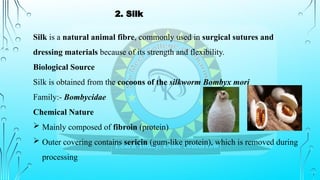
Silk is a natural animal fibre, commonly used in surgical sutures and
dressing materials because of its strength and flexibility.
Biological Source
Silk is obtained from the cocoons of the silkworm Bombyx mori
Family:- Bombycidae
Chemical Nature
 Mainly composed of fibroin (protein)
 Outer covering contains sericin (gum-like protein), which is removed during
processing
2. Silk
Characters
 Smooth, soft, and lustrous fibre
 High tensile strength
 Flexible and easy to handle
 Less absorbent than cotton
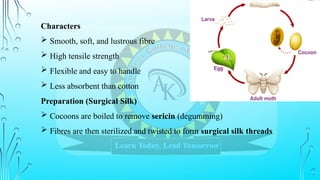
Preparation (Surgical Silk)
 Cocoons are boiled to remove sericin (degumming)
 Fibres are then sterilized and twisted to form surgical silk threads
Uses
 Used as non-absorbable surgical sutures
 Used in ligatures
 Occasionally used in special dressing materials
Advantages
 Strong and easy to knot
 Good handling properties
Disadvantages
 Causes a mild tissue reaction
 Non-absorbable (requires removal after healing)
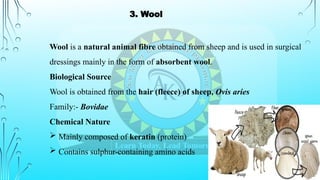
Wool is a natural animal fibre obtained from sheep and is used in surgical
dressings mainly in the form of absorbent wool.
Biological Source
Wool is obtained from the hair (fleece) of sheep, Ovis aries
Family:- Bovidae
Chemical Nature
 Mainly composed of keratin (protein)
 Contains sulphur-containing amino acids
3. Wool
Characters
 Soft, curly fibres
 Non-lustrous
 Less absorbent in natural form due to the presence of fats (lanolin)
Preparation of Absorbent Wool
 Raw wool contains lanolin, fats, and impurities
 These are removed by alkali treatment and washing
 After purification, wool becomes absorbent wool
Uses
Used as surgical dressing material
Padding material under bandages
Absorption of exudates and discharges
Advantages
Soft and cushioning
Provides warmth and protection to wounds
Disadvantages
Less absorbent than cotton
May cause allergic reactions in some patients
Regenerated fibres are fibres obtained by chemical processing of natural
polymers (mainly cellulose) and then regenerating them into fibre form.
These fibres are widely used in surgical dressings due to their uniformity
and absorbency.
Source
 Prepared from natural cellulose, mainly obtained from
 Wood pulp
 Cotton linters
Chemical Nature
 Cellulose (regenerated form)
Regenerated Fibres
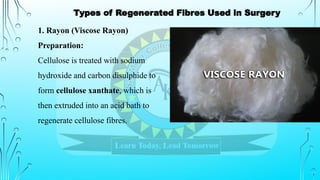
1. Rayon (Viscose Rayon)
Preparation:
Cellulose is treated with sodium
hydroxide and carbon disulphide to
form cellulose xanthate, which is
then extruded into an acid bath to
regenerate cellulose fibres.
Types of Regenerated Fibres Used in Surgery
Characters:
 White, smooth fibres
 Highly absorbent
 Uniform thickness
Uses:
 Surgical dressings
 Bandages
 Absorbent pads
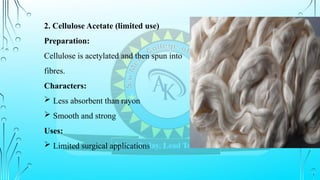
2. Cellulose Acetate (limited use)
Preparation:
Cellulose is acetylated and then spun into
fibres.
Characters:
 Less absorbent than rayon
 Smooth and strong
Uses:
 Limited surgical applications
Advantages of Regenerated Fibres
 High absorbency
 Uniform quality
 Free from natural impurities
 Easily sterilized
Disadvantages
 Lower wet strength compared to cotton
 Less durable
Sutures – Surgical Catgut and Ligatures
Sutures:-
Sutures are surgical threads used to close wounds, hold tissues together, and
ligate blood vessels during surgical procedures.
Classification of sutures
I. Classification Based on Absorbability
1. Absorbable Sutures
These sutures are absorbed by body tissues after a certain period and do not
require removal.
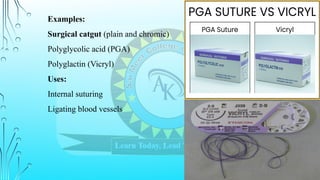
Examples:
Surgical catgut (plain and chromic)
Polyglycolic acid (PGA)
Polyglactin (Vicryl)
Uses:
Internal suturing
Ligating blood vessels
2. Non-Absorbable Sutures
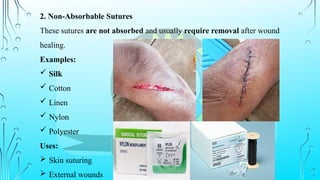
These sutures are not absorbed and usually require removal after wound
healing.
Examples:
 Silk
 Cotton
 Linen
 Nylon
 Polyester
Uses:
 Skin suturing
 External wounds
II. Classification Based on Origin
1. Natural Sutures
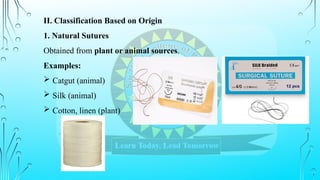
Obtained from plant or animal sources.
Examples:
 Catgut (animal)
 Silk (animal)
 Cotton, linen (plant)
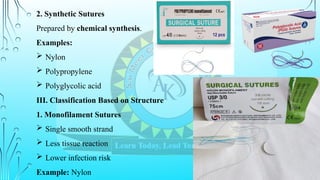
2. Synthetic Sutures
Prepared by chemical synthesis.
Examples:
 Nylon
 Polypropylene
 Polyglycolic acid
III. Classification Based on Structure
1. Monofilament Sutures
 Single smooth strand
 Less tissue reaction
 Lower infection risk
Example: Nylon
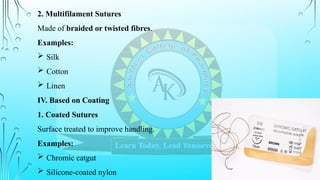
2. Multifilament Sutures
Made of braided or twisted fibres.
Examples:
 Silk
 Cotton
 Linen
IV. Based on Coating
1. Coated Sutures
Surface treated to improve handling.
Examples:
 Chromic catgut
 Silicone-coated nylon
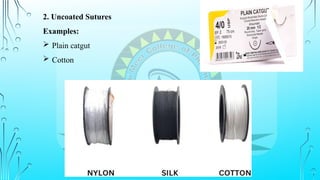
2. Uncoated Sutures
Examples:
 Plain catgut
 Cotton
Surgical Catgut
Definition
Surgical catgut is an absorbable natural surgical suture obtained from animal
connective tissue and used for suturing internal tissues and ligating blood
vessels.
Biological Source
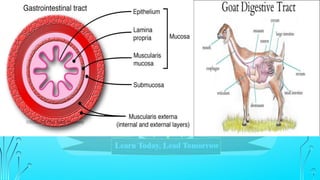
Prepared from the submucosal layer of the small intestine of sheep or goats
Family: Bovidae
Chemical Nature
 Composed mainly of collagen (protein)
Preparation
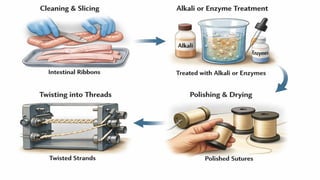
1.The small intestine is cleaned and split into ribbons
2.Treated with alkali or enzymes
3.Ribbons are twisted into threads
4.Polished, sterilized, and packed
Types of Surgical Catgut
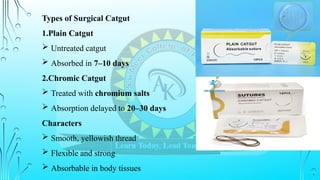
1.Plain Catgut
 Untreated catgut
 Absorbed in 7–10 days
2.Chromic Catgut
 Treated with chromium salts
 Absorption delayed to 20–30 days
Characters
 Smooth, yellowish thread
 Flexible and strong
 Absorbable in body tissues
Uses
 Suturing internal tissues
 Ligating blood vessels
 Surgical operations where the removal of sutures is not possible
Advantages
 Absorbable
 No need for removal
Disadvantages
 Causes tissue reaction
 Absorption rate is not uniform
Ligatures
Definition
Ligatures are surgical threads or materials used to tie blood vessels or other tubular
structures in order to control bleeding (haemostasis) during surgical procedures.
Types of Ligatures
1. Absorbable Ligatures
The body absorbs these ligatures over time.
Examples:
 Plain catgut
 Chromic catgut
Uses:
 Tying internal blood vessels
2. Non-Absorbable Ligatures
These ligatures are not absorbed and may remain in the body.
Examples:
 Silk
 Cotton
 Linen
 Nylon
Materials Used as Ligatures
 Catgut (most commonly used)
 Silk
 Cotton
 Linen
Characters of an Ideal Ligature
 High tensile strength
 Easily knotable
 Sterile and non-toxic
 Causes minimal tissue reaction
Uses of Ligatures
 Control of haemorrhage
 Tying blood vessels during surgical operations
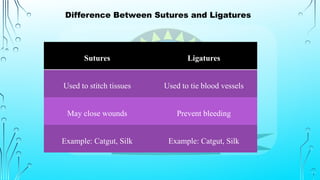
Difference Between Sutures and Ligatures
Sutures Ligatures
Used to stitch tissues Used to tie blood vessels
May close wounds Prevent bleeding
Example: Catgut, Silk Example: Catgut, Silk
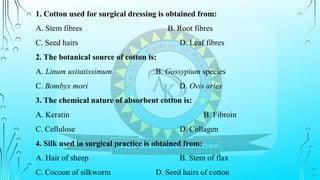
1. Cotton used for surgical dressing is obtained from:
A. Stem fibres B. Root fibres
C. Seed hairs D. Leaf fibres
2. The botanical source of cotton is:
A. Linum usitatissimum B. Gossypium species
C. Bombyx mori D. Ovis aries
3. The chemical nature of absorbent cotton is:
A. Keratin B. Fibroin
C. Cellulose D. Collagen
4. Silk used in surgical practice is obtained from:
A. Hair of sheep B. Stem of flax
C. Cocoon of silkworm D. Seed hairs of cotton
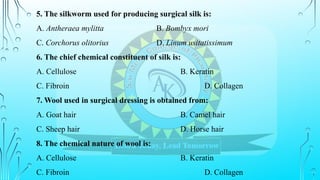
5. The silkworm used for producing surgical silk is:
A. Antheraea mylitta B. Bombyx mori
C. Corchorus olitorius D. Linum usitatissimum
6. The chief chemical constituent of silk is:
A. Cellulose B. Keratin
C. Fibroin D. Collagen
7. Wool used in surgical dressing is obtained from:
A. Goat hair B. Camel hair
C. Sheep hair D. Horse hair
8. The chemical nature of wool is:
A. Cellulose B. Keratin
C. Fibroin D. Collagen
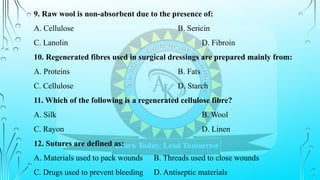
9. Raw wool is non-absorbent due to the presence of:
A. Cellulose B. Sericin
C. Lanolin D. Fibroin
10. Regenerated fibres used in surgical dressings are prepared mainly from:
A. Proteins B. Fats
C. Cellulose D. Starch
11. Which of the following is a regenerated cellulose fibre?
A. Silk B. Wool
C. Rayon D. Linen
12. Sutures are defined as:
A. Materials used to pack wounds B. Threads used to close wounds
C. Drugs used to prevent bleeding D. Antiseptic materials
13. Surgical catgut is obtained from:
A. Skin of sheep B. Tendon of cattle
C. Small intestine of sheep or goat D. Cocoon of silkworm
14. The chemical nature of surgical catgut is:
A. Cellulose B. Keratin
C. Fibroin D. Collagen
15. Surgical catgut is classified as:
A. Non-absorbable suture B. Synthetic suture
C. Absorbable natural suture D. Plant fibre suture
16. Chromic catgut differs from plain catgut because it is:
A. Non-absorbable B. Made from silk
C. Treated with chromium salts D. Synthetic in nature
17. Chromic catgut is absorbed in approximately:
A. 2–3 days B. 7–10 days
C. 20–30 days D. 2–3 months
18. Ligatures are mainly used to:
A. Stitch skin B. Absorb wound exudates
C. Tie blood vessels D. Sterilize wounds
19. The most commonly used absorbable ligature is:
A. Silk B. Cotton
C. Linen D. Catgut
20. Which of the following is a non-absorbable ligature?
A. Plain catgut B. Chromic catgut
C. Silk D. Surgical catgut
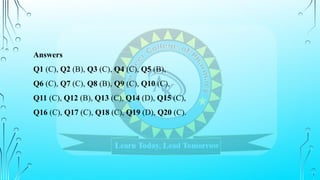
Answers
Q1 (C), Q2 (B), Q3 (C), Q4 (C), Q5 (B),
Q6 (C), Q7 (C), Q8 (B), Q9 (C), Q10 (C),
Q11 (C), Q12 (B), Q13 (C), Q14 (D), Q15 (C),
Q16 (C), Q17 (C), Q18 (C), Q19 (D), Q20 (C).
Thank you

Plant fibres used as surgical dressings & Sutures – Surgical Catgut and Ligatures, Pharmacognosy Chapter -6, D Pharm-I Year.

  • 1.
    Name –Arun Kumar AssistantProfessor Department of Pharmaceutics Sai Meer college of pharmacy, Chhibramau, Kannauj
  • 2.
    A presentation on Pharmacognosy Chapter-6 Presented by Arun Kumar Sai Meer College of Pharmacy
  • 3.
    CHAPTER -6 Plant fibresused as surgical dressings: Cotton, silk, wool, and regenerated fibres.. Sutures – Surgical Catgut and Ligatures
  • 4.
    Plant fibres areobtained from plants and are widely used in surgical dressings to cover wounds, absorb blood and exudates, and prevent infection. Examples:- Cotton, silk, wool, and regenerated fibres Plant Fibres Used as Surgical Dressings
  • 5.
    Biological source: Fibres obtainedfrom the seed hairs of Gossypium species Gossypium herbaceum (Levant cotton) Family:- Malvaceae Chemical nature:  Almost pure cellulose (about 99%) Preparation of absorbent cotton:  Raw cotton contains wax, fats, and colouring matter, which make it non- absorbent.  These impurities are removed by alkali treatment (with sodium hydroxide), followed by washing and bleaching, producing absorbent cotton. 1. Cotton
  • 6.
    Characters:  White, soft,and odourless  Highly absorbent  Non-irritant and non-toxic Uses:  Dressing of wounds  Absorption of blood and pus  Preparation of surgical swabs and bandages
  • 7.
    Silk is anatural animal fibre, commonly used in surgical sutures and dressing materials because of its strength and flexibility. Biological Source Silk is obtained from the cocoons of the silkworm Bombyx mori Family:- Bombycidae Chemical Nature  Mainly composed of fibroin (protein)  Outer covering contains sericin (gum-like protein), which is removed during processing 2. Silk
  • 8.
    Characters  Smooth, soft,and lustrous fibre  High tensile strength  Flexible and easy to handle  Less absorbent than cotton Preparation (Surgical Silk)  Cocoons are boiled to remove sericin (degumming)  Fibres are then sterilized and twisted to form surgical silk threads
  • 9.
    Uses  Used asnon-absorbable surgical sutures  Used in ligatures  Occasionally used in special dressing materials Advantages  Strong and easy to knot  Good handling properties Disadvantages  Causes a mild tissue reaction  Non-absorbable (requires removal after healing)
  • 10.
    Wool is anatural animal fibre obtained from sheep and is used in surgical dressings mainly in the form of absorbent wool. Biological Source Wool is obtained from the hair (fleece) of sheep, Ovis aries Family:- Bovidae Chemical Nature  Mainly composed of keratin (protein)  Contains sulphur-containing amino acids 3. Wool
  • 11.
    Characters  Soft, curlyfibres  Non-lustrous  Less absorbent in natural form due to the presence of fats (lanolin) Preparation of Absorbent Wool  Raw wool contains lanolin, fats, and impurities  These are removed by alkali treatment and washing  After purification, wool becomes absorbent wool
  • 12.
    Uses Used as surgicaldressing material Padding material under bandages Absorption of exudates and discharges Advantages Soft and cushioning Provides warmth and protection to wounds Disadvantages Less absorbent than cotton May cause allergic reactions in some patients
  • 13.
    Regenerated fibres arefibres obtained by chemical processing of natural polymers (mainly cellulose) and then regenerating them into fibre form. These fibres are widely used in surgical dressings due to their uniformity and absorbency. Source  Prepared from natural cellulose, mainly obtained from  Wood pulp  Cotton linters Chemical Nature  Cellulose (regenerated form) Regenerated Fibres
  • 14.
    1. Rayon (ViscoseRayon) Preparation: Cellulose is treated with sodium hydroxide and carbon disulphide to form cellulose xanthate, which is then extruded into an acid bath to regenerate cellulose fibres. Types of Regenerated Fibres Used in Surgery
  • 15.
    Characters:  White, smoothfibres  Highly absorbent  Uniform thickness Uses:  Surgical dressings  Bandages  Absorbent pads
  • 16.
    2. Cellulose Acetate(limited use) Preparation: Cellulose is acetylated and then spun into fibres. Characters:  Less absorbent than rayon  Smooth and strong Uses:  Limited surgical applications
  • 17.
    Advantages of RegeneratedFibres  High absorbency  Uniform quality  Free from natural impurities  Easily sterilized Disadvantages  Lower wet strength compared to cotton  Less durable
  • 18.
    Sutures – SurgicalCatgut and Ligatures Sutures:- Sutures are surgical threads used to close wounds, hold tissues together, and ligate blood vessels during surgical procedures. Classification of sutures I. Classification Based on Absorbability 1. Absorbable Sutures These sutures are absorbed by body tissues after a certain period and do not require removal.
  • 19.
    Examples: Surgical catgut (plainand chromic) Polyglycolic acid (PGA) Polyglactin (Vicryl) Uses: Internal suturing Ligating blood vessels
  • 20.
    2. Non-Absorbable Sutures Thesesutures are not absorbed and usually require removal after wound healing. Examples:  Silk  Cotton  Linen  Nylon  Polyester Uses:  Skin suturing  External wounds
  • 21.
    II. Classification Basedon Origin 1. Natural Sutures Obtained from plant or animal sources. Examples:  Catgut (animal)  Silk (animal)  Cotton, linen (plant)
  • 22.
    2. Synthetic Sutures Preparedby chemical synthesis. Examples:  Nylon  Polypropylene  Polyglycolic acid III. Classification Based on Structure 1. Monofilament Sutures  Single smooth strand  Less tissue reaction  Lower infection risk Example: Nylon
  • 23.
    2. Multifilament Sutures Madeof braided or twisted fibres. Examples:  Silk  Cotton  Linen IV. Based on Coating 1. Coated Sutures Surface treated to improve handling. Examples:  Chromic catgut  Silicone-coated nylon
  • 24.
    2. Uncoated Sutures Examples: Plain catgut  Cotton
  • 25.
    Surgical Catgut Definition Surgical catgutis an absorbable natural surgical suture obtained from animal connective tissue and used for suturing internal tissues and ligating blood vessels. Biological Source Prepared from the submucosal layer of the small intestine of sheep or goats Family: Bovidae
  • 26.
    Chemical Nature  Composedmainly of collagen (protein) Preparation 1.The small intestine is cleaned and split into ribbons 2.Treated with alkali or enzymes 3.Ribbons are twisted into threads 4.Polished, sterilized, and packed
  • 29.
    Types of SurgicalCatgut 1.Plain Catgut  Untreated catgut  Absorbed in 7–10 days 2.Chromic Catgut  Treated with chromium salts  Absorption delayed to 20–30 days Characters  Smooth, yellowish thread  Flexible and strong  Absorbable in body tissues
  • 30.
    Uses  Suturing internaltissues  Ligating blood vessels  Surgical operations where the removal of sutures is not possible Advantages  Absorbable  No need for removal Disadvantages  Causes tissue reaction  Absorption rate is not uniform
  • 31.
    Ligatures Definition Ligatures are surgicalthreads or materials used to tie blood vessels or other tubular structures in order to control bleeding (haemostasis) during surgical procedures. Types of Ligatures 1. Absorbable Ligatures The body absorbs these ligatures over time. Examples:  Plain catgut  Chromic catgut Uses:  Tying internal blood vessels
  • 32.
    2. Non-Absorbable Ligatures Theseligatures are not absorbed and may remain in the body. Examples:  Silk  Cotton  Linen  Nylon Materials Used as Ligatures  Catgut (most commonly used)  Silk  Cotton  Linen
  • 33.
    Characters of anIdeal Ligature  High tensile strength  Easily knotable  Sterile and non-toxic  Causes minimal tissue reaction Uses of Ligatures  Control of haemorrhage  Tying blood vessels during surgical operations
  • 34.
    Difference Between Suturesand Ligatures Sutures Ligatures Used to stitch tissues Used to tie blood vessels May close wounds Prevent bleeding Example: Catgut, Silk Example: Catgut, Silk
  • 35.
    1. Cotton usedfor surgical dressing is obtained from: A. Stem fibres B. Root fibres C. Seed hairs D. Leaf fibres 2. The botanical source of cotton is: A. Linum usitatissimum B. Gossypium species C. Bombyx mori D. Ovis aries 3. The chemical nature of absorbent cotton is: A. Keratin B. Fibroin C. Cellulose D. Collagen 4. Silk used in surgical practice is obtained from: A. Hair of sheep B. Stem of flax C. Cocoon of silkworm D. Seed hairs of cotton
  • 36.
    5. The silkwormused for producing surgical silk is: A. Antheraea mylitta B. Bombyx mori C. Corchorus olitorius D. Linum usitatissimum 6. The chief chemical constituent of silk is: A. Cellulose B. Keratin C. Fibroin D. Collagen 7. Wool used in surgical dressing is obtained from: A. Goat hair B. Camel hair C. Sheep hair D. Horse hair 8. The chemical nature of wool is: A. Cellulose B. Keratin C. Fibroin D. Collagen
  • 37.
    9. Raw woolis non-absorbent due to the presence of: A. Cellulose B. Sericin C. Lanolin D. Fibroin 10. Regenerated fibres used in surgical dressings are prepared mainly from: A. Proteins B. Fats C. Cellulose D. Starch 11. Which of the following is a regenerated cellulose fibre? A. Silk B. Wool C. Rayon D. Linen 12. Sutures are defined as: A. Materials used to pack wounds B. Threads used to close wounds C. Drugs used to prevent bleeding D. Antiseptic materials
  • 38.
    13. Surgical catgutis obtained from: A. Skin of sheep B. Tendon of cattle C. Small intestine of sheep or goat D. Cocoon of silkworm 14. The chemical nature of surgical catgut is: A. Cellulose B. Keratin C. Fibroin D. Collagen 15. Surgical catgut is classified as: A. Non-absorbable suture B. Synthetic suture C. Absorbable natural suture D. Plant fibre suture 16. Chromic catgut differs from plain catgut because it is: A. Non-absorbable B. Made from silk C. Treated with chromium salts D. Synthetic in nature
  • 39.
    17. Chromic catgutis absorbed in approximately: A. 2–3 days B. 7–10 days C. 20–30 days D. 2–3 months 18. Ligatures are mainly used to: A. Stitch skin B. Absorb wound exudates C. Tie blood vessels D. Sterilize wounds 19. The most commonly used absorbable ligature is: A. Silk B. Cotton C. Linen D. Catgut 20. Which of the following is a non-absorbable ligature? A. Plain catgut B. Chromic catgut C. Silk D. Surgical catgut
  • 40.
    Answers Q1 (C), Q2(B), Q3 (C), Q4 (C), Q5 (B), Q6 (C), Q7 (C), Q8 (B), Q9 (C), Q10 (C), Q11 (C), Q12 (B), Q13 (C), Q14 (D), Q15 (C), Q16 (C), Q17 (C), Q18 (C), Q19 (D), Q20 (C).
  • 41.