RAJASTHAN UNIVERSITY OF
VETERINARYAND ANIMAL
SCIENCES
NUTRITION AND FEEDING OF DOG AND CAT
SUBMITTED TO :-
DR. TARA BOTHRA
ASSISTANT PROFESSOR
LIVESTOCK PRODUCTION
MANAGEMENT
SUBMITTED BY :-
HARSHA SHARMA
M.V.Sc. [2ND
SEMESTER]
LPM
2.
Content:
Introduction
Principleof feeding
Nutrient requirements
Energy
water
Protein
Fat
Carbohydrate
Fibre
Feeding schedule
Common feedstuff
Feeding management
Obligate carnivores?
3.
Introduction:
Dogs andcats require specific dietary nutrient concentrations based on their life
stage.
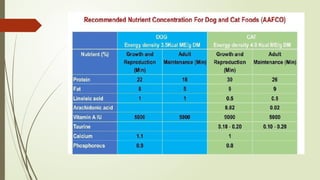
The Association of American Feed Control Officials (AAFCO) publishes nutrient
profiles for dogs and cats in the two main life stage categories of nutritional
requirements:
1. Adult maintenance
2. Growth and Reproduction
The National Research Council (NRC) also published nutrient profiles for dogs, cats,
puppies, and kittens (last published in 2006).
However, neither AAFCO nor NRC recognizes that nutritional requirements may
change in healthy, older adult dogs and cats.
4.
Cats havedifferent dietary requirements than dogs and can develop
nutritional deficiencies when fed diets formulated for dogs.
The form in which the food is fed (raw versus cooked) can impact nutrient
availability.
.
6.
Principle
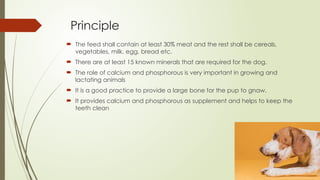
The feedshall contain at least 30% meat and the rest shall be cereals,
vegetables, milk, egg, bread etc.
There are at least 15 known minerals that are required for the dog.
The role of calcium and phosphorous is very important in growing and
lactating animals
It is a good practice to provide a large bone for the pup to gnaw.
It provides calcium and phosphorous as supplement and helps to keep the
teeth clean
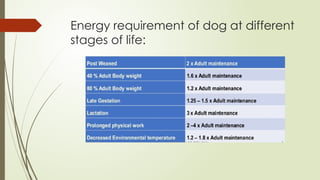
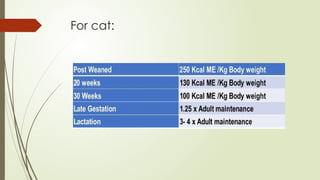
Energy:
The mostuseful measure of energy for nutritional puposes is metabolizable
energy(ME).
Dogs and cats require sufficient energy to allow for optimal body weight,
body condition score (BCS), and muscle condition score (MCS).
Energy requirement is not linear function of body weight.
• For ex. Newfoundland require few calorie than great dane.
Formula for energy calculation:
ME requirement = k ×W[0.75]
K =95[inactive adult dogs], 130 [ active adult dogs]
W= weight of animal in kg
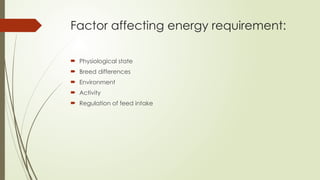
Factor affecting energyrequirement:
Physiological state
Breed differences
Environment
Activity
Regulation of feed intake
12.
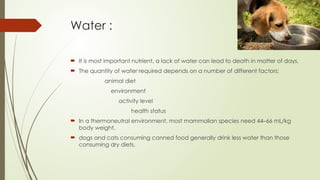
Water :
Itis most important nutrient, a lack of water can lead to death in matter of days.
The quantity of water required depends on a number of different factors:
animal diet
environment
activity level
health status
In a thermoneutral environment, most mammalian species need 44–66 mL/kg
body weight.
dogs and cats consuming canned food generally drink less water than those
consuming dry diets.
13.
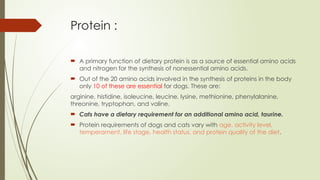
Protein :
Aprimary function of dietary protein is as a source of essential amino acids
and nitrogen for the synthesis of nonessential amino acids.
Out of the 20 amino acids involved in the synthesis of proteins in the body
only 10 of these are essential for dogs. These are:
arginine, histidine, isoleucine, leucine, lysine, methionine, phenylalanine,
threonine, tryptophan, and valine.
Cats have a dietary requirement for an additional amino acid, taurine.
Protein requirements of dogs and cats vary with age, activity level,
temperament, life stage, health status, and protein quality of the diet.
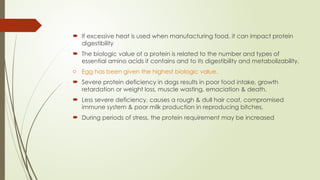
14.
If excessiveheat is used when manufacturing food, it can impact protein
digestibility
The biologic value of a protein is related to the number and types of
essential amino acids it contains and to its digestibility and metabolizability.
o Egg has been given the highest biologic value.
Severe protein deficiency in dogs results in poor food intake, growth
retardation or weight loss, muscle wasting, emaciation & death.
Less severe deficiency, causes a rough & dull hair coat, compromised
immune system & poor milk production in reproducing bitches.
During periods of stress, the protein requirement may be increased
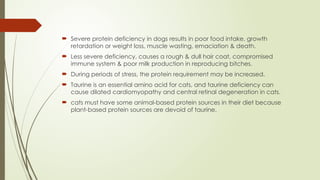
15.
Severe proteindeficiency in dogs results in poor food intake, growth
retardation or weight loss, muscle wasting, emaciation & death.
Less severe deficiency, causes a rough & dull hair coat, compromised
immune system & poor milk production in reproducing bitches.
During periods of stress, the protein requirement may be increased.
Taurine is an essential amino acid for cats, and taurine deficiency can
cause dilated cardiomyopathy and central retinal degeneration in cats.
cats must have some animal-based protein sources in their diet because
plant-based protein sources are devoid of taurine.
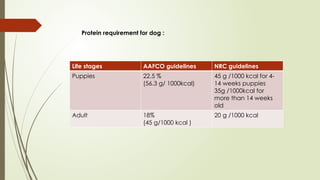
16.
Life stages AAFCOguidelines NRC guidelines
Puppies 22.5 %
(56.3 g/ 1000kcal)
45 g /1000 kcal for 4-
14 weeks puppies
35g /1000kcal for
more than 14 weeks
old
Adult 18%
(45 g/1000 kcal )
20 g /1000 kcal
Protein requirement for dog :
17.
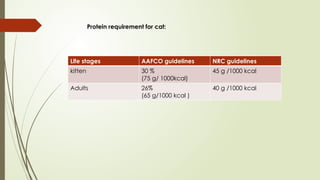
Life stages AAFCOguidelines NRC guidelines
kitten 30 %
(75 g/ 1000kcal)
45 g /1000 kcal
Adults 26%
(65 g/1000 kcal )
40 g /1000 kcal
Protein requirement for cat:
18.
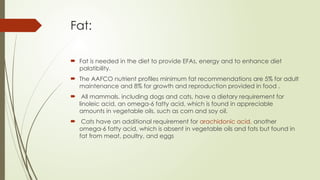
Fat:
Fat isneeded in the diet to provide EFAs, energy and to enhance diet
palatibility.
The AAFCO nutrient profiles minimum fat recommendations are 5% for adult
maintenance and 8% for growth and reproduction provided in food .
All mammals, including dogs and cats, have a dietary requirement for
linoleic acid, an omega-6 fatty acid, which is found in appreciable
amounts in vegetable oils, such as corn and soy oil.
Cats have an additional requirement for arachidonic acid, another
omega-6 fatty acid, which is absent in vegetable oils and fats but found in
fat from meat, poultry, and eggs
19.
More recently,omega-3 fatty acids (alpha-linolenic acid [ALA],
eicosapentaenoic acid [EPA], and docosahexaenoic acid [DHA]) have
been added to the list of EFAs required during growth and reproduction in
both dogs and cats.
The best dietary source of ALA is flaxseed oil, and the best dietary sources
of EPA and DHA are oily fish, krill oil, and algae oil.
As much as 60% of the calories in a cat’s diet may come from fat, although
diets that contain 8%–40% fat
Most commercial adult dog foods typically contain 5%–15% fat (dry-matter
basis). Puppy diets usually contain 8%–20% fat.
20.
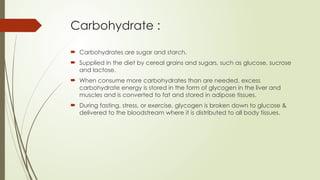
Carbohydrate :
Carbohydratesare sugar and starch.
Supplied in the diet by cereal grains and sugars, such as glucose, sucrose
and lactose.
When consume more carbohydrates than are needed, excess
carbohydrate energy is stored in the form of glycogen in the liver and
muscles and is converted to fat and stored in adipose tissues.
During fasting, stress, or exercise, glycogen is broken down to glucose &
delivered to the bloodstream where it is distributed to all body tissues.
21.
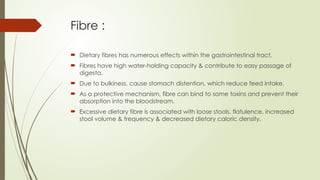
Fibre :
Dietaryfibres has numerous effects within the gastrointestinal tract.
Fibres have high water-holding capacity & contribute to easy passage of
digesta.
Due to bulkiness, cause stomach distention, which reduce feed intake.
As a protective mechanism, fibre can bind to some toxins and prevent their
absorption into the bloodstream.
Excessive dietary fibre is associated with loose stools, flatulence, increased
stool volume & frequency & decreased dietary caloric density.
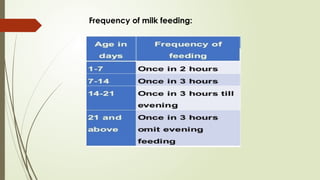
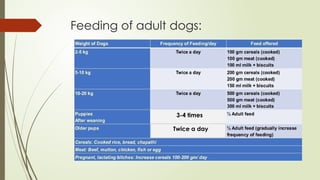
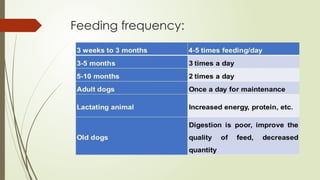
Puppy feeding schedule:
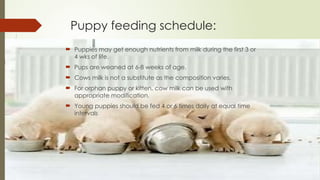
Puppies may get enough nutrients from milk during the first 3 or
4 wks of life.
Pups are weaned at 6-8 weeks of age.
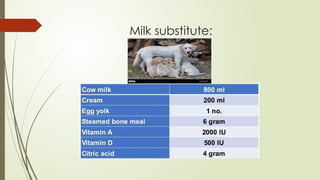
Cows milk is not a substitute as the composition varies.
For orphan puppy or kitten, cow milk can be used with
appropriate modification.
Young puppies should be fed 4 or 6 times daily at equal time
intervals
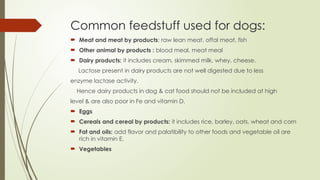
Common feedstuff usedfor dogs:
Meat and meat by products: raw lean meat, offal meat, fish
Other animal by products : blood meal, meat meal
Dairy products: it includes cream, skimmed milk, whey, cheese.
Lactose present in dairy products are not well digested due to less
enzyme lactase activity.
Hence dairy products in dog & cat food should not be included at high
level & are also poor in Fe and vitamin D.
Eggs
Cereals and cereal by products: it includes rice, barley, oats, wheat and corn
Fat and oils: add flavor and palatibility to other foods and vegetable oil are
rich in vitamin E.
Vegetables
32.
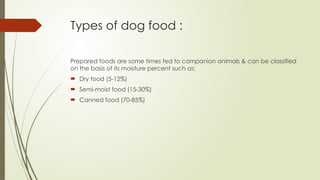
Types of dogfood :
Prepared foods are some times fed to companion animals & can be classified
on the basis of its moisture percent such as;
Dry food (5-12%)
Semi-moist food (15-30%)
Canned food (70-85%)
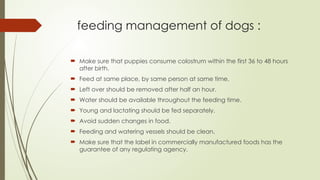
33.
feeding management ofdogs :
Make sure that puppies consume colostrum within the first 36 to 48 hours
after birth.
Feed at same place, by same person at same time.
Left over should be removed after half an hour.
Water should be available throughout the feeding time.
Young and lactating should be fed separately.
Avoid sudden changes in food.
Feeding and watering vessels should be clean.
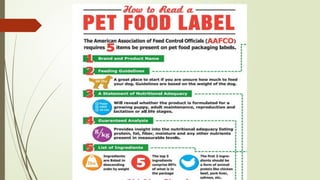
Make sure that the label in commercially manufactured foods has the
guarantee of any regulating agency.
34.
If thedog has a special dietary requirement that cannot be met by
commercial foods, consider feeding homemade diets.
Feed the dog according to correct body weight and condition, and consider
factors such as growth, adult maintenance, level of activity, gestation,
lactation, and age.
When changing foods, mix 1/4 of the new food to 3/4 of the old food, and
increase gradually to prevent gastric upsets.
Watch the dog's stool, weight, and coat while changing foods.
Allow approximately 20 minutes for the dog to clean the bowl.
Be certain that the food has an expiration date.
Store food in a sealed container in a cool, dry place
35.
Cat- an obligatecarnivores?
An obligate carnivore is a predator that eats meat out of biological necessity.
Although cats can digest plant material safely, but are unable to meet all of
their nutritional needs on a strictly plant-based diet.
Cats have the shortest digestive tract to body size ratio of any mammal which
result, less fermenting bacteria to help them break down plant material and
derive nutrients from it.
Cats, cannot make beta-carotene conversion due to lack of enzyme, hence,
require vitamin A from animal source.
Plant sources are deficiency in taurine and cat require taurine (dark meat rich
in taurine) to support eyesight, nerve function, immune system and heart.
36.
Difference between dogand cat
nutrition :
Cat food contains a higher level of protein when compared to dog food.
Cats need more protein because they use the proteins as an energy
source.
Cats have 11 essential amino acids while dogs only have 10.
Taurine is an amino acid that is essential for cats but non-essential for dogs.
Dogs can convert beta carotene into vitamin A within their bodies but cats
can’t.
Cats also require five times more thiamine in their diets than dogs.
Arachidonic acid is an essential fatty acid that cats cannot manufacture,
while dogs are able.
![RAJASTHAN UNIVERSITY OF
VETERINARY AND ANIMAL
SCIENCES
NUTRITION AND FEEDING OF DOG AND CAT
SUBMITTED TO :-
DR. TARA BOTHRA
ASSISTANT PROFESSOR
LIVESTOCK PRODUCTION
MANAGEMENT
SUBMITTED BY :-
HARSHA SHARMA
M.V.Sc. [2ND
SEMESTER]
LPM](https://image.slidesharecdn.com/feedingofdog1-260210143419-0668ff73/85/feeding-of-dog-1-pptx-of-animal-science-1-320.jpg)
![RAJASTHAN UNIVERSITY OF
VETERINARY AND ANIMAL
SCIENCES
NUTRITION AND FEEDING OF DOG AND CAT
SUBMITTED TO :-
DR. TARA BOTHRA
ASSISTANT PROFESSOR
LIVESTOCK PRODUCTION
MANAGEMENT
SUBMITTED BY :-
HARSHA SHARMA
M.V.Sc. [2ND
SEMESTER]
LPM](https://image.slidesharecdn.com/feedingofdog1-260210143419-0668ff73/75/feeding-of-dog-1-pptx-of-animal-science-1-2048.jpg)

![Energy:
The most useful measure of energy for nutritional puposes is metabolizable
energy(ME).
Dogs and cats require sufficient energy to allow for optimal body weight,
body condition score (BCS), and muscle condition score (MCS).
Energy requirement is not linear function of body weight.
• For ex. Newfoundland require few calorie than great dane.
Formula for energy calculation:
ME requirement = k ×W[0.75]
K =95[inactive adult dogs], 130 [ active adult dogs]
W= weight of animal in kg](https://image.slidesharecdn.com/feedingofdog1-260210143419-0668ff73/85/feeding-of-dog-1-pptx-of-animal-science-8-320.jpg)
![ More recently, omega-3 fatty acids (alpha-linolenic acid [ALA],
eicosapentaenoic acid [EPA], and docosahexaenoic acid [DHA]) have
been added to the list of EFAs required during growth and reproduction in
both dogs and cats.
The best dietary source of ALA is flaxseed oil, and the best dietary sources
of EPA and DHA are oily fish, krill oil, and algae oil.
As much as 60% of the calories in a cat’s diet may come from fat, although
diets that contain 8%–40% fat
Most commercial adult dog foods typically contain 5%–15% fat (dry-matter
basis). Puppy diets usually contain 8%–20% fat.](https://image.slidesharecdn.com/feedingofdog1-260210143419-0668ff73/85/feeding-of-dog-1-pptx-of-animal-science-19-320.jpg)