ARGUMENTATIVE TEXT de no se q, no lo descarguen porq es pura basura xddddddd
1.
ARGUMENTATIVE
Barrios Hernández Victoria
CruzJiménez Jesús Alejandro
Gomez Lozano Anabdely
Nava Garcia Josué Abisay
Olguin Orta Jose Edgar
Vázquez Islas Alejandro
OMG
Octubre 2025
TEXTS
2.
C O NT E N T S
Index of
What is an argumentative text?
How is an argumentative text
structured?
Characteristics of an
argumentative text
01.
02.
03.
04.
05.
06.
Types of argumentative text
Examples of argumentative texts
Summary
3.
W H AT I S A N
A R G U M E N T A T I V E
T E X T ?
An argumentative text is a text whose main aim
is to convince the reader of a specific idea,
opinion or position. To achieve this, the author
presents solid arguments supported by
evidence and logical reasoning. These texts
may address controversial or debatable topics
and usually have an organised structure that
includes a clear thesis, development of
arguments and a persuasive conclusion.
4.
H O WI S A N
A R G U M E N T A T I V E T E X T
S T R U C T U R E D ?
The aim of an argumentative text is to put forward a viewpoint
clearly and simply, supported by data and a logical conclusion to
back it up. To do this, follow the structure below:
5.
I N TR O D U C T I O N
Briefly explain the subject matter dealt with in the text and
provide the necessary background, so the reader can
understand your position. The introduction presents the thesis,
which is the main idea argued for in the text.
6.
B O DY O F T H E A R G U M E N T :
This usually consists of three or more paragraphs
where the reasoning and data that support your point
of view are outlined. Each paragraph should focus on
a different idea and should begin by clearly
establishing the theme you wish to develop. The
opposing arguments that you'll be refuting should be
included here along with your own, although the
order will depend on the approach you take.
7.
C O NC L U S I O N
This last paragraph should focus on the final
argumentation underpinning the thesis,
synthesising the most important arguments as
developed in the preceding paragraphs. Here,
you should avoid including new ideas, and
instead highlight the fundamental points in
favour of your argument.
8.
C H AR A C T E R I S T I C S O F A N
A R G U M E N T A T I V E T E X T
Clear thesis: the text presents a
main idea or thesis that is
defended throughout the
document.
0 1
Strong argumentation: the
arguments presented are
supported by relevant evidence,
data and/or examples.
0 2
Coherence and cohesion: the text
has a logical and well-organised
structure, with paragraphs that
connect fluidly.
0 3
Persuasiveness: the purpose of
the text is to persuade the reader
to accept the author's position.
0 4
0 5
Objectivity and subjectivity:
although based on objective data,
the text may reflect the author's
subjective viewpoint or opinion.
9.
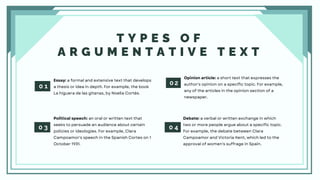
T Y PE S O F
A R G U M E N T A T I V E T E X T
Essay: a formal and extensive text that develops
a thesis or idea in depth. For example, the book
La higuera de las gitanas, by Noelia Cortés.
0 1
0 2
Opinion article: a short text that expresses the
author's opinion on a specific topic. For example,
any of the articles in the opinion section of a
newspaper.
0 3 0 4
Political speech: an oral or written text that
seeks to persuade an audience about certain
policies or ideologies. For example, Clara
Campoamor's speech in the Spanish Cortes on 1
October 1931.
Debate: a verbal or written exchange in which
two or more people argue about a specific topic.
For example, the debate between Clara
Campoamor and Victoria Kent, which led to the
approval of women's suffrage in Spain.
10.
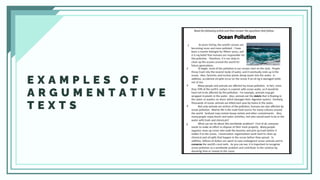
E X AM P L E S O F
A R G U M E N T A T I V E
T E X T S
11.
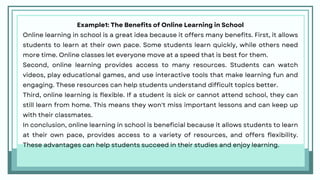
Example1: The Benefitsof Online Learning in School
Online learning in school is a great idea because it offers many benefits. First, it allows
students to learn at their own pace. Some students learn quickly, while others need
more time. Online classes let everyone move at a speed that is best for them.
Second, online learning provides access to many resources. Students can watch
videos, play educational games, and use interactive tools that make learning fun and
engaging. These resources can help students understand difficult topics better.
Third, online learning is flexible. If a student is sick or cannot attend school, they can
still learn from home. This means they won't miss important lessons and can keep up
with their classmates.
In conclusion, online learning in school is beneficial because it allows students to learn
at their own pace, provides access to a variety of resources, and offers flexibility.
These advantages can help students succeed in their studies and enjoy learning.
12.
S U MM A R Y
In summary, argumentative texts are an essential tool for
communicating and persuading in a variety of contexts. From definition
and characteristics to structure and types of arguments, each aspect is
crucial to constructing a convincing and effective text.
We hope this guide has provided you with a clear and practical
understanding of how to write argumentative texts. Now, it's your turn to
put this knowledge into practice and create texts that really make an
impact on your readers.



![Argumentative Essay [Autosaved].pptxasdf](https://cdn.slidesharecdn.com/ss_thumbnails/argumentativeessayautosaved-251123231228-be72e8ed-thumbnail.jpg?width=640&height=640&fit=bounds)


