POLLUTION
Pollution Is The Introduction Of Harmful Materials Into The
Environment. These Harmful Materials Are Called Pollutants. Pollutants
Can Be Natural, Such As Volcanic Ash. They Can Also Be Created By
Human Activity, Such As Trash Or Runoff Produced By Factories.
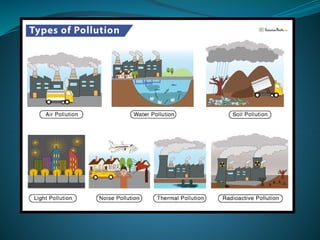
TYPES OF POLLUTION
Following are the different types of pollution:
 Water Pollution
 Air Pollution
 Soil Pollution
 Noise Pollution
 Other types of Pollution like light Pollution,
Thermal Pollution, Radioactive Pollution.
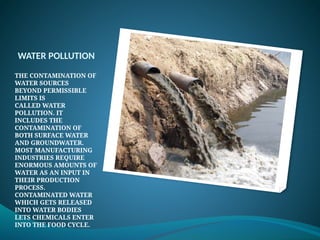
WATER POLLUTION
THE CONTAMINATION OF
WATER SOURCES
BEYOND PERMISSIBLE
LIMITS IS
CALLED WATER
POLLUTION. IT
INCLUDES THE
CONTAMINATION OF
BOTH SURFACE WATER
AND GROUNDWATER.
MOST MANUFACTURING
INDUSTRIES REQUIRE
ENORMOUS AMOUNTS OF
WATER AS AN INPUT IN
THEIR PRODUCTION
PROCESS.
CONTAMINATED WATER
WHICH GETS RELEASED
INTO WATER BODIES
LETS CHEMICALS ENTER
INTO THE FOOD CYCLE.
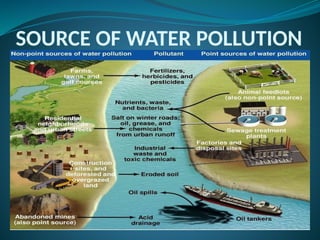
SOURCE OF WATER POLLUTION
CAUSES OF WATER POLLUTION
DOMESTIC SEWAGE:
Untreated sewage water that contains soaps, chemicals, food waste,
human waste etc is the single largest source of water pollution.
INDUSTRIAL EFFLUENTS:
Manufacturing units are generally located near rivers.
Untreated wastewater from these factories is high on toxic content and
resistant to breakdown by microorganisms.
AGRICULTURAL WASTE:
Runoff of fertilizers, pesticides and manure used in agricultural
production contaminate the water. This process of toxic chemicals
entering the food chain is called Biomagnifications.
SPILLAGE OF PETROLEUM PRODUCTS:
Petroleum products contaminating sea water as a result of accident
spillover is a regular news item.
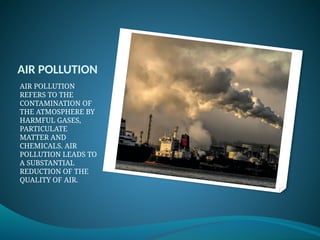
AIR POLLUTION
AIR POLLUTION
REFERS TO THE
CONTAMINATION OF
THE ATMOSPHERE BY
HARMFUL GASES,
PARTICULATE
MATTER AND
CHEMICALS. AIR
POLLUTION LEADS TO
A SUBSTANTIAL
REDUCTION OF THE
QUALITY OF AIR.
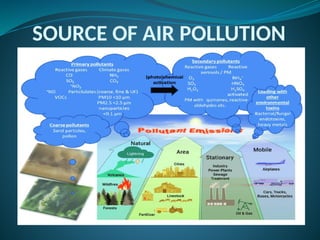
SOURCE OF AIR POLLUTION
CAUSES OF AIR POLLUTION
The harmful effects of air pollution on the environment are:
 DISEASES:
Air pollution has caused several respiratory disorders and heart diseases among humans. Children living
near industrial areas are more prone to pneumonia and asthma.
 GLOBAL WARMING:
Emission caused by greenhouse gases results in an imbalance of the gaseous composition of the air. This
has caused an increase in the temperature of the earth. This increase in the temperature of the earth is
known as global warming.
 ACID RAIN:
The combustion of fossil fuels releases harmful gases such as nitrogen oxides and sulfur oxides in the air.
The water vapor in the atmosphere combines with these pollutants, becomes acidic, and fall as acid rain
which damages human, animal and plant life.
 OZONE LAYER DEPLETION:
The release of chlorofluorocarbons (CFC), halons, and hydrochlorofluorocarbons in the atmosphere is the
major cause of the depletion of the ozone layer. The depleting ozone layer causes the harmful UV-B rays
coming from the sun and causes skin diseases and eye problems among individuals.
 EFFECT ON ANIMALS:
The air pollutants suspend on the water bodies and affect the aquatic lifeforms.
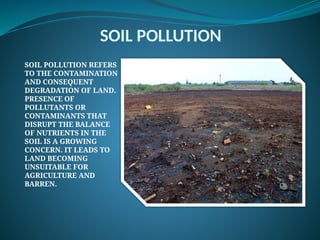
SOIL POLLUTION
SOIL POLLUTION REFERS
TO THE CONTAMINATION
AND CONSEQUENT
DEGRADATION OF LAND.
PRESENCE OF
POLLUTANTS OR
CONTAMINANTS THAT
DISRUPT THE BALANCE
OF NUTRIENTS IN THE
SOIL IS A GROWING
CONCERN. IT LEADS TO
LAND BECOMING
UNSUITABLE FOR
AGRICULTURE AND
BARREN.
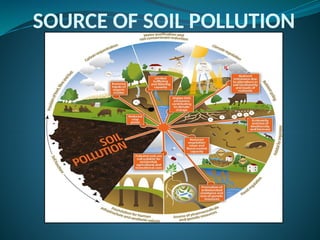
SOURCE OF SOIL POLLUTION
CAUSES OF SOIL POLLUTION
There is numerous cause of soil pollution that can be natural or anthropogenic causes:
NATURAL POLLUTION OF SOIL:
Sometimes, some pollutants are naturally accumulated in soils. This may be due to
the differential deposition of soil by the atmosphere. Another way through which
this type of soil pollution can occur is via the transportation of soil pollutants with
precipitation water.
ANTHROPOGENIC SOIL POLLUTION:
Various man-made activities also lead to the cause the contamination of soil.
PESTICIDES:
Earlier, the chemical nicotine which is present in the tobacco plants was used as the
pest controlling substance in agricultural practices. However, DDT was found to be
extremely useful for malaria control and pest control of many insects but a high
concentration of pesticides may cause soil pollution.
INORGANIC FERTILIZERS:
Excessive use of inorganic nitrogen fertilizers leads to acidification of soil and thus
contaminates the agricultural soil.
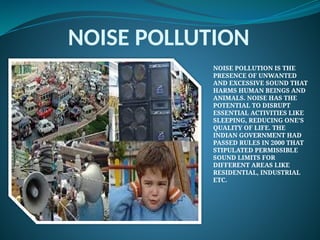
NOISE POLLUTION
NOISE POLLUTION IS THE
PRESENCE OF UNWANTED
AND EXCESSIVE SOUND THAT
HARMS HUMAN BEINGS AND
ANIMALS. NOISE HAS THE
POTENTIAL TO DISRUPT
ESSENTIAL ACTIVITIES LIKE
SLEEPING, REDUCING ONE’S
QUALITY OF LIFE. THE
INDIAN GOVERNMENT HAD
PASSED RULES IN 2000 THAT
STIPULATED PERMISSIBLE
SOUND LIMITS FOR
DIFFERENT AREAS LIKE
RESIDENTIAL, INDUSTRIAL
ETC.
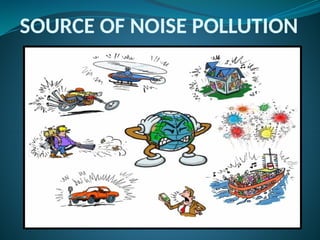
SOURCE OF NOISE POLLUTION
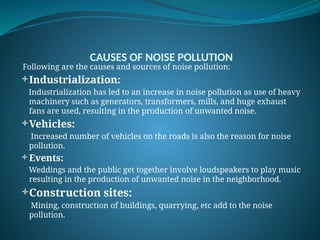
CAUSES OF NOISE POLLUTION
Following are the causes and sources of noise pollution:
Industrialization:
Industrialization has led to an increase in noise pollution as use of heavy
machinery such as generators, transformers, mills, and huge exhaust
fans are used, resulting in the production of unwanted noise.
Vehicles:
Increased number of vehicles on the roads is also the reason for noise
pollution.
Events:
Weddings and the public get together involve loudspeakers to play music
resulting in the production of unwanted noise in the neighborhood.
Construction sites:
Mining, construction of buildings, quarrying, etc add to the noise
pollution.
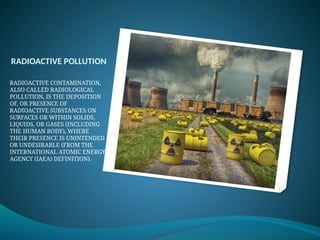
RADIOACTIVE POLLUTION
RADIOACTIVE CONTAMINATION,
ALSO CALLED RADIOLOGICAL
POLLUTION, IS THE DEPOSITION
OF, OR PRESENCE OF
RADIOACTIVE SUBSTANCES ON
SURFACES OR WITHIN SOLIDS,
LIQUIDS, OR GASES (INCLUDING
THE HUMAN BODY), WHERE
THEIR PRESENCE IS UNINTENDED
OR UNDESIRABLE (FROM THE
INTERNATIONAL ATOMIC ENERGY
AGENCY (IAEA) DEFINITION).
CAUSES OF RADIOACTIVE POLLUTION
Radioactive contamination occurs when objects are exposed to ionizing radiation from radioactive releases.
The most significant causes of radioactive contamination include:
 Harmful exposure to X-rays. Although X-rays are useful in clinical imaging, frequent exposure to this
high-frequency energy is dangerous. The gamma rays passing through a person's body may cause
radiation sickness or burns in high quantities.
 Detonation of nuclear weapons. Nuclear explosions have contributed to the single highest concentration
of radioactive radiation in human history. The nuclear bombs detonated in Japan and the extensive
nuclear tests carried out during the Cold War have had far-reaching effects on people and the
environment.
 Handling and disposal of nuclear waste. Radioactive waste is produced through mining radioactive ores,
nuclear power plants, and the production of nuclear weapons. This waste cannot be treated in the
traditional sense before safe disposal, and can only be stored in remote areas to allow for its slow decay.
Unfortunately, the radiation from this waste often finds its way into water sources, soil, and even the air.
 Mining radioactive ores. The mining of radioactive ores, such as uranium and plutonium, also produces
radioactive waste. Radioactive ores are chemically unstable and thus tend to release radiation during
crushing and processing, which contaminates the surrounding land, air, and water.
 Nuclear accidents or meltdowns in nuclear power plants. Although nuclear energy is considered clean,
nuclear reactors and cores found in nuclear power plants may accidentally fail or malfunction. If
unmitigated, a nuclear disaster will occur, whereby radioactive waste will explode into the surrounding
areas. The most infamous nuclear disaster was in Chernobyl, Ukraine, in 1986. The resulting radiation
contamination made the area an uninhabitable wasteland.

Defination, Causes, Sources and Types of Pollutions

  • 1.
    POLLUTION Pollution Is TheIntroduction Of Harmful Materials Into The Environment. These Harmful Materials Are Called Pollutants. Pollutants Can Be Natural, Such As Volcanic Ash. They Can Also Be Created By Human Activity, Such As Trash Or Runoff Produced By Factories.
  • 2.
    TYPES OF POLLUTION Followingare the different types of pollution:  Water Pollution  Air Pollution  Soil Pollution  Noise Pollution  Other types of Pollution like light Pollution, Thermal Pollution, Radioactive Pollution.
  • 4.
    WATER POLLUTION THE CONTAMINATIONOF WATER SOURCES BEYOND PERMISSIBLE LIMITS IS CALLED WATER POLLUTION. IT INCLUDES THE CONTAMINATION OF BOTH SURFACE WATER AND GROUNDWATER. MOST MANUFACTURING INDUSTRIES REQUIRE ENORMOUS AMOUNTS OF WATER AS AN INPUT IN THEIR PRODUCTION PROCESS. CONTAMINATED WATER WHICH GETS RELEASED INTO WATER BODIES LETS CHEMICALS ENTER INTO THE FOOD CYCLE.
  • 5.
    SOURCE OF WATERPOLLUTION
  • 6.
    CAUSES OF WATERPOLLUTION DOMESTIC SEWAGE: Untreated sewage water that contains soaps, chemicals, food waste, human waste etc is the single largest source of water pollution. INDUSTRIAL EFFLUENTS: Manufacturing units are generally located near rivers. Untreated wastewater from these factories is high on toxic content and resistant to breakdown by microorganisms. AGRICULTURAL WASTE: Runoff of fertilizers, pesticides and manure used in agricultural production contaminate the water. This process of toxic chemicals entering the food chain is called Biomagnifications. SPILLAGE OF PETROLEUM PRODUCTS: Petroleum products contaminating sea water as a result of accident spillover is a regular news item.
  • 7.
    AIR POLLUTION AIR POLLUTION REFERSTO THE CONTAMINATION OF THE ATMOSPHERE BY HARMFUL GASES, PARTICULATE MATTER AND CHEMICALS. AIR POLLUTION LEADS TO A SUBSTANTIAL REDUCTION OF THE QUALITY OF AIR.
  • 8.
    SOURCE OF AIRPOLLUTION
  • 9.
    CAUSES OF AIRPOLLUTION The harmful effects of air pollution on the environment are:  DISEASES: Air pollution has caused several respiratory disorders and heart diseases among humans. Children living near industrial areas are more prone to pneumonia and asthma.  GLOBAL WARMING: Emission caused by greenhouse gases results in an imbalance of the gaseous composition of the air. This has caused an increase in the temperature of the earth. This increase in the temperature of the earth is known as global warming.  ACID RAIN: The combustion of fossil fuels releases harmful gases such as nitrogen oxides and sulfur oxides in the air. The water vapor in the atmosphere combines with these pollutants, becomes acidic, and fall as acid rain which damages human, animal and plant life.  OZONE LAYER DEPLETION: The release of chlorofluorocarbons (CFC), halons, and hydrochlorofluorocarbons in the atmosphere is the major cause of the depletion of the ozone layer. The depleting ozone layer causes the harmful UV-B rays coming from the sun and causes skin diseases and eye problems among individuals.  EFFECT ON ANIMALS: The air pollutants suspend on the water bodies and affect the aquatic lifeforms.
  • 10.
    SOIL POLLUTION SOIL POLLUTIONREFERS TO THE CONTAMINATION AND CONSEQUENT DEGRADATION OF LAND. PRESENCE OF POLLUTANTS OR CONTAMINANTS THAT DISRUPT THE BALANCE OF NUTRIENTS IN THE SOIL IS A GROWING CONCERN. IT LEADS TO LAND BECOMING UNSUITABLE FOR AGRICULTURE AND BARREN.
  • 11.
    SOURCE OF SOILPOLLUTION
  • 12.
    CAUSES OF SOILPOLLUTION There is numerous cause of soil pollution that can be natural or anthropogenic causes: NATURAL POLLUTION OF SOIL: Sometimes, some pollutants are naturally accumulated in soils. This may be due to the differential deposition of soil by the atmosphere. Another way through which this type of soil pollution can occur is via the transportation of soil pollutants with precipitation water. ANTHROPOGENIC SOIL POLLUTION: Various man-made activities also lead to the cause the contamination of soil. PESTICIDES: Earlier, the chemical nicotine which is present in the tobacco plants was used as the pest controlling substance in agricultural practices. However, DDT was found to be extremely useful for malaria control and pest control of many insects but a high concentration of pesticides may cause soil pollution. INORGANIC FERTILIZERS: Excessive use of inorganic nitrogen fertilizers leads to acidification of soil and thus contaminates the agricultural soil.
  • 13.
    NOISE POLLUTION NOISE POLLUTIONIS THE PRESENCE OF UNWANTED AND EXCESSIVE SOUND THAT HARMS HUMAN BEINGS AND ANIMALS. NOISE HAS THE POTENTIAL TO DISRUPT ESSENTIAL ACTIVITIES LIKE SLEEPING, REDUCING ONE’S QUALITY OF LIFE. THE INDIAN GOVERNMENT HAD PASSED RULES IN 2000 THAT STIPULATED PERMISSIBLE SOUND LIMITS FOR DIFFERENT AREAS LIKE RESIDENTIAL, INDUSTRIAL ETC.
  • 14.
    SOURCE OF NOISEPOLLUTION
  • 15.
    CAUSES OF NOISEPOLLUTION Following are the causes and sources of noise pollution: Industrialization: Industrialization has led to an increase in noise pollution as use of heavy machinery such as generators, transformers, mills, and huge exhaust fans are used, resulting in the production of unwanted noise. Vehicles: Increased number of vehicles on the roads is also the reason for noise pollution. Events: Weddings and the public get together involve loudspeakers to play music resulting in the production of unwanted noise in the neighborhood. Construction sites: Mining, construction of buildings, quarrying, etc add to the noise pollution.
  • 16.
    RADIOACTIVE POLLUTION RADIOACTIVE CONTAMINATION, ALSOCALLED RADIOLOGICAL POLLUTION, IS THE DEPOSITION OF, OR PRESENCE OF RADIOACTIVE SUBSTANCES ON SURFACES OR WITHIN SOLIDS, LIQUIDS, OR GASES (INCLUDING THE HUMAN BODY), WHERE THEIR PRESENCE IS UNINTENDED OR UNDESIRABLE (FROM THE INTERNATIONAL ATOMIC ENERGY AGENCY (IAEA) DEFINITION).
  • 17.
    CAUSES OF RADIOACTIVEPOLLUTION Radioactive contamination occurs when objects are exposed to ionizing radiation from radioactive releases. The most significant causes of radioactive contamination include:  Harmful exposure to X-rays. Although X-rays are useful in clinical imaging, frequent exposure to this high-frequency energy is dangerous. The gamma rays passing through a person's body may cause radiation sickness or burns in high quantities.  Detonation of nuclear weapons. Nuclear explosions have contributed to the single highest concentration of radioactive radiation in human history. The nuclear bombs detonated in Japan and the extensive nuclear tests carried out during the Cold War have had far-reaching effects on people and the environment.  Handling and disposal of nuclear waste. Radioactive waste is produced through mining radioactive ores, nuclear power plants, and the production of nuclear weapons. This waste cannot be treated in the traditional sense before safe disposal, and can only be stored in remote areas to allow for its slow decay. Unfortunately, the radiation from this waste often finds its way into water sources, soil, and even the air.  Mining radioactive ores. The mining of radioactive ores, such as uranium and plutonium, also produces radioactive waste. Radioactive ores are chemically unstable and thus tend to release radiation during crushing and processing, which contaminates the surrounding land, air, and water.  Nuclear accidents or meltdowns in nuclear power plants. Although nuclear energy is considered clean, nuclear reactors and cores found in nuclear power plants may accidentally fail or malfunction. If unmitigated, a nuclear disaster will occur, whereby radioactive waste will explode into the surrounding areas. The most infamous nuclear disaster was in Chernobyl, Ukraine, in 1986. The resulting radiation contamination made the area an uninhabitable wasteland.