Beyond the Bus Factor:
Build your teams for the
future
Agile Austria 2026
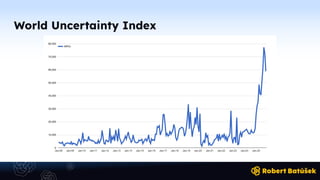
World Uncertainty Index
We don’t know, what’s ahead of us
Resilience
“The capacity to withstand or to
recover quickly from difficulties”
Oxford English dictionaries
“The quality of being able to return quickly to a
previous good condition after problems”
Cambridge Dictionary
“The ability of a system to withstand changes
in its environment and still function”
Wikipedia
Project Biosphere 2
What do individuals do to prepare for uncertainty
All of these measures decrease comfort
or well-being now in order to increase
the chances of success in the future
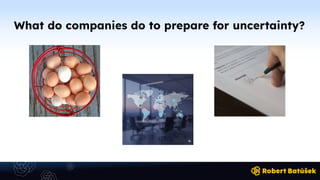
What do companies do to prepare for uncertainty?
All of these measures decrease
profitability now in order to keep
the company profitable in the future
What measures do you or your company use to
increase resilience?
https://www.menti.com/almdxpc6jtt8
What measures do you or your company use to
increase resilience?
https://sli.do #4537443
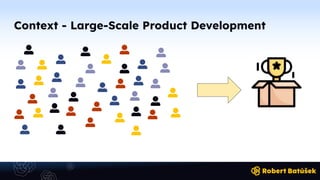
Context - Large-Scale Product Development
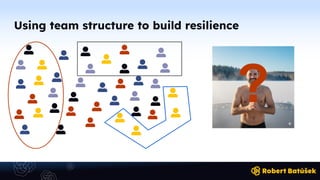
Using team structure to build resilience
?
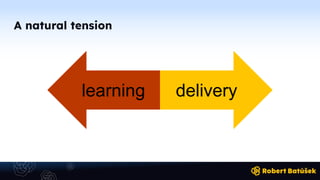
A natural tension
delivery
learning
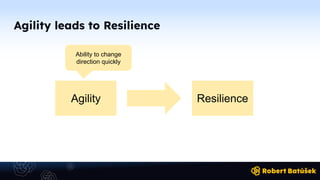
Agility leads to Resilience
Agility Resilience
Ability to change
direction quickly
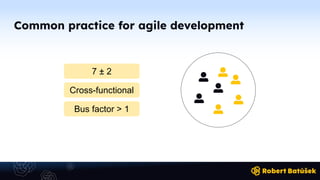
Common practice for agile development
7 ± 2
Cross-functional
Bus factor > 1
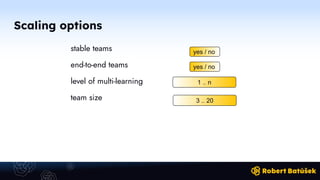
Scaling options
stable teams
end-to-end teams
level of multi-learning
team size
yes / no
1 .. n
3 .. 20
yes / no
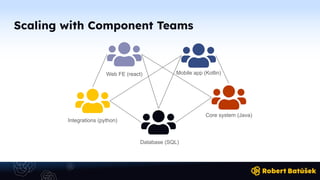
Scaling with Component Teams
Database (SQL)
Core system (Java)
Integrations (python)
Web FE (react) Mobile app (Kotlin)
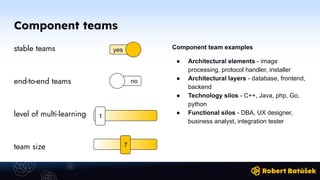
Component teams
stable teams
end-to-end teams
level of multi-learning
team size
Component team examples
● Architectural elements - image
processing, protocol handler, installer
● Architectural layers - database, frontend,
backend
● Technology silos - C++, Java, php, Go,
python
● Functional silos - DBA, UX designer,
business analyst, integration tester
yes
no
1
7
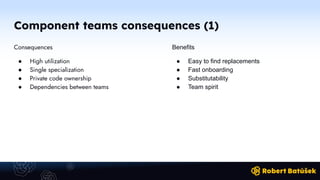
Component teams consequences (1)
Consequences
● High utilization
● Single specialization
● Private code ownership
● Dependencies between teams
Benefits
● Easy to find replacements
● Fast onboarding
● Substitutability
● Team spirit
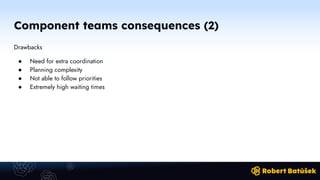
Component teams consequences (2)
Drawbacks
● Need for extra coordination
● Planning complexity
● Not able to follow priorities
● Extremely high waiting times
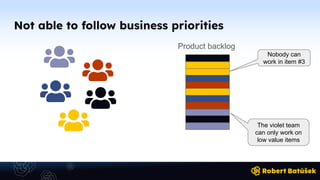
Not able to follow business priorities
Product backlog
Nobody can
work in item #3
The violet team
can only work on
low value items
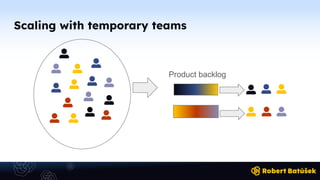
Scaling with temporary teams
Product backlog
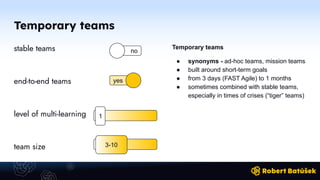
Temporary teams
stable teams
end-to-end teams
level of multi-learning
team size
Temporary teams
● synonyms - ad-hoc teams, mission teams
● built around short-term goals
● from 3 days (FAST Agile) to 1 months
● sometimes combined with stable teams,
especially in times of crises (“tiger” teams)
yes
no
1
3-10
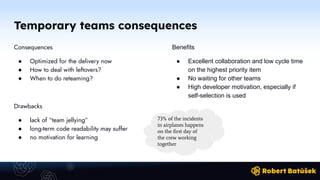
Temporary teams consequences
Consequences
● Optimized for the delivery now
● How to deal with leftovers?
● When to do reteaming?
Drawbacks
● lack of “team jellying”
● long-term code readability may suffer
● no motivation for learning
Benefits
● Excellent collaboration and low cycle time
on the highest priority item
● No waiting for other teams
● High developer motivation, especially if
self-selection is used
73% of the incidents
in airplanes happens
on the first day of
the crew working
together
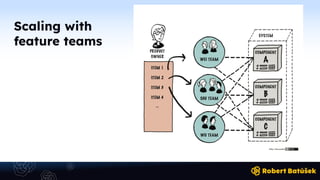
Scaling with
feature teams
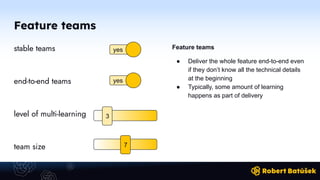
Feature teams
stable teams
end-to-end teams
level of multi-learning
team size
Feature teams
● Deliver the whole feature end-to-end even
if they don’t know all the technical details
at the beginning
● Typically, some amount of learning
happens as part of delivery
yes
yes
3
7
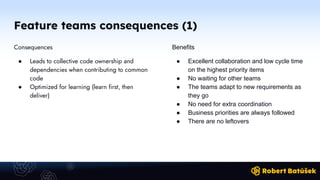
Feature teams consequences (1)
Consequences
● Leads to collective code ownership and
dependencies when contributing to common
code
● Optimized for learning (learn first, then
deliver)
Benefits
● Excellent collaboration and low cycle time
on the highest priority items
● No waiting for other teams
● The teams adapt to new requirements as
they go
● No need for extra coordination
● Business priorities are always followed
● There are no leftovers
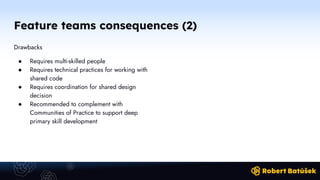
Feature teams consequences (2)
Drawbacks
● Requires multi-skilled people
● Requires technical practices for working with
shared code
● Requires coordination for shared design
decision
● Recommended to complement with
Communities of Practice to support deep
primary skill development
Which team types do you primarily use?
https://sli.do #4537443
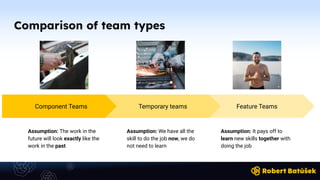
Comparison of team types
Feature Teams
Assumption: It pays off to
learn new skills together with
doing the job
Component Teams
Assumption: The work in the
future will look exactly like the
work in the past
Temporary teams
Assumption: We have all the
skill to do the job now, we do
not need to learn
5 Practical Tips for
Building Resilient Teams
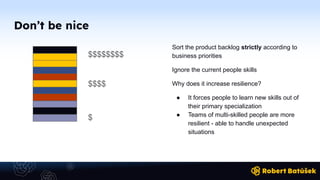
Don’t be nice
Sort the product backlog strictly according to
business priorities
Ignore the current people skills
Why does it increase resilience?
● It forces people to learn new skills out of
their primary specialization
● Teams of multi-skilled people are more
resilient - able to handle unexpected
situations
$$$$$$$$
$
$$$$
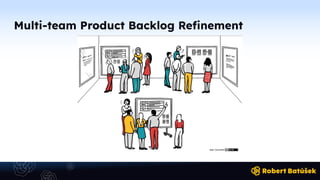
Multi-team Product Backlog Refinement
Increase quality of internal documentation
Clean your documentation data sources
Why does it increase resilience:
● it speeds up onboarding of new hires
● it decreases switching costs of your teams
Side effect: it increases the productivity gain
from AI usage.*
*Source: DORA report 2025
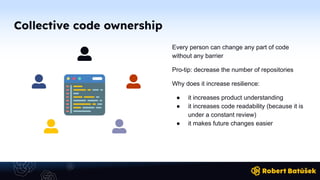
Collective code ownership
Every person can change any part of code
without any barrier
Pro-tip: decrease the number of repositories
Why does it increase resilience:
● it increases product understanding
● it increases code readability (because it is
under a constant review)
● it makes future changes easier
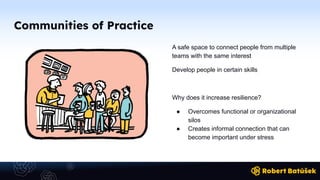
Communities of Practice
A safe space to connect people from multiple
teams with the same interest
Develop people in certain skills
Why does it increase resilience?
● Overcomes functional or organizational
silos
● Creates informal connection that can
become important under stress
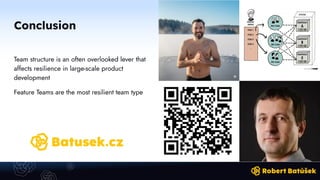
Conclusion
Team structure is an often overlooked lever that
affects resilience in large-scale product
development
Feature Teams are the most resilient team type

AAC2026_Batusek_Beyond the Bus Factor: Build your teams for for the future.pdf

  • 1.
    Beyond the BusFactor: Build your teams for the future Agile Austria 2026
  • 2.
  • 3.
    We don’t know,what’s ahead of us
  • 4.
    Resilience “The capacity towithstand or to recover quickly from difficulties” Oxford English dictionaries “The quality of being able to return quickly to a previous good condition after problems” Cambridge Dictionary “The ability of a system to withstand changes in its environment and still function” Wikipedia
  • 5.
  • 6.
    What do individualsdo to prepare for uncertainty
  • 7.
    All of thesemeasures decrease comfort or well-being now in order to increase the chances of success in the future
  • 8.
    What do companiesdo to prepare for uncertainty?
  • 9.
    All of thesemeasures decrease profitability now in order to keep the company profitable in the future
  • 10.
    What measures doyou or your company use to increase resilience? https://www.menti.com/almdxpc6jtt8
  • 11.
    What measures doyou or your company use to increase resilience? https://sli.do #4537443
  • 12.
    Context - Large-ScaleProduct Development
  • 13.
    Using team structureto build resilience ?
  • 14.
  • 15.
    Agility leads toResilience Agility Resilience Ability to change direction quickly
  • 16.
    Common practice foragile development 7 ± 2 Cross-functional Bus factor > 1
  • 17.
    Scaling options stable teams end-to-endteams level of multi-learning team size yes / no 1 .. n 3 .. 20 yes / no
  • 18.
    Scaling with ComponentTeams Database (SQL) Core system (Java) Integrations (python) Web FE (react) Mobile app (Kotlin)
  • 19.
    Component teams stable teams end-to-endteams level of multi-learning team size Component team examples ● Architectural elements - image processing, protocol handler, installer ● Architectural layers - database, frontend, backend ● Technology silos - C++, Java, php, Go, python ● Functional silos - DBA, UX designer, business analyst, integration tester yes no 1 7
  • 20.
    Component teams consequences(1) Consequences ● High utilization ● Single specialization ● Private code ownership ● Dependencies between teams Benefits ● Easy to find replacements ● Fast onboarding ● Substitutability ● Team spirit
  • 21.
    Component teams consequences(2) Drawbacks ● Need for extra coordination ● Planning complexity ● Not able to follow priorities ● Extremely high waiting times
  • 22.
    Not able tofollow business priorities Product backlog Nobody can work in item #3 The violet team can only work on low value items
  • 23.
    Scaling with temporaryteams Product backlog
  • 24.
    Temporary teams stable teams end-to-endteams level of multi-learning team size Temporary teams ● synonyms - ad-hoc teams, mission teams ● built around short-term goals ● from 3 days (FAST Agile) to 1 months ● sometimes combined with stable teams, especially in times of crises (“tiger” teams) yes no 1 3-10
  • 25.
    Temporary teams consequences Consequences ●Optimized for the delivery now ● How to deal with leftovers? ● When to do reteaming? Drawbacks ● lack of “team jellying” ● long-term code readability may suffer ● no motivation for learning Benefits ● Excellent collaboration and low cycle time on the highest priority item ● No waiting for other teams ● High developer motivation, especially if self-selection is used 73% of the incidents in airplanes happens on the first day of the crew working together
  • 26.
  • 27.
    Feature teams stable teams end-to-endteams level of multi-learning team size Feature teams ● Deliver the whole feature end-to-end even if they don’t know all the technical details at the beginning ● Typically, some amount of learning happens as part of delivery yes yes 3 7
  • 28.
    Feature teams consequences(1) Consequences ● Leads to collective code ownership and dependencies when contributing to common code ● Optimized for learning (learn first, then deliver) Benefits ● Excellent collaboration and low cycle time on the highest priority items ● No waiting for other teams ● The teams adapt to new requirements as they go ● No need for extra coordination ● Business priorities are always followed ● There are no leftovers
  • 29.
    Feature teams consequences(2) Drawbacks ● Requires multi-skilled people ● Requires technical practices for working with shared code ● Requires coordination for shared design decision ● Recommended to complement with Communities of Practice to support deep primary skill development
  • 30.
    Which team typesdo you primarily use? https://sli.do #4537443
  • 31.
    Comparison of teamtypes Feature Teams Assumption: It pays off to learn new skills together with doing the job Component Teams Assumption: The work in the future will look exactly like the work in the past Temporary teams Assumption: We have all the skill to do the job now, we do not need to learn
  • 32.
    5 Practical Tipsfor Building Resilient Teams
  • 33.
    Don’t be nice Sortthe product backlog strictly according to business priorities Ignore the current people skills Why does it increase resilience? ● It forces people to learn new skills out of their primary specialization ● Teams of multi-skilled people are more resilient - able to handle unexpected situations $$$$$$$$ $ $$$$
  • 34.
  • 35.
    Increase quality ofinternal documentation Clean your documentation data sources Why does it increase resilience: ● it speeds up onboarding of new hires ● it decreases switching costs of your teams Side effect: it increases the productivity gain from AI usage.* *Source: DORA report 2025
  • 36.
    Collective code ownership Everyperson can change any part of code without any barrier Pro-tip: decrease the number of repositories Why does it increase resilience: ● it increases product understanding ● it increases code readability (because it is under a constant review) ● it makes future changes easier
  • 37.
    Communities of Practice Asafe space to connect people from multiple teams with the same interest Develop people in certain skills Why does it increase resilience? ● Overcomes functional or organizational silos ● Creates informal connection that can become important under stress
  • 38.
    Conclusion Team structure isan often overlooked lever that affects resilience in large-scale product development Feature Teams are the most resilient team type