AI, People Analytics, and Digital HR
Practices, Agentic AI in HRM
Session : 8 & 9
Dr Sushmita Srivastava
Case : Amber By Infeedo
https://www.youtube.com/watch?v=CHGKrDphHsY
Dr Sushmita Srivastava
Organizational and Leadership Studies
Story: BBC on The Digital Friend Helping Staff with Stress at Work –
YouTube
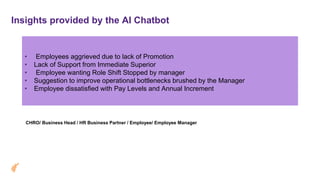
Insights provided by the AI Chatbot
• Employees aggrieved due to lack of Promotion
• Lack of Support from Immediate Superior
• Employee wanting Role Shift Stopped by manager
• Suggestion to improve operational bottlenecks brushed by the Manager
• Employee dissatisfied with Pay Levels and Annual Increment
CHRO/ Business Head / HR Business Partner / Employee/ Employee Manager
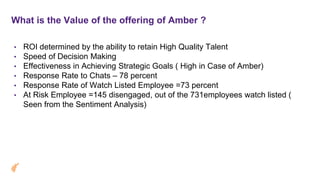
What is the Value of the offering of Amber ?
• ROI determined by the ability to retain High Quality Talent
• Speed of Decision Making
• Effectiveness in Achieving Strategic Goals ( High in Case of Amber)
• Response Rate to Chats – 78 percent
• Response Rate of Watch Listed Employee =73 percent
• At Risk Employee =145 disengaged, out of the 731employees watch listed (
Seen from the Sentiment Analysis)
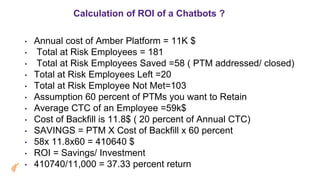
Calculation of ROI of a Chatbots ?
• Annual cost of Amber Platform = 11K $
• Total at Risk Employees = 181
• Total at Risk Employees Saved =58 ( PTM addressed/ closed)
• Total at Risk Employees Left =20
• Total at Risk Employee Not Met=103
• Assumption 60 percent of PTMs you want to Retain
• Average CTC of an Employee =59k$
• Cost of Backfill is 11.8$ ( 20 percent of Annual CTC)
• SAVINGS = PTM X Cost of Backfill x 60 percent
• 58x 11.8x60 = 410640 $
• ROI = Savings/ Investment
• 410740/11,000 = 37.33 percent return
How to Leverage Ambers Insights – by HR
• Agility in Dealing with Employee Concerns
• Solution Mind set
• Responsiveness, backed with Empathy
• Broad Knowledge of all domains
• Risk Management
• Value Creation
• Competency Building of entire workforce
• Response time in closing the concerns raised by the
Chatbots
Ethical Concerns
• Privacy concerns are addressed through Explainable AI
• Productivity Enhancing AI/ ML
• Configuring Cultural Differences
• E-mail from CEO desk, but actually the Chatbot
• Quoting what the employee responds to the Chat bot can be
dangerous
• Would PTM change behaviour of Managers >
• Breach of Trust in way the Chatbots Insights are used
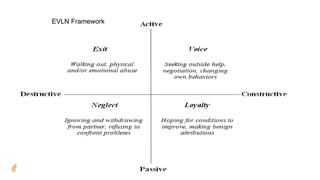
EVLN Framework
Tech HR – What is it about ?
• Provides Technology solutions to streamline and enhance
various processes and activities within an organization
• Improve HR efficiency,
• Enhance employee experiences,
• Enable professionals to focus on more strategic aspects of
business.
• Ensures better alignment of workforce with business objectives,
make informed decisions, and adapt to changing business
environments more effectively.
• Involves the integration of digital technology
• manages and optimize HR functions, making them more efficient,
data-driven, and user-friendly.
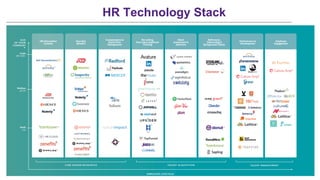
HR Technology Stack
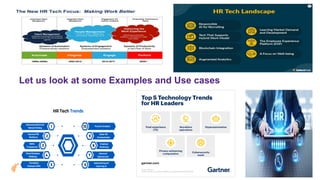
Let us look at some Examples and Use cases
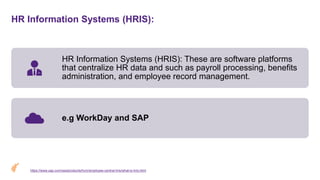
HR Information Systems (HRIS):
HR Information Systems (HRIS): These are software platforms
that centralize HR data and such as payroll processing, benefits
administration, and employee record management.
e.g WorkDay and SAP
https://www.sap.com/sea/products/hcm/employee-central-hris/what-is-hris.html
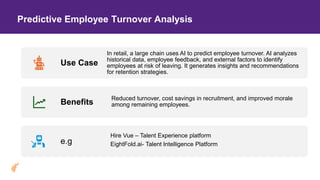
Predictive Employee Turnover Analysis
Use Case
In retail, a large chain uses AI to predict employee turnover. AI analyzes
historical data, employee feedback, and external factors to identify
employees at risk of leaving. It generates insights and recommendations
for retention strategies.
Benefits
Reduced turnover, cost savings in recruitment, and improved morale
among remaining employees.
e.g
Hire Vue – Talent Experience platform
EightFold.ai- Talent Intelligence Platform
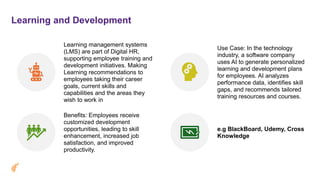
Learning and Development
Learning management systems
(LMS) are part of Digital HR,
supporting employee training and
development initiatives. Making
Learning recommendations to
employees taking their career
goals, current skills and
capabilities and the areas they
wish to work in
Use Case: In the technology
industry, a software company
uses AI to generate personalized
learning and development plans
for employees. AI analyzes
performance data, identifies skill
gaps, and recommends tailored
training resources and courses.
Benefits: Employees receive
customized development
opportunities, leading to skill
enhancement, increased job
satisfaction, and improved
productivity.
e.g BlackBoard, Udemy, Cross
Knowledge
Diversity and Inclusion Insights:
Use Case
In financial services, a bank
uses Gen AI to analyze
employee demographics,
feedback, and performance
data to generate reports on
diversity and inclusion. The AI
identifies areas for
improvement and offers
strategies.
Benefits
Enhanced diversity and
inclusion efforts, improved
corporate culture, and greater
attractiveness to a diverse
talent pool.
Strategic Workforce Planning:
Use Case
• In energy and utilities, an organization
uses Gen AI to develop long-term
workforce plans. AI analyzes industry
trends, internal data, and workforce
demographics to generate forecasts
and staffing recommendations.
Benefits:
• Efficient resource allocation, cost
savings, and agility in adapting to
industry changes.
Employee Benefits Optimization:
Use Case
In manufacturing, a company
leverages Gen AI to optimize
employee benefit packages. AI
analyzes employee preferences,
healthcare usage data, and industry
benchmarks to recommend tailored
benefits.
Benefits
Improved employee satisfaction,
attraction of top talent, and cost-
effective benefit offerings.
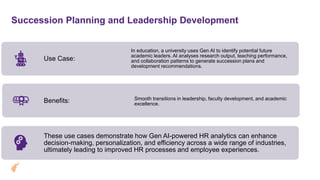
Succession Planning and Leadership Development
Use Case:
In education, a university uses Gen AI to identify potential future
academic leaders. AI analyses research output, teaching performance,
and collaboration patterns to generate succession plans and
development recommendations.
Benefits: Smooth transitions in leadership, faculty development, and academic
excellence.
These use cases demonstrate how Gen AI-powered HR analytics can enhance
decision-making, personalization, and efficiency across a wide range of industries,
ultimately leading to improved HR processes and employee experiences.
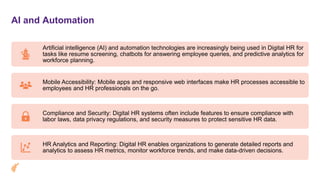
AI and Automation
Artificial intelligence (AI) and automation technologies are increasingly being used in Digital HR for
tasks like resume screening, chatbots for answering employee queries, and predictive analytics for
workforce planning.
Mobile Accessibility: Mobile apps and responsive web interfaces make HR processes accessible to
employees and HR professionals on the go.
Compliance and Security: Digital HR systems often include features to ensure compliance with
labor laws, data privacy regulations, and security measures to protect sensitive HR data.
HR Analytics and Reporting: Digital HR enables organizations to generate detailed reports and
analytics to assess HR metrics, monitor workforce trends, and make data-driven decisions.
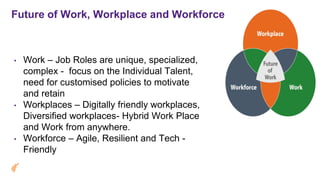
Future of Work, Workplace and Workforce
• Work – Job Roles are unique, specialized,
complex - focus on the Individual Talent,
need for customised policies to motivate
and retain
• Workplaces – Digitally friendly workplaces,
Diversified workplaces- Hybrid Work Place
and Work from anywhere.
• Workforce – Agile, Resilient and Tech -
Friendly
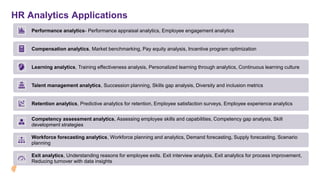
HR Analytics Applications
Performance analytics- Performance appraisal analytics, Employee engagement analytics
Compensation analytics, Market benchmarking, Pay equity analysis, Incentive program optimization
Learning analytics, Training effectiveness analysis, Personalized learning through analytics, Continuous learning culture
Talent management analytics, Succession planning, Skills gap analysis, Diversity and inclusion metrics
Retention analytics, Predictive analytics for retention, Employee satisfaction surveys, Employee experience analytics
Competency assessment analytics, Assessing employee skills and capabilities, Competency gap analysis, Skill
development strategies
Workforce forecasting analytics, Workforce planning and analytics, Demand forecasting, Supply forecasting, Scenario
planning
Exit analytics, Understanding reasons for employee exits. Exit interview analysis, Exit analytics for process improvement,
Reducing turnover with data insights
Why Human Resources Analytics
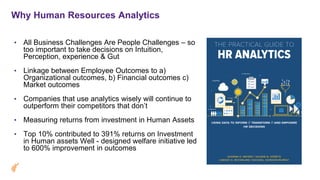
• All Business Challenges Are People Challenges – so
too important to take decisions on Intuition,
Perception, experience & Gut
• Linkage between Employee Outcomes to a)
Organizational outcomes, b) Financial outcomes c)
Market outcomes
• Companies that use analytics wisely will continue to
outperform their competitors that don’t
• Measuring returns from investment in Human Assets
• Top 10% contributed to 391% returns on Investment
in Human assets Well - designed welfare initiative led
to 600% improvement in outcomes
Why Study impact of Digital in People Management ?
• Digital is bound to transform how
companies will manage their
employees
• Adopting AI in HR practices –
Diversity & Inclusion, Recruitment,
Performance Management,
Compensation, Workforce Planning
• Remote and Hybrid Work is here to
stay
Work, Workplace and Workforce
What is a digital workplace?
A digital workplace is an extension of a physical workplace, wherein the office is not
confined to any one physical space. It is spread over geographies through a network of
several workplaces technologically connected.
Why do we need a digital workplace?
Apart from being the need of the hour to run operations seamlessly, there are compelling
reasons for companies to build digital workplaces:
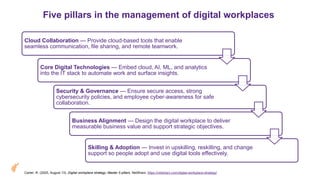
Five pillars in the management of digital workplaces
Cloud Collaboration — Provide cloud-based tools that enable
seamless communication, file sharing, and remote teamwork.
Core Digital Technologies — Embed cloud, AI, ML, and analytics
into the IT stack to automate work and surface insights.
Security & Governance — Ensure secure access, strong
cybersecurity policies, and employee cyber-awareness for safe
collaboration.
Business Alignment — Design the digital workplace to deliver
measurable business value and support strategic objectives.
Skilling & Adoption — Invest in upskilling, reskilling, and change
support so people adopt and use digital tools effectively.
Carter, R. (2025, August 13). Digital workplace strategy: Master 5 pillars. NetSharx. https://netsharx.com/digital-workplace-strategy/
Examples of Companies Leveraging HR Analytics
IBM
Accenture
CITI bank
Starbucks
Best buy
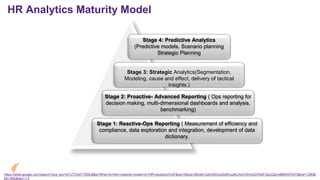
Stage 4: Predictive Analytics
(Predictive models, Scenario planning
Strategic Planning
Stage 3: Strategic Analytics(Segmentation,
Modeling, cause and effect, delivery of tactical
insights.)
Stage 2: Proactive- Advanced Reporting ( Ops reporting for
decision making, multi-dimensional dashboards and analysis,
benchmarking)
Stage 1: Reactive-Ops Reporting ( Measurement of efficiency and
compliance, data exploration and integration, development of data
dictionary.
HR Analytics Maturity Model
https://www.google.com/search?sca_esv=b7c7725471ff36c8&q=What+is+the+maturity+model+in+HR+analytics%3F&sa=X&sqi=2&ved=2ahUKEwiz9sWuueKJAxVvSmwGHSaFGpUQzmd6BAhFEAY&biw=1280&
bih=665&dpr=1.5
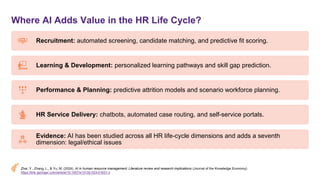
Where AI Adds Value in the HR Life Cycle?
Recruitment: automated screening, candidate matching, and predictive fit scoring.
Learning & Development: personalized learning pathways and skill gap prediction.
Performance & Planning: predictive attrition models and scenario workforce planning.
HR Service Delivery: chatbots, automated case routing, and self-service portals.
Evidence: AI has been studied across all HR life-cycle dimensions and adds a seventh
dimension: legal/ethical issues
Zhai, Y., Zhang, L., & Yu, M. (2024). AI in human resource management: Literature review and research implications (Journal of the Knowledge Economy).
https://link.springer.com/article/10.1007/s13132-023-01631-z
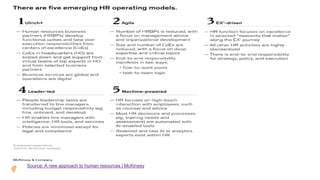
Source: A new approach to human resources | McKinsey
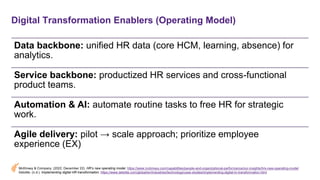
Digital Transformation Enablers (Operating Model)
Data backbone: unified HR data (core HCM, learning, absence) for
analytics.
Service backbone: productized HR services and cross-functional
product teams.
Automation & AI: automate routine tasks to free HR for strategic
work.
Agile delivery: pilot → scale approach; prioritize employee
experience (EX)
McKinsey & Company. (2022, December 22). HR’s new operating model. https://www.mckinsey.com/capabilities/people-and-organizational-performance/our-insights/hrs-new-operating-model
Deloitte. (n.d.). Implementing digital HR transformation. https://www.deloitte.com/global/en/Industries/technology/case-studies/implementing-digital-hr-transformation.html
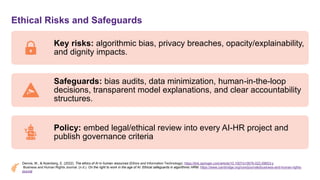
Ethical Risks and Safeguards
Key risks: algorithmic bias, privacy breaches, opacity/explainability,
and dignity impacts.
Safeguards: bias audits, data minimization, human-in-the-loop
decisions, transparent model explanations, and clear accountability
structures.
Policy: embed legal/ethical review into every AI-HR project and
publish governance criteria
Dennis, M., & Aizenberg, E. (2022). The ethics of AI in human resources (Ethics and Information Technology). https://link.springer.com/article/10.1007/s10676-022-09653-y
Business and Human Rights Journal. (n.d.). On the right to work in the age of AI: Ethical safeguards in algorithmic HRM. https://www.cambridge.org/core/journals/business-and-human-rights-
journal
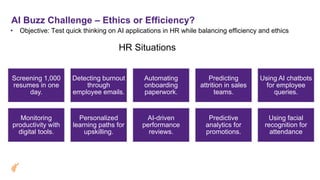
AI Buzz Challenge – Ethics or Efficiency?
• Objective: Test quick thinking on AI applications in HR while balancing efficiency and ethics
HR Situations
Screening 1,000
resumes in one
day.
Detecting burnout
through
employee emails.
Automating
onboarding
paperwork.
Predicting
attrition in sales
teams.
Using AI chatbots
for employee
queries.
Monitoring
productivity with
digital tools.
Personalized
learning paths for
upskilling.
AI-driven
performance
reviews.
Predictive
analytics for
promotions.
Using facial
recognition for
attendance
Compensation Design
•AI is increasingly used to analyze market benchmarks, flag
pay gaps, model salary scenarios, and support
compensation decisions.
•Advanced analytics tools are shifting compensation planning
from manual spreadsheets to automated insights.
Dilemmas:
Bias & Fairness: AI systems can perpetuate bias if trained on
flawed historical data, undermining equity goals.
Transparency of AI Decisions: Employees may question
decisions made by AI “black boxes” unless methods are
explained.
Over-reliance vs. Human Judgment: Organizations must
balance algorithmic recommendations with human oversight to
preserve trust and business context.
Agentic AI in HR– Transforming
People Management
Agentic AI in HRM – Transforming People Management
• Focus: To explore the concept of Agentic AI—AI systems capable of autonomous decision-
making—and its implications, applications, and ethical considerations in Human Resources.
• Trends: AI augmenting HR functions, highlighting challenges and risks
• Session Objectives:
• • Identify current AI adoption levels in HR functions
• • Explore specific use cases of Agentic AI across HR functions
• - Assess potential impact on efficiency, decision-making, and employee experience
• Discuss how AI can complement human judgment rather than replace it.
Readings
• Pati, A. K. (Year). Agentic AI: A comprehensive survey of technologies, applications, and societal
implications. In Proceedings of the Name of Conference (pp. xx–xx). IEEE.
https://ieeexplore.ieee.org/stamp/stamp.jsp?arnumber=11071266
• Ginac, F. (2024). Harnessing agentic AI: What HR leaders need to know. Medium. https://frank-
ginac.medium.com/harnessing-agentic-ai-what-hr-leaders-need-to-know-1f86afc5e3d9
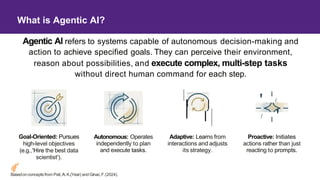
What is Agentic AI?
Agentic Al refers to systems capable of autonomous decision-making and
action to achieve specified goals. They can perceive their environment,
reason about possibilities, and execute complex, multi-step tasks
without direct human command for each step.
I
' /
/
I
'
Goal-Oriented: Pursues
high-level objectives
(e.g.,'Hire the best data
scientist').
Autonomous: Operates
independently to plan
and execute tasks.
Adaptive: Learns from
interactions and adjusts
its strategy.
Proactive: Initiates
actions rather than just
reacting to prompts.
Basedonconceptsfrom Pati, A.K.(Year) and Ginac,F.(2024).
The New Mandate for Leaders
◄ - - - - + -
l T
'I
�
I
I
I•
I
I
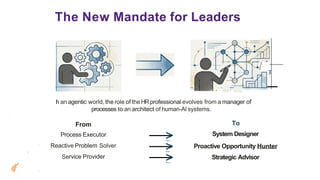
n an agentic world, the role of theHRprofessional evolves from a manager of
processes to an architect of human-Al systems.
From
Process Executor
Reactive Problem Solver
Service Provider
>
>
>
To
System Designer
Proactive Opportunity Hunter
Strategic Advisor
1:>t
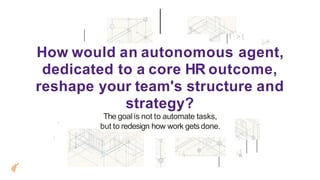
How would an autonomous agent,
dedicated to a core HR outcome,
reshape your team's structure and
strategy?
•
J
The goal is not to automate tasks,
but to redesign how work getsdone.
l
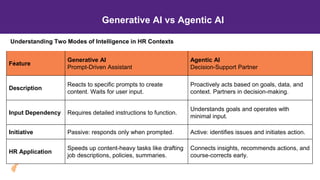
Generative AI vs Agentic AI
Feature
Generative AI
Prompt-Driven Assistant
Agentic AI
Decision-Support Partner
Description
Reacts to specific prompts to create
content. Waits for user input.
Proactively acts based on goals, data, and
context. Partners in decision-making.
Input Dependency Requires detailed instructions to function.
Understands goals and operates with
minimal input.
Initiative Passive: responds only when prompted. Active: identifies issues and initiates action.
HR Application
Speeds up content-heavy tasks like drafting
job descriptions, policies, summaries.
Connects insights, recommends actions, and
course-corrects early.
:
Understanding Two Modes of Intelligence in HR Contexts
Agentic AI in HRM –
Transforming People
Management
Agentic AI in HRM – Transforming
People Management
How far should AI be allowed to “act” in people decisions—and
where must human judgment remain non-negotiable?
Agentic AI marks a shift
from AI as a tool to AI as
an actor in HR systems.
This session helps in critically evaluating where autonomy adds value, where it
introduces risk, and how HR leaders must redesign governance, roles, and
capabilities.
Agenda Items
Identify current levels of AI adoption across HR functions
Understand Agentic AI and how it differs from traditional HR
analytics and automation
Explore use cases of Agentic AI across the employee lifecycle
Assess the impact on efficiency, decision quality, and employee
experience
Critically evaluate ethical, legal, and governance risks
Articulate how AI can augment—not replace—human judgment
in HR
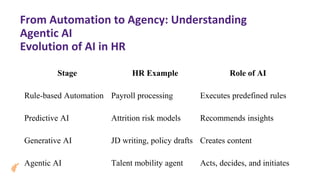
From Automation to Agency: Understanding
Agentic AI
Evolution of AI in HR
Stage HR Example Role of AI
Rule-based Automation Payroll processing Executes predefined rules
Predictive AI Attrition risk models Recommends insights
Generative AI JD writing, policy drafts Creates content
Agentic AI Talent mobility agent Acts, decides, and initiates
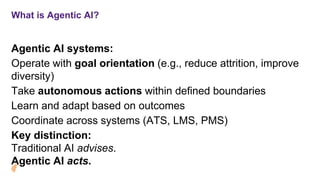
What is Agentic AI?
Agentic AI systems:
Operate with goal orientation (e.g., reduce attrition, improve
diversity)
Take autonomous actions within defined boundaries
Learn and adapt based on outcomes
Coordinate across systems (ATS, LMS, PMS)
Key distinction:
Traditional AI advises.
Agentic AI acts.
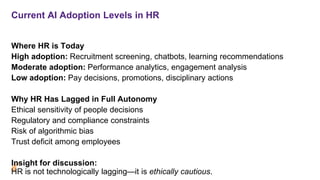
Current AI Adoption Levels in HR
Where HR is Today
High adoption: Recruitment screening, chatbots, learning recommendations
Moderate adoption: Performance analytics, engagement analysis
Low adoption: Pay decisions, promotions, disciplinary actions
Why HR Has Lagged in Full Autonomy
Ethical sensitivity of people decisions
Regulatory and compliance constraints
Risk of algorithmic bias
Trust deficit among employees
Insight for discussion:
HR is not technologically lagging—it is ethically cautious.
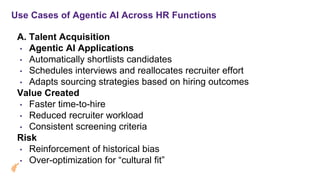
Use Cases of Agentic AI Across HR Functions
A. Talent Acquisition
• Agentic AI Applications
• Automatically shortlists candidates
• Schedules interviews and reallocates recruiter effort
• Adapts sourcing strategies based on hiring outcomes
Value Created
• Faster time-to-hire
• Reduced recruiter workload
• Consistent screening criteria
Risk
• Reinforcement of historical bias
• Over-optimization for “cultural fit”
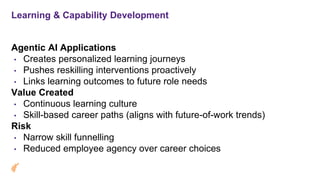
Learning & Capability Development
Agentic AI Applications
• Creates personalized learning journeys
• Pushes reskilling interventions proactively
• Links learning outcomes to future role needs
Value Created
• Continuous learning culture
• Skill-based career paths (aligns with future-of-work trends)
Risk
• Narrow skill funnelling
• Reduced employee agency over career choices
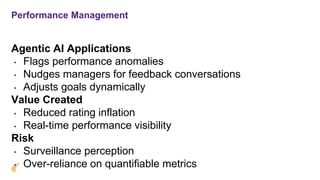
Performance Management
Agentic AI Applications
• Flags performance anomalies
• Nudges managers for feedback conversations
• Adjusts goals dynamically
Value Created
• Reduced rating inflation
• Real-time performance visibility
Risk
• Surveillance perception
• Over-reliance on quantifiable metrics
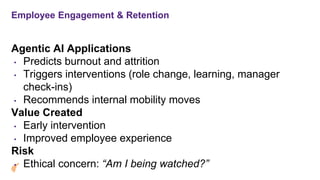
Employee Engagement & Retention
Agentic AI Applications
• Predicts burnout and attrition
• Triggers interventions (role change, learning, manager
check-ins)
• Recommends internal mobility moves
Value Created
• Early intervention
• Improved employee experience
Risk
• Ethical concern: “Am I being watched?”
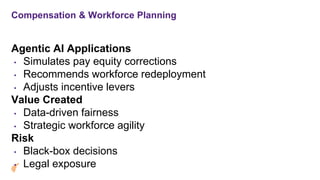
Compensation & Workforce Planning
Agentic AI Applications
• Simulates pay equity corrections
• Recommends workforce redeployment
• Adjusts incentive levers
Value Created
• Data-driven fairness
• Strategic workforce agility
Risk
• Black-box decisions
• Legal exposure
Impact Assessment: Efficiency, Decisions & Employee Experience
• Efficiency
• Reduced cycle times
Scalable HR operations
Risk of over-automation
• Decision Quality
• Pattern recognition beyond human capacity
Consistency in decisions
Loss of contextual nuance
• Employee Experience
• Personalized journeys
Faster responses
Reduced sense of “being heard”
• Paradox:
Agentic AI improves process experience but may weaken
relational experience.
•
Impact Assessment: Efficiency, Decisions & Employee Experience
Ethical, Legal & Governance Challenges
Key Risks
Algorithmic bias and discrimination
Lack of explainability
Accountability ambiguity (Who is responsible?)
Data privacy and consent
Emerging Governance Principles
Human-in-the-loop for high-stakes decisions
Explainability mandates
Ethical review boards for HR algorithms
Clear escalation protocols
Link to ESG:
Responsible AI in HR is becoming a governance and
sustainability issue, not just a tech issue.
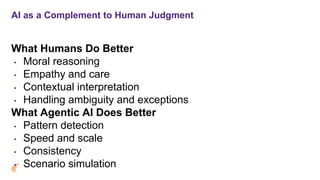
AI as a Complement to Human Judgment
What Humans Do Better
• Moral reasoning
• Empathy and care
• Contextual interpretation
• Handling ambiguity and exceptions
What Agentic AI Does Better
• Pattern detection
• Speed and scale
• Consistency
• Scenario simulation
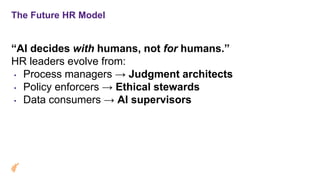
The Future HR Model
“AI decides with humans, not for humans.”
HR leaders evolve from:
• Process managers → Judgment architects
• Policy enforcers → Ethical stewards
• Data consumers → AI supervisors
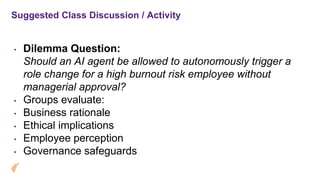
Suggested Class Discussion / Activity
• Dilemma Question:
Should an AI agent be allowed to autonomously trigger a
role change for a high burnout risk employee without
managerial approval?
• Groups evaluate:
• Business rationale
• Ethical implications
• Employee perception
• Governance safeguards
Session Closure
• Key Takeaway:
Agentic AI will not eliminate HR roles—but it will
redefine power, responsibility, and judgment in
people management.
• The future of HR lies not in choosing between human
or AI, but in designing responsible human–AI
partnerships.
Thank You

AI,Analytics, Digital HR, Agentic AI.pdf

  • 1.
    AI, People Analytics,and Digital HR Practices, Agentic AI in HRM Session : 8 & 9 Dr Sushmita Srivastava
  • 2.
    Case : AmberBy Infeedo https://www.youtube.com/watch?v=CHGKrDphHsY Dr Sushmita Srivastava Organizational and Leadership Studies Story: BBC on The Digital Friend Helping Staff with Stress at Work – YouTube
  • 3.
    Insights provided bythe AI Chatbot • Employees aggrieved due to lack of Promotion • Lack of Support from Immediate Superior • Employee wanting Role Shift Stopped by manager • Suggestion to improve operational bottlenecks brushed by the Manager • Employee dissatisfied with Pay Levels and Annual Increment CHRO/ Business Head / HR Business Partner / Employee/ Employee Manager
  • 4.
    What is theValue of the offering of Amber ? • ROI determined by the ability to retain High Quality Talent • Speed of Decision Making • Effectiveness in Achieving Strategic Goals ( High in Case of Amber) • Response Rate to Chats – 78 percent • Response Rate of Watch Listed Employee =73 percent • At Risk Employee =145 disengaged, out of the 731employees watch listed ( Seen from the Sentiment Analysis)
  • 5.
    Calculation of ROIof a Chatbots ? • Annual cost of Amber Platform = 11K $ • Total at Risk Employees = 181 • Total at Risk Employees Saved =58 ( PTM addressed/ closed) • Total at Risk Employees Left =20 • Total at Risk Employee Not Met=103 • Assumption 60 percent of PTMs you want to Retain • Average CTC of an Employee =59k$ • Cost of Backfill is 11.8$ ( 20 percent of Annual CTC) • SAVINGS = PTM X Cost of Backfill x 60 percent • 58x 11.8x60 = 410640 $ • ROI = Savings/ Investment • 410740/11,000 = 37.33 percent return
  • 6.
    How to LeverageAmbers Insights – by HR • Agility in Dealing with Employee Concerns • Solution Mind set • Responsiveness, backed with Empathy • Broad Knowledge of all domains • Risk Management • Value Creation • Competency Building of entire workforce • Response time in closing the concerns raised by the Chatbots
  • 7.
    Ethical Concerns • Privacyconcerns are addressed through Explainable AI • Productivity Enhancing AI/ ML • Configuring Cultural Differences • E-mail from CEO desk, but actually the Chatbot • Quoting what the employee responds to the Chat bot can be dangerous • Would PTM change behaviour of Managers > • Breach of Trust in way the Chatbots Insights are used
  • 8.
  • 9.
    Tech HR –What is it about ? • Provides Technology solutions to streamline and enhance various processes and activities within an organization • Improve HR efficiency, • Enhance employee experiences, • Enable professionals to focus on more strategic aspects of business. • Ensures better alignment of workforce with business objectives, make informed decisions, and adapt to changing business environments more effectively. • Involves the integration of digital technology • manages and optimize HR functions, making them more efficient, data-driven, and user-friendly.
  • 10.
  • 11.
    Let us lookat some Examples and Use cases
  • 12.
    HR Information Systems(HRIS): HR Information Systems (HRIS): These are software platforms that centralize HR data and such as payroll processing, benefits administration, and employee record management. e.g WorkDay and SAP https://www.sap.com/sea/products/hcm/employee-central-hris/what-is-hris.html
  • 13.
    Predictive Employee TurnoverAnalysis Use Case In retail, a large chain uses AI to predict employee turnover. AI analyzes historical data, employee feedback, and external factors to identify employees at risk of leaving. It generates insights and recommendations for retention strategies. Benefits Reduced turnover, cost savings in recruitment, and improved morale among remaining employees. e.g Hire Vue – Talent Experience platform EightFold.ai- Talent Intelligence Platform
  • 14.
    Learning and Development Learningmanagement systems (LMS) are part of Digital HR, supporting employee training and development initiatives. Making Learning recommendations to employees taking their career goals, current skills and capabilities and the areas they wish to work in Use Case: In the technology industry, a software company uses AI to generate personalized learning and development plans for employees. AI analyzes performance data, identifies skill gaps, and recommends tailored training resources and courses. Benefits: Employees receive customized development opportunities, leading to skill enhancement, increased job satisfaction, and improved productivity. e.g BlackBoard, Udemy, Cross Knowledge
  • 15.
    Diversity and InclusionInsights: Use Case In financial services, a bank uses Gen AI to analyze employee demographics, feedback, and performance data to generate reports on diversity and inclusion. The AI identifies areas for improvement and offers strategies. Benefits Enhanced diversity and inclusion efforts, improved corporate culture, and greater attractiveness to a diverse talent pool.
  • 16.
    Strategic Workforce Planning: UseCase • In energy and utilities, an organization uses Gen AI to develop long-term workforce plans. AI analyzes industry trends, internal data, and workforce demographics to generate forecasts and staffing recommendations. Benefits: • Efficient resource allocation, cost savings, and agility in adapting to industry changes.
  • 17.
    Employee Benefits Optimization: UseCase In manufacturing, a company leverages Gen AI to optimize employee benefit packages. AI analyzes employee preferences, healthcare usage data, and industry benchmarks to recommend tailored benefits. Benefits Improved employee satisfaction, attraction of top talent, and cost- effective benefit offerings.
  • 18.
    Succession Planning andLeadership Development Use Case: In education, a university uses Gen AI to identify potential future academic leaders. AI analyses research output, teaching performance, and collaboration patterns to generate succession plans and development recommendations. Benefits: Smooth transitions in leadership, faculty development, and academic excellence. These use cases demonstrate how Gen AI-powered HR analytics can enhance decision-making, personalization, and efficiency across a wide range of industries, ultimately leading to improved HR processes and employee experiences.
  • 19.
    AI and Automation Artificialintelligence (AI) and automation technologies are increasingly being used in Digital HR for tasks like resume screening, chatbots for answering employee queries, and predictive analytics for workforce planning. Mobile Accessibility: Mobile apps and responsive web interfaces make HR processes accessible to employees and HR professionals on the go. Compliance and Security: Digital HR systems often include features to ensure compliance with labor laws, data privacy regulations, and security measures to protect sensitive HR data. HR Analytics and Reporting: Digital HR enables organizations to generate detailed reports and analytics to assess HR metrics, monitor workforce trends, and make data-driven decisions.
  • 20.
    Future of Work,Workplace and Workforce • Work – Job Roles are unique, specialized, complex - focus on the Individual Talent, need for customised policies to motivate and retain • Workplaces – Digitally friendly workplaces, Diversified workplaces- Hybrid Work Place and Work from anywhere. • Workforce – Agile, Resilient and Tech - Friendly
  • 21.
    HR Analytics Applications Performanceanalytics- Performance appraisal analytics, Employee engagement analytics Compensation analytics, Market benchmarking, Pay equity analysis, Incentive program optimization Learning analytics, Training effectiveness analysis, Personalized learning through analytics, Continuous learning culture Talent management analytics, Succession planning, Skills gap analysis, Diversity and inclusion metrics Retention analytics, Predictive analytics for retention, Employee satisfaction surveys, Employee experience analytics Competency assessment analytics, Assessing employee skills and capabilities, Competency gap analysis, Skill development strategies Workforce forecasting analytics, Workforce planning and analytics, Demand forecasting, Supply forecasting, Scenario planning Exit analytics, Understanding reasons for employee exits. Exit interview analysis, Exit analytics for process improvement, Reducing turnover with data insights
  • 22.
    Why Human ResourcesAnalytics • All Business Challenges Are People Challenges – so too important to take decisions on Intuition, Perception, experience & Gut • Linkage between Employee Outcomes to a) Organizational outcomes, b) Financial outcomes c) Market outcomes • Companies that use analytics wisely will continue to outperform their competitors that don’t • Measuring returns from investment in Human Assets • Top 10% contributed to 391% returns on Investment in Human assets Well - designed welfare initiative led to 600% improvement in outcomes
  • 23.
    Why Study impactof Digital in People Management ? • Digital is bound to transform how companies will manage their employees • Adopting AI in HR practices – Diversity & Inclusion, Recruitment, Performance Management, Compensation, Workforce Planning • Remote and Hybrid Work is here to stay
  • 24.
    Work, Workplace andWorkforce What is a digital workplace? A digital workplace is an extension of a physical workplace, wherein the office is not confined to any one physical space. It is spread over geographies through a network of several workplaces technologically connected. Why do we need a digital workplace? Apart from being the need of the hour to run operations seamlessly, there are compelling reasons for companies to build digital workplaces:
  • 25.
    Five pillars inthe management of digital workplaces Cloud Collaboration — Provide cloud-based tools that enable seamless communication, file sharing, and remote teamwork. Core Digital Technologies — Embed cloud, AI, ML, and analytics into the IT stack to automate work and surface insights. Security & Governance — Ensure secure access, strong cybersecurity policies, and employee cyber-awareness for safe collaboration. Business Alignment — Design the digital workplace to deliver measurable business value and support strategic objectives. Skilling & Adoption — Invest in upskilling, reskilling, and change support so people adopt and use digital tools effectively. Carter, R. (2025, August 13). Digital workplace strategy: Master 5 pillars. NetSharx. https://netsharx.com/digital-workplace-strategy/
  • 26.
    Examples of CompaniesLeveraging HR Analytics IBM Accenture CITI bank Starbucks Best buy
  • 27.
    Stage 4: PredictiveAnalytics (Predictive models, Scenario planning Strategic Planning Stage 3: Strategic Analytics(Segmentation, Modeling, cause and effect, delivery of tactical insights.) Stage 2: Proactive- Advanced Reporting ( Ops reporting for decision making, multi-dimensional dashboards and analysis, benchmarking) Stage 1: Reactive-Ops Reporting ( Measurement of efficiency and compliance, data exploration and integration, development of data dictionary. HR Analytics Maturity Model https://www.google.com/search?sca_esv=b7c7725471ff36c8&q=What+is+the+maturity+model+in+HR+analytics%3F&sa=X&sqi=2&ved=2ahUKEwiz9sWuueKJAxVvSmwGHSaFGpUQzmd6BAhFEAY&biw=1280& bih=665&dpr=1.5
  • 28.
    Where AI AddsValue in the HR Life Cycle? Recruitment: automated screening, candidate matching, and predictive fit scoring. Learning & Development: personalized learning pathways and skill gap prediction. Performance & Planning: predictive attrition models and scenario workforce planning. HR Service Delivery: chatbots, automated case routing, and self-service portals. Evidence: AI has been studied across all HR life-cycle dimensions and adds a seventh dimension: legal/ethical issues Zhai, Y., Zhang, L., & Yu, M. (2024). AI in human resource management: Literature review and research implications (Journal of the Knowledge Economy). https://link.springer.com/article/10.1007/s13132-023-01631-z
  • 29.
    Source: A newapproach to human resources | McKinsey
  • 30.
    Digital Transformation Enablers(Operating Model) Data backbone: unified HR data (core HCM, learning, absence) for analytics. Service backbone: productized HR services and cross-functional product teams. Automation & AI: automate routine tasks to free HR for strategic work. Agile delivery: pilot → scale approach; prioritize employee experience (EX) McKinsey & Company. (2022, December 22). HR’s new operating model. https://www.mckinsey.com/capabilities/people-and-organizational-performance/our-insights/hrs-new-operating-model Deloitte. (n.d.). Implementing digital HR transformation. https://www.deloitte.com/global/en/Industries/technology/case-studies/implementing-digital-hr-transformation.html
  • 31.
    Ethical Risks andSafeguards Key risks: algorithmic bias, privacy breaches, opacity/explainability, and dignity impacts. Safeguards: bias audits, data minimization, human-in-the-loop decisions, transparent model explanations, and clear accountability structures. Policy: embed legal/ethical review into every AI-HR project and publish governance criteria Dennis, M., & Aizenberg, E. (2022). The ethics of AI in human resources (Ethics and Information Technology). https://link.springer.com/article/10.1007/s10676-022-09653-y Business and Human Rights Journal. (n.d.). On the right to work in the age of AI: Ethical safeguards in algorithmic HRM. https://www.cambridge.org/core/journals/business-and-human-rights- journal
  • 32.
    AI Buzz Challenge– Ethics or Efficiency? • Objective: Test quick thinking on AI applications in HR while balancing efficiency and ethics HR Situations Screening 1,000 resumes in one day. Detecting burnout through employee emails. Automating onboarding paperwork. Predicting attrition in sales teams. Using AI chatbots for employee queries. Monitoring productivity with digital tools. Personalized learning paths for upskilling. AI-driven performance reviews. Predictive analytics for promotions. Using facial recognition for attendance
  • 33.
    Compensation Design •AI isincreasingly used to analyze market benchmarks, flag pay gaps, model salary scenarios, and support compensation decisions. •Advanced analytics tools are shifting compensation planning from manual spreadsheets to automated insights.
  • 34.
    Dilemmas: Bias & Fairness:AI systems can perpetuate bias if trained on flawed historical data, undermining equity goals. Transparency of AI Decisions: Employees may question decisions made by AI “black boxes” unless methods are explained. Over-reliance vs. Human Judgment: Organizations must balance algorithmic recommendations with human oversight to preserve trust and business context.
  • 35.
    Agentic AI inHR– Transforming People Management
  • 36.
    Agentic AI inHRM – Transforming People Management • Focus: To explore the concept of Agentic AI—AI systems capable of autonomous decision- making—and its implications, applications, and ethical considerations in Human Resources. • Trends: AI augmenting HR functions, highlighting challenges and risks • Session Objectives: • • Identify current AI adoption levels in HR functions • • Explore specific use cases of Agentic AI across HR functions • - Assess potential impact on efficiency, decision-making, and employee experience • Discuss how AI can complement human judgment rather than replace it.
  • 37.
    Readings • Pati, A.K. (Year). Agentic AI: A comprehensive survey of technologies, applications, and societal implications. In Proceedings of the Name of Conference (pp. xx–xx). IEEE. https://ieeexplore.ieee.org/stamp/stamp.jsp?arnumber=11071266 • Ginac, F. (2024). Harnessing agentic AI: What HR leaders need to know. Medium. https://frank- ginac.medium.com/harnessing-agentic-ai-what-hr-leaders-need-to-know-1f86afc5e3d9
  • 38.
    What is AgenticAI? Agentic Al refers to systems capable of autonomous decision-making and action to achieve specified goals. They can perceive their environment, reason about possibilities, and execute complex, multi-step tasks without direct human command for each step. I ' / / I ' Goal-Oriented: Pursues high-level objectives (e.g.,'Hire the best data scientist'). Autonomous: Operates independently to plan and execute tasks. Adaptive: Learns from interactions and adjusts its strategy. Proactive: Initiates actions rather than just reacting to prompts. Basedonconceptsfrom Pati, A.K.(Year) and Ginac,F.(2024).
  • 39.
    The New Mandatefor Leaders ◄ - - - - + - l T 'I � I I I• I I n an agentic world, the role of theHRprofessional evolves from a manager of processes to an architect of human-Al systems. From Process Executor Reactive Problem Solver Service Provider > > > To System Designer Proactive Opportunity Hunter Strategic Advisor
  • 40.
    1:>t How would anautonomous agent, dedicated to a core HR outcome, reshape your team's structure and strategy? • J The goal is not to automate tasks, but to redesign how work getsdone. l
  • 41.
    Generative AI vsAgentic AI Feature Generative AI Prompt-Driven Assistant Agentic AI Decision-Support Partner Description Reacts to specific prompts to create content. Waits for user input. Proactively acts based on goals, data, and context. Partners in decision-making. Input Dependency Requires detailed instructions to function. Understands goals and operates with minimal input. Initiative Passive: responds only when prompted. Active: identifies issues and initiates action. HR Application Speeds up content-heavy tasks like drafting job descriptions, policies, summaries. Connects insights, recommends actions, and course-corrects early. : Understanding Two Modes of Intelligence in HR Contexts
  • 42.
    Agentic AI inHRM – Transforming People Management
  • 43.
    Agentic AI inHRM – Transforming People Management How far should AI be allowed to “act” in people decisions—and where must human judgment remain non-negotiable?
  • 44.
    Agentic AI marksa shift from AI as a tool to AI as an actor in HR systems. This session helps in critically evaluating where autonomy adds value, where it introduces risk, and how HR leaders must redesign governance, roles, and capabilities.
  • 45.
    Agenda Items Identify currentlevels of AI adoption across HR functions Understand Agentic AI and how it differs from traditional HR analytics and automation Explore use cases of Agentic AI across the employee lifecycle Assess the impact on efficiency, decision quality, and employee experience Critically evaluate ethical, legal, and governance risks Articulate how AI can augment—not replace—human judgment in HR
  • 46.
    From Automation toAgency: Understanding Agentic AI Evolution of AI in HR Stage HR Example Role of AI Rule-based Automation Payroll processing Executes predefined rules Predictive AI Attrition risk models Recommends insights Generative AI JD writing, policy drafts Creates content Agentic AI Talent mobility agent Acts, decides, and initiates
  • 47.
    What is AgenticAI? Agentic AI systems: Operate with goal orientation (e.g., reduce attrition, improve diversity) Take autonomous actions within defined boundaries Learn and adapt based on outcomes Coordinate across systems (ATS, LMS, PMS) Key distinction: Traditional AI advises. Agentic AI acts.
  • 48.
    Current AI AdoptionLevels in HR Where HR is Today High adoption: Recruitment screening, chatbots, learning recommendations Moderate adoption: Performance analytics, engagement analysis Low adoption: Pay decisions, promotions, disciplinary actions Why HR Has Lagged in Full Autonomy Ethical sensitivity of people decisions Regulatory and compliance constraints Risk of algorithmic bias Trust deficit among employees Insight for discussion: HR is not technologically lagging—it is ethically cautious.
  • 49.
    Use Cases ofAgentic AI Across HR Functions A. Talent Acquisition • Agentic AI Applications • Automatically shortlists candidates • Schedules interviews and reallocates recruiter effort • Adapts sourcing strategies based on hiring outcomes Value Created • Faster time-to-hire • Reduced recruiter workload • Consistent screening criteria Risk • Reinforcement of historical bias • Over-optimization for “cultural fit”
  • 50.
    Learning & CapabilityDevelopment Agentic AI Applications • Creates personalized learning journeys • Pushes reskilling interventions proactively • Links learning outcomes to future role needs Value Created • Continuous learning culture • Skill-based career paths (aligns with future-of-work trends) Risk • Narrow skill funnelling • Reduced employee agency over career choices
  • 51.
    Performance Management Agentic AIApplications • Flags performance anomalies • Nudges managers for feedback conversations • Adjusts goals dynamically Value Created • Reduced rating inflation • Real-time performance visibility Risk • Surveillance perception • Over-reliance on quantifiable metrics
  • 52.
    Employee Engagement &Retention Agentic AI Applications • Predicts burnout and attrition • Triggers interventions (role change, learning, manager check-ins) • Recommends internal mobility moves Value Created • Early intervention • Improved employee experience Risk • Ethical concern: “Am I being watched?”
  • 53.
    Compensation & WorkforcePlanning Agentic AI Applications • Simulates pay equity corrections • Recommends workforce redeployment • Adjusts incentive levers Value Created • Data-driven fairness • Strategic workforce agility Risk • Black-box decisions • Legal exposure
  • 54.
    Impact Assessment: Efficiency,Decisions & Employee Experience • Efficiency • Reduced cycle times Scalable HR operations Risk of over-automation • Decision Quality • Pattern recognition beyond human capacity Consistency in decisions Loss of contextual nuance
  • 55.
    • Employee Experience •Personalized journeys Faster responses Reduced sense of “being heard” • Paradox: Agentic AI improves process experience but may weaken relational experience. • Impact Assessment: Efficiency, Decisions & Employee Experience
  • 56.
    Ethical, Legal &Governance Challenges Key Risks Algorithmic bias and discrimination Lack of explainability Accountability ambiguity (Who is responsible?) Data privacy and consent
  • 57.
    Emerging Governance Principles Human-in-the-loopfor high-stakes decisions Explainability mandates Ethical review boards for HR algorithms Clear escalation protocols Link to ESG: Responsible AI in HR is becoming a governance and sustainability issue, not just a tech issue.
  • 58.
    AI as aComplement to Human Judgment What Humans Do Better • Moral reasoning • Empathy and care • Contextual interpretation • Handling ambiguity and exceptions What Agentic AI Does Better • Pattern detection • Speed and scale • Consistency • Scenario simulation
  • 59.
    The Future HRModel “AI decides with humans, not for humans.” HR leaders evolve from: • Process managers → Judgment architects • Policy enforcers → Ethical stewards • Data consumers → AI supervisors
  • 60.
    Suggested Class Discussion/ Activity • Dilemma Question: Should an AI agent be allowed to autonomously trigger a role change for a high burnout risk employee without managerial approval? • Groups evaluate: • Business rationale • Ethical implications • Employee perception • Governance safeguards
  • 61.
    Session Closure • KeyTakeaway: Agentic AI will not eliminate HR roles—but it will redefine power, responsibility, and judgment in people management. • The future of HR lies not in choosing between human or AI, but in designing responsible human–AI partnerships.
  • 62.