 Introduction to Pharmacology
 Pharmacology: Study of drugs.
Pharmacon = Drug/Medicine
Logos = To study
• Pharmacology is the branch of science which deals with the study of pharmacodynamics and
pharmacokinetics.
• It is the study of drugs, their effects on the body, and the body’s response to drugs.
 Pharmacodynamics- Branch of pharmacology concerned with the effects of drugs and
mechanism of action. What the drug does to the body.
 Pharmacokinetics- Branch of pharmacology concerned with the movement of drugs within
the body. What the body does to the drug.
• ADME: A – Absorption, D – Distribution, M – Metabolism, E – Elimination.
 Definitions
1. Pharmacology: Pharmacology is the branch of science which deals with the study of drugs in
living being.
2. Clinical Pharmacology: Clinical pharmacology is the study of drugs with their clinical uses.
3. Drug: A drug is a medicine or other substance which gives therapeutic effect when ingested
into the body.
4. Pharmacokinetics: Pharmacokinetics is the branch of pharmacology concerned with the
movement of drug in the body or study of ADME.
5. Pharmacodynamics: Pharmacodynamics is the branch of pharmacology concerned with the
effect of drug on the body. (What the drug does to the body)
6. Toxicology: Toxicology is the branch of science concerned with the study of poisons, toxic
substances and their antidotes or treatment.
7. Chemotherapy: Chemotherapy is the branch in which we study the use of chemical drugs for
the treatment of disease.
8. Adverse Drug Reaction: In pharmacology, any unexpected or dangerous reaction to a drug is
known as an adverse drug reaction.
9. Bioavailability: it is the actual amount of drug that is administered into systemic circulation.
 Historical Landmarks
• The knowledge of drugs and their uses for diseases is as old as the history of mankind.
• Primitive man (ancient) gathered knowledge of healing and medicines by observing nature,
noticing animals while ill and personal experiences after consuming plants and herbs as
remedies.
• They discovered that extracts from plants, animals, and minerals had medicinal effects on
body tissues.
Landmarks
 Hippocrates (460–375 BC) – Greek physician, considered the 'Father of Medicine'.
• First person to recognize disease as an abnormal reaction of the body.
• Introduced the use of metallic salts for the treatment of disease.
 Paracelsus (1493–1541) – Grandfather of pharmacology.
• Introduced the use of chemicals for the treatment of disease.
 Oswald Schmiedeberg (1838–1921) – Father of Pharmacology.
• Established pharmacology as an independent discipline.
• Estimation of chloroform in blood.
 John Jacob Abel (1857–1938).
• Isolation of histamine from pituitary (causes allergic response, vasodilation, etc.).
• Preparation of pure crystalline insulin.
 Paul Ehrlich (1854–1915).
• Nobel Prize winner, Father of Chemotherapy.
• Found a cure for syphilis in 1909 (used arsenical for syphilis).
 Alexander Fleming (1881–1955):
• Scottish physician who discovered the world’s first broad-spectrum antibiotic, Penicillin.
 RamNath Chopra (1882–1973):
• Known as the father of Indian Pharmacology.
• He was an Indian Medical Service (IMS) officer.
• Systematic study of Indian medicinal plant.
 Scope of Pharmacology
• Study of drugs and their actions.
• Study about disease or disorder which comes under pathophysiology.
• Study of pharmacodynamics
• Study of pharmacokinetics
• At present time there are many scopes in pharmacology such as research, industries and
academics.
• Study of toxicology – toxic substances, their antidotes and prevention/treatment.
• Study of forensic science (investigating).
• Drug discovery and drug development.
• New drugs undergo clinical trials according to their phases.
 Nature and Sources of Drugs
1. Nature of Drugs
• All drugs are chemical entities with simple or complex molecules.
• Inorganic drugs: Some drugs are of inorganic nature.
Examples: Ferrous sulphate, lithium carbonate, etc.
• Organic drugs: Majority of drugs are organic compounds.
• They may be: - Weakly acidic (aspirin, penicillin) - Weakly basic (morphine) -
Non-electrolytes (alcohols, etc.)
• Mostly drugs are normally solids,
e.g. Paracetamol, ampicillin, etc., but some such as ethanol, glycerol are liquids, and few like
nitrous oxide are gases.
• The molecular weight of majority of drugs is in the range of 100–1000 D.
2. According to Their Action
i) Preventive: These drugs are used to prevent the cause of disease.
ii) Symptomatic: These drugs are used to treat the symptoms of a disease.
iii) Diagnostic: These drugs help to determine the presence or cause of a disease.
iv) Curative: These drugs are used in the treatment of any disease.
v) Health Maintenance Drugs: These drugs help to maintain our health
 Sources of Drugs
1. Plants:
• Many plants contain biologically active substances and are the oldest sources of drugs.
Examples:- Tulsi: Used for cough treatment and cold remedies.
Neem: Has antimicrobial activity.
2. Animals:
• Though animal parts have been used as crude drugs since early times. Used for making
vaccines (blood). Used for insulin for control of diabetes.
Examples:- Thyroxin- Insulin- Liver extracts (Vitamin B12)
3. Microbes:
• Most antibiotics are obtained from fungi and bacteria.
Examples:- Penicillin- Tetracycline Some vaccines are also produced by the use of microbes.
4. Minerals:
• There are many minerals which are used as medicinal substances.
Examples:- Iron (for anemia)
Zinc (for wound healing)
Iodine (antiseptic)
Silver (immunity booster)
5. Synthetic:
• It is the largest source of modern medicines.
Advantages:- High purity and uniformity of the product.
Manufactured as per need
6. Biotechnology:
• In this method, biological organisms are combined with technology to produce drugs.
 Essential Drugs concept
• World Health Organization (WHO) introduced the concept of Essential Medicines in 1977.
Initially, the list included 208 medicines.
• The WHO updates the Essential Medicines List every two years
• Definition: Essential medicines are those drugs that satisfy the priority health care needs of
the population.
Criteria for Selection:
• Public health relevance
• Clinical evidence on efficacy and safety
• Comparative cost-effectiveness
• Availability at all times in adequate amounts
• Appropriate dosage forms
• Assured quality and adequate information
• India proposed its first National List of Essential Medicines (NLEM) in 1996.
• It was revised in 2011 and again in April 2015.The NLEM includes 376 medicines.
• It can differ from country to country due to changes in their environment.
• Common Drugs Used for Pain Management
E.g. Acetylsalicylic acid (Aspirin)
Paracetamol
Ibuprofen
Morphine etc.
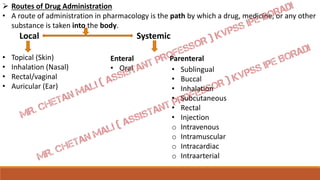
 Routes of Drug Administration
• A route of administration in pharmacology is the path by which a drug, medicine, or any other
substance is taken into the body.
Local Systemic
• Topical (Skin)
• Inhalation (Nasal)
• Rectal/vaginal
• Auricular (Ear)
Enteral Parenteral
• Oral • Sublingual
• Buccal
• Inhalation
• Subcutaneous
• Rectal
• Injection
o Intravenous
o Intramuscular
o Intracardiac
o Intraarterial
A. Local Routes-
• It is the simplest route, in which drug is applied only on a particular area or directly on a site
of action
1. Topical routes
• Drug is applied externally on the surface of skin and give localize action
Advantages
• Applied for local action
• More convenient and encouraging to patients
• Painless, safe, cheap, and useful for children
Disadvantages
• Slow action
• Some drugs may cause irritation drugs can be efficiently delivered to localized lesions on skin
in the form of lotions, ointments, creams, powders, sprays, etc.
2. Inhalation / Nasal Route
• It is also a part of systemic circulation, in which the drug is inhaled through the mouth/nose
and gives its action on a particular area.
• Some drug is absorbed into blood through blood capillaries present in mucosa/muscle,
producing rapid absorption and effects.
Example: Asthma – drugs used as bronchodilator
3. Rectal / Vaginal Route
• In this route, special types of drug preparations are injected or placed into the rectum or
vagina to give their local action on that area.
Examples: Suppositories etc.
Advantages-
• Can be given to unconscious patients.
• Ideal if the drug causes vomiting when taken orally.
Disadvantages-
• Causes irritation.
4. Auricular Ear / Eyes Route
• In this route, the drug is introduced into body cavities like ear or eye and produces a local
effect.
Examples: Ear drops, eye ointments, and sometimes suspensions.
B. Systemic Routes
• In this route, the drug administered through systemic routes means it is absorbed into the
blood stream and distributed all over the body, including the site of action.
1. Enteral Route
• In this route, the drug passes through the intestinal tract (GIT) and then reaches the blood.
• It shows first-pass metabolism.
• In this process, when a drug directly goes into the liver after absorption from the intestine
through the portal vein, it undergoes metabolism, due to which the bioavailability of the
drug decreases.
a. Oral Route
• It is the oldest and simplest method for drug administration.
• In this, drug is directly swallowed through mouth and it reaches systemic circulation by
passing GIT.
• Both solid dosage forms (powders, tablets, capsules, etc.) and liquid dosage forms (elixirs,
syrups, emulsions, etc.) can be given orally.
Advantages:
• Safe, more convenient, does not need assistance
• Painless, cheap & cost effective
• Easily available
Disadvantages:
• Slow response due to first pass metabolism
• Not suitable for emergencies
• Cannot be used for unconscious patients
2. Parenteral Route
• In this, drug reaches into bloodstream other than intestinal routes.
• It follows bypass metabolism.
• Bypass metabolism: In which drug directly reaches into blood then reaches site of action
through circulation without passing intestine & liver.
a. Sublingual Route
• Drug is kept under the tongue.
• The tablet or pellet containing the drug is placed under the tongue / carried in the mouth and
spread over the mucosa, which further absorbed into the blood.
Advantages:
• Rapid action
• It follows bypass metabolism
b. Buccal Route
• The drug is kept between the cheek and gums.
• It dissolves slowly and is absorbed into the blood through the mouth lining.
c. Inhalation
• The drug is breathed into the lungs.
• From the lungs it quickly enters the blood and gives rapid effect, especially in asthma.
INJECTIONS
d. Subcutaneous
• Drug is given under the skin by injection.(45 Degree angle)
• It is absorbed slowly and gives a long-lasting effect.
e. Rectal
• The drug is inserted into the rectum.
• It is useful when the patient is vomiting or unconscious.
f. Intravenous (IV)
• The drug is injected directly into a vein. (25 Degree angle)
• It gives immediate effect because it goes straight into the blood.
g. Intramuscular (IM)
• The drug is injected into a muscle. (90 degree angle)
• The drug is absorbed faster than subcutaneous injection.
h. Intracardiac
• The drug is injected into the heart.
• It is used only in life-saving emergency conditions.
i. Intra-arterial
• The drug is injected into an artery.
• It is used to deliver medicine directly to a specific organ.
1. Agonists
2. Antagonists (competitive and non-competitive)
3. Spare receptors
4. Addiction
5. Tolerance
6. Dependence
7. Tachyphylaxis
8. Idiosyncrasy
9. Allergy
1. Agonist
• Agonists are drugs or substances that bind to a receptor and cause the same pharmacological
action as the substance that normally binds to the receptor.
 Types of Agonists-
a. Full agonist: High efficacy, produces full response.
b. Partial agonist: Lower efficacy, produces less response.
c. Inverse agonist: Produces opposite response.
Examples- Heroin, methadone, morphine (all are full agonists, etc.).
2. Antagonists
• These are those drugs/substances which have similar structure like agonist and bind with
receptor but they do not give any pharmacological action. Instead, they block the receptor
and inhibit the agonist/natural substance to bind with receptor.
It is of two types:
a. Competitive antagonist
b. Non-competitive antagonist
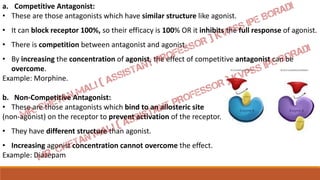
a. Competitive Antagonist:
• These are those antagonists which have similar structure like agonist.
• It can block receptor 100%, so their efficacy is 100% OR it inhibits the full response of agonist.
• There is competition between antagonist and agonist.
• By increasing the concentration of agonist, the effect of competitive antagonist can be
overcome.
Example: Morphine.
b. Non-Competitive Antagonist:
• These are those antagonists which bind to an allosteric site
(non-agonist) on the receptor to prevent activation of the receptor.
• They have different structure than agonist.
• Increasing agonist concentration cannot overcome the effect.
Example: Diazepam
3. Spare Receptors
• Spare receptors are those receptors which are not occupied by drug molecules to produce
100% response.
• Even if only a small percentage of receptors are occupied by a drug, maximum response can
be produced.
• Increasing drug concentration increases receptor occupancy but not the maximum response.
Example: β1 receptors of the heart – only about 90% occupancy may be required for maximum
effect. Increasing drug concentration further may increase side effects (e.g., heart failure).
Occupied 100% receptors give more pharmacological action.
4. Addiction
• When a drug or substance is taken for a long duration, it may show consumption response in
the body.
• It is a psychological and physical inability to stop consuming a drug, even when the drug
causes harm.
• A strong habit of using a drug again and again. It is considered a brain disorder.
Examples: Heroin, cocaine, alcohol, etc.
5. Tolerance
• Tolerance is the diminished effect (reduced response) of a drug when it is given repeatedly
for a long duration at the same dose.
• It occurs when a person no longer responds to a drug in the same way as they did initially.
• A higher dose of the drug is required to produce the same effect as before.
• This may increase the risk of adverse effects
6. Dependence
• When a person takes any drug or substance for a long duration for any reason or cure, then
the body becomes dependent on that drug and behaves normally only with that drug. If the
body does not receive that drug, it may cause unusual effects such as headache, nausea,
discomfort, etc.
• When the body cannot work normally without the drug.
Example: Excess use of Analgesic Drugs Analgesic drugs are used to relieve pain (painkillers).
7. Tachyphylaxis
• It is defined as a rapid decrease in the response of a drug upon repeated administration of
the same dose in short intervals. It is also known as acute tolerance.
• When a drug suddenly stops working after repeated use in a short time.
• Examples: Ephedrine, Nicotine, etc.
8. Idiosyncrasy
• This are unusual or unexpected reaction of any drug which occur in some individual (or a
particular person) These effects are known as idiosyncratic effects.
• An unusual reaction to a drug in some people.
Example: Barbiturates (CNS depressants) may cause mental confusion or excitement in some
people.
9. Allergy (Drug Allergy)
• Some drugs or substances cause unwanted side effects or adverse effects to the body. These
reactions are known as drug allergies.
• An allergic drug reaction is an abnormal reaction of the immune system to a medication or
drug.
• The most common forms of allergic reactions are skin reactions such as rashes, itching, etc.
Examples: Ibuprofen, Aspirin, etc.
PHARMACOKINETICS
• Pharmacokinetics is the quantitative study of drug movement in, through and out of the
body.
• What does the body do to the drug
Pharmacokinetics involves four processes collectively known as ADME
i) Absorption
ii) Distribution
iii) Metabolism
iv) Excretion
A) Absorption
• Absorption is defined as the movement of drug molecules from the site of administration to
the systemic circulation.
• It is the first and most important step of pharmacokinetics.
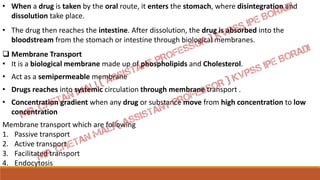
• When a drug is taken by the oral route, it enters the stomach, where disintegration and
dissolution take place.
• The drug then reaches the intestine. After dissolution, the drug is absorbed into the
bloodstream from the stomach or intestine through biological membranes.
 Membrane Transport
• It is a biological membrane made up of phospholipids and Cholesterol.
• Act as a semipermeable membrane
• Drugs reaches into systemic circulation through membrane transport .
• Concentration gradient when any drug or substance move from high concentration to low
concentration
Membrane transport which are following
1. Passive transport
2. Active transport
3. Facilitated transport
4. Endocytosis
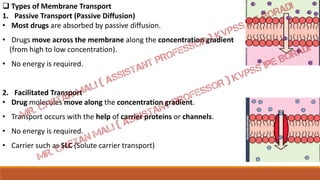
 Types of Membrane Transport
1. Passive Transport (Passive Diffusion)
• Most drugs are absorbed by passive diffusion.
• Drugs move across the membrane along the concentration gradient
(from high to low concentration).
• No energy is required.
2. Facilitated Transport
• Drug molecules move along the concentration gradient.
• Transport occurs with the help of carrier proteins or channels.
• No energy is required.
• Carrier such as SLC (Solute carrier transport)
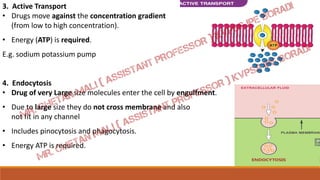
3. Active Transport
• Drugs move against the concentration gradient
(from low to high concentration).
• Energy (ATP) is required.
E.g. sodium potassium pump
4. Endocytosis
• Drug of very Large size molecules enter the cell by engulfment.
• Due to large size they do not cross membrane and also
not fit in any channel
• Includes pinocytosis and phagocytosis.
• Energy ATP is required.
 Factors Affecting Drug Absorption
1. Physicochemical Properties
• Particle size
• Formulation (dosage form)
• Ionization
• PH
• Concentration Gradient
2. Biological Factors
• Surface area
• Membrane transport
• Gastric emptying time
• Blood flow (circulation)
• Food
3. Routes of Administration
• Bioavailability
• First-pass metabolism
1. Physicochemical Properties
a. Particle size
• It is inversely proportional to the absorption
• The smaller particle size the greater will be its absorption because small size drug dissolve
easily
b. Formulation (dosage form)
• In solid, liquid, Parenteral (Injection)
• Medications administered parentally are absorbed more quickly compared to oral
c. PH
• It tells about the nature of the drug (acidic/basic).
• Acidic drugs are mostly absorbed in the stomach (e.g., aspirin).
• Basic drugs are mostly absorbed in the intestine.
d. Lipid Solubility
• Lipophilic drugs are absorbed more readily than hydrophilic drugs.
• Lipid-soluble drugs can cross biological membranes easily.
e. Concentration Gradient
• Passive diffusion follows the concentration gradient.
• Higher concentration of drug leads to greater absorption
f. Ionization
• Both form are important for pharmacological response of drugs but for absorption drug must
be in unionized form.
2 Biological Factors
a. Surface Area
• Absorption is directly proportional to the surface area.
• Greater surface area leads to increased absorption.
b. Membrane Transport
• Most drugs are absorbed by passive diffusion.
• It does not require energy and follows concentration gradient.
c. Gastric Emptying Time
• Drugs with faster gastric emptying show faster absorption.
• If gastric emptying is too fast, absorption may be incomplete.
• Optimum gastric emptying time is required for proper absorption.
d. Blood Flow (Circulation)
• Absorption is directly proportional to blood flow.
• Greater blood flow results in greater absorption of drug.
e. Food
• Effect of Food on Drug Absorption Food can affect the absorption of drugs.
• If food is present in the stomach, it may delay drug absorption.
• Therefore, some medicines are advised to be taken after a certain time gap from meals.
3. Route of Administration
• The route of administration affects drug absorption because each route has its own
characteristics.
a. Bioavailability
• Bioavailability is the actual amount of drug that reaches the systemic circulation.
• Parenteral routes have maximum bioavailability because the drug reaches systemic
circulation directly.
• Oral Route has lower bioavailability and absorption because the drug undergoes first-pass
metabolism through the liver, which decreases absorption
b. First-Pass Metabolism
• Oral drug → GIT → Liver → Vein → Heart → Systemic circulation due to liver metabolism, the
concentration of drug decreases.
B) Distribution
• After absorption, the drug reaches the systemic circulation (blood).
• Drug distribution is the movement of drug from systemic circulation to interstitial fluid
(extracellular fluid) and various other parts of the body.
• It is a passive diffusion process (High concentration → Low concentration).
• Drugs distribute non-uniformly throughout the body.
• It is a reversible process.
 Factors Affecting Drug Distribution
1. Blood flow
2. Lipophilicity
3. Capillary permeability
4. Plasma protein binding
5. Some other factors
1. Blood Flow
• Where there is more blood flow, there will be more drug distribution.
High blood flow organs:
• Brain
• Heart
• Kidney
• Liver
2. Lipophilicity
• Drugs that are lipid soluble cross membranes easily.
• Greater lipid solubility increases the distribution of drugs.
• Because the membrane is lipophilic, lipophilic drugs cross more easily.
• Increased Lipophilicity → increased distribution.
Low blood flow tissues:
• Skeletal muscle
• Adipose tissue
• Skin
3. Capillary Permeability
• The higher the permeability of capillaries, the greater the distribution of drugs.
• Distribution of drugs depends upon capillary permeability.
It is depends upon
Barriers (Physiological Barriers)
a) Blood–Brain Barrier (BBB)
• Capillary endothelial cells in the brain have tight junctions.
• There is lack of intercellular space and investment of neural tissue covers the capillaries.
• Only lipid soluble drugs can easily cross the BBB.
b) Blood–CSF Barrier (BCSFB) cerebral spinal fluid
• Blood–CSF barrier is similar to the BBB.
• It restricts hydrophilic drugs and allows lipophilic drugs.
• Hence, only lipid soluble drugs are distributed.
c) Blood–Placenta Barrier (BPB)
• Seen during pregnancy.
• It protects the fetus from drugs and toxins.
• It is lipid in nature, Lipophilic drugs can cross easily, while hydrophilic drugs are restricted.
4. Plasma Protein Binding
When drugs reach systemic circulation, they exist in two forms:
a) Free drug
• Has good distribution
b) Bound drug (drug bound with plasma protein)
• Most drugs bind with albumin, Acidic drugs generally bind to albumin.
• Has less distribution because of increased size, Cannot cross membranes easily Has poor
distribution.
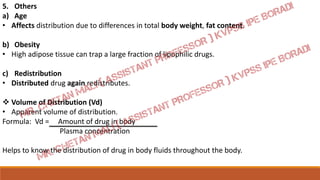
5. Others
a) Age
• Affects distribution due to differences in total body weight, fat content.
b) Obesity
• High adipose tissue can trap a large fraction of lipophilic drugs.
c) Redistribution
• Distributed drug again redistributes.
 Volume of Distribution (Vd)
• Apparent volume of distribution.
Formula: Vd = Amount of drug in body
Plasma concentration
Helps to know the distribution of drug in body fluids throughout the body.
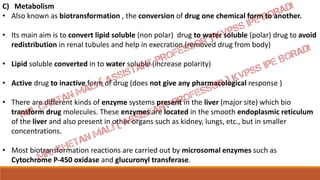
C) Metabolism
• Also known as biotransformation , the conversion of drug one chemical form to another.
• Its main aim is to convert lipid soluble (non polar) drug to water soluble (polar) drug to avoid
redistribution in renal tubules and help in execration (removed drug from body)
• Lipid soluble converted in to water soluble (increase polarity)
• Active drug to inactive form of drug (does not give any pharmacological response )
• There are different kinds of enzyme systems present in the liver (major site) which bio
transform drug molecules. These enzymes are located in the smooth endoplasmic reticulum
of the liver and also present in other organs such as kidney, lungs, etc., but in smaller
concentrations.
• Most biotransformation reactions are carried out by microsomal enzymes such as
Cytochrome P-450 oxidase and glucuronyl transferase.
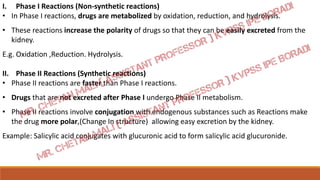
I. Phase I Reactions (Non-synthetic reactions)
• In Phase I reactions, drugs are metabolized by oxidation, reduction, and hydrolysis.
• These reactions increase the polarity of drugs so that they can be easily excreted from the
kidney.
E.g. Oxidation ,Reduction. Hydrolysis.
II. Phase II Reactions (Synthetic reactions)
• Phase II reactions are faster than Phase I reactions.
• Drugs that are not excreted after Phase I undergo Phase II metabolism.
• Phase II reactions involve conjugation with endogenous substances such as Reactions make
the drug more polar,(Change In structure) allowing easy excretion by the kidney.
Example: Salicylic acid conjugates with glucuronic acid to form salicylic acid glucuronide.
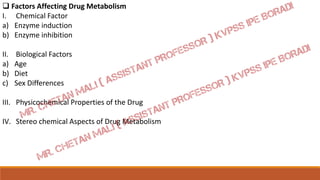
 Factors Affecting Drug Metabolism
I. Chemical Factor
a) Enzyme induction
b) Enzyme inhibition
II. Biological Factors
a) Age
b) Diet
c) Sex Differences
III. Physicochemical Properties of the Drug
IV. Stereo chemical Aspects of Drug Metabolism
I. Chemical Factor
a) Enzyme induction
• Enzyme induction is the phenomenon of increased drug metabolizing ability of enzymes by
several drugs and chemicals known as enzyme inducers.
b) Enzyme inhibition
• A decrease in drug metabolizing ability of an enzyme is called enzyme inhibition.
• Direct interaction at the enzyme site and change in enzyme activity
• Indirectly due to fall in rate of enzyme synthesis (repression) or due to nutritional deficiency
or hormonal imbalance (altered physiology).
II. Biological Factors
a) Age
• The drug metabolic rate differs in different age groups
• Neonates (up to 4 months) and premature infants (up to 1 year): metabolism is slow due to
less development of microsomal enzymes.
• Children (1–12 years): metabolism is rapid as compared to adults.
• Elderly persons: metabolism is slow.
b) Diet
• The enzyme content and activity are altered (affected) by dietary components.
E.g. Low protein diet → slowly metabolized drugs.
High protein diet → rapid metabolism.
• Because Protein-rich diet increases enzyme synthesis.
c) Sex Differences
• Sex differences also affect drug metabolism.
E.g. Benzodiazepines are metabolized slowly in women than men. Men metabolize drugs more
rapidly than women.
• There are also some factor which affect metabolism such as pregnancy, disease, hormonal
imbalance
III. Physicochemical Properties of the Drug
• Physicochemical properties such as pKa, solubility, polarity, size, and shape of the drug may
affect drug metabolism by influencing interaction with the active sites of enzymes.
IV. Stereo chemical Aspects of Drug Metabolism
• Stereo chemical aspects also affect drug metabolism because some metabolizing enzymes
often display preference for one enantiomer of a drug over the other
E.g. D(+) glucose is easily metabolized whereas L(−) glucose is not metabolized.
D. Elimination
• Excretion of drugs is the removal of systemically absorbed drug from the body. It is the last
step of pharmacokinetics.
 Routes of Elimination
1. Urine (Renal Excretion)
• Most drugs are excreted through the kidney by the process of urination.
• Water-soluble (hydrophilic) drugs are excreted easily through urine.
2. Faeces (Biliary Excretion)
• Some of the highly lipophilic drug in liver is absorbed into bile juice (which is secreted by
liver).
• These drugs are further excreted through faeces.
3. Lungs (Expired Air)
• Mostly lipid-soluble (lipophilic) drugs are excreted through lungs.
• Some drugs in the form of gases and volatile liquids are eliminated through exhalation by
lungs.
Examples: General anesthetics, alcohol.
4. Sweat and Saliva
• Some amount of drug is excreted in the form of sweat from skin.
• Some drugs are excreted through sputum which mixes with saliva, but most drugs mixed with
saliva go into oral route and are swallowed.
Examples: Lithium, heavy metals..
5. Milk
• In pregnant mothers, some drugs enter breast milk by passive diffusion.
• These drugs are excreted through mother’s milk.
 Kinetics of Elimination
 Clearance
• Clearance of a drug is defined as the theoretical volume of plasma from which the drug is
completely removed per unit time.
Formula: Cl = Rate of elimination
Plasma concentration
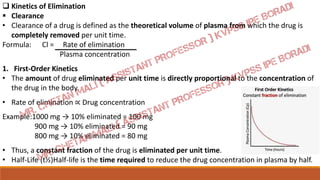
1. First-Order Kinetics
• The amount of drug eliminated per unit time is directly proportional to the concentration of
the drug in the body.
• Rate of elimination ∝ Drug concentration
Example:1000 mg → 10% eliminated = 100 mg
900 mg → 10% eliminated = 90 mg
800 mg → 10% eliminated = 80 mg
• Thus, a constant fraction of the drug is eliminated per unit time.
• Half-Life (t½)Half-life is the time required to reduce the drug concentration in plasma by half.
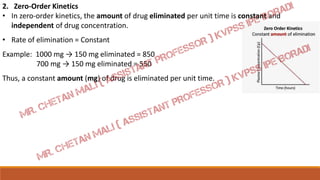
2. Zero-Order Kinetics
• In zero-order kinetics, the amount of drug eliminated per unit time is constant and
independent of drug concentration.
• Rate of elimination = Constant
Example: 1000 mg → 150 mg eliminated = 850
700 mg → 150 mg eliminated = 550
Thus, a constant amount (mg) of drug is eliminated per unit time.

PHARMACOLOGY 1 ( BP 404 T) Unit 1 (Cology 1)

  • 2.
     Introduction toPharmacology  Pharmacology: Study of drugs. Pharmacon = Drug/Medicine Logos = To study • Pharmacology is the branch of science which deals with the study of pharmacodynamics and pharmacokinetics. • It is the study of drugs, their effects on the body, and the body’s response to drugs.  Pharmacodynamics- Branch of pharmacology concerned with the effects of drugs and mechanism of action. What the drug does to the body.  Pharmacokinetics- Branch of pharmacology concerned with the movement of drugs within the body. What the body does to the drug. • ADME: A – Absorption, D – Distribution, M – Metabolism, E – Elimination.
  • 3.
     Definitions 1. Pharmacology:Pharmacology is the branch of science which deals with the study of drugs in living being. 2. Clinical Pharmacology: Clinical pharmacology is the study of drugs with their clinical uses. 3. Drug: A drug is a medicine or other substance which gives therapeutic effect when ingested into the body. 4. Pharmacokinetics: Pharmacokinetics is the branch of pharmacology concerned with the movement of drug in the body or study of ADME. 5. Pharmacodynamics: Pharmacodynamics is the branch of pharmacology concerned with the effect of drug on the body. (What the drug does to the body) 6. Toxicology: Toxicology is the branch of science concerned with the study of poisons, toxic substances and their antidotes or treatment.
  • 4.
    7. Chemotherapy: Chemotherapyis the branch in which we study the use of chemical drugs for the treatment of disease. 8. Adverse Drug Reaction: In pharmacology, any unexpected or dangerous reaction to a drug is known as an adverse drug reaction. 9. Bioavailability: it is the actual amount of drug that is administered into systemic circulation.
  • 5.
     Historical Landmarks •The knowledge of drugs and their uses for diseases is as old as the history of mankind. • Primitive man (ancient) gathered knowledge of healing and medicines by observing nature, noticing animals while ill and personal experiences after consuming plants and herbs as remedies. • They discovered that extracts from plants, animals, and minerals had medicinal effects on body tissues. Landmarks  Hippocrates (460–375 BC) – Greek physician, considered the 'Father of Medicine'. • First person to recognize disease as an abnormal reaction of the body. • Introduced the use of metallic salts for the treatment of disease.
  • 6.
     Paracelsus (1493–1541)– Grandfather of pharmacology. • Introduced the use of chemicals for the treatment of disease.  Oswald Schmiedeberg (1838–1921) – Father of Pharmacology. • Established pharmacology as an independent discipline. • Estimation of chloroform in blood.  John Jacob Abel (1857–1938). • Isolation of histamine from pituitary (causes allergic response, vasodilation, etc.). • Preparation of pure crystalline insulin.
  • 7.
     Paul Ehrlich(1854–1915). • Nobel Prize winner, Father of Chemotherapy. • Found a cure for syphilis in 1909 (used arsenical for syphilis).  Alexander Fleming (1881–1955): • Scottish physician who discovered the world’s first broad-spectrum antibiotic, Penicillin.  RamNath Chopra (1882–1973): • Known as the father of Indian Pharmacology. • He was an Indian Medical Service (IMS) officer. • Systematic study of Indian medicinal plant.
  • 8.
     Scope ofPharmacology • Study of drugs and their actions. • Study about disease or disorder which comes under pathophysiology. • Study of pharmacodynamics • Study of pharmacokinetics • At present time there are many scopes in pharmacology such as research, industries and academics. • Study of toxicology – toxic substances, their antidotes and prevention/treatment. • Study of forensic science (investigating). • Drug discovery and drug development. • New drugs undergo clinical trials according to their phases.
  • 9.
     Nature andSources of Drugs 1. Nature of Drugs • All drugs are chemical entities with simple or complex molecules. • Inorganic drugs: Some drugs are of inorganic nature. Examples: Ferrous sulphate, lithium carbonate, etc. • Organic drugs: Majority of drugs are organic compounds. • They may be: - Weakly acidic (aspirin, penicillin) - Weakly basic (morphine) - Non-electrolytes (alcohols, etc.) • Mostly drugs are normally solids, e.g. Paracetamol, ampicillin, etc., but some such as ethanol, glycerol are liquids, and few like nitrous oxide are gases. • The molecular weight of majority of drugs is in the range of 100–1000 D.
  • 10.
    2. According toTheir Action i) Preventive: These drugs are used to prevent the cause of disease. ii) Symptomatic: These drugs are used to treat the symptoms of a disease. iii) Diagnostic: These drugs help to determine the presence or cause of a disease. iv) Curative: These drugs are used in the treatment of any disease. v) Health Maintenance Drugs: These drugs help to maintain our health
  • 11.
     Sources ofDrugs 1. Plants: • Many plants contain biologically active substances and are the oldest sources of drugs. Examples:- Tulsi: Used for cough treatment and cold remedies. Neem: Has antimicrobial activity. 2. Animals: • Though animal parts have been used as crude drugs since early times. Used for making vaccines (blood). Used for insulin for control of diabetes. Examples:- Thyroxin- Insulin- Liver extracts (Vitamin B12) 3. Microbes: • Most antibiotics are obtained from fungi and bacteria. Examples:- Penicillin- Tetracycline Some vaccines are also produced by the use of microbes.
  • 12.
    4. Minerals: • Thereare many minerals which are used as medicinal substances. Examples:- Iron (for anemia) Zinc (for wound healing) Iodine (antiseptic) Silver (immunity booster) 5. Synthetic: • It is the largest source of modern medicines. Advantages:- High purity and uniformity of the product. Manufactured as per need 6. Biotechnology: • In this method, biological organisms are combined with technology to produce drugs.
  • 13.
     Essential Drugsconcept • World Health Organization (WHO) introduced the concept of Essential Medicines in 1977. Initially, the list included 208 medicines. • The WHO updates the Essential Medicines List every two years • Definition: Essential medicines are those drugs that satisfy the priority health care needs of the population. Criteria for Selection: • Public health relevance • Clinical evidence on efficacy and safety • Comparative cost-effectiveness • Availability at all times in adequate amounts • Appropriate dosage forms • Assured quality and adequate information
  • 14.
    • India proposedits first National List of Essential Medicines (NLEM) in 1996. • It was revised in 2011 and again in April 2015.The NLEM includes 376 medicines. • It can differ from country to country due to changes in their environment. • Common Drugs Used for Pain Management E.g. Acetylsalicylic acid (Aspirin) Paracetamol Ibuprofen Morphine etc.
  • 15.
     Routes ofDrug Administration • A route of administration in pharmacology is the path by which a drug, medicine, or any other substance is taken into the body. Local Systemic • Topical (Skin) • Inhalation (Nasal) • Rectal/vaginal • Auricular (Ear) Enteral Parenteral • Oral • Sublingual • Buccal • Inhalation • Subcutaneous • Rectal • Injection o Intravenous o Intramuscular o Intracardiac o Intraarterial
  • 16.
    A. Local Routes- •It is the simplest route, in which drug is applied only on a particular area or directly on a site of action 1. Topical routes • Drug is applied externally on the surface of skin and give localize action Advantages • Applied for local action • More convenient and encouraging to patients • Painless, safe, cheap, and useful for children Disadvantages • Slow action • Some drugs may cause irritation drugs can be efficiently delivered to localized lesions on skin in the form of lotions, ointments, creams, powders, sprays, etc.
  • 17.
    2. Inhalation /Nasal Route • It is also a part of systemic circulation, in which the drug is inhaled through the mouth/nose and gives its action on a particular area. • Some drug is absorbed into blood through blood capillaries present in mucosa/muscle, producing rapid absorption and effects. Example: Asthma – drugs used as bronchodilator 3. Rectal / Vaginal Route • In this route, special types of drug preparations are injected or placed into the rectum or vagina to give their local action on that area. Examples: Suppositories etc. Advantages- • Can be given to unconscious patients. • Ideal if the drug causes vomiting when taken orally. Disadvantages- • Causes irritation.
  • 18.
    4. Auricular Ear/ Eyes Route • In this route, the drug is introduced into body cavities like ear or eye and produces a local effect. Examples: Ear drops, eye ointments, and sometimes suspensions. B. Systemic Routes • In this route, the drug administered through systemic routes means it is absorbed into the blood stream and distributed all over the body, including the site of action. 1. Enteral Route • In this route, the drug passes through the intestinal tract (GIT) and then reaches the blood. • It shows first-pass metabolism. • In this process, when a drug directly goes into the liver after absorption from the intestine through the portal vein, it undergoes metabolism, due to which the bioavailability of the drug decreases.
  • 19.
    a. Oral Route •It is the oldest and simplest method for drug administration. • In this, drug is directly swallowed through mouth and it reaches systemic circulation by passing GIT. • Both solid dosage forms (powders, tablets, capsules, etc.) and liquid dosage forms (elixirs, syrups, emulsions, etc.) can be given orally. Advantages: • Safe, more convenient, does not need assistance • Painless, cheap & cost effective • Easily available Disadvantages: • Slow response due to first pass metabolism • Not suitable for emergencies • Cannot be used for unconscious patients
  • 20.
    2. Parenteral Route •In this, drug reaches into bloodstream other than intestinal routes. • It follows bypass metabolism. • Bypass metabolism: In which drug directly reaches into blood then reaches site of action through circulation without passing intestine & liver. a. Sublingual Route • Drug is kept under the tongue. • The tablet or pellet containing the drug is placed under the tongue / carried in the mouth and spread over the mucosa, which further absorbed into the blood. Advantages: • Rapid action • It follows bypass metabolism
  • 21.
    b. Buccal Route •The drug is kept between the cheek and gums. • It dissolves slowly and is absorbed into the blood through the mouth lining. c. Inhalation • The drug is breathed into the lungs. • From the lungs it quickly enters the blood and gives rapid effect, especially in asthma. INJECTIONS d. Subcutaneous • Drug is given under the skin by injection.(45 Degree angle) • It is absorbed slowly and gives a long-lasting effect. e. Rectal • The drug is inserted into the rectum. • It is useful when the patient is vomiting or unconscious.
  • 22.
    f. Intravenous (IV) •The drug is injected directly into a vein. (25 Degree angle) • It gives immediate effect because it goes straight into the blood. g. Intramuscular (IM) • The drug is injected into a muscle. (90 degree angle) • The drug is absorbed faster than subcutaneous injection. h. Intracardiac • The drug is injected into the heart. • It is used only in life-saving emergency conditions. i. Intra-arterial • The drug is injected into an artery. • It is used to deliver medicine directly to a specific organ.
  • 23.
    1. Agonists 2. Antagonists(competitive and non-competitive) 3. Spare receptors 4. Addiction 5. Tolerance 6. Dependence 7. Tachyphylaxis 8. Idiosyncrasy 9. Allergy 1. Agonist • Agonists are drugs or substances that bind to a receptor and cause the same pharmacological action as the substance that normally binds to the receptor.
  • 24.
     Types ofAgonists- a. Full agonist: High efficacy, produces full response. b. Partial agonist: Lower efficacy, produces less response. c. Inverse agonist: Produces opposite response. Examples- Heroin, methadone, morphine (all are full agonists, etc.). 2. Antagonists • These are those drugs/substances which have similar structure like agonist and bind with receptor but they do not give any pharmacological action. Instead, they block the receptor and inhibit the agonist/natural substance to bind with receptor. It is of two types: a. Competitive antagonist b. Non-competitive antagonist
  • 25.
    a. Competitive Antagonist: •These are those antagonists which have similar structure like agonist. • It can block receptor 100%, so their efficacy is 100% OR it inhibits the full response of agonist. • There is competition between antagonist and agonist. • By increasing the concentration of agonist, the effect of competitive antagonist can be overcome. Example: Morphine. b. Non-Competitive Antagonist: • These are those antagonists which bind to an allosteric site (non-agonist) on the receptor to prevent activation of the receptor. • They have different structure than agonist. • Increasing agonist concentration cannot overcome the effect. Example: Diazepam
  • 26.
    3. Spare Receptors •Spare receptors are those receptors which are not occupied by drug molecules to produce 100% response. • Even if only a small percentage of receptors are occupied by a drug, maximum response can be produced. • Increasing drug concentration increases receptor occupancy but not the maximum response. Example: β1 receptors of the heart – only about 90% occupancy may be required for maximum effect. Increasing drug concentration further may increase side effects (e.g., heart failure). Occupied 100% receptors give more pharmacological action.
  • 27.
    4. Addiction • Whena drug or substance is taken for a long duration, it may show consumption response in the body. • It is a psychological and physical inability to stop consuming a drug, even when the drug causes harm. • A strong habit of using a drug again and again. It is considered a brain disorder. Examples: Heroin, cocaine, alcohol, etc. 5. Tolerance • Tolerance is the diminished effect (reduced response) of a drug when it is given repeatedly for a long duration at the same dose. • It occurs when a person no longer responds to a drug in the same way as they did initially. • A higher dose of the drug is required to produce the same effect as before. • This may increase the risk of adverse effects
  • 28.
    6. Dependence • Whena person takes any drug or substance for a long duration for any reason or cure, then the body becomes dependent on that drug and behaves normally only with that drug. If the body does not receive that drug, it may cause unusual effects such as headache, nausea, discomfort, etc. • When the body cannot work normally without the drug. Example: Excess use of Analgesic Drugs Analgesic drugs are used to relieve pain (painkillers). 7. Tachyphylaxis • It is defined as a rapid decrease in the response of a drug upon repeated administration of the same dose in short intervals. It is also known as acute tolerance. • When a drug suddenly stops working after repeated use in a short time. • Examples: Ephedrine, Nicotine, etc.
  • 29.
    8. Idiosyncrasy • Thisare unusual or unexpected reaction of any drug which occur in some individual (or a particular person) These effects are known as idiosyncratic effects. • An unusual reaction to a drug in some people. Example: Barbiturates (CNS depressants) may cause mental confusion or excitement in some people. 9. Allergy (Drug Allergy) • Some drugs or substances cause unwanted side effects or adverse effects to the body. These reactions are known as drug allergies. • An allergic drug reaction is an abnormal reaction of the immune system to a medication or drug. • The most common forms of allergic reactions are skin reactions such as rashes, itching, etc. Examples: Ibuprofen, Aspirin, etc.
  • 30.
    PHARMACOKINETICS • Pharmacokinetics isthe quantitative study of drug movement in, through and out of the body. • What does the body do to the drug Pharmacokinetics involves four processes collectively known as ADME i) Absorption ii) Distribution iii) Metabolism iv) Excretion A) Absorption • Absorption is defined as the movement of drug molecules from the site of administration to the systemic circulation. • It is the first and most important step of pharmacokinetics.
  • 31.
    • When adrug is taken by the oral route, it enters the stomach, where disintegration and dissolution take place. • The drug then reaches the intestine. After dissolution, the drug is absorbed into the bloodstream from the stomach or intestine through biological membranes.  Membrane Transport • It is a biological membrane made up of phospholipids and Cholesterol. • Act as a semipermeable membrane • Drugs reaches into systemic circulation through membrane transport . • Concentration gradient when any drug or substance move from high concentration to low concentration Membrane transport which are following 1. Passive transport 2. Active transport 3. Facilitated transport 4. Endocytosis
  • 32.
     Types ofMembrane Transport 1. Passive Transport (Passive Diffusion) • Most drugs are absorbed by passive diffusion. • Drugs move across the membrane along the concentration gradient (from high to low concentration). • No energy is required. 2. Facilitated Transport • Drug molecules move along the concentration gradient. • Transport occurs with the help of carrier proteins or channels. • No energy is required. • Carrier such as SLC (Solute carrier transport)
  • 33.
    3. Active Transport •Drugs move against the concentration gradient (from low to high concentration). • Energy (ATP) is required. E.g. sodium potassium pump 4. Endocytosis • Drug of very Large size molecules enter the cell by engulfment. • Due to large size they do not cross membrane and also not fit in any channel • Includes pinocytosis and phagocytosis. • Energy ATP is required.
  • 34.
     Factors AffectingDrug Absorption 1. Physicochemical Properties • Particle size • Formulation (dosage form) • Ionization • PH • Concentration Gradient 2. Biological Factors • Surface area • Membrane transport • Gastric emptying time • Blood flow (circulation) • Food 3. Routes of Administration • Bioavailability • First-pass metabolism
  • 35.
    1. Physicochemical Properties a.Particle size • It is inversely proportional to the absorption • The smaller particle size the greater will be its absorption because small size drug dissolve easily b. Formulation (dosage form) • In solid, liquid, Parenteral (Injection) • Medications administered parentally are absorbed more quickly compared to oral c. PH • It tells about the nature of the drug (acidic/basic). • Acidic drugs are mostly absorbed in the stomach (e.g., aspirin). • Basic drugs are mostly absorbed in the intestine. d. Lipid Solubility • Lipophilic drugs are absorbed more readily than hydrophilic drugs. • Lipid-soluble drugs can cross biological membranes easily.
  • 36.
    e. Concentration Gradient •Passive diffusion follows the concentration gradient. • Higher concentration of drug leads to greater absorption f. Ionization • Both form are important for pharmacological response of drugs but for absorption drug must be in unionized form. 2 Biological Factors a. Surface Area • Absorption is directly proportional to the surface area. • Greater surface area leads to increased absorption. b. Membrane Transport • Most drugs are absorbed by passive diffusion. • It does not require energy and follows concentration gradient.
  • 37.
    c. Gastric EmptyingTime • Drugs with faster gastric emptying show faster absorption. • If gastric emptying is too fast, absorption may be incomplete. • Optimum gastric emptying time is required for proper absorption. d. Blood Flow (Circulation) • Absorption is directly proportional to blood flow. • Greater blood flow results in greater absorption of drug. e. Food • Effect of Food on Drug Absorption Food can affect the absorption of drugs. • If food is present in the stomach, it may delay drug absorption. • Therefore, some medicines are advised to be taken after a certain time gap from meals.
  • 38.
    3. Route ofAdministration • The route of administration affects drug absorption because each route has its own characteristics. a. Bioavailability • Bioavailability is the actual amount of drug that reaches the systemic circulation. • Parenteral routes have maximum bioavailability because the drug reaches systemic circulation directly. • Oral Route has lower bioavailability and absorption because the drug undergoes first-pass metabolism through the liver, which decreases absorption b. First-Pass Metabolism • Oral drug → GIT → Liver → Vein → Heart → Systemic circulation due to liver metabolism, the concentration of drug decreases.
  • 39.
    B) Distribution • Afterabsorption, the drug reaches the systemic circulation (blood). • Drug distribution is the movement of drug from systemic circulation to interstitial fluid (extracellular fluid) and various other parts of the body. • It is a passive diffusion process (High concentration → Low concentration). • Drugs distribute non-uniformly throughout the body. • It is a reversible process.  Factors Affecting Drug Distribution 1. Blood flow 2. Lipophilicity 3. Capillary permeability 4. Plasma protein binding 5. Some other factors
  • 40.
    1. Blood Flow •Where there is more blood flow, there will be more drug distribution. High blood flow organs: • Brain • Heart • Kidney • Liver 2. Lipophilicity • Drugs that are lipid soluble cross membranes easily. • Greater lipid solubility increases the distribution of drugs. • Because the membrane is lipophilic, lipophilic drugs cross more easily. • Increased Lipophilicity → increased distribution. Low blood flow tissues: • Skeletal muscle • Adipose tissue • Skin
  • 41.
    3. Capillary Permeability •The higher the permeability of capillaries, the greater the distribution of drugs. • Distribution of drugs depends upon capillary permeability. It is depends upon Barriers (Physiological Barriers) a) Blood–Brain Barrier (BBB) • Capillary endothelial cells in the brain have tight junctions. • There is lack of intercellular space and investment of neural tissue covers the capillaries. • Only lipid soluble drugs can easily cross the BBB. b) Blood–CSF Barrier (BCSFB) cerebral spinal fluid • Blood–CSF barrier is similar to the BBB. • It restricts hydrophilic drugs and allows lipophilic drugs. • Hence, only lipid soluble drugs are distributed.
  • 42.
    c) Blood–Placenta Barrier(BPB) • Seen during pregnancy. • It protects the fetus from drugs and toxins. • It is lipid in nature, Lipophilic drugs can cross easily, while hydrophilic drugs are restricted. 4. Plasma Protein Binding When drugs reach systemic circulation, they exist in two forms: a) Free drug • Has good distribution b) Bound drug (drug bound with plasma protein) • Most drugs bind with albumin, Acidic drugs generally bind to albumin. • Has less distribution because of increased size, Cannot cross membranes easily Has poor distribution.
  • 43.
    5. Others a) Age •Affects distribution due to differences in total body weight, fat content. b) Obesity • High adipose tissue can trap a large fraction of lipophilic drugs. c) Redistribution • Distributed drug again redistributes.  Volume of Distribution (Vd) • Apparent volume of distribution. Formula: Vd = Amount of drug in body Plasma concentration Helps to know the distribution of drug in body fluids throughout the body.
  • 44.
    C) Metabolism • Alsoknown as biotransformation , the conversion of drug one chemical form to another. • Its main aim is to convert lipid soluble (non polar) drug to water soluble (polar) drug to avoid redistribution in renal tubules and help in execration (removed drug from body) • Lipid soluble converted in to water soluble (increase polarity) • Active drug to inactive form of drug (does not give any pharmacological response ) • There are different kinds of enzyme systems present in the liver (major site) which bio transform drug molecules. These enzymes are located in the smooth endoplasmic reticulum of the liver and also present in other organs such as kidney, lungs, etc., but in smaller concentrations. • Most biotransformation reactions are carried out by microsomal enzymes such as Cytochrome P-450 oxidase and glucuronyl transferase.
  • 45.
    I. Phase IReactions (Non-synthetic reactions) • In Phase I reactions, drugs are metabolized by oxidation, reduction, and hydrolysis. • These reactions increase the polarity of drugs so that they can be easily excreted from the kidney. E.g. Oxidation ,Reduction. Hydrolysis. II. Phase II Reactions (Synthetic reactions) • Phase II reactions are faster than Phase I reactions. • Drugs that are not excreted after Phase I undergo Phase II metabolism. • Phase II reactions involve conjugation with endogenous substances such as Reactions make the drug more polar,(Change In structure) allowing easy excretion by the kidney. Example: Salicylic acid conjugates with glucuronic acid to form salicylic acid glucuronide.
  • 46.
     Factors AffectingDrug Metabolism I. Chemical Factor a) Enzyme induction b) Enzyme inhibition II. Biological Factors a) Age b) Diet c) Sex Differences III. Physicochemical Properties of the Drug IV. Stereo chemical Aspects of Drug Metabolism
  • 47.
    I. Chemical Factor a)Enzyme induction • Enzyme induction is the phenomenon of increased drug metabolizing ability of enzymes by several drugs and chemicals known as enzyme inducers. b) Enzyme inhibition • A decrease in drug metabolizing ability of an enzyme is called enzyme inhibition. • Direct interaction at the enzyme site and change in enzyme activity • Indirectly due to fall in rate of enzyme synthesis (repression) or due to nutritional deficiency or hormonal imbalance (altered physiology).
  • 48.
    II. Biological Factors a)Age • The drug metabolic rate differs in different age groups • Neonates (up to 4 months) and premature infants (up to 1 year): metabolism is slow due to less development of microsomal enzymes. • Children (1–12 years): metabolism is rapid as compared to adults. • Elderly persons: metabolism is slow. b) Diet • The enzyme content and activity are altered (affected) by dietary components. E.g. Low protein diet → slowly metabolized drugs. High protein diet → rapid metabolism. • Because Protein-rich diet increases enzyme synthesis.
  • 49.
    c) Sex Differences •Sex differences also affect drug metabolism. E.g. Benzodiazepines are metabolized slowly in women than men. Men metabolize drugs more rapidly than women. • There are also some factor which affect metabolism such as pregnancy, disease, hormonal imbalance III. Physicochemical Properties of the Drug • Physicochemical properties such as pKa, solubility, polarity, size, and shape of the drug may affect drug metabolism by influencing interaction with the active sites of enzymes. IV. Stereo chemical Aspects of Drug Metabolism • Stereo chemical aspects also affect drug metabolism because some metabolizing enzymes often display preference for one enantiomer of a drug over the other E.g. D(+) glucose is easily metabolized whereas L(−) glucose is not metabolized.
  • 50.
    D. Elimination • Excretionof drugs is the removal of systemically absorbed drug from the body. It is the last step of pharmacokinetics.  Routes of Elimination 1. Urine (Renal Excretion) • Most drugs are excreted through the kidney by the process of urination. • Water-soluble (hydrophilic) drugs are excreted easily through urine. 2. Faeces (Biliary Excretion) • Some of the highly lipophilic drug in liver is absorbed into bile juice (which is secreted by liver). • These drugs are further excreted through faeces.
  • 51.
    3. Lungs (ExpiredAir) • Mostly lipid-soluble (lipophilic) drugs are excreted through lungs. • Some drugs in the form of gases and volatile liquids are eliminated through exhalation by lungs. Examples: General anesthetics, alcohol. 4. Sweat and Saliva • Some amount of drug is excreted in the form of sweat from skin. • Some drugs are excreted through sputum which mixes with saliva, but most drugs mixed with saliva go into oral route and are swallowed. Examples: Lithium, heavy metals.. 5. Milk • In pregnant mothers, some drugs enter breast milk by passive diffusion. • These drugs are excreted through mother’s milk.
  • 52.
     Kinetics ofElimination  Clearance • Clearance of a drug is defined as the theoretical volume of plasma from which the drug is completely removed per unit time. Formula: Cl = Rate of elimination Plasma concentration 1. First-Order Kinetics • The amount of drug eliminated per unit time is directly proportional to the concentration of the drug in the body. • Rate of elimination ∝ Drug concentration Example:1000 mg → 10% eliminated = 100 mg 900 mg → 10% eliminated = 90 mg 800 mg → 10% eliminated = 80 mg • Thus, a constant fraction of the drug is eliminated per unit time. • Half-Life (t½)Half-life is the time required to reduce the drug concentration in plasma by half.
  • 53.
    2. Zero-Order Kinetics •In zero-order kinetics, the amount of drug eliminated per unit time is constant and independent of drug concentration. • Rate of elimination = Constant Example: 1000 mg → 150 mg eliminated = 850 700 mg → 150 mg eliminated = 550 Thus, a constant amount (mg) of drug is eliminated per unit time.