Unit (3) Rocks and rock cycle notes.pdfadsfsdgfnhgjmtrefnhgjmhyet5ghfngjmhtrhfngjh
2.
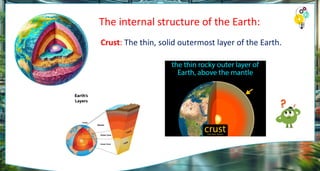
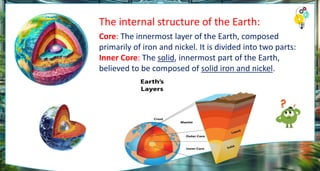
The internal structureof the Earth:
Crust: The thin, solid outermost layer of the Earth.
3.
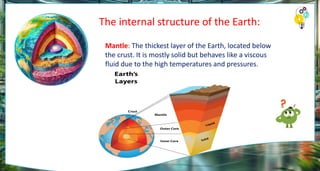
The internal structureof the Earth:
Mantle: The thickest layer of the Earth, located below
the crust. It is mostly solid but behaves like a viscous
fluid due to the high temperatures and pressures.
4.
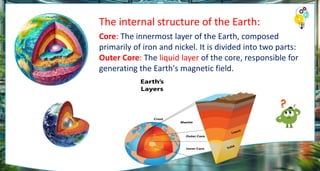
The internal structureof the Earth:
Core: The innermost layer of the Earth, composed
primarily of iron and nickel. It is divided into two parts:
Outer Core: The liquid layer of the core, responsible for
generating the Earth's magnetic field.
5.
The internal structureof the Earth:
Core: The innermost layer of the Earth, composed
primarily of iron and nickel. It is divided into two parts:
Inner Core: The solid, innermost part of the Earth,
believed to be composed of solid iron and nickel.
6.
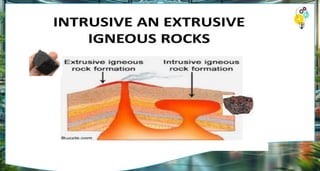
What are igneousrocks?
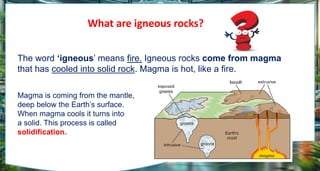
The word ‘igneous’ means fire. Igneous rocks come from magma
that has cooled into solid rock. Magma is hot, like a fire.
Magma is coming from the mantle,
deep below the Earth’s surface.
When magma cools it turns into
a solid. This process is called
solidification.
8.
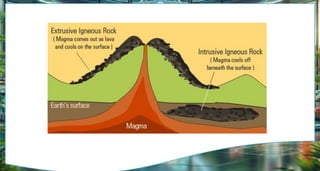
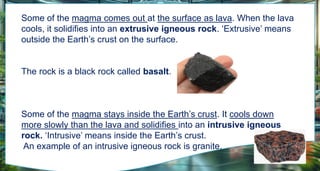
Some of themagma comes out at the surface as lava. When the lava
cools, it solidifies into an extrusive igneous rock. ‘Extrusive’ means
outside the Earth’s crust on the surface.
The rock is a black rock called basalt.
Some of the magma stays inside the Earth’s crust. It cools down
more slowly than the lava and solidifies into an intrusive igneous
rock. ‘Intrusive’ means inside the Earth’s crust.
An example of an intrusive igneous rock is granite.
10.
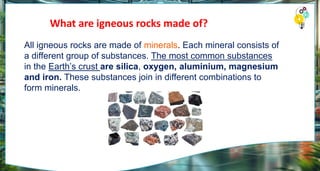
What are igneousrocks made of?
All igneous rocks are made of minerals. Each mineral consists of
a different group of substances. The most common substances
in the Earth’s crust are silica, oxygen, aluminium, magnesium
and iron. These substances join in different combinations to
form minerals.
11.
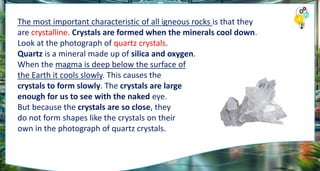
The most importantcharacteristic of all igneous rocks is that they
are crystalline. Crystals are formed when the minerals cool down.
Look at the photograph of quartz crystals.
Quartz is a mineral made up of silica and oxygen.
When the magma is deep below the surface of
the Earth it cools slowly. This causes the
crystals to form slowly. The crystals are large
enough for us to see with the naked eye.
But because the crystals are so close, they
do not form shapes like the crystals on their
own in the photograph of quartz crystals.
12.
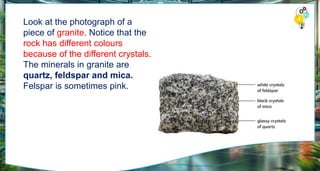
Look at thephotograph of a
piece of granite. Notice that the
rock has different colours
because of the different crystals.
The minerals in granite are
quartz, feldspar and mica.
Felspar is sometimes pink.
13.
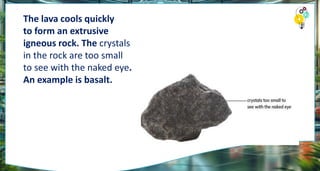
The lava coolsquickly
to form an extrusive
igneous rock. The crystals
in the rock are too small
to see with the naked eye.
An example is basalt.
15.
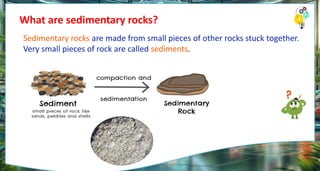
What are sedimentaryrocks?
Sedimentary rocks are made from small pieces of other rocks stuck together.
Very small pieces of rock are called sediments.
16.
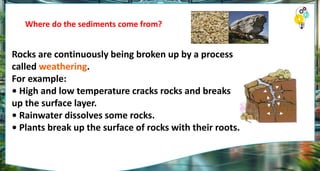
Where do thesediments come from?
Rocks are continuously being broken up by a process
called weathering.
For example:
• High and low temperature cracks rocks and breaks
up the surface layer.
• Rainwater dissolves some rocks.
• Plants break up the surface of rocks with their roots.
17.
Once the rocksare weakened by weathering, they become eroded by rivers.
The broken-up rocks wear away or erode the sides and bottom of river
valleys. The broken rocks are eroded into sediments. Ice and wind can also
erode rocks into sediments.
All the sediments are carried or transported by rivers. When the water in
a river reaches the sea or a lake, it flows slowly. It drops or deposits the
sediments. This process is called sedimentation.
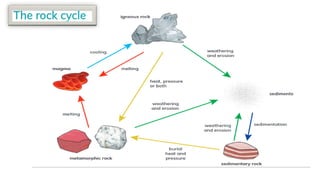
Over millions of years the layers at the bottom get more and more squashed
by the layers on top of them. These sediments are stuck together by
minerals in the water to
form sedimentary rock.
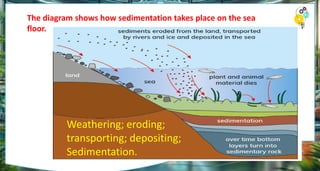
18.
The diagram showshow sedimentation takes place on the sea
floor.
Weathering; eroding;
transporting; depositing;
Sedimentation.
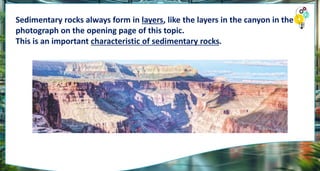
19.
Sedimentary rocks alwaysform in layers, like the layers in the canyon in the
photograph on the opening page of this topic.
This is an important characteristic of sedimentary rocks.
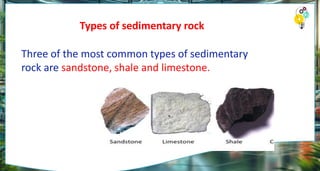
20.
Types of sedimentaryrock
Three of the most common types of sedimentary
rock are sandstone, shale and limestone.
21.
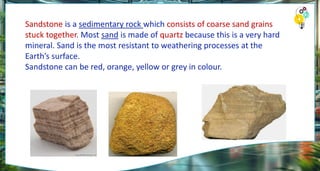
Sandstone is asedimentary rock which consists of coarse sand grains
stuck together. Most sand is made of quartz because this is a very hard
mineral. Sand is the most resistant to weathering processes at the
Earth’s surface.
Sandstone can be red, orange, yellow or grey in colour.
22.
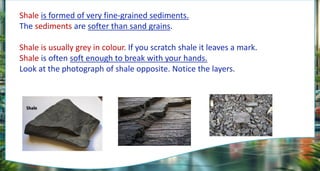
Shale is formedof very fine-grained sediments.
The sediments are softer than sand grains.
Shale is usually grey in colour. If you scratch shale it leaves a mark.
Shale is often soft enough to break with your hands.
Look at the photograph of shale opposite. Notice the layers.
23.
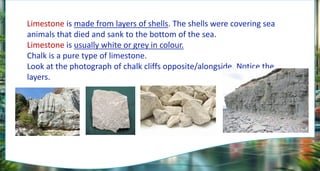
Limestone is madefrom layers of shells. The shells were covering sea
animals that died and sank to the bottom of the sea.
Limestone is usually white or grey in colour.
Chalk is a pure type of limestone.
Look at the photograph of chalk cliffs opposite/alongside. Notice the
layers.
24.
Fossils
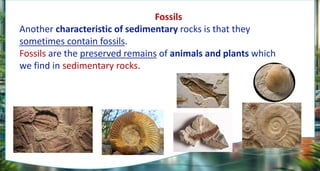
Another characteristic ofsedimentary rocks is that they
sometimes contain fossils.
Fossils are the preserved remains of animals and plants which
we find in sedimentary rocks.
25.
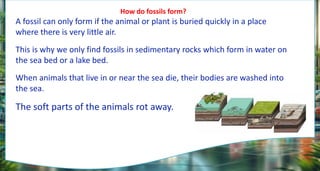
How do fossilsform?
A fossil can only form if the animal or plant is buried quickly in a place
where there is very little air.
This is why we only find fossils in sedimentary rocks which form in water on
the sea bed or a lake bed.
When animals that live in or near the sea die, their bodies are washed into
the sea.
The soft parts of the animals rot away.
26.
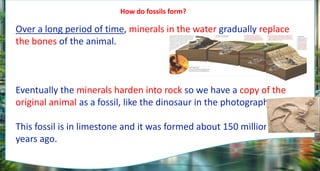
How do fossilsform?
Over a long period of time, minerals in the water gradually replace
the bones of the animal.
Eventually the minerals harden into rock so we have a copy of the
original animal as a fossil, like the dinosaur in the photograph.
This fossil is in limestone and it was formed about 150 million
years ago.
27.
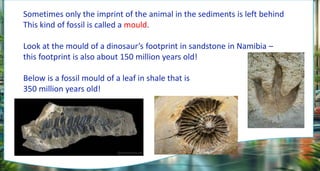
Sometimes only theimprint of the animal in the sediments is left behind
This kind of fossil is called a mould.
Look at the mould of a dinosaur’s footprint in sandstone in Namibia –
this footprint is also about 150 million years old!
Below is a fossil mould of a leaf in shale that is
350 million years old!
28.
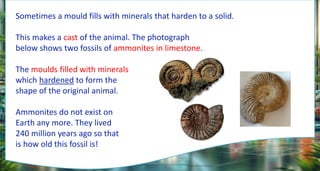
Sometimes a mouldfills with minerals that harden to a solid.
This makes a cast of the animal. The photograph
below shows two fossils of ammonites in limestone.
The moulds filled with minerals
which hardened to form the
shape of the original animal.
Ammonites do not exist on
Earth any more. They lived
240 million years ago so that
is how old this fossil is!
30.
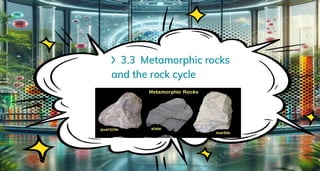
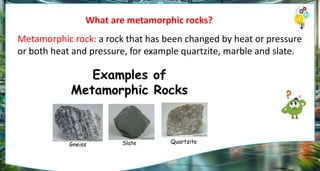
What are metamorphicrocks?
Metamorphic rock: a rock that has been changed by heat or pressure
or both heat and pressure, for example quartzite, marble and slate.
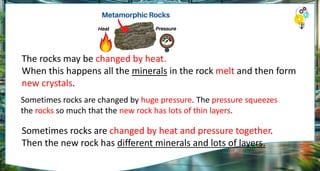
31.
The rocks maybe changed by heat.
When this happens all the minerals in the rock melt and then form
new crystals.
Sometimes rocks are changed by huge pressure. The pressure squeezes
the rocks so much that the new rock has lots of thin layers.
Sometimes rocks are changed by heat and pressure together.
Then the new rock has different minerals and lots of layers.
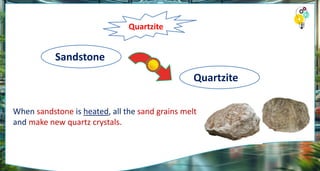
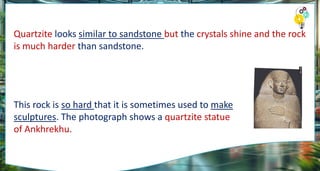
Quartzite looks similarto sandstone but the crystals shine and the rock
is much harder than sandstone.
This rock is so hard that it is sometimes used to make
sculptures. The photograph shows a quartzite statue
of Ankhrekhu.
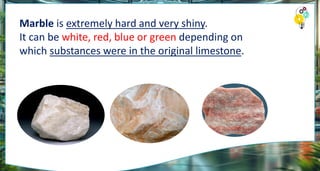
Marble is extremelyhard and very shiny.
It can be white, red, blue or green depending on
which substances were in the original limestone.
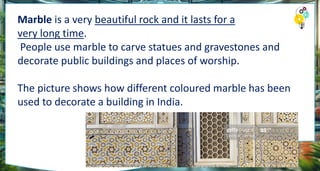
36.
Marble is avery beautiful rock and it lasts for a
very long time.
People use marble to carve statues and gravestones and
decorate public buildings and places of worship.
The picture shows how different coloured marble has been
used to decorate a building in India.
37.
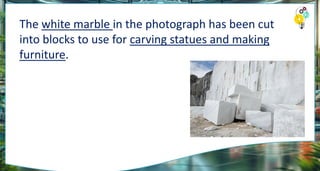
The white marblein the photograph has been cut
into blocks to use for carving statues and making
furniture.
38.
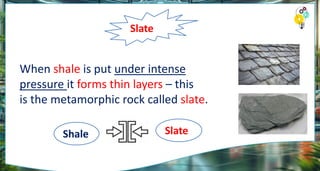
Slate
When shale isput under intense
pressure it forms thin layers – this
is the metamorphic rock called slate.
Shale Slate
39.
Remember that layersof sediments build up on the sea bed.
The bottom layers are buried by the top layers.
If there are many layers, the bottom layer is put under huge
pressure from the layers above.
Burial changes the rock into a metamorphic rock with many
layers like slate.
40.
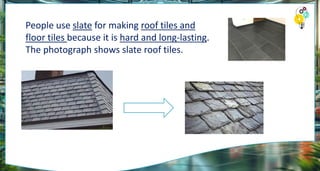
People use slatefor making roof tiles and
floor tiles because it is hard and long-lasting.
The photograph shows slate roof tiles.
41.
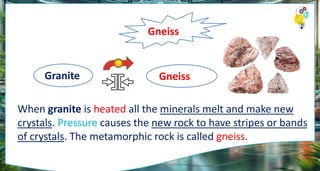
Gneiss
When granite isheated all the minerals melt and make new
crystals. Pressure causes the new rock to have stripes or bands
of crystals. The metamorphic rock is called gneiss.
Granite Gneiss
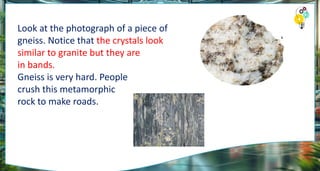
42.
Look at thephotograph of a piece of
gneiss. Notice that the crystals look
similar to granite but they are
in bands.
Gneiss is very hard. People
crush this metamorphic
rock to make roads.
46.
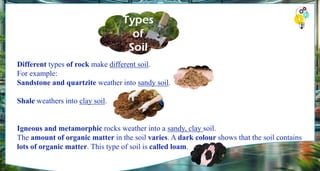
Different types ofrock make different soil.
For example:
Sandstone and quartzite weather into sandy soil.
Shale weathers into clay soil.
Igneous and metamorphic rocks weather into a sandy, clay soil.
The amount of organic matter in the soil varies. A dark colour shows that the soil contains
lots of organic matter. This type of soil is called loam.
47.
Sandy soil
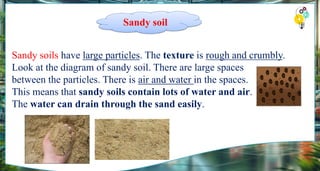
Sandy soilshave large particles. The texture is rough and crumbly.
Look at the diagram of sandy soil. There are large spaces
between the particles. There is air and water in the spaces.
This means that sandy soils contain lots of water and air.
The water can drain through the sand easily.
48.
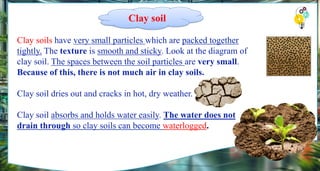
Clay soils havevery small particles which are packed together
tightly. The texture is smooth and sticky. Look at the diagram of
clay soil. The spaces between the soil particles are very small.
Because of this, there is not much air in clay soils.
Clay soil dries out and cracks in hot, dry weather.
Clay soil absorbs and holds water easily. The water does not
drain through so clay soils can become waterlogged.
Clay soil
49.
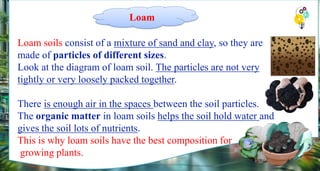
Loam soils consistof a mixture of sand and clay, so they are
made of particles of different sizes.
Look at the diagram of loam soil. The particles are not very
tightly or very loosely packed together.
There is enough air in the spaces between the soil particles.
The organic matter in loam soils helps the soil hold water and
gives the soil lots of nutrients.
This is why loam soils have the best composition for
growing plants.
Loam
50.
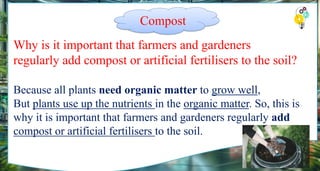
Why is itimportant that farmers and gardeners
regularly add compost or artificial fertilisers to the soil?
Because all plants need organic matter to grow well,
But plants use up the nutrients in the organic matter. So, this is
why it is important that farmers and gardeners regularly add
compost or artificial fertilisers to the soil.
Compost
51.
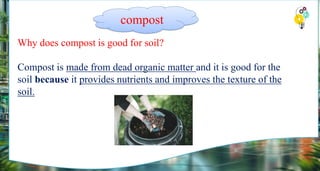
Why does compostis good for soil?
Compost is made from dead organic matter and it is good for the
soil because it provides nutrients and improves the texture of the
soil.
compost
52.
You can makeyour own compost with food scraps like vegetable
peels, egg shells, over-ripe fruits and bones:
- Add garden waste like grass cuttings, leaves and weeds.
- Keep the mixture moist in a warm place.
-In a few weeks you will have compost!
compost
53.
Artificial fertilisers providethe same nutrients as organic matter.
But they do not improve the texture of the soil like compost does.
54.
For plants togrow well, it is important to look after the soil by
maintaining the composition of the soil.
Sometimes farmers or gardeners do not look after the soil and the composition
changes.
Here are some examples:
- Farmers plant the same crop year after year. The crop uses up the nutrients in
the soil. The soil dries out easily and is no longer good for growing plants.
Damagingsoil
55.
- Farmers usepesticides to kill weeds and insects. The chemicals
in pesticides can also kill the organic matter in the soil.
- Farmers use artificial fertilisers. These can damage the soil
texture and dry out the soil.
- Farmers do not dig and turn the soil over often enough.
Air and organic matter needs to be mixed through the soil.
Damagingsoil