INTRODUCTION TO AIR CONDITIONING
PROCESS
SUB TOPIC
⚫Introduction
⚫Principles of air-conditioning
⚫Type of of air-conditioning
⚫Cooling cycle / refrigeration cycle
⚫The coolant
INTRODUCTION
⚫Definition - Air conditioning is the process
of altering the properties of air (primarily
temperature and humidity) to more favorable
conditions.
⚫The control of these conditions may be
desirable to maintain the health and comfort of
the occupants, or to meet the requirements of
industrial processes irrespective of the external
climatic conditions
PRINCIPLES OF AIR-CONDITIONING
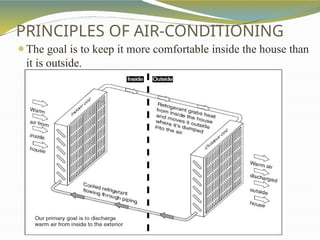
⚫The goal is to keep it more comfortable inside the house than
it is outside.
TYPE OF AIR-CONDITIONING
1) Window air-conditioning system
2) Split air-conditioning system
3) Centralised air-conditioning system
4) Package air-conditioning system
1) Windows Air-conditioning
System
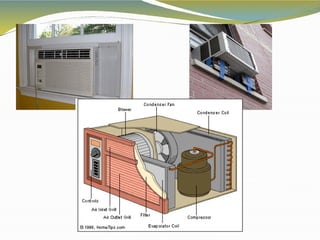
⚫Window air conditioners are one of the most
commonly used and cheapest type of air
conditioners.
⚫To install one of these units, you need the space to
make a slot in the wall, and there should also be
some open space behind the wall.
⚫Window air-conditioner units are reliable and
simple-to-install solution to keep a room cool
while avoiding the costly construction of a central
air system.
⚫Better yet, when the summer heat dies down, these
units can be easily removed for storage, and you
can use the window sill for other purpose
2) Split Air-Conditioning
System
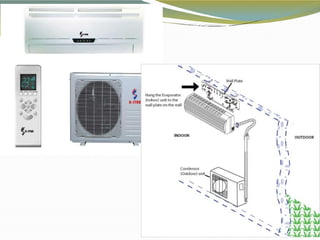
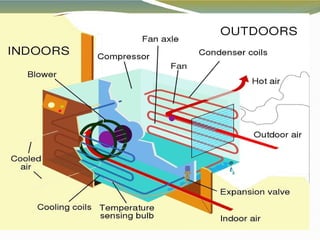
⚫The split air conditioner comprises of two parts:
the outdoor unit and the indoor unit.
⚫The outdoor unit, fitted outside the room, houses
components like the compressor, condenser
and expansion valve.
⚫The indoor unit comprises the evaporator or
cooling coil and the cooling fan. For this unit you
don’t have to make any slot in the wall of the
room.
⚫Further, the present day split units have aesthetic
looks and add to the beauty of the room. The
split air conditioner can be used to cool one or
two rooms.
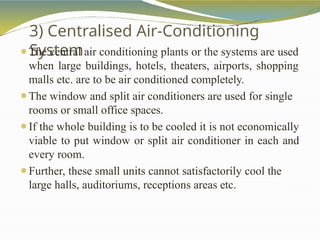
3) Centralised Air-Conditioning
System
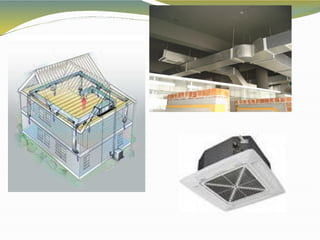
⚫The central air conditioning plants or the systems are used
when large buildings, hotels, theaters, airports, shopping
malls etc. are to be air conditioned completely.
⚫The window and split air conditioners are used for single
rooms or small office spaces.
⚫If the whole building is to be cooled it is not economically
viable to put window or split air conditioner in each and
every room.
⚫Further, these small units cannot satisfactorily cool the
large halls, auditoriums, receptions areas etc.
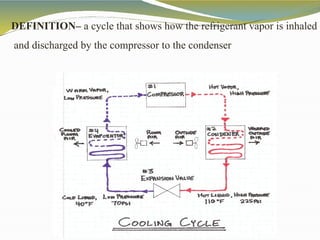
DEFINITION– a cycle that shows how the refrigerant vapor is inhaled
and discharged by the compressor to the condenser.
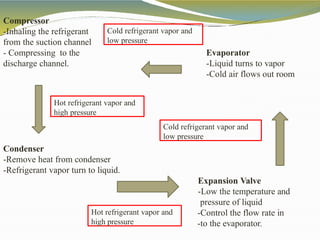
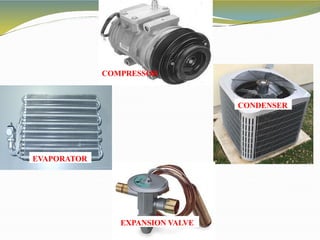
Compressor
-Inhaling the refrigerant
from the suction channel
- Compressing to the
discharge channel.
Hot refrigerant vapor and
high pressure
Condenser
-Remove heat from condenser
-Refrigerant vapor turn to liquid.
Hot refrigerant vapor and
high pressure
Expansion Valve
-Low the temperature and
pressure of liquid
-Control the flow rate in
-to the evaporator.
Cold refrigerant vapor and
low pressure
Evaporator
-Liquid turns to vapor
-Cold air flows out room
Cold refrigerant vapor and
low pressure
COMPRESSOR
CONDENSER
EVAPORATOR
EXPANSION VALVE
⚫Heat is removed from the cooling by coolant.
⚫Functions as a heat absorber from the evaporator
⚫Good coolant must have features ;
1. Non toxic
2. Not explosive
3. Non-corrosive components
THE COOLANT
⚫Not explosive
⚫Soluble in oil to lubricate effectively
⚫Harmless when responding to oil even in the presence of
moisture
⚫Have a high resistance to electricity.
THE COOLANT
REVIEW
Basic Refrigeration
System
B
C
D
EVAPORATOR
EXPANSION
DEVICE
CONDENSER
High
pressure
side
Low pressure side
Discharge line
[6°C
]
[10°C
]
[90°C
]
[55°C
]
[50°C
]
A
A
COMPRESSOR
B
Suction line
C
D
Q
k
Q
o
W
Qk = Heat Rejected
Qo = Heat Absorbed
W = Work
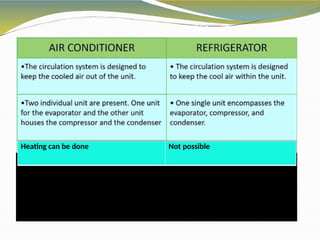
Heating can be done Not possible

363172474-Air-Conditioning-System-1.pptx

  • 1.
    INTRODUCTION TO AIRCONDITIONING PROCESS
  • 2.
    SUB TOPIC ⚫Introduction ⚫Principles ofair-conditioning ⚫Type of of air-conditioning ⚫Cooling cycle / refrigeration cycle ⚫The coolant
  • 3.
    INTRODUCTION ⚫Definition - Airconditioning is the process of altering the properties of air (primarily temperature and humidity) to more favorable conditions. ⚫The control of these conditions may be desirable to maintain the health and comfort of the occupants, or to meet the requirements of industrial processes irrespective of the external climatic conditions
  • 4.
    PRINCIPLES OF AIR-CONDITIONING ⚫Thegoal is to keep it more comfortable inside the house than it is outside.
  • 5.
    TYPE OF AIR-CONDITIONING 1)Window air-conditioning system 2) Split air-conditioning system 3) Centralised air-conditioning system 4) Package air-conditioning system
  • 6.
    1) Windows Air-conditioning System ⚫Windowair conditioners are one of the most commonly used and cheapest type of air conditioners. ⚫To install one of these units, you need the space to make a slot in the wall, and there should also be some open space behind the wall. ⚫Window air-conditioner units are reliable and simple-to-install solution to keep a room cool while avoiding the costly construction of a central air system. ⚫Better yet, when the summer heat dies down, these units can be easily removed for storage, and you can use the window sill for other purpose
  • 8.
    2) Split Air-Conditioning System ⚫Thesplit air conditioner comprises of two parts: the outdoor unit and the indoor unit. ⚫The outdoor unit, fitted outside the room, houses components like the compressor, condenser and expansion valve. ⚫The indoor unit comprises the evaporator or cooling coil and the cooling fan. For this unit you don’t have to make any slot in the wall of the room. ⚫Further, the present day split units have aesthetic looks and add to the beauty of the room. The split air conditioner can be used to cool one or two rooms.
  • 10.
    3) Centralised Air-Conditioning System ⚫Thecentral air conditioning plants or the systems are used when large buildings, hotels, theaters, airports, shopping malls etc. are to be air conditioned completely. ⚫The window and split air conditioners are used for single rooms or small office spaces. ⚫If the whole building is to be cooled it is not economically viable to put window or split air conditioner in each and every room. ⚫Further, these small units cannot satisfactorily cool the large halls, auditoriums, receptions areas etc.
  • 12.
    DEFINITION– a cyclethat shows how the refrigerant vapor is inhaled and discharged by the compressor to the condenser.
  • 13.
    Compressor -Inhaling the refrigerant fromthe suction channel - Compressing to the discharge channel. Hot refrigerant vapor and high pressure Condenser -Remove heat from condenser -Refrigerant vapor turn to liquid. Hot refrigerant vapor and high pressure Expansion Valve -Low the temperature and pressure of liquid -Control the flow rate in -to the evaporator. Cold refrigerant vapor and low pressure Evaporator -Liquid turns to vapor -Cold air flows out room Cold refrigerant vapor and low pressure
  • 15.
  • 16.
    ⚫Heat is removedfrom the cooling by coolant. ⚫Functions as a heat absorber from the evaporator ⚫Good coolant must have features ; 1. Non toxic 2. Not explosive 3. Non-corrosive components THE COOLANT
  • 17.
    ⚫Not explosive ⚫Soluble inoil to lubricate effectively ⚫Harmless when responding to oil even in the presence of moisture ⚫Have a high resistance to electricity. THE COOLANT
  • 18.
    REVIEW Basic Refrigeration System B C D EVAPORATOR EXPANSION DEVICE CONDENSER High pressure side Low pressureside Discharge line [6°C ] [10°C ] [90°C ] [55°C ] [50°C ] A A COMPRESSOR B Suction line C D Q k Q o W Qk = Heat Rejected Qo = Heat Absorbed W = Work
  • 19.
    Heating can bedone Not possible