

Roberta Lynn Minicola
February 2026
PhD in Psychology
Walden University
Chair: Hedy R. Dexter, PhD
SCM: Rhonda A. Bohs, PhD
Dissertation Defense
The Moderating Role of Self-Esteem
in the Relationship Between
Perceived Gender Bias and Job
Satisfaction Among Women
in the Technology Industry
Background
Women remain underrepresented in the U.S. technology industry,
particularly in technical and leadership roles.
Research consistently shows that women in technology report lower
job satisfaction and higher turnover intentions than men
Gender bias in male-dominated workplaces often manifests as:
• insufficient support (e.g., limited mentoring and sponsorship)
• devaluation of contributions and competence
• hostile or exclusionary behaviors
Prior research links perceived gender bias to negative work outcomes,
including reduced job satisfaction
Psychological factors such as self-esteem have been associated with
job attitudes, but their role in shaping responses to gender bias
remains unclear
Purpose
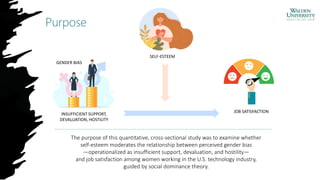
The purpose of this quantitative, cross-sectional study was to examine whether
self-esteem moderates the relationship between perceived gender bias
—operationalized as insufficient support, devaluation, and hostility—
and job satisfaction among women working in the U.S. technology industry,
guided by social dominance theory.
SELF-ESTEEM
JOB SATISFACTION
INSUFFICIENT SUPPORT,
DEVALUATION, HOSTILITY
GENDER BIAS
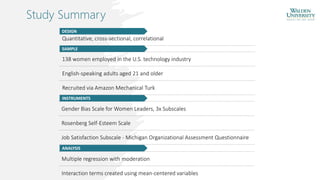
Quantitative, cross-sectional, correlational
DESIGN
Study Summary
SAMPLE
Multiple regression with moderation
Interaction terms created using mean-centered variables
138 women employed in the U.S. technology industry
English-speaking adults aged 21 and older
Recruited via Amazon Mechanical Turk
Gender Bias Scale for Women Leaders, 3x Subscales
Rosenberg Self-Esteem Scale
Job Satisfaction Subscale - Michigan Organizational Assessment Questionnaire
ANALYSIS
INSTRUMENTS
RQ1:
To what extent does insufficient support, as measured by the Gender Bias Scale for Women Leaders,
relate to job satisfaction, as measured by the Job Satisfaction Subscale of the Michigan Organizational
Assessment Questionnaire, among women working in the United States technology industry?
RQ2:
To what extent does devaluation, as measured by the Gender Bias Scale for Women Leaders, relate to
job satisfaction, as measured by the Job Satisfaction Subscale of the Michigan Organizational
Assessment Questionnaire, among women working in the United States technology industry?
RQ3:
To what extent does hostility, as measured by the Gender Bias Scale for Women Leaders, relate to job
satisfaction, as measured by the Job Satisfaction Subscale of the Michigan Organizational Assessment
Questionnaire, among women working in the United States technology industry?
RQ4:
To what extent does self-esteem, as measured by the Rosenberg Self-Esteem Scale, relate to job
satisfaction, as measured by the Job Satisfaction Subscale of the Michigan Organizational Assessment
Questionnaire, among women working in the United States technology industry?
RQ5:
To what extent does self-esteem, as measured by the Rosenberg Self-Esteem Scale, moderate the
relationship between insufficient support, as measured by the Gender Bias Scale for Women Leaders,
and job satisfaction, as measured by the Job Satisfaction Subscale of the Michigan Organizational
Assessment Questionnaire?
RQ6:
To what extent does self-esteem, as measured by the Rosenberg Self-Esteem Scale, moderate the
relationship between devaluation, as measured by the Gender Bias Scale for Women Leaders, and job
satisfaction, as measured by the Job Satisfaction Subscale of the Michigan Organizational Assessment
Questionnaire?
RQ7:
To what extent does self-esteem, as measured by the Rosenberg Self-Esteem Scale, moderate the
relationship between hostility, as measured by the Gender Bias Scale for Women Leaders, and job
satisfaction, as measured by the Job Satisfaction Subscale of the Michigan Organizational Assessment
Questionnaire?
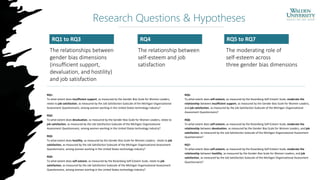
The relationships between
gender bias dimensions
(insufficient support,
devaluation, and hostility)
and job satisfaction
The relationship between
self-esteem and job
satisfaction
The moderating role of
self-esteem across
three gender bias dimensions
RQ1 to RQ3 RQ4 RQ5 to RQ7
Research Questions & Hypotheses
The relationships between
gender bias dimensions
(insufficient support,
devaluation, and hostility)
and job satisfaction
The relationship between
self-esteem and job
satisfaction
The moderating role of
self-esteem across
three gender bias dimensions
RQ1 to RQ3 RQ4 RQ5 to RQ7
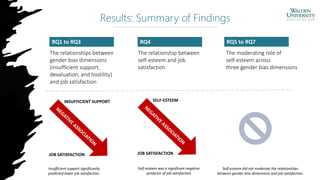
Results: Summary of Findings
Self-esteem was a significant negative
predictor of job satisfaction
Insufficient support significantly
predicted lower job satisfaction.
Self-esteem did not moderate the relationships
between gender bias dimensions and job satisfaction.
SELF-ESTEEM
JOB SATISFACTION
INSUFFICIENT SUPPORT
JOB SATISFACTION
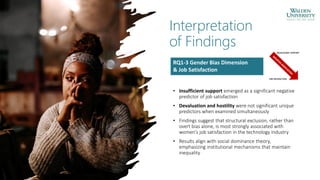
Interpretation
of Findings
• Insufficient support emerged as a significant negative
predictor of job satisfaction
• Devaluation and hostility were not significant unique
predictors when examined simultaneously
• Findings suggest that structural exclusion, rather than
overt bias alone, is most strongly associated with
women’s job satisfaction in the technology industry
• Results align with social dominance theory,
emphasizing institutional mechanisms that maintain
inequality
RQ1-3 Gender Bias Dimension
& Job Satisfaction
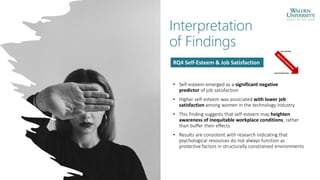
Interpretation
of Findings
• Self-esteem emerged as a significant negative
predictor of job satisfaction
• Higher self-esteem was associated with lower job
satisfaction among women in the technology industry
• This finding suggests that self-esteem may heighten
awareness of inequitable workplace conditions, rather
than buffer their effects
• Results are consistent with research indicating that
psychological resources do not always function as
protective factors in structurally constrained environments
RQ4 Self-Esteem & Job Satisfaction
Interpretation
of Findings
• Self-esteem did not moderate the relationships between
gender bias dimensions and job satisfaction
• The strength and direction of the relationships between
gender bias and job satisfaction were consistent across
levels of self-esteem
• Findings indicate that individual psychological resources
did not alter the impact of structural workplace
conditions
• Results align with social dominance theory, which
emphasizes institutional mechanisms over individual traits
in maintaining inequality
RQ5-7 Moderating Role of Self-Esteem
Limitations
Nonprobability sampling via Amazon Mechanical Turk limits generalizability
SAMPLING METHOD
Data collected at a single time point precludes causal inference
CROSS-SECTIONAL DESIGN
Potential for response and common method bias
SELF-REPORT MEASURES
Global self-esteem assessed rather than organization-based self-esteem
MEASUREMENT SCOPE
Racial distribution skewed toward White participants
SAMPLE COMPOSITION
Recommendations
for Future Research
• Longitudinal designs to examine how gender bias,
self-esteem, and job satisfaction evolve over time
• Context-specific self-esteem measures,
such as organization-based self-esteem, to assess
workplace-contingent effects
• More diverse and representative samples,
including greater racial and ethnic diversity within the
technology sector
• Multilevel and organizational analyses to examine how
individual perceptions interact with team- and
organization-level conditions
• Intersectional approaches to explore how gender bias
interacts with race, age, and career stage
Implications for
Social Change
• Findings highlight the central role of organizational
support structures in shaping women’s job satisfaction in
the technology industry
• Results suggest that individual psychological resources
alone are insufficient to mitigate the effects of perceived
gender bias
• Emphasizes the importance of institutional accountability
for mentoring, sponsorship, and inclusion practices
• Supports a shift from individual-level resilience narratives
toward structural and organizational change
Dissemination
of Results
• Submission of findings to peer-reviewed psychology
and organizational research journals
• Presentation of results at academic and professional
conferences focused on work, gender, and
organizational psychology
• Sharing findings with academic and practitioner
audiences interested in gender equity in technology
• Use of findings to inform future research and
scholarly dialogue
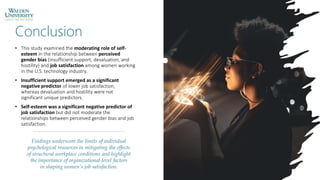
Conclusion
• This study examined the moderating role of self-
esteem in the relationship between perceived
gender bias (insufficient support, devaluation, and
hostility) and job satisfaction among women working
in the U.S. technology industry.
• Insufficient support emerged as a significant
negative predictor of lower job satisfaction,
whereas devaluation and hostility were not
significant unique predictors.
• Self-esteem was a significant negative predictor of
job satisfaction but did not moderate the
relationships between perceived gender bias and job
satisfaction.
Findings underscore the limits of individual
psychological resources in mitigating the effects
of structural workplace conditions and highlight
the importance of organizational-level factors
in shaping women’s job satisfaction.
Acknowledgements
• Chair: Hedy R. Dexter, PhD
• SCM: Rhonda A. Bohs, PhD
• Anthony Perry, PhD
• Associate Dean: Amy E. Sickel, PhD
Questions
For further questions or feedback,
please contact me: Roberta.Minicola@waldenu.edu
References
• Cammann, C., Fichman, M., Jenkins, D., &
Klesh, J. (2008). Michigan Organizational
Assessment Questionnaire—Job Satisfaction
Subscale. PsycTESTS.
https://doi.org/10.1037/t09214-000
• Diehl, A. B., Stephenson, A. L., Dzubinski, L.
M., & Wang, D. C. (2020). Measuring the
invisible: Development and multi-industry
validation of the Gender Bias Scale for
Women Leaders. Human Resource
Development Quarterly, 31(3), 249–280.
https://doi.org/10.1002/hrdq.21389
• Rosenberg, M. (1965). Society and the
adolescent self-image. Princeton University
Press.
• Sidanius, J., & Pratto, F. (1999). Social
dominance: An intergroup theory of social
hierarchy and oppression. Cambridge
University Press.
PHOTOGRAPHY: UNSPLASH+
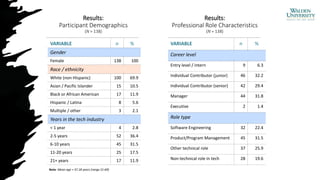
Results:
Participant Demographics
(N = 138)
VARIABLE n %
Gender
Female 138 100
Race / ethnicity
White (non-Hispanic) 100 69.9
Asian / Pacific Islander 15 10.5
Black or African American 17 11.9
Hispanic / Latina 8 5.6
Multiple / other 3 2.1
Years in the tech industry
< 1 year 4 2.8
2-5 years 52 36.4
6-10 years 45 31.5
11-20 years 25 17.5
21+ years 17 11.9
Note: Mean age = 37.18 years (range 21-69)
Results:
Professional Role Characteristics
(N = 138)
VARIABLE n %
Career level
Entry level / intern 9 6.3
Individual Contributor (junior) 46 32.2
Individual Contributor (senior) 42 29.4
Manager 44 31.8
Executive 2 1.4
Role type
Software Engineering 32 22.4
Product/Program Management 45 31.5
Other technical role 37 25.9
Non-technical role in tech 28 19.6
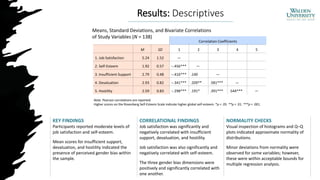
Results: Descriptives
Correlation Coefficients
M SD 1 2 3 4 5
1. Job Satisfaction 5.24 1.52 —
2. Self-Esteem 1.92 0.57 −.456*** —
3. Insufficient Support 2.79 0.48 −.416*** .140 —
4. Devaluation 2.93 0.82 −.341*** .209** .581*** —
5. Hostility 2.59 0.83 −.298*** .191* .391*** .544*** —
Means, Standard Deviations, and Bivariate Correlations
of Study Variables (N = 138)
Note. Pearson correlations are reported.
Higher scores on the Rosenberg Self-Esteem Scale indicate higher global self-esteem. *p < .05. **p < .01. ***p < .001.
KEY FINDINGS
Participants reported moderate levels of
job satisfaction and self-esteem.
Mean scores for insufficient support,
devaluation, and hostility indicated the
presence of perceived gender bias within
the sample.
CORRELATIONAL FINDINGS
Job satisfaction was significantly and
negatively correlated with insufficient
support, devaluation, and hostility.
Job satisfaction was also significantly and
negatively correlated with self-esteem.
The three gender bias dimensions were
positively and significantly correlated with
one another.
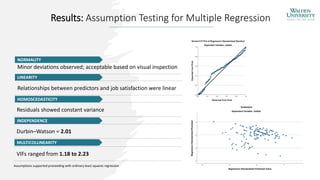
NORMALITY CHECKS
Visual inspection of histograms and Q–Q
plots indicated approximate normality of
distributions.
Minor deviations from normality were
observed for some variables; however,
these were within acceptable bounds for
multiple regression analysis.
Minor deviations observed; acceptable based on visual inspection
NORMALITY
LINEARITY
Durbin–Watson = 2.01
Relationships between predictors and job satisfaction were linear
Residuals showed constant variance
INDEPENDENCE
HOMOSCEDASTICITY
Results: Assumption Testing for Multiple Regression
MULTICOLLINEARITY
VIFs ranged from 1.18 to 2.23
Assumptions supported proceeding with ordinary least squares regression
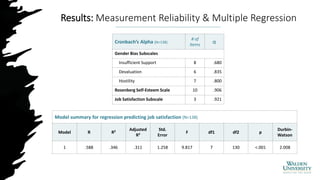
Results: Measurement Reliability & Multiple Regression
Cronbach’s Alpha (N=138)
# of
Items
α
Gender Bias Subscales
Insufficient Support 8 .680
Devaluation 6 .835
Hostility 7 .800
Rosenberg Self-Esteem Scale 10 .906
Job Satisfaction Subscale 3 .921
Model summary for regression predicting job satisfaction (N=138)
Model R R²
Adjusted
R²
Std.
Error
F df1 df2 p
Durbin-
Watson
1 .588 .346 .311 1.258 9.817 7 130 <.001 2.008

Robbee Minicola PhD Oral Defense Presentation

  • 1.
    Roberta Lynn Minicola February2026 PhD in Psychology Walden University Chair: Hedy R. Dexter, PhD SCM: Rhonda A. Bohs, PhD Dissertation Defense The Moderating Role of Self-Esteem in the Relationship Between Perceived Gender Bias and Job Satisfaction Among Women in the Technology Industry
  • 2.
    Background Women remain underrepresentedin the U.S. technology industry, particularly in technical and leadership roles. Research consistently shows that women in technology report lower job satisfaction and higher turnover intentions than men Gender bias in male-dominated workplaces often manifests as: • insufficient support (e.g., limited mentoring and sponsorship) • devaluation of contributions and competence • hostile or exclusionary behaviors Prior research links perceived gender bias to negative work outcomes, including reduced job satisfaction Psychological factors such as self-esteem have been associated with job attitudes, but their role in shaping responses to gender bias remains unclear
  • 3.
    Purpose The purpose ofthis quantitative, cross-sectional study was to examine whether self-esteem moderates the relationship between perceived gender bias —operationalized as insufficient support, devaluation, and hostility— and job satisfaction among women working in the U.S. technology industry, guided by social dominance theory. SELF-ESTEEM JOB SATISFACTION INSUFFICIENT SUPPORT, DEVALUATION, HOSTILITY GENDER BIAS
  • 4.
    Quantitative, cross-sectional, correlational DESIGN StudySummary SAMPLE Multiple regression with moderation Interaction terms created using mean-centered variables 138 women employed in the U.S. technology industry English-speaking adults aged 21 and older Recruited via Amazon Mechanical Turk Gender Bias Scale for Women Leaders, 3x Subscales Rosenberg Self-Esteem Scale Job Satisfaction Subscale - Michigan Organizational Assessment Questionnaire ANALYSIS INSTRUMENTS
  • 5.
    RQ1: To what extentdoes insufficient support, as measured by the Gender Bias Scale for Women Leaders, relate to job satisfaction, as measured by the Job Satisfaction Subscale of the Michigan Organizational Assessment Questionnaire, among women working in the United States technology industry? RQ2: To what extent does devaluation, as measured by the Gender Bias Scale for Women Leaders, relate to job satisfaction, as measured by the Job Satisfaction Subscale of the Michigan Organizational Assessment Questionnaire, among women working in the United States technology industry? RQ3: To what extent does hostility, as measured by the Gender Bias Scale for Women Leaders, relate to job satisfaction, as measured by the Job Satisfaction Subscale of the Michigan Organizational Assessment Questionnaire, among women working in the United States technology industry? RQ4: To what extent does self-esteem, as measured by the Rosenberg Self-Esteem Scale, relate to job satisfaction, as measured by the Job Satisfaction Subscale of the Michigan Organizational Assessment Questionnaire, among women working in the United States technology industry? RQ5: To what extent does self-esteem, as measured by the Rosenberg Self-Esteem Scale, moderate the relationship between insufficient support, as measured by the Gender Bias Scale for Women Leaders, and job satisfaction, as measured by the Job Satisfaction Subscale of the Michigan Organizational Assessment Questionnaire? RQ6: To what extent does self-esteem, as measured by the Rosenberg Self-Esteem Scale, moderate the relationship between devaluation, as measured by the Gender Bias Scale for Women Leaders, and job satisfaction, as measured by the Job Satisfaction Subscale of the Michigan Organizational Assessment Questionnaire? RQ7: To what extent does self-esteem, as measured by the Rosenberg Self-Esteem Scale, moderate the relationship between hostility, as measured by the Gender Bias Scale for Women Leaders, and job satisfaction, as measured by the Job Satisfaction Subscale of the Michigan Organizational Assessment Questionnaire? The relationships between gender bias dimensions (insufficient support, devaluation, and hostility) and job satisfaction The relationship between self-esteem and job satisfaction The moderating role of self-esteem across three gender bias dimensions RQ1 to RQ3 RQ4 RQ5 to RQ7 Research Questions & Hypotheses
  • 6.
    The relationships between genderbias dimensions (insufficient support, devaluation, and hostility) and job satisfaction The relationship between self-esteem and job satisfaction The moderating role of self-esteem across three gender bias dimensions RQ1 to RQ3 RQ4 RQ5 to RQ7 Results: Summary of Findings Self-esteem was a significant negative predictor of job satisfaction Insufficient support significantly predicted lower job satisfaction. Self-esteem did not moderate the relationships between gender bias dimensions and job satisfaction. SELF-ESTEEM JOB SATISFACTION INSUFFICIENT SUPPORT JOB SATISFACTION
  • 7.
    Interpretation of Findings • Insufficientsupport emerged as a significant negative predictor of job satisfaction • Devaluation and hostility were not significant unique predictors when examined simultaneously • Findings suggest that structural exclusion, rather than overt bias alone, is most strongly associated with women’s job satisfaction in the technology industry • Results align with social dominance theory, emphasizing institutional mechanisms that maintain inequality RQ1-3 Gender Bias Dimension & Job Satisfaction
  • 8.
    Interpretation of Findings • Self-esteememerged as a significant negative predictor of job satisfaction • Higher self-esteem was associated with lower job satisfaction among women in the technology industry • This finding suggests that self-esteem may heighten awareness of inequitable workplace conditions, rather than buffer their effects • Results are consistent with research indicating that psychological resources do not always function as protective factors in structurally constrained environments RQ4 Self-Esteem & Job Satisfaction
  • 9.
    Interpretation of Findings • Self-esteemdid not moderate the relationships between gender bias dimensions and job satisfaction • The strength and direction of the relationships between gender bias and job satisfaction were consistent across levels of self-esteem • Findings indicate that individual psychological resources did not alter the impact of structural workplace conditions • Results align with social dominance theory, which emphasizes institutional mechanisms over individual traits in maintaining inequality RQ5-7 Moderating Role of Self-Esteem
  • 10.
    Limitations Nonprobability sampling viaAmazon Mechanical Turk limits generalizability SAMPLING METHOD Data collected at a single time point precludes causal inference CROSS-SECTIONAL DESIGN Potential for response and common method bias SELF-REPORT MEASURES Global self-esteem assessed rather than organization-based self-esteem MEASUREMENT SCOPE Racial distribution skewed toward White participants SAMPLE COMPOSITION
  • 11.
    Recommendations for Future Research •Longitudinal designs to examine how gender bias, self-esteem, and job satisfaction evolve over time • Context-specific self-esteem measures, such as organization-based self-esteem, to assess workplace-contingent effects • More diverse and representative samples, including greater racial and ethnic diversity within the technology sector • Multilevel and organizational analyses to examine how individual perceptions interact with team- and organization-level conditions • Intersectional approaches to explore how gender bias interacts with race, age, and career stage
  • 12.
    Implications for Social Change •Findings highlight the central role of organizational support structures in shaping women’s job satisfaction in the technology industry • Results suggest that individual psychological resources alone are insufficient to mitigate the effects of perceived gender bias • Emphasizes the importance of institutional accountability for mentoring, sponsorship, and inclusion practices • Supports a shift from individual-level resilience narratives toward structural and organizational change
  • 13.
    Dissemination of Results • Submissionof findings to peer-reviewed psychology and organizational research journals • Presentation of results at academic and professional conferences focused on work, gender, and organizational psychology • Sharing findings with academic and practitioner audiences interested in gender equity in technology • Use of findings to inform future research and scholarly dialogue
  • 14.
    Conclusion • This studyexamined the moderating role of self- esteem in the relationship between perceived gender bias (insufficient support, devaluation, and hostility) and job satisfaction among women working in the U.S. technology industry. • Insufficient support emerged as a significant negative predictor of lower job satisfaction, whereas devaluation and hostility were not significant unique predictors. • Self-esteem was a significant negative predictor of job satisfaction but did not moderate the relationships between perceived gender bias and job satisfaction. Findings underscore the limits of individual psychological resources in mitigating the effects of structural workplace conditions and highlight the importance of organizational-level factors in shaping women’s job satisfaction.
  • 15.
    Acknowledgements • Chair: HedyR. Dexter, PhD • SCM: Rhonda A. Bohs, PhD • Anthony Perry, PhD • Associate Dean: Amy E. Sickel, PhD Questions For further questions or feedback, please contact me: Roberta.Minicola@waldenu.edu
  • 16.
    References • Cammann, C.,Fichman, M., Jenkins, D., & Klesh, J. (2008). Michigan Organizational Assessment Questionnaire—Job Satisfaction Subscale. PsycTESTS. https://doi.org/10.1037/t09214-000 • Diehl, A. B., Stephenson, A. L., Dzubinski, L. M., & Wang, D. C. (2020). Measuring the invisible: Development and multi-industry validation of the Gender Bias Scale for Women Leaders. Human Resource Development Quarterly, 31(3), 249–280. https://doi.org/10.1002/hrdq.21389 • Rosenberg, M. (1965). Society and the adolescent self-image. Princeton University Press. • Sidanius, J., & Pratto, F. (1999). Social dominance: An intergroup theory of social hierarchy and oppression. Cambridge University Press. PHOTOGRAPHY: UNSPLASH+
  • 17.
    Results: Participant Demographics (N =138) VARIABLE n % Gender Female 138 100 Race / ethnicity White (non-Hispanic) 100 69.9 Asian / Pacific Islander 15 10.5 Black or African American 17 11.9 Hispanic / Latina 8 5.6 Multiple / other 3 2.1 Years in the tech industry < 1 year 4 2.8 2-5 years 52 36.4 6-10 years 45 31.5 11-20 years 25 17.5 21+ years 17 11.9 Note: Mean age = 37.18 years (range 21-69) Results: Professional Role Characteristics (N = 138) VARIABLE n % Career level Entry level / intern 9 6.3 Individual Contributor (junior) 46 32.2 Individual Contributor (senior) 42 29.4 Manager 44 31.8 Executive 2 1.4 Role type Software Engineering 32 22.4 Product/Program Management 45 31.5 Other technical role 37 25.9 Non-technical role in tech 28 19.6
  • 18.
    Results: Descriptives Correlation Coefficients MSD 1 2 3 4 5 1. Job Satisfaction 5.24 1.52 — 2. Self-Esteem 1.92 0.57 −.456*** — 3. Insufficient Support 2.79 0.48 −.416*** .140 — 4. Devaluation 2.93 0.82 −.341*** .209** .581*** — 5. Hostility 2.59 0.83 −.298*** .191* .391*** .544*** — Means, Standard Deviations, and Bivariate Correlations of Study Variables (N = 138) Note. Pearson correlations are reported. Higher scores on the Rosenberg Self-Esteem Scale indicate higher global self-esteem. *p < .05. **p < .01. ***p < .001. KEY FINDINGS Participants reported moderate levels of job satisfaction and self-esteem. Mean scores for insufficient support, devaluation, and hostility indicated the presence of perceived gender bias within the sample. CORRELATIONAL FINDINGS Job satisfaction was significantly and negatively correlated with insufficient support, devaluation, and hostility. Job satisfaction was also significantly and negatively correlated with self-esteem. The three gender bias dimensions were positively and significantly correlated with one another. NORMALITY CHECKS Visual inspection of histograms and Q–Q plots indicated approximate normality of distributions. Minor deviations from normality were observed for some variables; however, these were within acceptable bounds for multiple regression analysis.
  • 19.
    Minor deviations observed;acceptable based on visual inspection NORMALITY LINEARITY Durbin–Watson = 2.01 Relationships between predictors and job satisfaction were linear Residuals showed constant variance INDEPENDENCE HOMOSCEDASTICITY Results: Assumption Testing for Multiple Regression MULTICOLLINEARITY VIFs ranged from 1.18 to 2.23 Assumptions supported proceeding with ordinary least squares regression
  • 20.
    Results: Measurement Reliability& Multiple Regression Cronbach’s Alpha (N=138) # of Items α Gender Bias Subscales Insufficient Support 8 .680 Devaluation 6 .835 Hostility 7 .800 Rosenberg Self-Esteem Scale 10 .906 Job Satisfaction Subscale 3 .921 Model summary for regression predicting job satisfaction (N=138) Model R R² Adjusted R² Std. Error F df1 df2 p Durbin- Watson 1 .588 .346 .311 1.258 9.817 7 130 <.001 2.008