1. An Afro-Asian literary text with an
embedded history, culture, heritage, or social
issue
2.Modals expressing politeness and questions
3.Types of sentences according to purpose
4.The draft of a formal letter of inquiry
ENGLISH 8, QUARTER 4,
LESSON 3, WEEK 3
EN8INF-IV-9 Synthesize significant information.
EN8INF-IV-11 Organize significant information
using various technique.
EN8INF-IV-14 Apply multimodal elements
appropriate to the chosen text delivery/ies.
EN8TRAN-IV-6 Compose a letter of inquiry.
EN8TRAN-IV-7 Revise for coherence and cohesion.
EN8TRAN-IV-8 Edit for consistency of diction, style,
tone and register, point of view, and grammar.
EN8TRAN-IV-9 Send correspondences to
communicate with and respond to senders within
the bounds of ethics.
LEARNING COMPETENCIES
1. Summarize an Afro-Asian literary
text highlighting its symbolisms and
thematic elements through various
means.
2. Formulate inquiries about an Afro-
Asian history, culture, heritage, or
social issues that are reflected in or
related to an Afro-Asian literary text.
3. Construct a formal letter using
standard parts and linguistic
LEARNING OBJECTIVES
Day
DRAFTING
PART 1
review
Short
Directions: Based on what you could recall from
the Afro-Asian literary text you were asked to read
in the previous lesson, prepare and present a
graphic outline/ diagram/ organizer that outlines
or summarizes the key events of the said text.
Focus on who the characters were and what
happened to them in the text from beginning to
ending. You may use the space below in
preparing your graphic organizer/ outline, or you
may write your output in a separate sheet of
Recalling text previously
read
In the previous unit, you have learned about the two
general types of letters—formal and informal—as
means of communication for discussing a wide range
of topics. They also explored an Afro-Asian literary
text that could serve as a discussion topic.
In this unit (lesson 1 of 2), you will recall the factual
details and interpretations of the assigned text
and express queries or concerns related to the
symbolic issues reflected in the text.
Establishing Lesson Purpose
Direction:
Read the
definition of
each term.
Unlocking Content Vocabulary
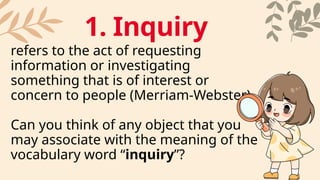
refers to the act of requesting
information or investigating
something that is of interest or
concern to people (Merriam-Webster)
Can you think of any object that you
may associate with the meaning of the
vocabulary word “inquiry”?
1. Inquiry
also known as social problem,
the term is about any condition
or situation that negatively
affects people individually or in
large groups
Can you give your own
example of social issues?
2. Social Issue
Day
Drafting Part 1
continued
Directions: Form a group with your
classmates and then prepare a short
skit or play presenting a real-life
scenario that also shows a similar
social problem to the one found in
the Afro-Asian text you were asked to
read. Be prepared to present in class
and explain how and why your skit
represents a similar social problem.
A. Unearthing the
Symbolized Social
Problem
Creativity/ Originality (7pts)—refers to whether or not the scenario
presented is creatively realistic and original or different from those
presented
by other groups
Relevance to the Symbolized Social Problem in the Text (6pts)—refers
to whether or not the explanation of how and why the skit has a similar
social problem to the one found in the text tackled justifies the connection
of the two
Compliance with Requirements (4pts)—refers to whether or not the
entirety of the skit, including its explanation, is within the given time limit
of 5 minutes or less
Use of the English Language (3pts)—refers to whether or not the skit
and its presentation involved the consistent use of the English language
Criteria:
Directions:Mark
an (X) before the
scenario number
if it shows a
social problem:
B. Thinking about
Other Social Problems
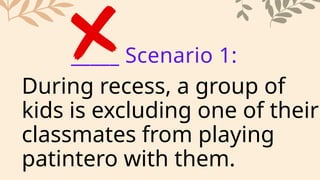
During recess, a group of
kids is excluding one of their
classmates from playing
patintero with them.
_____ Scenario 1:
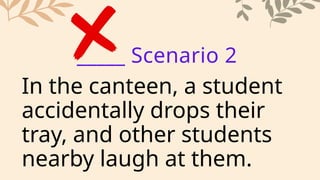
In the canteen, a student
accidentally drops their
tray, and other students
nearby laugh at them.
_____ Scenario 2
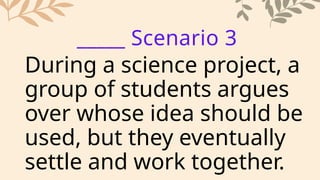
During a science project, a
group of students argues
over whose idea should be
used, but they eventually
settle and work together.
_____ Scenario 3
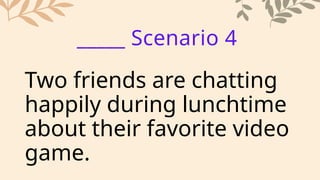
Two friends are chatting
happily during lunchtime
about their favorite video
game.
_____ Scenario 4
In the classroom, a student asks
for help from the teacher
because they are being
endlessly scares or says bad
things towards another
_____ Scenario 5
Day
Drafting Part
1 continued
MAKING QUESTIONS ABOUT
SOCIAL PROBLEMS USING
INTERROGATIVES AND
MODALS
What are
we doing?
We will learn how to
make questions about
social problems using WH-
questions and modals.
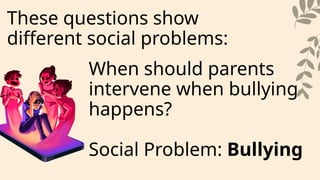
These questions show
different social problems:
When should parents
intervene when bullying
happens?
Social Problem: Bullying
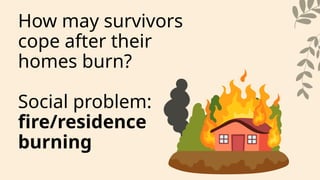
How may survivors
cope after their
homes burn?
Social problem:
fire/residence
burning
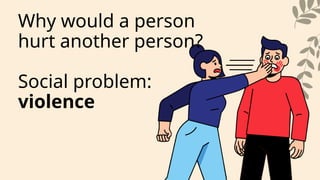
Why would a person
hurt another person?
Social problem:
violence
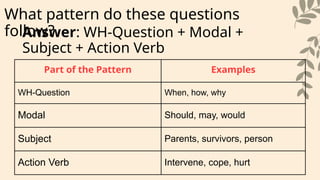
What pattern do these questions
follow?
Answer: WH-Question + Modal +
Subject + Action Verb
Part of the Pattern Examples
WH-Question When, how, why
Modal Should, may, would
Subject Parents, survivors, person
Action Verb Intervene, cope, hurt
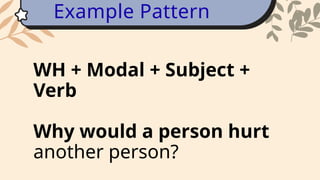
WH + Modal + Subject +
Verb
Why would a person hurt
another person?
Example Pattern
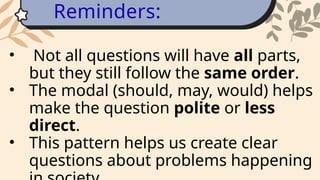
• Not all questions will have all parts,
but they still follow the same order.
• The modal (should, may, would) helps
make the question polite or less
direct.
• This pattern helps us create clear
questions about problems happening
Reminders:
WRITING A LETTER
OF INQUIRY ABOUT
A SOCIAL PROBLEM
Letter of
Inquiry
A letter of inquiry is a formal letter
written to politely ask for information
or clarification about something you
want to know or understand better.
Sometimes, social problems affect many people
—not just one.
When the issue involves schools, offices, or
professionals, simply asking questions verbally
is not enough.
Why do we write a letter
of inquiry?
➡️In these cases, we write a formal letter of
inquiry to ask for clear information or action.
SAMPLE LETTER OF
INQUIRY
(Parts before the salutation
are not shown)
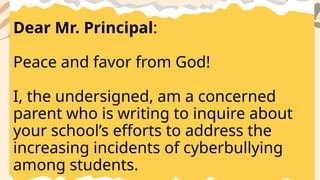
Dear Mr. Principal:
Peace and favor from God!
I, the undersigned, am a concerned
parent who is writing to inquire about
your school’s efforts to address the
increasing incidents of cyberbullying
among students.
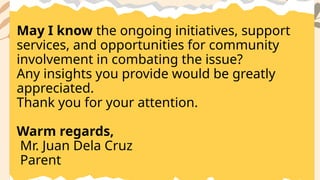
May I know the ongoing initiatives, support
services, and opportunities for community
involvement in combating the issue?
Any insights you provide would be greatly
appreciated.
Thank you for your attention.
Warm regards,
Mr. Juan Dela Cruz
Parent
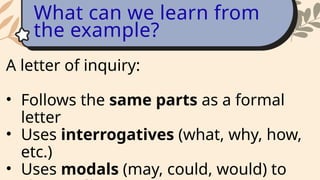
A letter of inquiry:
• Follows the same parts as a formal
letter
• Uses interrogatives (what, why, how,
etc.)
• Uses modals (may, could, would) to
What can we learn from
the example?
a. Opening / First Paragraph
• Introduce yourself
• State your position (e.g., parent,
student leader, official)
• Explain why you are writing
Important Parts of a
Letter of Inquiry
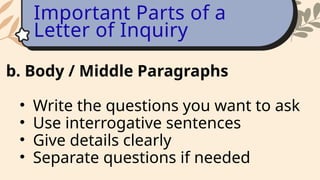
b. Body / Middle Paragraphs
• Write the questions you want to ask
• Use interrogative sentences
• Give details clearly
• Separate questions if needed
Important Parts of a
Letter of Inquiry
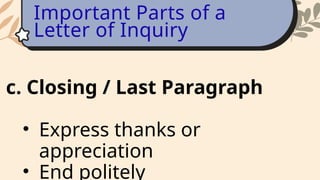
c. Closing / Last Paragraph
• Express thanks or
appreciation
• End politely
Important Parts of a
Letter of Inquiry
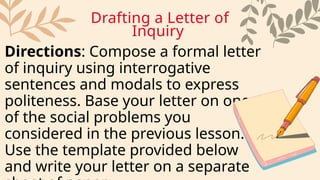
Directions: Compose a formal letter
of inquiry using interrogative
sentences and modals to express
politeness. Base your letter on one
of the social problems you
considered in the previous lesson.
Use the template provided below
and write your letter on a separate
Drafting a Letter of
Inquiry
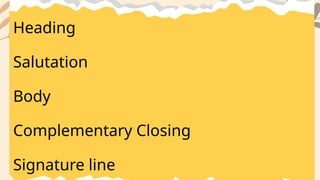
Heading
Salutation
Body
Complementary Closing
Signature line
LEARNER’S
TAKEAWAYS
Directions: Complete the
following prompts so that
the teacher may check
your gains and readiness
to exit this lesson:
Exit Ticket
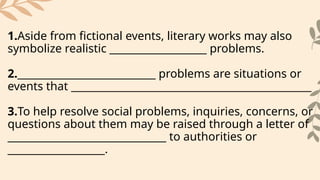
1.Aside from fictional events, literary works may also
symbolize realistic ___________________ problems.
2.___________________________ problems are situations or
events that _______________________________________________
3.To help resolve social problems, inquiries, concerns, or
questions about them may be raised through a letter of
_______________________________ to authorities or
___________________.
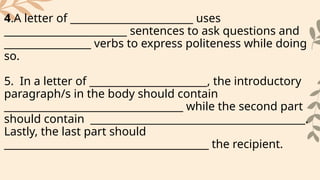
4.A letter of ________________________ uses
________________________ sentences to ask questions and
_________________ verbs to express politeness while doing
so.
5. In a letter of _______________________, the introductory
paragraph/s in the body should contain
___________________________________ while the second part
should contain __________________________________________.
Lastly, the last part should
________________________________________ the recipient.
Directions: As a form of
reflection, answer the
following prompts as well
without having to submit
your responses.
Reflection on Learning
a. In this lesson, I learned about
____________________________________________.
b. I find the part about
_______________________________________interesting and
useful.
c. I find the part about
___________________________________a bit difficult or
confusing.
d. What I should do to help myself overcome my
Day
Pre-Writing
Part 1
continued
SUMMATIVE
ASSESSMENT
For items 1-5, provide a one-
paragraph summary of all the key
events in the literary text read. The
paragraph should have a maximum
of eight sentences.
1-5. Summary of the literary text
a. Literary Text Summary
(5pts):
List down five social issues or problems either
related to the one symbolized in the literary text
read or found in other Afro-Asian countries or
texts.
6.
7.
8.
9.
10.
b. Enumeration (5pts):
Using your answers to Items 6 to 10 as your
topics, construct or write proper interrogative
sentences with modals expressing politeness.
11.
12.
13.
14.
15.
c. Interrogatives and
Modals (5pts):
For items 16-20, write a short formal letter of inquiry
to a professional or authority who can answer one of
the interrogative questions you constructed in Items
11 to 15. As there is no actual recipient, the heading
may just be the date today followed by the salutation,
“To whom it may concern:”. The other elements of a
letter and the details needed in the body as tackled
during the lesson discussion should be provided
correctly.
d. Mini Letter Writing
(5pts):
FOR LISTENING!

English eight _Quarter4_WEEK3 SY 2526_LESSON3.pptx

  • 1.
    1. An Afro-Asianliterary text with an embedded history, culture, heritage, or social issue 2.Modals expressing politeness and questions 3.Types of sentences according to purpose 4.The draft of a formal letter of inquiry ENGLISH 8, QUARTER 4, LESSON 3, WEEK 3
  • 2.
    EN8INF-IV-9 Synthesize significantinformation. EN8INF-IV-11 Organize significant information using various technique. EN8INF-IV-14 Apply multimodal elements appropriate to the chosen text delivery/ies. EN8TRAN-IV-6 Compose a letter of inquiry. EN8TRAN-IV-7 Revise for coherence and cohesion. EN8TRAN-IV-8 Edit for consistency of diction, style, tone and register, point of view, and grammar. EN8TRAN-IV-9 Send correspondences to communicate with and respond to senders within the bounds of ethics. LEARNING COMPETENCIES
  • 3.
    1. Summarize anAfro-Asian literary text highlighting its symbolisms and thematic elements through various means. 2. Formulate inquiries about an Afro- Asian history, culture, heritage, or social issues that are reflected in or related to an Afro-Asian literary text. 3. Construct a formal letter using standard parts and linguistic LEARNING OBJECTIVES
  • 4.
  • 5.
  • 6.
    Directions: Based onwhat you could recall from the Afro-Asian literary text you were asked to read in the previous lesson, prepare and present a graphic outline/ diagram/ organizer that outlines or summarizes the key events of the said text. Focus on who the characters were and what happened to them in the text from beginning to ending. You may use the space below in preparing your graphic organizer/ outline, or you may write your output in a separate sheet of Recalling text previously read
  • 8.
    In the previousunit, you have learned about the two general types of letters—formal and informal—as means of communication for discussing a wide range of topics. They also explored an Afro-Asian literary text that could serve as a discussion topic. In this unit (lesson 1 of 2), you will recall the factual details and interpretations of the assigned text and express queries or concerns related to the symbolic issues reflected in the text. Establishing Lesson Purpose
  • 9.
    Direction: Read the definition of eachterm. Unlocking Content Vocabulary
  • 10.
    refers to theact of requesting information or investigating something that is of interest or concern to people (Merriam-Webster) Can you think of any object that you may associate with the meaning of the vocabulary word “inquiry”? 1. Inquiry
  • 11.
    also known associal problem, the term is about any condition or situation that negatively affects people individually or in large groups Can you give your own example of social issues? 2. Social Issue
  • 12.
  • 13.
    Directions: Form agroup with your classmates and then prepare a short skit or play presenting a real-life scenario that also shows a similar social problem to the one found in the Afro-Asian text you were asked to read. Be prepared to present in class and explain how and why your skit represents a similar social problem. A. Unearthing the Symbolized Social Problem
  • 14.
    Creativity/ Originality (7pts)—refersto whether or not the scenario presented is creatively realistic and original or different from those presented by other groups Relevance to the Symbolized Social Problem in the Text (6pts)—refers to whether or not the explanation of how and why the skit has a similar social problem to the one found in the text tackled justifies the connection of the two Compliance with Requirements (4pts)—refers to whether or not the entirety of the skit, including its explanation, is within the given time limit of 5 minutes or less Use of the English Language (3pts)—refers to whether or not the skit and its presentation involved the consistent use of the English language Criteria:
  • 15.
    Directions:Mark an (X) beforethe scenario number if it shows a social problem: B. Thinking about Other Social Problems
  • 16.
    During recess, agroup of kids is excluding one of their classmates from playing patintero with them. _____ Scenario 1:
  • 17.
    In the canteen,a student accidentally drops their tray, and other students nearby laugh at them. _____ Scenario 2
  • 18.
    During a scienceproject, a group of students argues over whose idea should be used, but they eventually settle and work together. _____ Scenario 3
  • 19.
    Two friends arechatting happily during lunchtime about their favorite video game. _____ Scenario 4
  • 20.
    In the classroom,a student asks for help from the teacher because they are being endlessly scares or says bad things towards another _____ Scenario 5
  • 21.
  • 22.
    MAKING QUESTIONS ABOUT SOCIALPROBLEMS USING INTERROGATIVES AND MODALS
  • 23.
    What are we doing? Wewill learn how to make questions about social problems using WH- questions and modals.
  • 24.
    These questions show differentsocial problems: When should parents intervene when bullying happens? Social Problem: Bullying
  • 25.
    How may survivors copeafter their homes burn? Social problem: fire/residence burning
  • 26.
    Why would aperson hurt another person? Social problem: violence
  • 27.
    What pattern dothese questions follow? Answer: WH-Question + Modal + Subject + Action Verb Part of the Pattern Examples WH-Question When, how, why Modal Should, may, would Subject Parents, survivors, person Action Verb Intervene, cope, hurt
  • 28.
    WH + Modal+ Subject + Verb Why would a person hurt another person? Example Pattern
  • 29.
    • Not allquestions will have all parts, but they still follow the same order. • The modal (should, may, would) helps make the question polite or less direct. • This pattern helps us create clear questions about problems happening Reminders:
  • 30.
    WRITING A LETTER OFINQUIRY ABOUT A SOCIAL PROBLEM
  • 31.
    Letter of Inquiry A letterof inquiry is a formal letter written to politely ask for information or clarification about something you want to know or understand better.
  • 32.
    Sometimes, social problemsaffect many people —not just one. When the issue involves schools, offices, or professionals, simply asking questions verbally is not enough. Why do we write a letter of inquiry? ➡️In these cases, we write a formal letter of inquiry to ask for clear information or action.
  • 33.
    SAMPLE LETTER OF INQUIRY (Partsbefore the salutation are not shown)
  • 34.
    Dear Mr. Principal: Peaceand favor from God! I, the undersigned, am a concerned parent who is writing to inquire about your school’s efforts to address the increasing incidents of cyberbullying among students.
  • 35.
    May I knowthe ongoing initiatives, support services, and opportunities for community involvement in combating the issue? Any insights you provide would be greatly appreciated. Thank you for your attention. Warm regards, Mr. Juan Dela Cruz Parent
  • 36.
    A letter ofinquiry: • Follows the same parts as a formal letter • Uses interrogatives (what, why, how, etc.) • Uses modals (may, could, would) to What can we learn from the example?
  • 37.
    a. Opening /First Paragraph • Introduce yourself • State your position (e.g., parent, student leader, official) • Explain why you are writing Important Parts of a Letter of Inquiry
  • 38.
    b. Body /Middle Paragraphs • Write the questions you want to ask • Use interrogative sentences • Give details clearly • Separate questions if needed Important Parts of a Letter of Inquiry
  • 39.
    c. Closing /Last Paragraph • Express thanks or appreciation • End politely Important Parts of a Letter of Inquiry
  • 40.
    Directions: Compose aformal letter of inquiry using interrogative sentences and modals to express politeness. Base your letter on one of the social problems you considered in the previous lesson. Use the template provided below and write your letter on a separate Drafting a Letter of Inquiry
  • 41.
  • 42.
  • 43.
    Directions: Complete the followingprompts so that the teacher may check your gains and readiness to exit this lesson: Exit Ticket
  • 44.
    1.Aside from fictionalevents, literary works may also symbolize realistic ___________________ problems. 2.___________________________ problems are situations or events that _______________________________________________ 3.To help resolve social problems, inquiries, concerns, or questions about them may be raised through a letter of _______________________________ to authorities or ___________________.
  • 45.
    4.A letter of________________________ uses ________________________ sentences to ask questions and _________________ verbs to express politeness while doing so. 5. In a letter of _______________________, the introductory paragraph/s in the body should contain ___________________________________ while the second part should contain __________________________________________. Lastly, the last part should ________________________________________ the recipient.
  • 46.
    Directions: As aform of reflection, answer the following prompts as well without having to submit your responses. Reflection on Learning
  • 47.
    a. In thislesson, I learned about ____________________________________________. b. I find the part about _______________________________________interesting and useful. c. I find the part about ___________________________________a bit difficult or confusing. d. What I should do to help myself overcome my
  • 48.
  • 49.
  • 50.
    For items 1-5,provide a one- paragraph summary of all the key events in the literary text read. The paragraph should have a maximum of eight sentences. 1-5. Summary of the literary text a. Literary Text Summary (5pts):
  • 51.
    List down fivesocial issues or problems either related to the one symbolized in the literary text read or found in other Afro-Asian countries or texts. 6. 7. 8. 9. 10. b. Enumeration (5pts):
  • 52.
    Using your answersto Items 6 to 10 as your topics, construct or write proper interrogative sentences with modals expressing politeness. 11. 12. 13. 14. 15. c. Interrogatives and Modals (5pts):
  • 53.
    For items 16-20,write a short formal letter of inquiry to a professional or authority who can answer one of the interrogative questions you constructed in Items 11 to 15. As there is no actual recipient, the heading may just be the date today followed by the salutation, “To whom it may concern:”. The other elements of a letter and the details needed in the body as tackled during the lesson discussion should be provided correctly. d. Mini Letter Writing (5pts):
  • 54.