SCIENCE 5
QUARTER 4 WEEK 3
D
A
Y
1
How Rocks Turn
into Soil
New lesson
Preliminary Activities
A. Prayer
B. Checking of Attendance
C. Kamustahan
Activity:
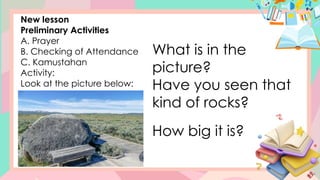
Look at the picture below:
What is in the
picture?
Have you seen that
kind of rocks?
How big it is?
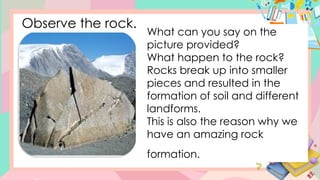
Observe the rock.
What can you say on the
picture provided?
What happen to the rock?
Rocks break up into smaller
pieces and resulted in the
formation of soil and different
landforms.
This is also the reason why we
have an amazing rock
formation.
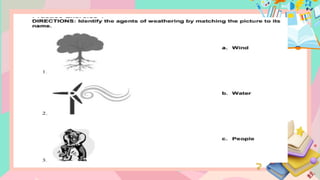
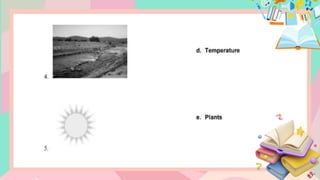
The main cause of soil formation is weathering.
Weathering is the wearing
away of rocks or the breaking of rocks into fragments. It is an
important process that helps shape the surface of the Earth.
Weathering occurs when rocks near or on the surface of the
Earth are exposed to air, water, and other living things.
Weathering can be classified into two general types:
mechanical or physical weathering and chemical weathering.
In this lesson, we will study the processes of mechanical
weathering.
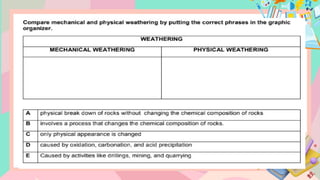
Mechanical weathering refers to the process by which
rocks disintegrate into small particles due to change in
temperature, human activities, and the actions of
plants, animals, and frost.
In this process, the physical characteristics of rocks are
changed but their chemical composition remains the
same. It occurs when water enters cracks and crevices
of rocks and exerts more pressure, causing the rocks to
break. Only the physical appearance (form and
shape) of rocks is changed.
Agent of Mechanical Weathering
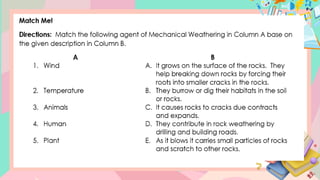
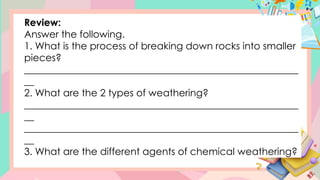
Temperature
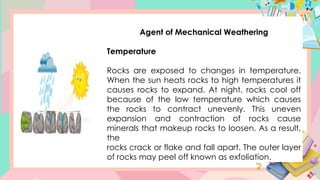
Rocks are exposed to changes in temperature.
When the sun heats rocks to high temperatures it
causes rocks to expand. At night, rocks cool off
because of the low temperature which causes
the rocks to contract unevenly. This uneven
expansion and contraction of rocks cause
minerals that makeup rocks to loosen. As a result,
the
rocks crack or flake and fall apart. The outer layer
of rocks may peel off known as exfoliation.
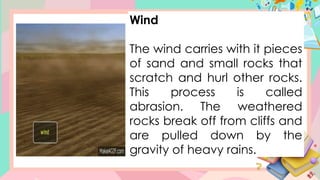
Wind
The wind carries with it pieces
of sand and small rocks that
scratch and hurl other rocks.
This process is called
abrasion. The weathered
rocks break off from cliffs and
are pulled down by the
gravity of heavy rains.
The plant also grows on the
surfaces of rocks. They help break
down rocks by forcing their roots
into smaller cracks in the rocks. As
the root of the plant grow bigger
the roots of the plant grow bigger
which will make the cracks on the
rocks grow bigger. This causes the
rocks to crumble into smaller
pieces.
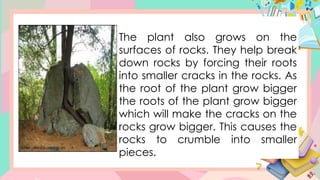
The plant also grows on the
surfaces of rocks. They help break
down rocks by forcing their roots
into smaller cracks in the rocks. As
the root of the plant grow bigger
the roots of the plant grow bigger
which will make the cracks on the
rocks grow bigger. This causes the
rocks to crumble into smaller
pieces.
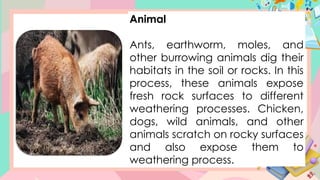
Animal
Ants, earthworm, moles, and
other burrowing animals dig their
habitats in the soil or rocks. In this
process, these animals expose
fresh rock surfaces to different
weathering processes. Chicken,
dogs, wild animals, and other
animals scratch on rocky surfaces
and also expose them to
weathering process.
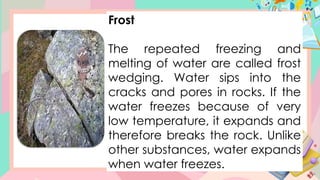
Frost
The repeated freezing and
melting of water are called frost
wedging. Water sips into the
cracks and pores in rocks. If the
water freezes because of very
low temperature, it expands and
therefore breaks the rock. Unlike
other substances, water expands
when water freezes.
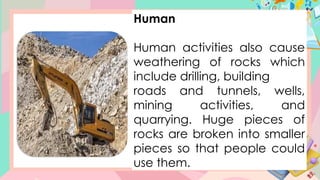
Human
Human activities also cause
weathering of rocks which
include drilling, building
roads and tunnels, wells,
mining activities, and
quarrying. Huge pieces of
rocks are broken into smaller
pieces so that people could
use them.
Say It!
Describe how the following agent of
mechanical weathering contributes to
rock weathering.
1. Human
2. Plants
3. Temperature
4. Animals
5. Frost
Animals contributes most
in rock weathering by
quarrying or extracting
rocks from the mountain.
Do you agree with their
activity? Why?
What do you mean by
weathering?
What are the different
agent of mechanical
weathering?
SCIENCE 5
QUARTER 4 WEEK 3
D
A
Y
2
How Rocks Turn
into Soil
Review:
Say It!
Describe how the following agent of
mechanical weathering contributes to rock
weathering.
1.Human
2.Plants
3.Temperature
4.Animals
Frost
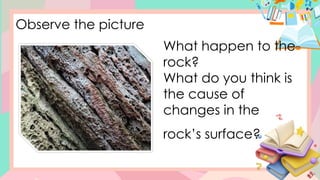
Observe the picture
What happen to the
rock?
What do you think is
the cause of
changes in the
rock’s surface?
Review:
Say It!
Describe how the following agent of
mechanical weathering contributes to rock
weathering.
1.Human
2.Plants
3.Temperature
4.Animals
5. Frost
Chemical weathering refers to the breaking down of
rocks into smaller pieces due to the action of some
elements and compounds in the environment like
oxygen,
carbon dioxide, and water.
The chemical composition of the rocks is changed
during this process, which causes minerals to
decompose and even dissolve. Water, oxygen,
carbon dioxide, and acids are the most common
causes of chemical weathering.
Agent of Chemical Weathering
Oxygen.
Oxidation is the process by which oxygen combines
with another substance. Oxygen causes chemical
weathering by oxidation. It readily combines with
minerals in the rocks. The compounds of iron are
usually the minerals in the rocks that readily
combine with oxygen. The product of this
combination is rust. Rust makes rocks soft and
crumbly and gives off a red-brown color.
Carbon Dioxide
When carbon dioxide in the air easily combines
with water, Carbonic Acid is formed. It is a
weak acid that may cause chemical
weathering in rocks. Carbonic acid dissolves
and removes some of the minerals in rocks and
form new compounds
when it comes in contact with a rock. These
compounds are called carbonates.
Carbonation is the process wherein rocks
become softer and later decompose.
The rocks become weaker by the
formation of carbonates. Calcite is the
mineral in limestone that is completely
dissolved in carbonic acid flows over
limestone rocks. The water carries away
the calcite. Because of this, limestone
weakens and may easily weather.
Water
New compounds are formed when water combines with
minerals in rocks or substances in the air. These
compounds weaken the rock's structure, causing it to
crumble into smaller pieces. For example, a new
compound is formed when water combines with feldspar,
a mineral in rocks. This new compound is called kaolin. It
occupies a greater space in the rock. As kaolin is formed,
it expands. The other minerals in the rock are loosened by
this expansion. This results in the breaking of the surface of
the rock. The rock slowly breaks into smaller pieces.
Other acids aside from carbonic acid
may form when water combines with
other substances. These acids help in the
chemical weathering of rocks. Acid rain
is the result of the combination of water
in the atmosphere with pollutants
released from factories, homes, and
vehicles. It also helps in the weathering
of rocks.
Answer the following.
1. What is the process of breaking down rocks into
smaller pieces?
___________________________________________________
_______
2. What are the 2 types of weathering?
___________________________________________________
_______
___________________________________________________
_______
3. What are the different agents of chemical
weathering?
Acid rain is brought about by
natural and man-made activities
like the burning of fuels. Acid
Rain makes buildings, bridges, and
monuments weaker as the years of
exposure go by. What can you do
to help reduce acid rain?
How Chemical
weathering involves in
turning rocks into soil?
What are the agent of
Chemical Weathering?
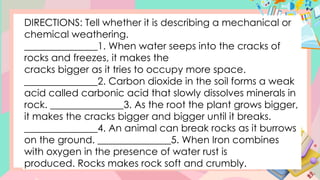
DIRECTIONS: Tell whether it is describing a mechanical or
chemical weathering.
_______________1. When water seeps into the cracks of
rocks and freezes, it makes the
cracks bigger as it tries to occupy more space.
_______________2. Carbon dioxide in the soil forms a weak
acid called carbonic acid that slowly dissolves minerals in
rock. _______________3. As the root the plant grows bigger,
it makes the cracks bigger and bigger until it breaks.
_______________4. An animal can break rocks as it burrows
on the ground. _______________5. When Iron combines
with oxygen in the presence of water rust is
produced. Rocks makes rock soft and crumbly.
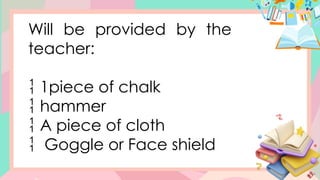
Will be provided by the
teacher:
 1piece of chalk
 hammer
 A piece of cloth
 Goggle or Face shield
SCIENCE 5
QUARTER 4 WEEK 3
D
A
Y
3
How Rocks
Turn into Soil
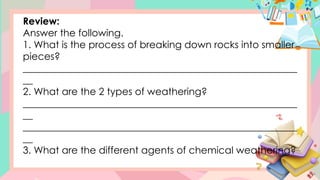
Review:
Answer the following.
1. What is the process of breaking down rocks into smaller
pieces?
________________________________________________________
__
2. What are the 2 types of weathering?
________________________________________________________
__
________________________________________________________
__
3. What are the different agents of chemical weathering?
Review:
Answer the following.
1. What is the process of breaking down rocks into smaller
pieces?
________________________________________________________
__
2. What are the 2 types of weathering?
________________________________________________________
__
________________________________________________________
__
3. What are the different agents of chemical weathering?
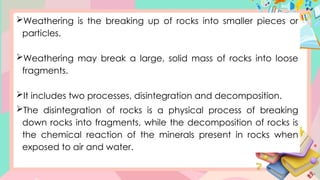
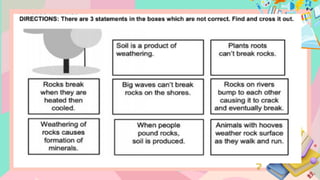
Weathering is the breaking up of rocks into smaller pieces or
particles.
Weathering may break a large, solid mass of rocks into loose
fragments.
It includes two processes, disintegration and decomposition.
The disintegration of rocks is a physical process of breaking
down rocks into fragments, while the decomposition of rocks is
the chemical reaction of the minerals present in rocks when
exposed to air and water.
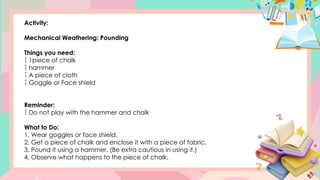
Activity:
Mechanical Weathering: Pounding
Things you need:
 1piece of chalk
 hammer
 A piece of cloth
 Goggle or Face shield
Reminder:
 Do not play with the hammer and chalk
What to Do:
1. Wear goggles or face shield.
2. Get a piece of chalk and enclose it with a piece of fabric.
3. Pound it using a hammer. (Be extra cautious in using it.)
4. Observe what happens to the piece of chalk.
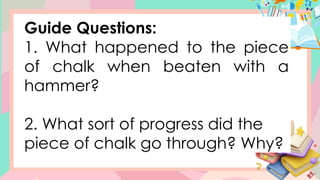
Guide Questions:
1. What happened to the piece
of chalk when beaten with a
hammer?
2. What sort of progress did the
piece of chalk go through? Why?
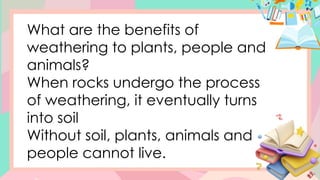
What are the benefits of
weathering to plants, people and
animals?
When rocks undergo the process
of weathering, it eventually turns
into soil
Without soil, plants, animals and
people cannot live.
DIRECTIONS: Write the letter of the
BEST answer.
_____1. Which of the following
human activities contribute to
weathering?
A. fishing
B. mining
C. snorkeling
D. studying
_____2. How do roots of plants
help in weathering of plants?
A. They heat the rocks.
B. They split the rock apart.
C. They absorb the rock
particles.
D. They leave minerals on the
rocks.
_____3. How does temperature
breakdown rocks?
A. Rocks break when it is cooled.
B. Rocks break when it is heated.
C. Rocks break when it is heated and
then cooled.
D. Rocks break when it is not exposed
temperature.
_____4. Animals like rabbits and moles dig up
soil for food and shelter. How does this activity
contribute to weathering of rocks?
A. Animals eat rocks.
B. Animals enjoy the cold soil.
C. Small rocks will be exposed to rain and
sunlight.
D. Digging or burrowing of animals break the
rocks into small pieces.
_____5. How do lichens break
down rocks?
A. Through their roots
B. Through their leaves
C. Through their branches
D. Through the acid they
produce
Bring the following
materials
You will need:
 A piece of chalk
 1 tablespoon of vinegar
 1 container
 1 Goggle or face shield
SCIENCE 5
QUARTER 4 WEEK 3
D
A
Y
4
How Rocks Turn into
Soil
Ask:
What are the benefits of
weathering to plants,
people and animals?
Rocks do not break on
their own. The outsides
forces that break down
rocks are called agents
of weathering.
Ask:
What are the benefits of
weathering to plants,
people and animals?
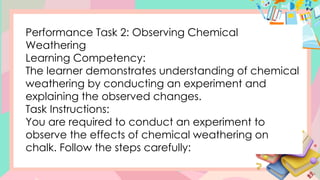
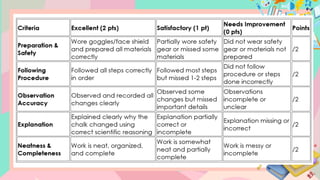
Performance Task 2: Observing Chemical
Weathering
Learning Competency:
The learner demonstrates understanding of chemical
weathering by conducting an experiment and
explaining the observed changes.
Task Instructions:
You are required to conduct an experiment to
observe the effects of chemical weathering on
chalk. Follow the steps carefully:
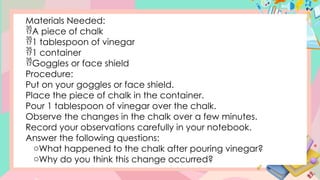
Materials Needed:
A piece of chalk
1 tablespoon of vinegar
1 container
Goggles or face shield
Procedure:
Put on your goggles or face shield.
Place the piece of chalk in the container.
Pour 1 tablespoon of vinegar over the chalk.
Observe the changes in the chalk over a few minutes.
Record your observations carefully in your notebook.
Answer the following questions:
oWhat happened to the chalk after pouring vinegar?
oWhy do you think this change occurred?
Do chemical weathering
helps human?
What happen to rocks
when exposed to
chemical?
DIRECTIONS: Write the letter of the best
answer before the number.
_____1. What is the most important
effect of weathering to people and
animals?
A. formation of clouds
B. formation of climate
C. formation of soil
D. formation of minerals
_____2. Which of the following
activities is possible because of
weathering?
A. Planting of plants
B. Producing essential oils
C. Forming of Rocks
D. Flying kites
_____3. What will happen to
plants is rocks are NOT
weathered?
A. Plants will grow.
B. Plants will not grow.
C. Plants will thrive.
D. None of the these
____4. What will happen to
rocks if it is weathered?
A. It becomes a soil.
B. It becomes humus.
C. It becomes a mineral.
D. It becomes a powdered
substance.
____5. Aside from formation of soil,
which of the following shows a result
of continuous weathering?
A. formation of sea
B. formation of clouds
C. formation of mineral
D. formation of landform
SCIENCE 5
QUARTER 4 WEEK 3
D
A
Y
5
COMPLETION OF
ALL TASKS

PPT-SCIENCE-5-Q4-W3-.pptx science science

  • 1.
    SCIENCE 5 QUARTER 4WEEK 3 D A Y 1 How Rocks Turn into Soil
  • 2.
    New lesson Preliminary Activities A.Prayer B. Checking of Attendance C. Kamustahan Activity: Look at the picture below: What is in the picture? Have you seen that kind of rocks? How big it is?
  • 3.
    Observe the rock. Whatcan you say on the picture provided? What happen to the rock? Rocks break up into smaller pieces and resulted in the formation of soil and different landforms. This is also the reason why we have an amazing rock formation.
  • 4.
    The main causeof soil formation is weathering. Weathering is the wearing away of rocks or the breaking of rocks into fragments. It is an important process that helps shape the surface of the Earth. Weathering occurs when rocks near or on the surface of the Earth are exposed to air, water, and other living things. Weathering can be classified into two general types: mechanical or physical weathering and chemical weathering. In this lesson, we will study the processes of mechanical weathering.
  • 5.
    Mechanical weathering refersto the process by which rocks disintegrate into small particles due to change in temperature, human activities, and the actions of plants, animals, and frost. In this process, the physical characteristics of rocks are changed but their chemical composition remains the same. It occurs when water enters cracks and crevices of rocks and exerts more pressure, causing the rocks to break. Only the physical appearance (form and shape) of rocks is changed.
  • 6.
    Agent of MechanicalWeathering Temperature Rocks are exposed to changes in temperature. When the sun heats rocks to high temperatures it causes rocks to expand. At night, rocks cool off because of the low temperature which causes the rocks to contract unevenly. This uneven expansion and contraction of rocks cause minerals that makeup rocks to loosen. As a result, the rocks crack or flake and fall apart. The outer layer of rocks may peel off known as exfoliation.
  • 7.
    Wind The wind carrieswith it pieces of sand and small rocks that scratch and hurl other rocks. This process is called abrasion. The weathered rocks break off from cliffs and are pulled down by the gravity of heavy rains.
  • 8.
    The plant alsogrows on the surfaces of rocks. They help break down rocks by forcing their roots into smaller cracks in the rocks. As the root of the plant grow bigger the roots of the plant grow bigger which will make the cracks on the rocks grow bigger. This causes the rocks to crumble into smaller pieces.
  • 9.
    The plant alsogrows on the surfaces of rocks. They help break down rocks by forcing their roots into smaller cracks in the rocks. As the root of the plant grow bigger the roots of the plant grow bigger which will make the cracks on the rocks grow bigger. This causes the rocks to crumble into smaller pieces.
  • 10.
    Animal Ants, earthworm, moles,and other burrowing animals dig their habitats in the soil or rocks. In this process, these animals expose fresh rock surfaces to different weathering processes. Chicken, dogs, wild animals, and other animals scratch on rocky surfaces and also expose them to weathering process.
  • 11.
    Frost The repeated freezingand melting of water are called frost wedging. Water sips into the cracks and pores in rocks. If the water freezes because of very low temperature, it expands and therefore breaks the rock. Unlike other substances, water expands when water freezes.
  • 12.
    Human Human activities alsocause weathering of rocks which include drilling, building roads and tunnels, wells, mining activities, and quarrying. Huge pieces of rocks are broken into smaller pieces so that people could use them.
  • 13.
    Say It! Describe howthe following agent of mechanical weathering contributes to rock weathering. 1. Human 2. Plants 3. Temperature 4. Animals 5. Frost
  • 14.
    Animals contributes most inrock weathering by quarrying or extracting rocks from the mountain. Do you agree with their activity? Why?
  • 15.
    What do youmean by weathering? What are the different agent of mechanical weathering?
  • 17.
    SCIENCE 5 QUARTER 4WEEK 3 D A Y 2 How Rocks Turn into Soil
  • 18.
    Review: Say It! Describe howthe following agent of mechanical weathering contributes to rock weathering. 1.Human 2.Plants 3.Temperature 4.Animals Frost
  • 19.
    Observe the picture Whathappen to the rock? What do you think is the cause of changes in the rock’s surface?
  • 20.
    Review: Say It! Describe howthe following agent of mechanical weathering contributes to rock weathering. 1.Human 2.Plants 3.Temperature 4.Animals 5. Frost
  • 21.
    Chemical weathering refersto the breaking down of rocks into smaller pieces due to the action of some elements and compounds in the environment like oxygen, carbon dioxide, and water. The chemical composition of the rocks is changed during this process, which causes minerals to decompose and even dissolve. Water, oxygen, carbon dioxide, and acids are the most common causes of chemical weathering.
  • 22.
    Agent of ChemicalWeathering Oxygen. Oxidation is the process by which oxygen combines with another substance. Oxygen causes chemical weathering by oxidation. It readily combines with minerals in the rocks. The compounds of iron are usually the minerals in the rocks that readily combine with oxygen. The product of this combination is rust. Rust makes rocks soft and crumbly and gives off a red-brown color.
  • 23.
    Carbon Dioxide When carbondioxide in the air easily combines with water, Carbonic Acid is formed. It is a weak acid that may cause chemical weathering in rocks. Carbonic acid dissolves and removes some of the minerals in rocks and form new compounds when it comes in contact with a rock. These compounds are called carbonates.
  • 24.
    Carbonation is theprocess wherein rocks become softer and later decompose. The rocks become weaker by the formation of carbonates. Calcite is the mineral in limestone that is completely dissolved in carbonic acid flows over limestone rocks. The water carries away the calcite. Because of this, limestone weakens and may easily weather.
  • 25.
    Water New compounds areformed when water combines with minerals in rocks or substances in the air. These compounds weaken the rock's structure, causing it to crumble into smaller pieces. For example, a new compound is formed when water combines with feldspar, a mineral in rocks. This new compound is called kaolin. It occupies a greater space in the rock. As kaolin is formed, it expands. The other minerals in the rock are loosened by this expansion. This results in the breaking of the surface of the rock. The rock slowly breaks into smaller pieces.
  • 26.
    Other acids asidefrom carbonic acid may form when water combines with other substances. These acids help in the chemical weathering of rocks. Acid rain is the result of the combination of water in the atmosphere with pollutants released from factories, homes, and vehicles. It also helps in the weathering of rocks.
  • 27.
    Answer the following. 1.What is the process of breaking down rocks into smaller pieces? ___________________________________________________ _______ 2. What are the 2 types of weathering? ___________________________________________________ _______ ___________________________________________________ _______ 3. What are the different agents of chemical weathering?
  • 28.
    Acid rain isbrought about by natural and man-made activities like the burning of fuels. Acid Rain makes buildings, bridges, and monuments weaker as the years of exposure go by. What can you do to help reduce acid rain?
  • 29.
    How Chemical weathering involvesin turning rocks into soil? What are the agent of Chemical Weathering?
  • 30.
    DIRECTIONS: Tell whetherit is describing a mechanical or chemical weathering. _______________1. When water seeps into the cracks of rocks and freezes, it makes the cracks bigger as it tries to occupy more space. _______________2. Carbon dioxide in the soil forms a weak acid called carbonic acid that slowly dissolves minerals in rock. _______________3. As the root the plant grows bigger, it makes the cracks bigger and bigger until it breaks. _______________4. An animal can break rocks as it burrows on the ground. _______________5. When Iron combines with oxygen in the presence of water rust is produced. Rocks makes rock soft and crumbly.
  • 31.
    Will be providedby the teacher:  1piece of chalk  hammer  A piece of cloth  Goggle or Face shield
  • 32.
    SCIENCE 5 QUARTER 4WEEK 3 D A Y 3 How Rocks Turn into Soil
  • 33.
    Review: Answer the following. 1.What is the process of breaking down rocks into smaller pieces? ________________________________________________________ __ 2. What are the 2 types of weathering? ________________________________________________________ __ ________________________________________________________ __ 3. What are the different agents of chemical weathering?
  • 36.
    Review: Answer the following. 1.What is the process of breaking down rocks into smaller pieces? ________________________________________________________ __ 2. What are the 2 types of weathering? ________________________________________________________ __ ________________________________________________________ __ 3. What are the different agents of chemical weathering?
  • 37.
    Weathering is thebreaking up of rocks into smaller pieces or particles. Weathering may break a large, solid mass of rocks into loose fragments. It includes two processes, disintegration and decomposition. The disintegration of rocks is a physical process of breaking down rocks into fragments, while the decomposition of rocks is the chemical reaction of the minerals present in rocks when exposed to air and water.
  • 39.
    Activity: Mechanical Weathering: Pounding Thingsyou need:  1piece of chalk  hammer  A piece of cloth  Goggle or Face shield Reminder:  Do not play with the hammer and chalk What to Do: 1. Wear goggles or face shield. 2. Get a piece of chalk and enclose it with a piece of fabric. 3. Pound it using a hammer. (Be extra cautious in using it.) 4. Observe what happens to the piece of chalk.
  • 40.
    Guide Questions: 1. Whathappened to the piece of chalk when beaten with a hammer? 2. What sort of progress did the piece of chalk go through? Why?
  • 41.
    What are thebenefits of weathering to plants, people and animals? When rocks undergo the process of weathering, it eventually turns into soil Without soil, plants, animals and people cannot live.
  • 42.
    DIRECTIONS: Write theletter of the BEST answer. _____1. Which of the following human activities contribute to weathering? A. fishing B. mining C. snorkeling D. studying
  • 43.
    _____2. How doroots of plants help in weathering of plants? A. They heat the rocks. B. They split the rock apart. C. They absorb the rock particles. D. They leave minerals on the rocks.
  • 44.
    _____3. How doestemperature breakdown rocks? A. Rocks break when it is cooled. B. Rocks break when it is heated. C. Rocks break when it is heated and then cooled. D. Rocks break when it is not exposed temperature.
  • 45.
    _____4. Animals likerabbits and moles dig up soil for food and shelter. How does this activity contribute to weathering of rocks? A. Animals eat rocks. B. Animals enjoy the cold soil. C. Small rocks will be exposed to rain and sunlight. D. Digging or burrowing of animals break the rocks into small pieces.
  • 46.
    _____5. How dolichens break down rocks? A. Through their roots B. Through their leaves C. Through their branches D. Through the acid they produce
  • 47.
    Bring the following materials Youwill need:  A piece of chalk  1 tablespoon of vinegar  1 container  1 Goggle or face shield
  • 48.
    SCIENCE 5 QUARTER 4WEEK 3 D A Y 4 How Rocks Turn into Soil
  • 49.
    Ask: What are thebenefits of weathering to plants, people and animals?
  • 50.
    Rocks do notbreak on their own. The outsides forces that break down rocks are called agents of weathering.
  • 51.
    Ask: What are thebenefits of weathering to plants, people and animals?
  • 53.
    Performance Task 2:Observing Chemical Weathering Learning Competency: The learner demonstrates understanding of chemical weathering by conducting an experiment and explaining the observed changes. Task Instructions: You are required to conduct an experiment to observe the effects of chemical weathering on chalk. Follow the steps carefully:
  • 54.
    Materials Needed: A pieceof chalk 1 tablespoon of vinegar 1 container Goggles or face shield Procedure: Put on your goggles or face shield. Place the piece of chalk in the container. Pour 1 tablespoon of vinegar over the chalk. Observe the changes in the chalk over a few minutes. Record your observations carefully in your notebook. Answer the following questions: oWhat happened to the chalk after pouring vinegar? oWhy do you think this change occurred?
  • 56.
    Do chemical weathering helpshuman? What happen to rocks when exposed to chemical?
  • 57.
    DIRECTIONS: Write theletter of the best answer before the number. _____1. What is the most important effect of weathering to people and animals? A. formation of clouds B. formation of climate C. formation of soil D. formation of minerals
  • 58.
    _____2. Which ofthe following activities is possible because of weathering? A. Planting of plants B. Producing essential oils C. Forming of Rocks D. Flying kites
  • 59.
    _____3. What willhappen to plants is rocks are NOT weathered? A. Plants will grow. B. Plants will not grow. C. Plants will thrive. D. None of the these
  • 60.
    ____4. What willhappen to rocks if it is weathered? A. It becomes a soil. B. It becomes humus. C. It becomes a mineral. D. It becomes a powdered substance.
  • 61.
    ____5. Aside fromformation of soil, which of the following shows a result of continuous weathering? A. formation of sea B. formation of clouds C. formation of mineral D. formation of landform
  • 62.
    SCIENCE 5 QUARTER 4WEEK 3 D A Y 5 COMPLETION OF ALL TASKS