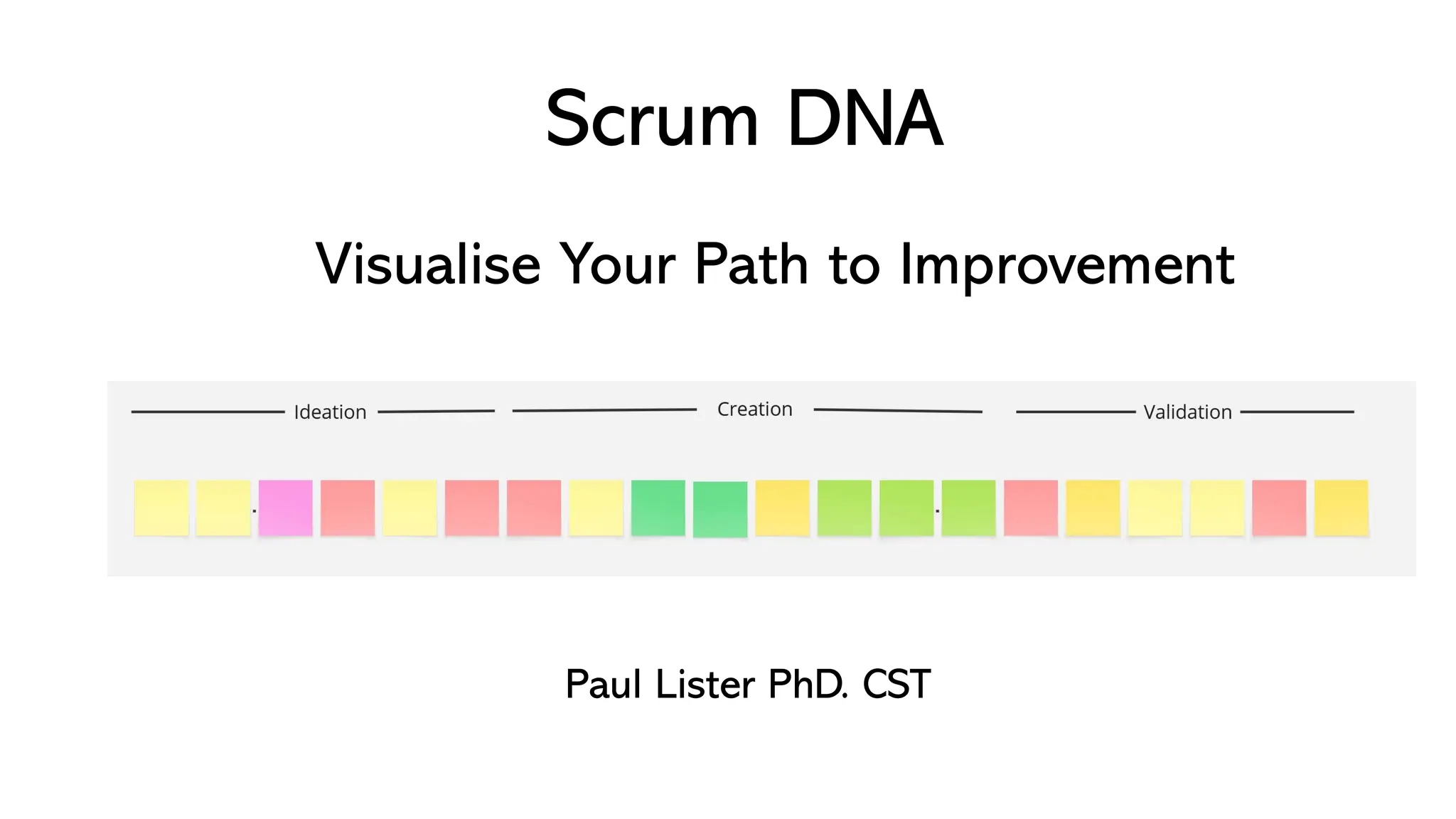
Scrum DNA
Visualise Your Path to Improvement
Paul Lister PhD. CST
Who Am I ?
Simple Contextual Answer:
• Have a Scientific background
• Became a Software Developer
• Became a Manager in a traditional Waterfall system
• Went through an Agile Transformation
• Worked as a Scrum Master for six years
• Became an Agile Coach
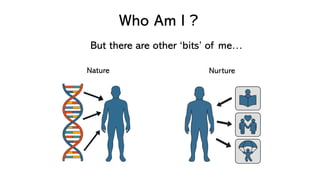
Who Am I ?
But there are other ‘bits’ of me…
Nature Nurture
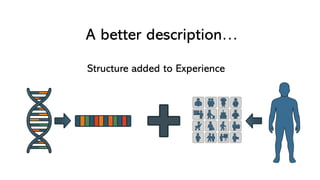
A better description…
Structure added to Experience
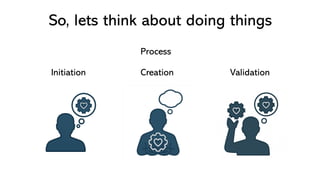
So, lets think about doing things
Initiation Creation Validation
Process
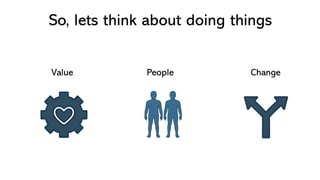
So, lets think about doing things
Value People Change
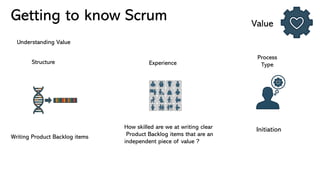
Getting to know Scrum Value
Understanding Value
Writing Product Backlog items
How skilled are we at writing clear
Product Backlog items that are an
independent piece of value ?
Structure Experience
Process
Type
Initiation
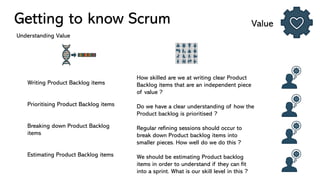
Getting to know Scrum Value
Understanding Value
Writing Product Backlog items
Prioritising Product Backlog items
Breaking down Product Backlog
items
Estimating Product Backlog items
How skilled are we at writing clear Product
Backlog items that are an independent piece
of value ?
Do we have a clear understanding of how the
Product backlog is prioritised ?
Regular refining sessions should occur to
break down Product backlog items into
smaller pieces. How well do we do this ?
We should be estimating Product backlog
items in order to understand if they can fit
into a sprint. What is our skill level in this ?
Getting to know Scrum Value
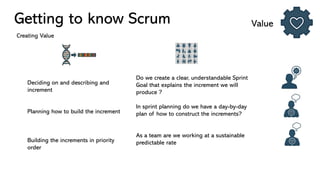
Creating Value
Deciding on and describing and
increment
Planning how to build the increment
Building the increments in priority
order
Do we create a clear, understandable Sprint
Goal that explains the increment we will
produce ?
In sprint planning do we have a day-by-day
plan of how to construct the increments?
As a team are we working at a sustainable
predictable rate
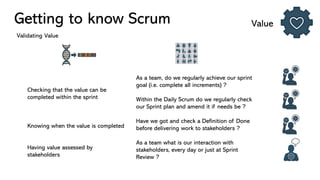
Getting to know Scrum Value
Validating Value
Checking that the value can be
completed within the sprint
Knowing when the value is completed
Having value assessed by
stakeholders
As a team, do we regularly achieve our sprint
goal (i.e. complete all increments) ?
Within the Daily Scrum do we regularly check
our Sprint plan and amend it if needs be ?
Have we got and check a Definition of Done
before delivering work to stakeholders ?
As a team what is our interaction with
stakeholders, every day or just at Sprint
Review ?
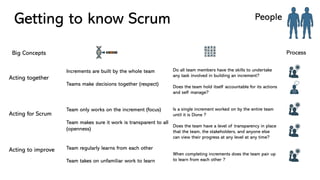
Getting to know Scrum People
Big Concepts
Acting together
Acting for Scrum
Acting to improve
Increments are built by the whole team
Teams make decisions together (respect)
Team only works on the increment (focus)
Team makes sure it work is transparent to all
(openness)
Team regularly learns from each other
Team takes on unfamiliar work to learn
Process
Do all team members have the skills to undertake
any task involved in building an increment?
Does the team hold itself accountable for its actions
and self manage?
Is a single increment worked on by the entire team
until it is Done ?
Does the team have a level of transparency in place
that the team, the stakeholders, and anyone else
can view their progress at any level at any time?
When completing increments does the team pair up
to learn from each other ?
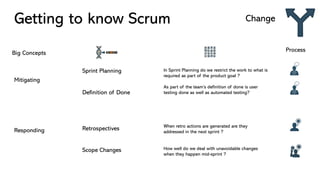
In Sprint Planning do we restrict the work to what is
required as part of the product goal ?
As part of the team’s definition of done is user
testing done as well as automated testing?
When retro actions are generated are they
addressed in the next sprint ?
How well do we deal with unavoidable changes
when they happen mid-sprint ?
Getting to know Scrum Change
Big Concepts
Mitigating
Responding
Sprint Planning
Definition of Done
Retrospectives
Scope Changes
Process
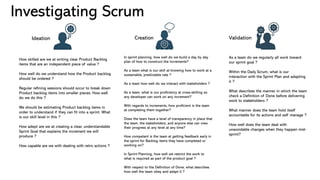
Investigating Scrum
How skilled are we at writing clear Product Backlog
items that are an independent piece of value ?
How well do we understand how the Product backlog
should be ordered ?
Regular refining sessions should occur to break down
Product backlog items into smaller pieces. How well
do we do this ?
We should be estimating Product backlog items in
order to understand if they can fit into a sprint. What
is our skill level in this ?
How adept are we at creating a clear, understandable
Sprint Goal that explains the increment we will
produce ?
How capable are we with dealing with retro actions ?
In sprint planning, how well do we build a day by day
plan of how to construct the increments?
As a team what is our skill at knowing how to work at a
sustainable, predictable rate ?
As a team how well do we interact with stakeholders ?
As a team, what is our proficiency at cross-skilling so
any developer can work on any increment?
With regards to increments, how proficient is the team
at completing them together?
Does the team have a level of transparency in place that
the team, the stakeholders, and anyone else can view
their progress at any level at any time?
How competent is the team at getting feedback early in
the sprint for Backlog items they have completed or
working on?
In Sprint Planning, how well we restrict the work to
what is required as part of the product goal ?
With respect to the Definition of Done, what describes
how well the team obey and adapt it ?
As a team do we regularly all work toward
our sprint goal ?
Within the Daily Scrum, what is our
interaction with the Sprint Plan and adapting
it ?
What describes the manner in which the team
check a Definition of Done before delivering
work to stakeholders ?
What manner does the team hold itself
accountable for its actions and self manage ?
How well does the team deal with
unavoidable changes when they happen mid-
sprint?
Ideation Creation Validation
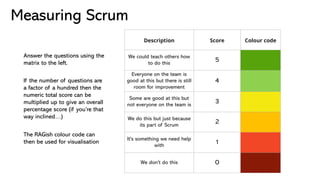
Measuring Scrum
Description Score Colour code
We could teach others how
to do this
5
Everyone on the team is
good at this but there is still
room for improvement
4
Some are good at this but
not everyone on the team is
3
We do this but just because
its part of Scrum
2
It's something we need help
with
1
We don't do this 0
Answer the questions using the
matrix to the left.
If the number of questions are
a factor of a hundred then the
numeric total score can be
multiplied up to give an overall
percentage score (if you’re that
way inclined…)
The RAGish colour code can
then be used for visualisation
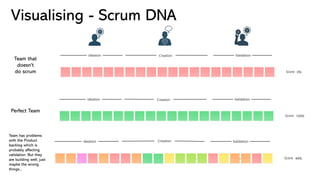
Visualising - Scrum DNA
Team that
doesn't
do scrum
Perfect Team
Team has problems
with the Product
backlog which is
probably affecting
validation. But they
are building well, just
maybe the wrong
things...
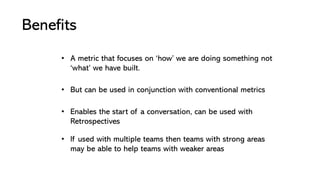
Benefits
• If used with multiple teams then teams with strong areas
may be able to help teams with weaker areas
• Enables the start of a conversation, can be used with
Retrospectives
• But can be used in conjunction with conventional metrics
• A metric that focuses on ‘how’ we are doing something not
‘what’ we have built.
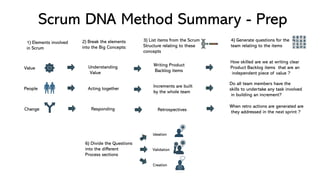
Scrum DNA Method Summary - Prep
2) Break the elements
into the Big Concepts:
Value
People
Change
Writing Product
Backlog items
Increments are built
by the whole team
Understanding
Value
Acting together
Responding
3) List items from the Scrum
Structure relating to these
concepts
Retrospectives
4) Generate questions for the
team relating to the items
How skilled are we at writing clear
Product Backlog items that are an
independent piece of value ?
1) Elements involved
in Scrum
Do all team members have the
skills to undertake any task involved
in building an increment?
When retro actions are generated are
they addressed in the next sprint ?
Ideation
Creation
Validation
6) Divide the Questions
into the different
Process sections
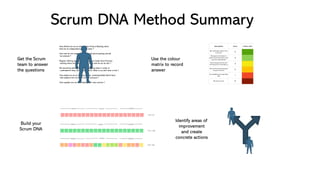
Scrum DNA Method Summary
How skilled are we at writing clear Product Backlog items
that are an independent piece of value ?
How well do we understand howthe Product backlog should
be ordered ?
Regular refining sessions should occur to break down Product
backlog items into smaller pieces. How well do we do this ?
We should be estimating Product backlog items in order to
understand if they can fit into a sprint. What is our skill level in this ?
How adept are we at creating a clear, understandable Sprint Goal
that explains the increment we will produce ?
How capable are we with dealing with retro actions ?
Get the Scrum
team to answer
the questions
Use the colour
matrix to record
answer
Build your
Scrum DNA
Identify areas of
improvement
and create
concrete actions
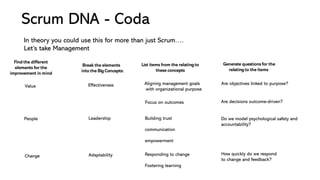
Scrum DNA - Coda
Break the elements
into the BigConcepts:
List items from the relatingto
these concepts
Generate questions for the
relatingto the items
Find the different
elements for the
improvement in mind
In theory you could use this for more than just Scrum….
Let’s take Management
People
Value Effectiveness
Leadership
Responding to change
Fostering learning
Aligning management goals
with organizational purpose
Are objectives linked to purpose?
Building trust
communication
empowerment
Adaptability
Do we model psychological safety and
accountability?
How quickly do we respond
to change and feedback?
Change
Focus on outcomes Are decisions outcome-driven?
Any Questions ?
Thank You

AAC2026_Lister_Understand your 'Scrum DNA' !pdf

  • 1.
    Scrum DNA Visualise YourPath to Improvement Paul Lister PhD. CST
  • 2.
    Who Am I? Simple Contextual Answer: • Have a Scientific background • Became a Software Developer • Became a Manager in a traditional Waterfall system • Went through an Agile Transformation • Worked as a Scrum Master for six years • Became an Agile Coach
  • 3.
    Who Am I? But there are other ‘bits’ of me… Nature Nurture
  • 4.
  • 5.
    So, lets thinkabout doing things Initiation Creation Validation Process
  • 6.
    So, lets thinkabout doing things Value People Change
  • 7.
    Getting to knowScrum Value Understanding Value Writing Product Backlog items How skilled are we at writing clear Product Backlog items that are an independent piece of value ? Structure Experience Process Type Initiation
  • 8.
    Getting to knowScrum Value Understanding Value Writing Product Backlog items Prioritising Product Backlog items Breaking down Product Backlog items Estimating Product Backlog items How skilled are we at writing clear Product Backlog items that are an independent piece of value ? Do we have a clear understanding of how the Product backlog is prioritised ? Regular refining sessions should occur to break down Product backlog items into smaller pieces. How well do we do this ? We should be estimating Product backlog items in order to understand if they can fit into a sprint. What is our skill level in this ?
  • 9.
    Getting to knowScrum Value Creating Value Deciding on and describing and increment Planning how to build the increment Building the increments in priority order Do we create a clear, understandable Sprint Goal that explains the increment we will produce ? In sprint planning do we have a day-by-day plan of how to construct the increments? As a team are we working at a sustainable predictable rate
  • 10.
    Getting to knowScrum Value Validating Value Checking that the value can be completed within the sprint Knowing when the value is completed Having value assessed by stakeholders As a team, do we regularly achieve our sprint goal (i.e. complete all increments) ? Within the Daily Scrum do we regularly check our Sprint plan and amend it if needs be ? Have we got and check a Definition of Done before delivering work to stakeholders ? As a team what is our interaction with stakeholders, every day or just at Sprint Review ?
  • 11.
    Getting to knowScrum People Big Concepts Acting together Acting for Scrum Acting to improve Increments are built by the whole team Teams make decisions together (respect) Team only works on the increment (focus) Team makes sure it work is transparent to all (openness) Team regularly learns from each other Team takes on unfamiliar work to learn Process Do all team members have the skills to undertake any task involved in building an increment? Does the team hold itself accountable for its actions and self manage? Is a single increment worked on by the entire team until it is Done ? Does the team have a level of transparency in place that the team, the stakeholders, and anyone else can view their progress at any level at any time? When completing increments does the team pair up to learn from each other ?
  • 12.
    In Sprint Planningdo we restrict the work to what is required as part of the product goal ? As part of the team’s definition of done is user testing done as well as automated testing? When retro actions are generated are they addressed in the next sprint ? How well do we deal with unavoidable changes when they happen mid-sprint ? Getting to know Scrum Change Big Concepts Mitigating Responding Sprint Planning Definition of Done Retrospectives Scope Changes Process
  • 13.
    Investigating Scrum How skilledare we at writing clear Product Backlog items that are an independent piece of value ? How well do we understand how the Product backlog should be ordered ? Regular refining sessions should occur to break down Product backlog items into smaller pieces. How well do we do this ? We should be estimating Product backlog items in order to understand if they can fit into a sprint. What is our skill level in this ? How adept are we at creating a clear, understandable Sprint Goal that explains the increment we will produce ? How capable are we with dealing with retro actions ? In sprint planning, how well do we build a day by day plan of how to construct the increments? As a team what is our skill at knowing how to work at a sustainable, predictable rate ? As a team how well do we interact with stakeholders ? As a team, what is our proficiency at cross-skilling so any developer can work on any increment? With regards to increments, how proficient is the team at completing them together? Does the team have a level of transparency in place that the team, the stakeholders, and anyone else can view their progress at any level at any time? How competent is the team at getting feedback early in the sprint for Backlog items they have completed or working on? In Sprint Planning, how well we restrict the work to what is required as part of the product goal ? With respect to the Definition of Done, what describes how well the team obey and adapt it ? As a team do we regularly all work toward our sprint goal ? Within the Daily Scrum, what is our interaction with the Sprint Plan and adapting it ? What describes the manner in which the team check a Definition of Done before delivering work to stakeholders ? What manner does the team hold itself accountable for its actions and self manage ? How well does the team deal with unavoidable changes when they happen mid- sprint? Ideation Creation Validation
  • 14.
    Measuring Scrum Description ScoreColour code We could teach others how to do this 5 Everyone on the team is good at this but there is still room for improvement 4 Some are good at this but not everyone on the team is 3 We do this but just because its part of Scrum 2 It's something we need help with 1 We don't do this 0 Answer the questions using the matrix to the left. If the number of questions are a factor of a hundred then the numeric total score can be multiplied up to give an overall percentage score (if you’re that way inclined…) The RAGish colour code can then be used for visualisation
  • 15.
    Visualising - ScrumDNA Team that doesn't do scrum Perfect Team Team has problems with the Product backlog which is probably affecting validation. But they are building well, just maybe the wrong things...
  • 16.
    Benefits • If usedwith multiple teams then teams with strong areas may be able to help teams with weaker areas • Enables the start of a conversation, can be used with Retrospectives • But can be used in conjunction with conventional metrics • A metric that focuses on ‘how’ we are doing something not ‘what’ we have built.
  • 17.
    Scrum DNA MethodSummary - Prep 2) Break the elements into the Big Concepts: Value People Change Writing Product Backlog items Increments are built by the whole team Understanding Value Acting together Responding 3) List items from the Scrum Structure relating to these concepts Retrospectives 4) Generate questions for the team relating to the items How skilled are we at writing clear Product Backlog items that are an independent piece of value ? 1) Elements involved in Scrum Do all team members have the skills to undertake any task involved in building an increment? When retro actions are generated are they addressed in the next sprint ? Ideation Creation Validation 6) Divide the Questions into the different Process sections
  • 18.
    Scrum DNA MethodSummary How skilled are we at writing clear Product Backlog items that are an independent piece of value ? How well do we understand howthe Product backlog should be ordered ? Regular refining sessions should occur to break down Product backlog items into smaller pieces. How well do we do this ? We should be estimating Product backlog items in order to understand if they can fit into a sprint. What is our skill level in this ? How adept are we at creating a clear, understandable Sprint Goal that explains the increment we will produce ? How capable are we with dealing with retro actions ? Get the Scrum team to answer the questions Use the colour matrix to record answer Build your Scrum DNA Identify areas of improvement and create concrete actions
  • 19.
    Scrum DNA -Coda Break the elements into the BigConcepts: List items from the relatingto these concepts Generate questions for the relatingto the items Find the different elements for the improvement in mind In theory you could use this for more than just Scrum…. Let’s take Management People Value Effectiveness Leadership Responding to change Fostering learning Aligning management goals with organizational purpose Are objectives linked to purpose? Building trust communication empowerment Adaptability Do we model psychological safety and accountability? How quickly do we respond to change and feedback? Change Focus on outcomes Are decisions outcome-driven?
  • 20.
  • 21.