Epilepsy
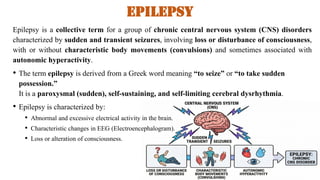
Epilepsy is a collective term for a group of chronic central nervous system (CNS) disorders
characterized by sudden and transient seizures, involving loss or disturbance of consciousness,
with or without characteristic body movements (convulsions) and sometimes associated with
autonomic hyperactivity.
• The term epilepsy is derived from a Greek word meaning “to seize” or “to take sudden
possession.”
It is a paroxysmal (sudden), self-sustaining, and self-limiting cerebral dysrhythmia.
• Epilepsy is characterized by:
• Abnormal and excessive electrical activity in the brain.
• Characteristic changes in EEG (Electroencephalogram).
• Loss or alteration of consciousness.
Cause of Seizures:
• Seizures are caused by sudden, excessive, and rapid electrical discharges of neurons, which:
• Originate in the grey matter of the brain.
• Spread to other parts of the central nervous system.
• Thus, seizures are manifestations of electrical disturbances in the brain.
Clinical Features:
• Sudden and recurrent episodes of:
• Sensory disturbance.
• Loss of consciousness.
• Convulsions (in some cases).
Convulsions:
• Convulsions are defined as sudden, violent, and irregular movements of the body caused by
involuntary contraction of muscles, commonly associated with epilepsy or toxic conditions.
• Important Note
• Epilepsy may or may not be associated with convulsions or visible body movements.
Principal Types of Epilepsy
Grand Mal Epilepsy: Grand mal epilepsy is characterized by a complete loss of consciousness, followed by
temporary muscular rigidity and generalized convulsions involving all voluntary muscles. The seizure
usually lasts for 2 to 5 minutes.
Petit Mal Epilepsy: Petit mal epilepsy involves a sudden and brief loss of consciousness. Convulsions are
absent, but mild symptoms such as blinking of eyelids or slight jerking of the head and arms may occur. The
episode lasts for about 5 to 30 seconds, after which the person becomes immediately alert. This type is more
common in children.
Psychomotor Epilepsy: Psychomotor epilepsy is characterized by seizure attacks without convulsions, lasting
for 2 to 3 minutes. It is associated with mental apathy, abnormal behaviour, and sometimes irrational or
destructive actions. The patient usually has no memory of the event after recovery.
Myoclonic Seizures: Myoclonic seizures are marked by sudden, brief, jerky movements of muscles, affecting
the head, limbs, or entire body. Each movement lasts for about one second and may recur at short intervals
for about one minute. These movements are rapid and rhythmic.
Anticonvulsant (Antiepileptic) Drugs
• Anticonvulsant drugs, also known as antiepileptic
drugs, are agents that selectively depress the central
nervous system (CNS) and are used to prevent or
control epileptic seizures.
• These drugs are defined as substances that prevent
seizures or reduce their frequency and severity in
patients suffering from epilepsy.
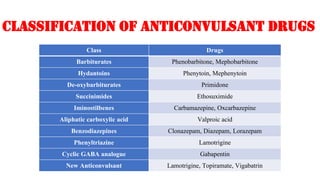
Classification of Anticonvulsant Drugs
Class Drugs
Barbiturates Phenobarbitone, Mephobarbitone
Hydantoins Phenytoin, Mephenytoin
De-oxybarbiturates Primidone
Succinimides Ethosuximide
Iminostilbenes Carbamazepine, Oxcarbazepine
Aliphatic carboxylic acid Valproic acid
Benzodiazepines Clonazepam, Diazepam, Lorazepam
Phenyltriazine Lamotrigine
Cyclic GABA analogue Gabapentin
New Anticonvulsant Lamotrigine, Topiramate, Vigabatrin
PHENYTOIN
• Phenytoin is the first anticonvulsant in which it was clearly demonstrated that anticonvulsant
activity could be separated from sedative–hypnotic activity.
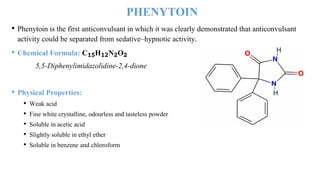
• Chemical Formula: C₁₅H₁₂N₂O₂
5,5-Diphenylimidazolidine-2,4-dione
• Physical Properties:
• Weak acid
• Fine white crystalline, odourless and tasteless powder
• Soluble in acetic acid
• Slightly soluble in ethyl ether
• Soluble in benzene and chloroform
• Pharmaceutical Formulation:
• Available as injectable (IV)
• Oral preparations: syrup, capsule, tablet
• Stability and Storage:
• Store at 20–25 °C (68–77 °F)
• Preserve in tight, light-resistant containers
• Protect from moisture
• Phenytoin sodium suspension in 0.9% NaCl is stable for at least 2 weeks at room temperature
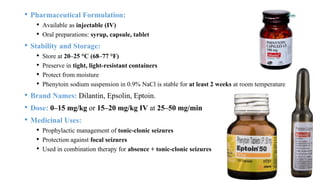
• Brand Names: Dilantin, Epsolin, Eptoin.
• Dose: 0–15 mg/kg or 15–20 mg/kg IV at 25–50 mg/min
• Medicinal Uses:
• Prophylactic management of tonic-clonic seizures
• Protection against focal seizures
• Used in combination therapy for absence + tonic-clonic seizures
CARBAMAZEPINE
• Inhibits voltage-dependent sodium channels
• Chemical Formula: C₁₅H₁₂N₂O
5H-dibenz[b,f]azepine-5-carboxamide
• Physical Properties
• Yellowish-white crystal, almost odourless
• Slightly bitter or tasteless
• Insoluble in water and ether
• Soluble in acetone, alcohol, chloroform, DMF, dioxane, propylene glycol.
• Pharmaceutical Formulation
• Tablets (sustained release, chewable)
• Capsules
• Syrups
• Injectables
• Stability and Storage
• Store at 2–8 °C in airtight container
• Protect from light
• Stable for 8 weeks at room temperature
• Concentration may change after opening
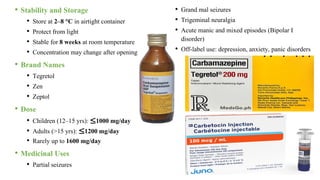
• Brand Names
• Tegretol
• Zen
• Zeptol
• Dose
• Children (12–15 yrs): ≤1000 mg/day
• Adults (>15 yrs): ≤1200 mg/day
• Rarely up to 1600 mg/day
• Medicinal Uses
• Partial seizures
• Grand mal seizures
• Trigeminal neuralgia
• Acute manic and mixed episodes (Bipolar I
disorder)
• Off-label use: depression, anxiety, panic disorders
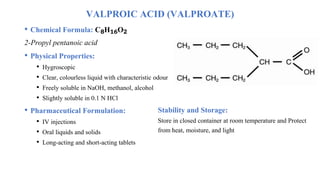
VALPROIC ACID (VALPROATE)
• Chemical Formula: C₈H₁₆O₂
2-Propyl pentanoic acid
• Physical Properties:
• Hygroscopic
• Clear, colourless liquid with characteristic odour
• Freely soluble in NaOH, methanol, alcohol
• Slightly soluble in 0.1 N HCl
• Pharmaceutical Formulation:
• IV injections
• Oral liquids and solids
• Long-acting and short-acting tablets
Stability and Storage:
Store in closed container at room temperature and Protect
from heat, moisture, and light
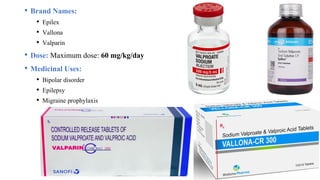
• Brand Names:
• Epilex
• Vallona
• Valparin
• Dose: Maximum dose: 60 mg/kg/day
• Medicinal Uses:
• Bipolar disorder
• Epilepsy
• Migraine prophylaxis
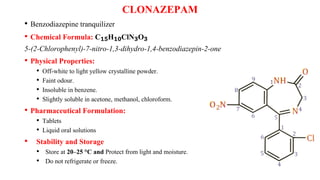
CLONAZEPAM
• Benzodiazepine tranquilizer
• Chemical Formula: C₁₅H₁₀ClN₃O₃
5-(2-Chlorophenyl)-7-nitro-1,3-dihydro-1,4-benzodiazepin-2-one
• Physical Properties:
• Off-white to light yellow crystalline powder.
• Faint odour.
• Insoluble in benzene.
• Slightly soluble in acetone, methanol, chloroform.
• Pharmaceutical Formulation:
• Tablets
• Liquid oral solutions
• Stability and Storage
• Store at 20–25 °C and Protect from light and moisture.
• Do not refrigerate or freeze.
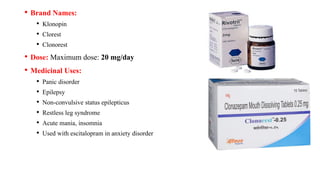
• Brand Names:
• Klonopin
• Clorest
• Clonorest
• Dose: Maximum dose: 20 mg/day
• Medicinal Uses:
• Panic disorder
• Epilepsy
• Non-convulsive status epilepticus
• Restless leg syndrome
• Acute mania, insomnia
• Used with escitalopram in anxiety disorder
LAMOTRIGINE
• Sodium channel blocker
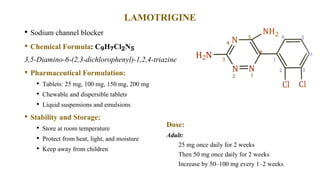
• Chemical Formula: C₉H₇Cl₂N₅
3,5-Diamino-6-(2,3-dichlorophenyl)-1,2,4-triazine
• Pharmaceutical Formulation:
• Tablets: 25 mg, 100 mg, 150 mg, 200 mg
• Chewable and dispersible tablets
• Liquid suspensions and emulsions
• Stability and Storage:
• Store at room temperature
• Protect from heat, light, and moisture
• Keep away from children
Dose:
Adult:
25 mg once daily for 2 weeks
Then 50 mg once daily for 2 weeks
Increase by 50–100 mg every 1–2 weeks
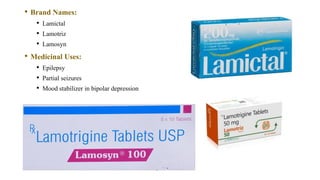
• Brand Names:
• Lamictal
• Lamotriz
• Lamosyn
• Medicinal Uses:
• Epilepsy
• Partial seizures
• Mood stabilizer in bipolar depression
GABAPENTIN
• Lipid-soluble GABA analogue
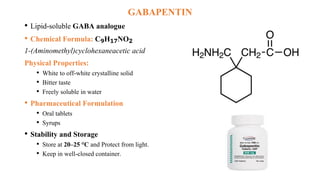
• Chemical Formula: C₉H₁₇NO₂
1-(Aminomethyl)cyclohexaneacetic acid
Physical Properties:
• White to off-white crystalline solid
• Bitter taste
• Freely soluble in water
• Pharmaceutical Formulation
• Oral tablets
• Syrups
• Stability and Storage
• Store at 20–25 °C and Protect from light.
• Keep in well-closed container.
• Brand Names
• Gabantin
• Gaba
• Namangaba
• Dose: Maximum: 3600 mg/day (in divided doses)
• Medicinal Uses
• Partial seizures
• Pediatric epilepsy (≥3 years)
• Post-herpetic neuralgia
• Restless leg syndrome
TOPIRAMATE
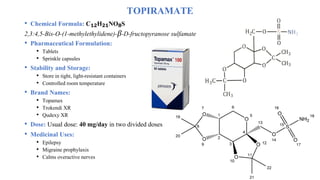
• Chemical Formula: C₁₂H₂₁NO₈S
2,3:4,5-Bis-O-(1-methylethylidene)-β-D-fructopyranose sulfamate
• Pharmaceutical Formulation:
• Tablets
• Sprinkle capsules
• Stability and Storage:
• Store in tight, light-resistant containers
• Controlled room temperature
• Brand Names:
• Topamax
• Trokendi XR
• Qudexy XR
• Dose: Usual dose: 40 mg/day in two divided doses
• Medicinal Uses:
• Epilepsy
• Migraine prophylaxis
• Calms overactive nerves
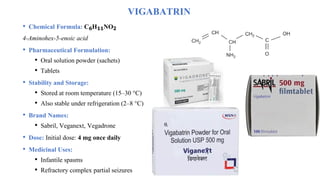
VIGABATRIN
• Chemical Formula: C₆H₁₁NO₂
4-Aminohex-5-enoic acid
• Pharmaceutical Formulation:
• Oral solution powder (sachets)
• Tablets
• Stability and Storage:
• Stored at room temperature (15–30 °C)
• Also stable under refrigeration (2–8 °C)
• Brand Names:
• Sabril, Veganext, Vegadrone
• Dose: Initial dose: 4 mg once daily
• Medicinal Uses:
• Infantile spasms
• Refractory complex partial seizures
Chapter 05 Drugs Acting on the Central Nervous System: Anticonvulsant (Antiepileptic) Drugs

Chapter 05 Drugs Acting on the Central Nervous System: Anticonvulsant (Antiepileptic) Drugs

  • 2.
    Epilepsy Epilepsy is acollective term for a group of chronic central nervous system (CNS) disorders characterized by sudden and transient seizures, involving loss or disturbance of consciousness, with or without characteristic body movements (convulsions) and sometimes associated with autonomic hyperactivity. • The term epilepsy is derived from a Greek word meaning “to seize” or “to take sudden possession.” It is a paroxysmal (sudden), self-sustaining, and self-limiting cerebral dysrhythmia. • Epilepsy is characterized by: • Abnormal and excessive electrical activity in the brain. • Characteristic changes in EEG (Electroencephalogram). • Loss or alteration of consciousness.
  • 3.
    Cause of Seizures: •Seizures are caused by sudden, excessive, and rapid electrical discharges of neurons, which: • Originate in the grey matter of the brain. • Spread to other parts of the central nervous system. • Thus, seizures are manifestations of electrical disturbances in the brain. Clinical Features: • Sudden and recurrent episodes of: • Sensory disturbance. • Loss of consciousness. • Convulsions (in some cases). Convulsions: • Convulsions are defined as sudden, violent, and irregular movements of the body caused by involuntary contraction of muscles, commonly associated with epilepsy or toxic conditions. • Important Note • Epilepsy may or may not be associated with convulsions or visible body movements.
  • 4.
    Principal Types ofEpilepsy Grand Mal Epilepsy: Grand mal epilepsy is characterized by a complete loss of consciousness, followed by temporary muscular rigidity and generalized convulsions involving all voluntary muscles. The seizure usually lasts for 2 to 5 minutes. Petit Mal Epilepsy: Petit mal epilepsy involves a sudden and brief loss of consciousness. Convulsions are absent, but mild symptoms such as blinking of eyelids or slight jerking of the head and arms may occur. The episode lasts for about 5 to 30 seconds, after which the person becomes immediately alert. This type is more common in children. Psychomotor Epilepsy: Psychomotor epilepsy is characterized by seizure attacks without convulsions, lasting for 2 to 3 minutes. It is associated with mental apathy, abnormal behaviour, and sometimes irrational or destructive actions. The patient usually has no memory of the event after recovery. Myoclonic Seizures: Myoclonic seizures are marked by sudden, brief, jerky movements of muscles, affecting the head, limbs, or entire body. Each movement lasts for about one second and may recur at short intervals for about one minute. These movements are rapid and rhythmic.
  • 5.
    Anticonvulsant (Antiepileptic) Drugs •Anticonvulsant drugs, also known as antiepileptic drugs, are agents that selectively depress the central nervous system (CNS) and are used to prevent or control epileptic seizures. • These drugs are defined as substances that prevent seizures or reduce their frequency and severity in patients suffering from epilepsy.
  • 6.
    Classification of AnticonvulsantDrugs Class Drugs Barbiturates Phenobarbitone, Mephobarbitone Hydantoins Phenytoin, Mephenytoin De-oxybarbiturates Primidone Succinimides Ethosuximide Iminostilbenes Carbamazepine, Oxcarbazepine Aliphatic carboxylic acid Valproic acid Benzodiazepines Clonazepam, Diazepam, Lorazepam Phenyltriazine Lamotrigine Cyclic GABA analogue Gabapentin New Anticonvulsant Lamotrigine, Topiramate, Vigabatrin
  • 7.
    PHENYTOIN • Phenytoin isthe first anticonvulsant in which it was clearly demonstrated that anticonvulsant activity could be separated from sedative–hypnotic activity. • Chemical Formula: C₁₅H₁₂N₂O₂ 5,5-Diphenylimidazolidine-2,4-dione • Physical Properties: • Weak acid • Fine white crystalline, odourless and tasteless powder • Soluble in acetic acid • Slightly soluble in ethyl ether • Soluble in benzene and chloroform
  • 8.
    • Pharmaceutical Formulation: •Available as injectable (IV) • Oral preparations: syrup, capsule, tablet • Stability and Storage: • Store at 20–25 °C (68–77 °F) • Preserve in tight, light-resistant containers • Protect from moisture • Phenytoin sodium suspension in 0.9% NaCl is stable for at least 2 weeks at room temperature • Brand Names: Dilantin, Epsolin, Eptoin. • Dose: 0–15 mg/kg or 15–20 mg/kg IV at 25–50 mg/min • Medicinal Uses: • Prophylactic management of tonic-clonic seizures • Protection against focal seizures • Used in combination therapy for absence + tonic-clonic seizures
  • 9.
    CARBAMAZEPINE • Inhibits voltage-dependentsodium channels • Chemical Formula: C₁₅H₁₂N₂O 5H-dibenz[b,f]azepine-5-carboxamide • Physical Properties • Yellowish-white crystal, almost odourless • Slightly bitter or tasteless • Insoluble in water and ether • Soluble in acetone, alcohol, chloroform, DMF, dioxane, propylene glycol. • Pharmaceutical Formulation • Tablets (sustained release, chewable) • Capsules • Syrups • Injectables
  • 10.
    • Stability andStorage • Store at 2–8 °C in airtight container • Protect from light • Stable for 8 weeks at room temperature • Concentration may change after opening • Brand Names • Tegretol • Zen • Zeptol • Dose • Children (12–15 yrs): ≤1000 mg/day • Adults (>15 yrs): ≤1200 mg/day • Rarely up to 1600 mg/day • Medicinal Uses • Partial seizures • Grand mal seizures • Trigeminal neuralgia • Acute manic and mixed episodes (Bipolar I disorder) • Off-label use: depression, anxiety, panic disorders
  • 11.
    VALPROIC ACID (VALPROATE) •Chemical Formula: C₈H₁₆O₂ 2-Propyl pentanoic acid • Physical Properties: • Hygroscopic • Clear, colourless liquid with characteristic odour • Freely soluble in NaOH, methanol, alcohol • Slightly soluble in 0.1 N HCl • Pharmaceutical Formulation: • IV injections • Oral liquids and solids • Long-acting and short-acting tablets Stability and Storage: Store in closed container at room temperature and Protect from heat, moisture, and light
  • 12.
    • Brand Names: •Epilex • Vallona • Valparin • Dose: Maximum dose: 60 mg/kg/day • Medicinal Uses: • Bipolar disorder • Epilepsy • Migraine prophylaxis
  • 13.
    CLONAZEPAM • Benzodiazepine tranquilizer •Chemical Formula: C₁₅H₁₀ClN₃O₃ 5-(2-Chlorophenyl)-7-nitro-1,3-dihydro-1,4-benzodiazepin-2-one • Physical Properties: • Off-white to light yellow crystalline powder. • Faint odour. • Insoluble in benzene. • Slightly soluble in acetone, methanol, chloroform. • Pharmaceutical Formulation: • Tablets • Liquid oral solutions • Stability and Storage • Store at 20–25 °C and Protect from light and moisture. • Do not refrigerate or freeze.
  • 14.
    • Brand Names: •Klonopin • Clorest • Clonorest • Dose: Maximum dose: 20 mg/day • Medicinal Uses: • Panic disorder • Epilepsy • Non-convulsive status epilepticus • Restless leg syndrome • Acute mania, insomnia • Used with escitalopram in anxiety disorder
  • 15.
    LAMOTRIGINE • Sodium channelblocker • Chemical Formula: C₉H₇Cl₂N₅ 3,5-Diamino-6-(2,3-dichlorophenyl)-1,2,4-triazine • Pharmaceutical Formulation: • Tablets: 25 mg, 100 mg, 150 mg, 200 mg • Chewable and dispersible tablets • Liquid suspensions and emulsions • Stability and Storage: • Store at room temperature • Protect from heat, light, and moisture • Keep away from children Dose: Adult: 25 mg once daily for 2 weeks Then 50 mg once daily for 2 weeks Increase by 50–100 mg every 1–2 weeks
  • 16.
    • Brand Names: •Lamictal • Lamotriz • Lamosyn • Medicinal Uses: • Epilepsy • Partial seizures • Mood stabilizer in bipolar depression
  • 17.
    GABAPENTIN • Lipid-soluble GABAanalogue • Chemical Formula: C₉H₁₇NO₂ 1-(Aminomethyl)cyclohexaneacetic acid Physical Properties: • White to off-white crystalline solid • Bitter taste • Freely soluble in water • Pharmaceutical Formulation • Oral tablets • Syrups • Stability and Storage • Store at 20–25 °C and Protect from light. • Keep in well-closed container.
  • 18.
    • Brand Names •Gabantin • Gaba • Namangaba • Dose: Maximum: 3600 mg/day (in divided doses) • Medicinal Uses • Partial seizures • Pediatric epilepsy (≥3 years) • Post-herpetic neuralgia • Restless leg syndrome
  • 19.
    TOPIRAMATE • Chemical Formula:C₁₂H₂₁NO₈S 2,3:4,5-Bis-O-(1-methylethylidene)-β-D-fructopyranose sulfamate • Pharmaceutical Formulation: • Tablets • Sprinkle capsules • Stability and Storage: • Store in tight, light-resistant containers • Controlled room temperature • Brand Names: • Topamax • Trokendi XR • Qudexy XR • Dose: Usual dose: 40 mg/day in two divided doses • Medicinal Uses: • Epilepsy • Migraine prophylaxis • Calms overactive nerves
  • 20.
    VIGABATRIN • Chemical Formula:C₆H₁₁NO₂ 4-Aminohex-5-enoic acid • Pharmaceutical Formulation: • Oral solution powder (sachets) • Tablets • Stability and Storage: • Stored at room temperature (15–30 °C) • Also stable under refrigeration (2–8 °C) • Brand Names: • Sabril, Veganext, Vegadrone • Dose: Initial dose: 4 mg once daily • Medicinal Uses: • Infantile spasms • Refractory complex partial seizures