CRICOS No.00213J
From ‘the’ Public Sphere to a Network of
Publics: Rethinking Contemporary
Public Communication Spaces
Axel Bruns
Australian Laureate Fellow
Digital Media Research Centre
Queensland University of Technology
Brisbane, Australia
a.bruns@qut.edu.au
Bluesky: @snurb.info | Mastodon: @snurb@aoir.social | Xitter: @snurb_dot_info
CRICOS No.00213J
CRICOS No.00213J
The Public Sphere?
CRICOS No.00213J
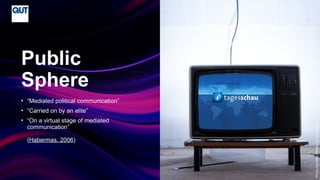
• “Mediated political communication”
• “Carried on by an elite”
• “On a virtual stage of mediated
communication”
(Habermas, 2006)
Public
Sphere
Photo
by
Mike
Philipp
on
Unsplash
Image: Midjourney
CRICOS No.00213J
https://dl.acm.org/doi/10.5555/1412688.1412691
(Image:
Julien
Beauséjour)
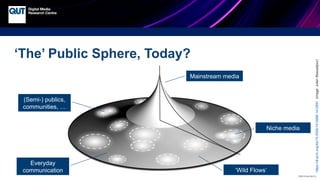
‘The’ Public Sphere, Today?
Mainstream media
Niche media
(Semi-) publics,
communities, …
Everyday
communication ‘Wild Flows’
CRICOS No.00213J
‘the’: no longer a unified space
The Public Sphere?
‘the’: no longer a unified space
‘public’: mix between public, semi-public, and private
‘sphere’: a network of spaces, not a simple sphere
‘the’: no longer a unified space
‘public’: mix between public, semi-public, and private
‘the’: no longer a unified space
‘public’: mix between public, semi-public, and private
‘sphere’: a network of spaces, not a simple sphere
CRICOS No.00213J
‘The’ Public Sphere?
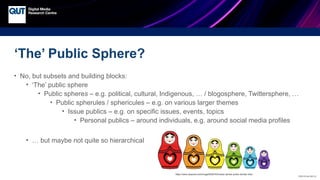
• No, but subsets and building blocks:
• ‘The’ public sphere
• Public spheres – e.g. political, cultural, Indigenous, … / blogosphere, Twittersphere, …
• Public spherules / sphericules – e.g. on various larger themes
• Issue publics – e.g. on specific issues, events, topics
• Personal publics – around individuals, e.g. around social media profiles
• … but maybe not quite so hierarchical
https://www.rawpixel.com/image/6536163/vector-sticker-public-domain-blue
CRICOS No.00213J
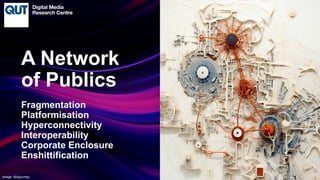
Fragmentation
Platformisation
Hyperconnectivity
Interoperability
Corporate Enclosure
Enshittification
A Network
of Publics
Image: Midjourney
CRICOS No.00213J
‘Good’ and ‘Bad’ Publics
• Forms of publics:
• Publics (Warner, 2002)
• Hegemonic publics
• Subaltern counterpublics (Fraser, 1990)
• Issue publics (Habermas, 2006)
• Ad hoc publics (Bruns & Burgess, 2011)
• Parasitic publics (Larson & McHendry Jr., 2019)
• Phantasmagoric publics (Badola, forthcoming)
• Affective publics (Papacharissi, 2014)
• …
Image: Midjourney
CRICOS No.00213J
Communities?
Audiences?
Publics?
Crowds?
Groups?
When Is a ‘Public’ Not a Public?
CRICOS No.00213J
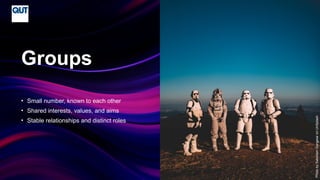
• Small number, known to each other
• Shared interests, values, and aims
• Stable relationships and distinct roles
Groups
Photo
by
Saksham
Gangwar
on
UnSplash
CRICOS No.00213J
• Small number, known to each other
• Shared interests, values, and aims
• Stable relationships and distinct roles
Groups How and Where to Find Them
• Strong, repeated, stable interconnections /
interactions
• Shared language, identity markers, media
objects
• Similar activity patterns and practices
CRICOS No.00213J
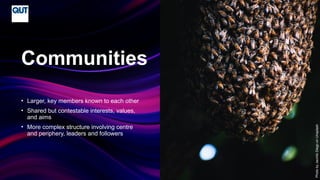
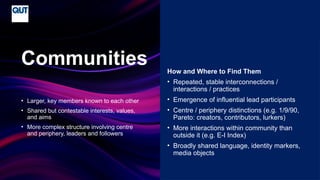
• Larger, key members known to each other
• Shared but contestable interests, values,
and aims
• More complex structure involving centre
and periphery, leaders and followers
Communities
Photo
by
Jacinto
Diego
on
Unsplash
CRICOS No.00213J
• Larger, key members known to each other
• Shared but contestable interests, values,
and aims
• More complex structure involving centre
and periphery, leaders and followers
Communities How and Where to Find Them
• Repeated, stable interconnections /
interactions / practices
• Emergence of influential lead participants
• Centre / periphery distinctions (e.g. 1/9/90,
Pareto: creators, contributors, lurkers)
• More interactions within community than
outside it (e.g. E-I Index)
• Broadly shared language, identity markers,
media objects
CRICOS No.00213J
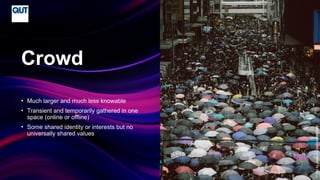
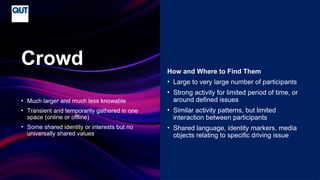
• Much larger and much less knowable
• Transient and temporarily gathered in one
space (online or offline)
• Some shared identity or interests but no
universally shared values
Crowd
Photo
by
Joseph
Chan
on
Unsplash
CRICOS No.00213J
• Much larger and much less knowable
• Transient and temporarily gathered in one
space (online or offline)
• Some shared identity or interests but no
universally shared values
Crowd How and Where to Find Them
• Large to very large number of participants
• Strong activity for limited period of time, or
around defined issues
• Similar activity patterns, but limited
interaction between participants
• Shared language, identity markers, media
objects relating to specific driving issue
CRICOS No.00213J
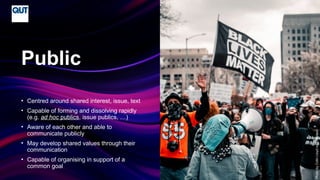
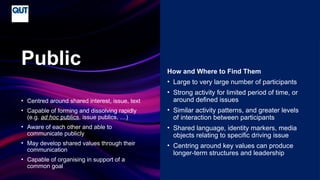
• Centred around shared interest, issue, text
• Capable of forming and dissolving rapidly
(e.g. ad hoc publics, issue publics, …)
• Aware of each other and able to
communicate publicly
• May develop shared values through their
communication
• Capable of organising in support of a
common goal
Public
Photo
by
Colin
Lloyd
on
Unsplash
CRICOS No.00213J
• Centred around shared interest, issue, text
• Capable of forming and dissolving rapidly
(e.g. ad hoc publics, issue publics, …)
• Aware of each other and able to
communicate publicly
• May develop shared values through their
communication
• Capable of organising in support of a
common goal
Public How and Where to Find Them
• Large to very large number of participants
• Strong activity for limited period of time, or
around defined issues
• Similar activity patterns, and greater levels
of interaction between participants
• Shared language, identity markers, media
objects relating to specific driving issue
• Centring around key values can produce
longer-term structures and leadership
CRICOS No.00213J
• Centred around a shared (media) text
• Large but dispersed and usually unknown
to each other
• Unlikely to share values beyond central
common interest
• Incapable of acting together
Audience
Photo
by
Ben
Tofan
on
Unsplash
CRICOS No.00213J
• Centred around a shared (media) text
• Large but dispersed and usually unknown
to each other
• Unlikely to share values beyond central
common interest
• Incapable of acting together
Audience How and Where to Find Them
• Unified by central text (live performance,
media object, event / issue hashtag, …)
• Participant numbers from niche to very large
• Observing rather than actively contributing
• Therefore invisible to and unaware of each
other
• Often imagined and assumed rather than
tangibly traceable
CRICOS No.00213J
a beautiful photorealistic painting of the public sphere (via Midjourney)
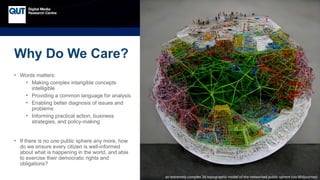
an extremely complex 3d topographic model of the networked public sphere (via Midjourney)
Why Do We Care?
• Words matters:
• Making complex intangible concepts
intelligible
• Providing a common language for analysis
• Enabling better diagnosis of issues and
problems
• Informing practical action, business
strategies, and policy-making
• If there is no one public sphere any more, how
do we ensure every citizen is well-informed
about what is happening in the world, and able
to exercise their democratic rights and
obligations?
CRICOS No.00213J
Mapping Publics
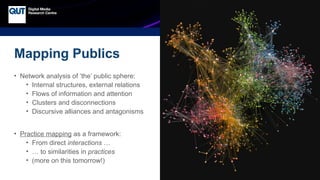
• Network analysis of ‘the’ public sphere:
• Internal structures, external relations
• Flows of information and attention
• Clusters and disconnections
• Discursive alliances and antagonisms
• Practice mapping as a framework:
• From direct interactions …
• … to similarities in practices
• (more on this tomorrow!)
CRICOS No.00213J
Thank you
Image: Midjourney
CRICOS No.00213J
This research is supported by the Australian Research Council through the
Australian Laureate Fellowship project Determining the Dynamics of
Partisanship and Polarisation in Online Public Debate.
Acknowledgments

From 'the' Public Sphere to a Network of Publics: Rethinking Contemporary Public Communication Spaces

  • 1.
    CRICOS No.00213J From ‘the’Public Sphere to a Network of Publics: Rethinking Contemporary Public Communication Spaces Axel Bruns Australian Laureate Fellow Digital Media Research Centre Queensland University of Technology Brisbane, Australia a.bruns@qut.edu.au Bluesky: @snurb.info | Mastodon: @snurb@aoir.social | Xitter: @snurb_dot_info
  • 2.
  • 4.
  • 5.
    CRICOS No.00213J • “Mediatedpolitical communication” • “Carried on by an elite” • “On a virtual stage of mediated communication” (Habermas, 2006) Public Sphere Photo by Mike Philipp on Unsplash
  • 6.
  • 7.
    CRICOS No.00213J https://dl.acm.org/doi/10.5555/1412688.1412691 (Image: Julien Beauséjour) ‘The’ PublicSphere, Today? Mainstream media Niche media (Semi-) publics, communities, … Everyday communication ‘Wild Flows’
  • 8.
    CRICOS No.00213J ‘the’: nolonger a unified space The Public Sphere? ‘the’: no longer a unified space ‘public’: mix between public, semi-public, and private ‘sphere’: a network of spaces, not a simple sphere ‘the’: no longer a unified space ‘public’: mix between public, semi-public, and private ‘the’: no longer a unified space ‘public’: mix between public, semi-public, and private ‘sphere’: a network of spaces, not a simple sphere
  • 9.
    CRICOS No.00213J ‘The’ PublicSphere? • No, but subsets and building blocks: • ‘The’ public sphere • Public spheres – e.g. political, cultural, Indigenous, … / blogosphere, Twittersphere, … • Public spherules / sphericules – e.g. on various larger themes • Issue publics – e.g. on specific issues, events, topics • Personal publics – around individuals, e.g. around social media profiles • … but maybe not quite so hierarchical https://www.rawpixel.com/image/6536163/vector-sticker-public-domain-blue
  • 10.
  • 11.
    CRICOS No.00213J ‘Good’ and‘Bad’ Publics • Forms of publics: • Publics (Warner, 2002) • Hegemonic publics • Subaltern counterpublics (Fraser, 1990) • Issue publics (Habermas, 2006) • Ad hoc publics (Bruns & Burgess, 2011) • Parasitic publics (Larson & McHendry Jr., 2019) • Phantasmagoric publics (Badola, forthcoming) • Affective publics (Papacharissi, 2014) • … Image: Midjourney
  • 12.
  • 13.
    CRICOS No.00213J • Smallnumber, known to each other • Shared interests, values, and aims • Stable relationships and distinct roles Groups Photo by Saksham Gangwar on UnSplash
  • 14.
    CRICOS No.00213J • Smallnumber, known to each other • Shared interests, values, and aims • Stable relationships and distinct roles Groups How and Where to Find Them • Strong, repeated, stable interconnections / interactions • Shared language, identity markers, media objects • Similar activity patterns and practices
  • 15.
    CRICOS No.00213J • Larger,key members known to each other • Shared but contestable interests, values, and aims • More complex structure involving centre and periphery, leaders and followers Communities Photo by Jacinto Diego on Unsplash
  • 16.
    CRICOS No.00213J • Larger,key members known to each other • Shared but contestable interests, values, and aims • More complex structure involving centre and periphery, leaders and followers Communities How and Where to Find Them • Repeated, stable interconnections / interactions / practices • Emergence of influential lead participants • Centre / periphery distinctions (e.g. 1/9/90, Pareto: creators, contributors, lurkers) • More interactions within community than outside it (e.g. E-I Index) • Broadly shared language, identity markers, media objects
  • 17.
    CRICOS No.00213J • Muchlarger and much less knowable • Transient and temporarily gathered in one space (online or offline) • Some shared identity or interests but no universally shared values Crowd Photo by Joseph Chan on Unsplash
  • 18.
    CRICOS No.00213J • Muchlarger and much less knowable • Transient and temporarily gathered in one space (online or offline) • Some shared identity or interests but no universally shared values Crowd How and Where to Find Them • Large to very large number of participants • Strong activity for limited period of time, or around defined issues • Similar activity patterns, but limited interaction between participants • Shared language, identity markers, media objects relating to specific driving issue
  • 19.
    CRICOS No.00213J • Centredaround shared interest, issue, text • Capable of forming and dissolving rapidly (e.g. ad hoc publics, issue publics, …) • Aware of each other and able to communicate publicly • May develop shared values through their communication • Capable of organising in support of a common goal Public Photo by Colin Lloyd on Unsplash
  • 20.
    CRICOS No.00213J • Centredaround shared interest, issue, text • Capable of forming and dissolving rapidly (e.g. ad hoc publics, issue publics, …) • Aware of each other and able to communicate publicly • May develop shared values through their communication • Capable of organising in support of a common goal Public How and Where to Find Them • Large to very large number of participants • Strong activity for limited period of time, or around defined issues • Similar activity patterns, and greater levels of interaction between participants • Shared language, identity markers, media objects relating to specific driving issue • Centring around key values can produce longer-term structures and leadership
  • 21.
    CRICOS No.00213J • Centredaround a shared (media) text • Large but dispersed and usually unknown to each other • Unlikely to share values beyond central common interest • Incapable of acting together Audience Photo by Ben Tofan on Unsplash
  • 22.
    CRICOS No.00213J • Centredaround a shared (media) text • Large but dispersed and usually unknown to each other • Unlikely to share values beyond central common interest • Incapable of acting together Audience How and Where to Find Them • Unified by central text (live performance, media object, event / issue hashtag, …) • Participant numbers from niche to very large • Observing rather than actively contributing • Therefore invisible to and unaware of each other • Often imagined and assumed rather than tangibly traceable
  • 23.
    CRICOS No.00213J a beautifulphotorealistic painting of the public sphere (via Midjourney) an extremely complex 3d topographic model of the networked public sphere (via Midjourney) Why Do We Care? • Words matters: • Making complex intangible concepts intelligible • Providing a common language for analysis • Enabling better diagnosis of issues and problems • Informing practical action, business strategies, and policy-making • If there is no one public sphere any more, how do we ensure every citizen is well-informed about what is happening in the world, and able to exercise their democratic rights and obligations?
  • 24.
    CRICOS No.00213J Mapping Publics •Network analysis of ‘the’ public sphere: • Internal structures, external relations • Flows of information and attention • Clusters and disconnections • Discursive alliances and antagonisms • Practice mapping as a framework: • From direct interactions … • … to similarities in practices • (more on this tomorrow!)
  • 25.
  • 26.
    CRICOS No.00213J This researchis supported by the Australian Research Council through the Australian Laureate Fellowship project Determining the Dynamics of Partisanship and Polarisation in Online Public Debate. Acknowledgments