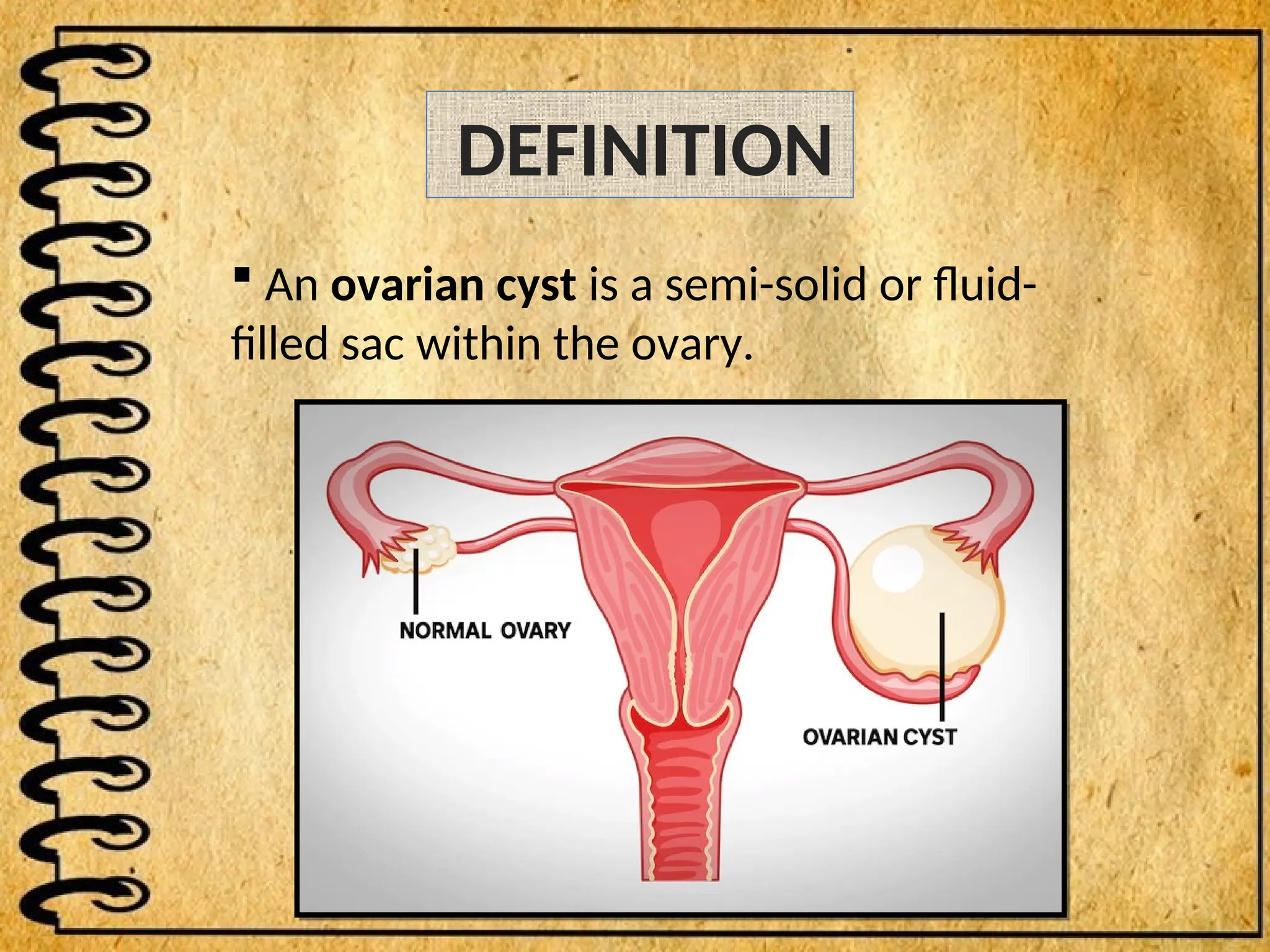
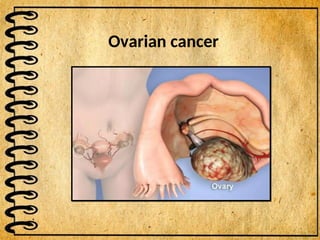
An ovariancyst is a semi-solid or fluid-
filled sac within the ovary.
DEFINITION
2.
Most ovariancysts occur as part of the
normal workings of the ovaries. These cysts are
generally harmless and disappear without
treatment in a few months.
ITIOLOGY
Cysts caused by abnormal cell growth and
aren't related to the menstrual cycle. They
can develop before and after the
menopause.
3.
CONDITIONS THAT CAUSEOVARIAN CYSTS
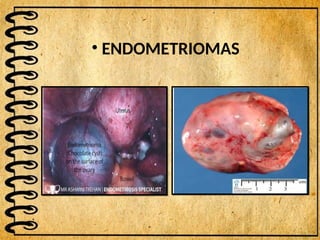
Endometriosis.
Polycystic ovary syndrome (PCOS)
is a condition that causes lots of small,
harmless cysts to develop on your
ovaries. The cysts are small egg follicles
that do not grow to ovulation and are
the result of altered hormone levels.
4.
TYPES OF OVARIANCYST
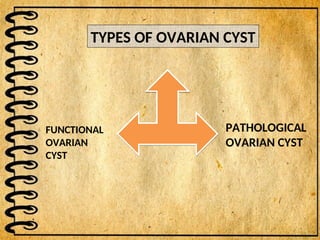
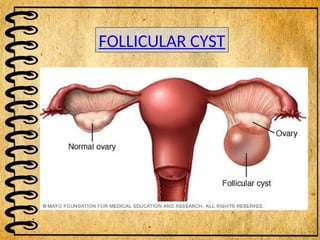
FUNCTIONAL
OVARIAN
CYST
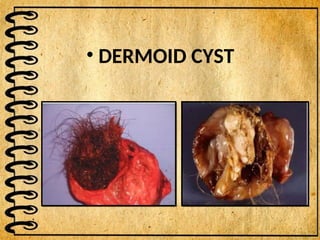
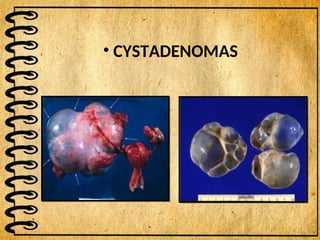
PATHOLOGICAL
OVARIAN CYST
5.
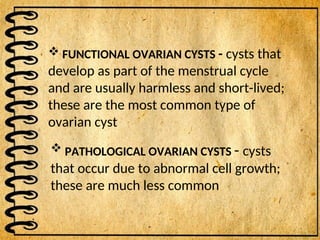
FUNCTIONAL OVARIANCYSTS - cysts that
develop as part of the menstrual cycle
and are usually harmless and short-lived;
these are the most common type of
ovarian cyst
PATHOLOGICAL OVARIAN CYSTS - cysts
that occur due to abnormal cell growth;
these are much less common
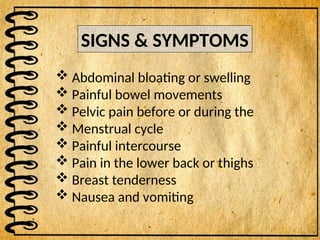
SIGNS & SYMPTOMS
Abdominal bloating or swelling
Painful bowel movements
Pelvic pain before or during the
Menstrual cycle
Painful intercourse
Pain in the lower back or thighs
Breast tenderness
Nausea and vomiting
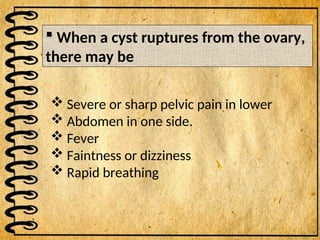
14.
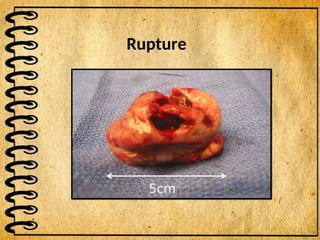
When acyst ruptures from the ovary,
there may be
Severe or sharp pelvic pain in lower
Abdomen in one side.
Fever
Faintness or dizziness
Rapid breathing
15.
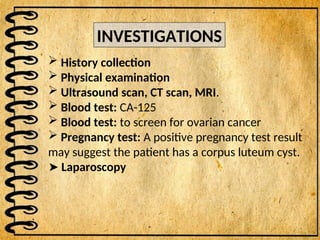
INVESTIGATIONS
History collection
Physical examination
Ultrasound scan, CT scan, MRI.
Blood test: CA-125
Blood test: to screen for ovarian cancer
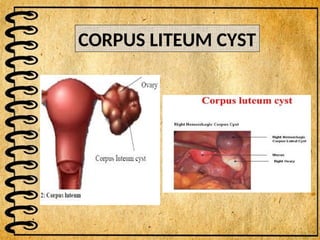
Pregnancy test: A positive pregnancy test result
may suggest the patient has a corpus luteum cyst.
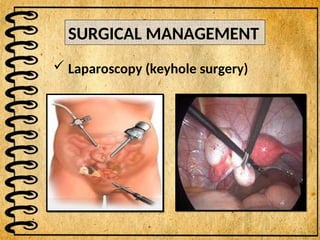
➤ Laparoscopy
16.
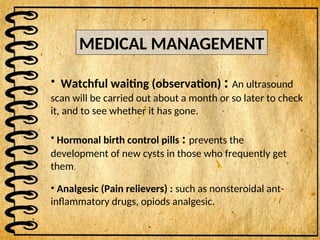
MEDICAL MANAGEMENT
• Watchfulwaiting (observation) : An ultrasound
scan will be carried out about a month or so later to check
it, and to see whether it has gone.
• Hormonal birth control pills : prevents the
development of new cysts in those who frequently get
them.
• Analgesic (Pain relievers) : such as nonsteroidal ant-
inflammatory drugs, opiods analgesic.