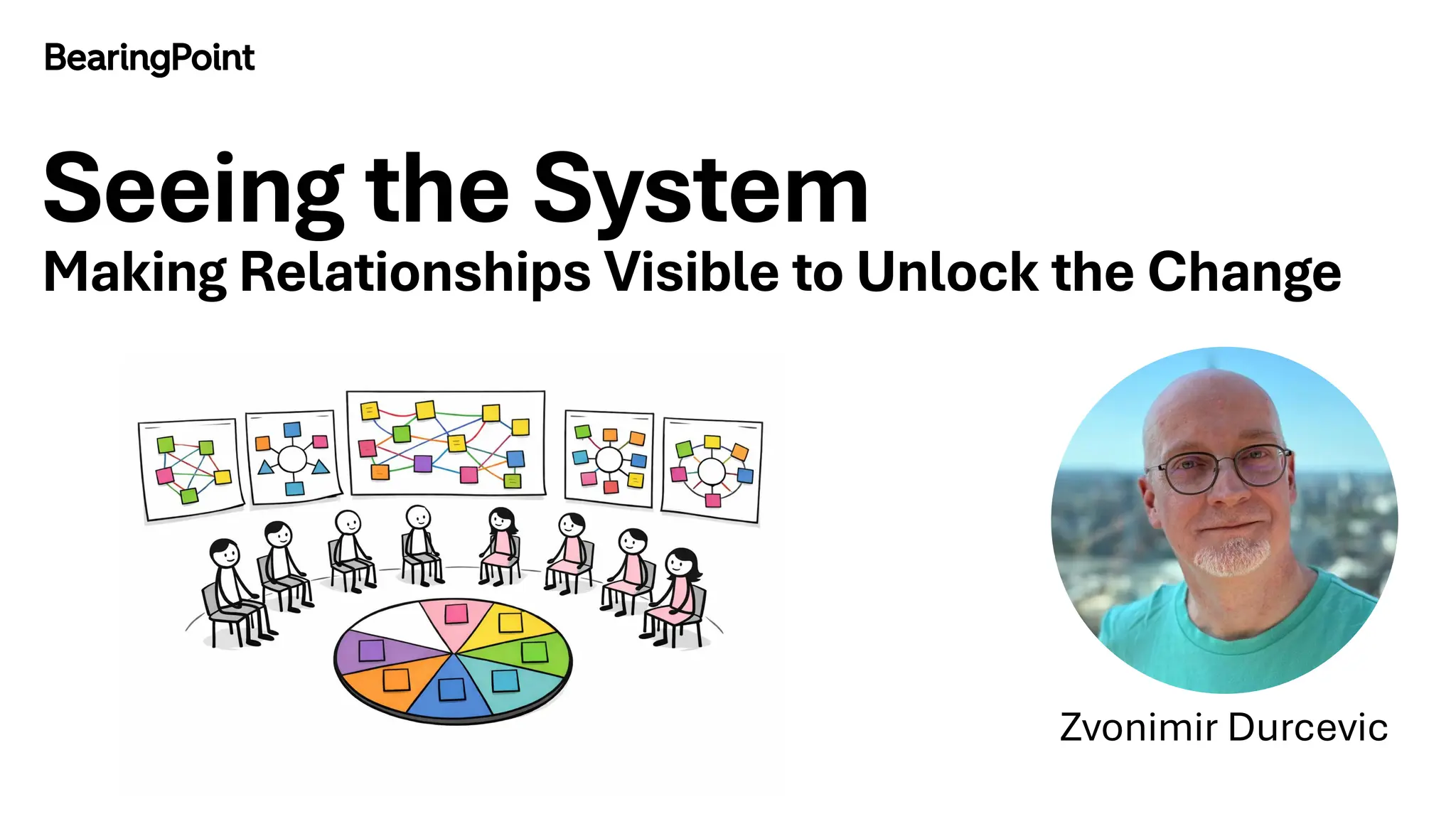
Seeing the System
Making Relationships Visible to Unlock the Change
Zvonimir Durcevic
©BEARINGPOINT 2
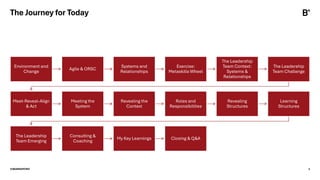
The Journey for Today
Environment and
Change
Agile & ORSC
Systems and
Relationships
Exercise:
Metaskills Wheel
The Leadership
Team Context:
Systems &
Relationships
The Leadership
Team Challenge
Meet-Reveal-Align
& Act
Meeting the
System
Revealing the
Context
Roles and
Responsibilities
Revealing
Structures
Learning
Structures
The Leadership
Team Emerging
Consulting &
Coaching
My Key Learnings Closing & Q&A
©BEARINGPOINT 3
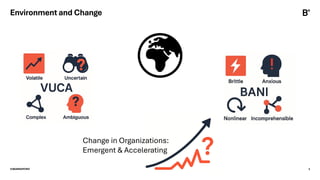
Environment and Change
Change in Organizations:
Emergent & Accelerating
©BEARINGPOINT 4
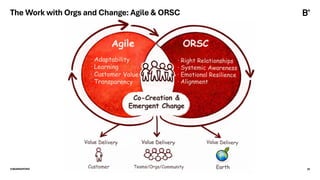
Agile & ORSC (Organization and Relationship Systems Coaching)
Individuals and interactions over processes and tools
Working software over comprehensive documentation
Customer collaborationover contract negotiation
Responding to change over following a plan
(As in https://agilemanifesto.org/)
1. Each relationship system has its own unique identity or “personality"
2. Every member of the relationship system (team or partnership) is a Voice of
the System.
3. Relationship systems are naturally intelligent, generative and creative
4. Relationship systems rely on roles for their organization and execution of
functions. Roles belong to the system, not to the individuals that inhabit the system.
5. Relationship systems are in a constant state of emergence.
Change is constant
(ORSC: Fundamentals of Organization and Relationship Systems Coaching, 2011)
Relationship Systems Intelligence
Principles
©BEARINGPOINT 5
Systems and Relationships
“A systemconsists of a set of interdependent elements or players with a
common focus or identity.”
(ORSC Virtual Fundamentals manuals, p.6)
A relationshipis “the way in which two
or more concepts, objects or people are
connected, or the state of being connected”
(The New Oxford Dictionary of English)
As an Agile and Systems/ORSC coach I work with systems.
©BEARINGPOINT 6
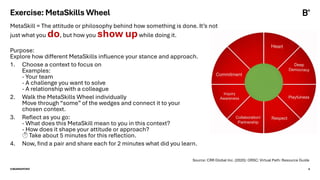
Exercise: MetaSkills Wheel
MetaSkill = The attitude or philosophy behind how something is done. It’s not
just what you do, but how you show upwhile doing it.
Purpose:
Explore how different MetaSkills influence your stance and approach.
1. Choose a context to focus on
Examples:
- Your team
- A challenge you want to solve
- A relationship with a colleague
2. Walk the MetaSkills Wheel individually
Move through “some” of the wedges and connect it to your
chosen context.
3. Reflect as you go:
- What does this MetaSkill mean to you in this context?
- How does it shape your attitude or approach?
Take about 5 minutes for this reflection.
4. Now, find a pair and share each for 2 minutes what did you learn.
Source: CRR Global Inc. (2020): ORSC: Virtual Path: Resource Guide
©BEARINGPOINT 7
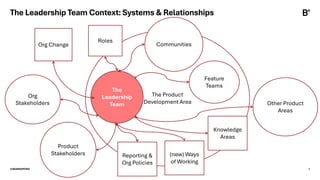
The Product
Development Area
The Leadership Team Context: Systems & Relationships
The
Leadership
Team
Roles
Knowledge
Areas
Feature
Teams
Org Change
Product
Stakeholders
Org
Stakeholders
Communities
Other Product
Areas
Reporting &
Org Policies
(new) Ways
of Working
©BEARINGPOINT 8
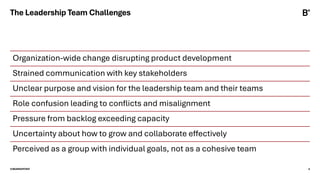
The Leadership Team Challenges
Organization-wide change disrupting product development
Strained communication with key stakeholders
Unclear purpose and vision for the leadership team and their teams
Role confusion leading to conflicts and misalignment
Pressure from backlog exceeding capacity
Uncertainty about how to grow and collaborate effectively
Perceived as a group with individual goals, not as a cohesive team
©BEARINGPOINT 9
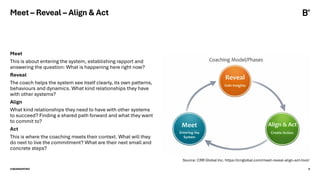
Meet
This is about entering the system, establishing rapport and
answering the question: What is happening here right now?
Reveal
The coach helps the system see itself clearly, its own patterns,
behaviours and dynamics. What kind relationships they have
with other systems?
Align
What kind relationships they need to have with other systems
to succeed? Finding a shared path forward and what they want
to commit to?
Act
This is where the coaching meets their context. What will they
do next to live the commitment? What are their next small and
concrete steps?
Meet – Reveal – Align & Act
Source: CRR Global Inc. https://crrglobal.com/meet-reveal-align-act-tool/
©BEARINGPOINT 10
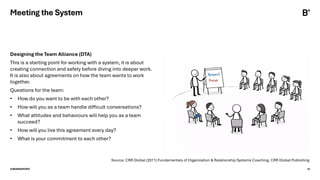
Designing the Team Alliance (DTA)
This is a starting point for working with a system, it is about
creating connection and safety before diving into deeper work.
It is also about agreements on how the team wants to work
together.
Questions for the team:
• How do you want to be with each other?
• How will you as a team handle difficult conversations?
• What attitudes and behaviours will help you as a team
succeed?
• How will you live this agreement every day?
• What is your commitment to each other?
Meeting the System
Source: CRR Global (2011) Fundamentals of Organization & Relationship Systems Coaching, CRR Global Publishing
©BEARINGPOINT 11
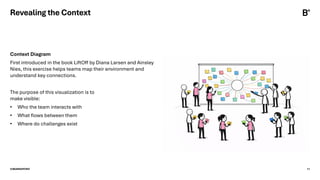
Context Diagram
First introduced in the book LiftOff by Diana Larsen and Ainsley
Nies, this exercise helps teams map their environment and
understand key connections.
The purpose of this visualization is to
make visible:
• Who the team interacts with
• What flows between them
• Where do challenges exist
Revealing the Context
©BEARINGPOINT 12
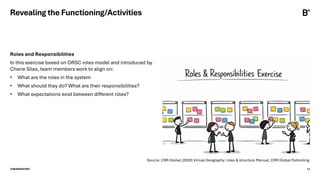
Roles and Responsibilities
In this exercise based on ORSC roles model and introduced by
Cherie Silas, team members work to align on:
• What are the roles in the system
• What should they do? What are their responsibilities?
• What expectations exist between different roles?
Revealing the Functioning/Activities
Source: CRR Global (2020) Virtual Geography: roles & structure Manual, CRR Global Publishing
©BEARINGPOINT 13
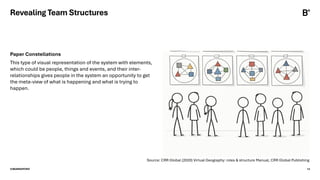
Paper Constellations
This type of visual representation of the system with elements,
which could be people, things and events, and their inter-
relationships gives people in the system an opportunity to get
the meta-view of what is happening and what is trying to
happen.
Revealing Team Structures
Source: CRR Global (2020) Virtual Geography: roles & structure Manual, CRR Global Publishing
©BEARINGPOINT 14
Learning Structures
The overall structure we co-created was designed to support continuous learning and
adaptation. It was based on Inspect & Adapt Workshops, initially planned quarterly.
• First workshops focused on building the team’s purpose and vision.
• Reality showed us that scheduling longer workshops was challenging, and the initial plan for
quarterly sessions was not realistic.
Between workshops:
• Weekly Sync Meetings
• Focused on: Who is doing what? What’s happening right now?
• Created transparency and alignment across leadership actions.
Interspersed:
• Individual and group coaching & consulting sessions
• Addressed different aspects of scaling and agile product development.
• Combined systems coaching with Agile practices to strengthen collaboration and flow.
©BEARINGPOINT 15
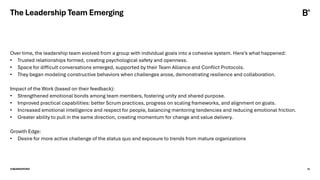
Over time, the leadership team evolved from a group with individual goals into a cohesive system. Here’s what happened:
• Trusted relationships formed, creating psychological safety and openness.
• Space for difficult conversations emerged, supported by their Team Alliance and Conflict Protocols.
• They began modeling constructive behaviors when challenges arose, demonstrating resilience and collaboration.
Impact of the Work (based on their feedback):
• Strengthened emotional bonds among team members, fostering unity and shared purpose.
• Improved practical capabilities: better Scrum practices, progress on scaling frameworks, and alignment on goals.
• Increased emotional intelligence and respect for people, balancing mentoring tendencies and reducing emotional friction.
• Greater ability to pull in the same direction, creating momentum for change and value delivery.
Growth Edge:
• Desire for more active challenge of the status quo and exposure to trends from mature organizations
The Leadership Team Emerging
©BEARINGPOINT 16
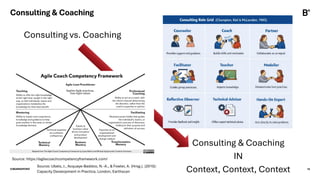
Consulting & Coaching
Consulting vs. Coaching
Consulting & Coaching
IN
Context, Context, Context
Source: https://agilecoachcompetencyframework.com/
Source: Ubels, J., Acquaye-Baddoo, N.-A., & Fowler, A. (Hrsg.). (2010):
Capacity Development in Practice, London, Earthscan
©BEARINGPOINT 17
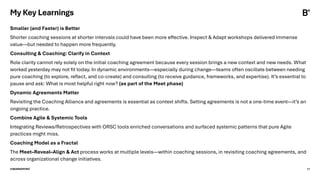
Smaller (and Faster) is Better
Shorter coaching sessions at shorter intervals could have been more effective. Inspect & Adapt workshops delivered immense
value—but needed to happen more frequently.
Consulting & Coaching: Clarify in Context
Role clarity cannot rely solely on the initial coaching agreement because every session brings a new context and new needs. What
worked yesterday may not fit today. In dynamic environments—especially during change—teams often oscillate between needing
pure coaching (to explore, reflect, and co-create) and consulting (to receive guidance, frameworks, and expertise). It’s essential to
pause and ask: What is most helpful right now? (as part of the Meet phase)
Dynamic Agreements Matter
Revisiting the Coaching Alliance and agreements is essential as context shifts. Setting agreements is not a one-time event—it’s an
ongoing practice.
Combine Agile & Systemic Tools
Integrating Reviews/Retrospectives with ORSC tools enriched conversations and surfaced systemic patterns that pure Agile
practices might miss.
Coaching Model as a Fractal
The Meet–Reveal–Align & Act process works at multiple levels—within coaching sessions, in revisiting coaching agreements, and
across organizational change initiatives.
My Key Learnings
Closing & Q&A
Closing Q&A!
Thanks for listening and for joining in!
©BEARINGPOINT 19
References
Faith Fuller (2023) Relationship Matters: A New Paradigm for an Evolutionary Leap in Relationships, CRR Global Publishing
CRR Global (2011) Fundamentals of Organization & Relationship Systems Coaching, CRR Global Publishing
CRR Global (2019) Intelligence: A Roadmap for Change Manual, CRR Global Publishing
CRR Global (2020) Virtual Geography: roles & structure Manual, CRR Global Publishing
CRR Global (2019) Path Vision and Potential Manual, CRR Global Publishing
CRR Global (2020) Systems Integration: moving toward mastery Manual, CRR Global Publishing
CRR Global (2022) Dojo Workbook Tools & Skills for Mastery, CRR Global Publishing
Ubels, J., Acquaye-Baddoo, N.-A., & Fowler, A. (Hrsg.). (2010): Capacity Development in Practice, London, Earthscan
Illustrationen und Bilder teilweise KI-generiert (Microsoft Copilot)
©BEARINGPOINT 20
The Work with Orgs and Change: Agile & ORSC

AAC2026_Durcevic_Seeing the System: Making Relationships Visible to Unlock the Change.pdf

  • 1.
    Seeing the System MakingRelationships Visible to Unlock the Change Zvonimir Durcevic
  • 2.
    ©BEARINGPOINT 2 The Journeyfor Today Environment and Change Agile & ORSC Systems and Relationships Exercise: Metaskills Wheel The Leadership Team Context: Systems & Relationships The Leadership Team Challenge Meet-Reveal-Align & Act Meeting the System Revealing the Context Roles and Responsibilities Revealing Structures Learning Structures The Leadership Team Emerging Consulting & Coaching My Key Learnings Closing & Q&A
  • 3.
    ©BEARINGPOINT 3 Environment andChange Change in Organizations: Emergent & Accelerating
  • 4.
    ©BEARINGPOINT 4 Agile &ORSC (Organization and Relationship Systems Coaching) Individuals and interactions over processes and tools Working software over comprehensive documentation Customer collaborationover contract negotiation Responding to change over following a plan (As in https://agilemanifesto.org/) 1. Each relationship system has its own unique identity or “personality" 2. Every member of the relationship system (team or partnership) is a Voice of the System. 3. Relationship systems are naturally intelligent, generative and creative 4. Relationship systems rely on roles for their organization and execution of functions. Roles belong to the system, not to the individuals that inhabit the system. 5. Relationship systems are in a constant state of emergence. Change is constant (ORSC: Fundamentals of Organization and Relationship Systems Coaching, 2011) Relationship Systems Intelligence Principles
  • 5.
    ©BEARINGPOINT 5 Systems andRelationships “A systemconsists of a set of interdependent elements or players with a common focus or identity.” (ORSC Virtual Fundamentals manuals, p.6) A relationshipis “the way in which two or more concepts, objects or people are connected, or the state of being connected” (The New Oxford Dictionary of English) As an Agile and Systems/ORSC coach I work with systems.
  • 6.
    ©BEARINGPOINT 6 Exercise: MetaSkillsWheel MetaSkill = The attitude or philosophy behind how something is done. It’s not just what you do, but how you show upwhile doing it. Purpose: Explore how different MetaSkills influence your stance and approach. 1. Choose a context to focus on Examples: - Your team - A challenge you want to solve - A relationship with a colleague 2. Walk the MetaSkills Wheel individually Move through “some” of the wedges and connect it to your chosen context. 3. Reflect as you go: - What does this MetaSkill mean to you in this context? - How does it shape your attitude or approach? Take about 5 minutes for this reflection. 4. Now, find a pair and share each for 2 minutes what did you learn. Source: CRR Global Inc. (2020): ORSC: Virtual Path: Resource Guide
  • 7.
    ©BEARINGPOINT 7 The Product DevelopmentArea The Leadership Team Context: Systems & Relationships The Leadership Team Roles Knowledge Areas Feature Teams Org Change Product Stakeholders Org Stakeholders Communities Other Product Areas Reporting & Org Policies (new) Ways of Working
  • 8.
    ©BEARINGPOINT 8 The LeadershipTeam Challenges Organization-wide change disrupting product development Strained communication with key stakeholders Unclear purpose and vision for the leadership team and their teams Role confusion leading to conflicts and misalignment Pressure from backlog exceeding capacity Uncertainty about how to grow and collaborate effectively Perceived as a group with individual goals, not as a cohesive team
  • 9.
    ©BEARINGPOINT 9 Meet This isabout entering the system, establishing rapport and answering the question: What is happening here right now? Reveal The coach helps the system see itself clearly, its own patterns, behaviours and dynamics. What kind relationships they have with other systems? Align What kind relationships they need to have with other systems to succeed? Finding a shared path forward and what they want to commit to? Act This is where the coaching meets their context. What will they do next to live the commitment? What are their next small and concrete steps? Meet – Reveal – Align & Act Source: CRR Global Inc. https://crrglobal.com/meet-reveal-align-act-tool/
  • 10.
    ©BEARINGPOINT 10 Designing theTeam Alliance (DTA) This is a starting point for working with a system, it is about creating connection and safety before diving into deeper work. It is also about agreements on how the team wants to work together. Questions for the team: • How do you want to be with each other? • How will you as a team handle difficult conversations? • What attitudes and behaviours will help you as a team succeed? • How will you live this agreement every day? • What is your commitment to each other? Meeting the System Source: CRR Global (2011) Fundamentals of Organization & Relationship Systems Coaching, CRR Global Publishing
  • 11.
    ©BEARINGPOINT 11 Context Diagram Firstintroduced in the book LiftOff by Diana Larsen and Ainsley Nies, this exercise helps teams map their environment and understand key connections. The purpose of this visualization is to make visible: • Who the team interacts with • What flows between them • Where do challenges exist Revealing the Context
  • 12.
    ©BEARINGPOINT 12 Roles andResponsibilities In this exercise based on ORSC roles model and introduced by Cherie Silas, team members work to align on: • What are the roles in the system • What should they do? What are their responsibilities? • What expectations exist between different roles? Revealing the Functioning/Activities Source: CRR Global (2020) Virtual Geography: roles & structure Manual, CRR Global Publishing
  • 13.
    ©BEARINGPOINT 13 Paper Constellations Thistype of visual representation of the system with elements, which could be people, things and events, and their inter- relationships gives people in the system an opportunity to get the meta-view of what is happening and what is trying to happen. Revealing Team Structures Source: CRR Global (2020) Virtual Geography: roles & structure Manual, CRR Global Publishing
  • 14.
    ©BEARINGPOINT 14 Learning Structures Theoverall structure we co-created was designed to support continuous learning and adaptation. It was based on Inspect & Adapt Workshops, initially planned quarterly. • First workshops focused on building the team’s purpose and vision. • Reality showed us that scheduling longer workshops was challenging, and the initial plan for quarterly sessions was not realistic. Between workshops: • Weekly Sync Meetings • Focused on: Who is doing what? What’s happening right now? • Created transparency and alignment across leadership actions. Interspersed: • Individual and group coaching & consulting sessions • Addressed different aspects of scaling and agile product development. • Combined systems coaching with Agile practices to strengthen collaboration and flow.
  • 15.
    ©BEARINGPOINT 15 Over time,the leadership team evolved from a group with individual goals into a cohesive system. Here’s what happened: • Trusted relationships formed, creating psychological safety and openness. • Space for difficult conversations emerged, supported by their Team Alliance and Conflict Protocols. • They began modeling constructive behaviors when challenges arose, demonstrating resilience and collaboration. Impact of the Work (based on their feedback): • Strengthened emotional bonds among team members, fostering unity and shared purpose. • Improved practical capabilities: better Scrum practices, progress on scaling frameworks, and alignment on goals. • Increased emotional intelligence and respect for people, balancing mentoring tendencies and reducing emotional friction. • Greater ability to pull in the same direction, creating momentum for change and value delivery. Growth Edge: • Desire for more active challenge of the status quo and exposure to trends from mature organizations The Leadership Team Emerging
  • 16.
    ©BEARINGPOINT 16 Consulting &Coaching Consulting vs. Coaching Consulting & Coaching IN Context, Context, Context Source: https://agilecoachcompetencyframework.com/ Source: Ubels, J., Acquaye-Baddoo, N.-A., & Fowler, A. (Hrsg.). (2010): Capacity Development in Practice, London, Earthscan
  • 17.
    ©BEARINGPOINT 17 Smaller (andFaster) is Better Shorter coaching sessions at shorter intervals could have been more effective. Inspect & Adapt workshops delivered immense value—but needed to happen more frequently. Consulting & Coaching: Clarify in Context Role clarity cannot rely solely on the initial coaching agreement because every session brings a new context and new needs. What worked yesterday may not fit today. In dynamic environments—especially during change—teams often oscillate between needing pure coaching (to explore, reflect, and co-create) and consulting (to receive guidance, frameworks, and expertise). It’s essential to pause and ask: What is most helpful right now? (as part of the Meet phase) Dynamic Agreements Matter Revisiting the Coaching Alliance and agreements is essential as context shifts. Setting agreements is not a one-time event—it’s an ongoing practice. Combine Agile & Systemic Tools Integrating Reviews/Retrospectives with ORSC tools enriched conversations and surfaced systemic patterns that pure Agile practices might miss. Coaching Model as a Fractal The Meet–Reveal–Align & Act process works at multiple levels—within coaching sessions, in revisiting coaching agreements, and across organizational change initiatives. My Key Learnings
  • 18.
    Closing & Q&A ClosingQ&A! Thanks for listening and for joining in!
  • 19.
    ©BEARINGPOINT 19 References Faith Fuller(2023) Relationship Matters: A New Paradigm for an Evolutionary Leap in Relationships, CRR Global Publishing CRR Global (2011) Fundamentals of Organization & Relationship Systems Coaching, CRR Global Publishing CRR Global (2019) Intelligence: A Roadmap for Change Manual, CRR Global Publishing CRR Global (2020) Virtual Geography: roles & structure Manual, CRR Global Publishing CRR Global (2019) Path Vision and Potential Manual, CRR Global Publishing CRR Global (2020) Systems Integration: moving toward mastery Manual, CRR Global Publishing CRR Global (2022) Dojo Workbook Tools & Skills for Mastery, CRR Global Publishing Ubels, J., Acquaye-Baddoo, N.-A., & Fowler, A. (Hrsg.). (2010): Capacity Development in Practice, London, Earthscan Illustrationen und Bilder teilweise KI-generiert (Microsoft Copilot)
  • 20.
    ©BEARINGPOINT 20 The Workwith Orgs and Change: Agile & ORSC