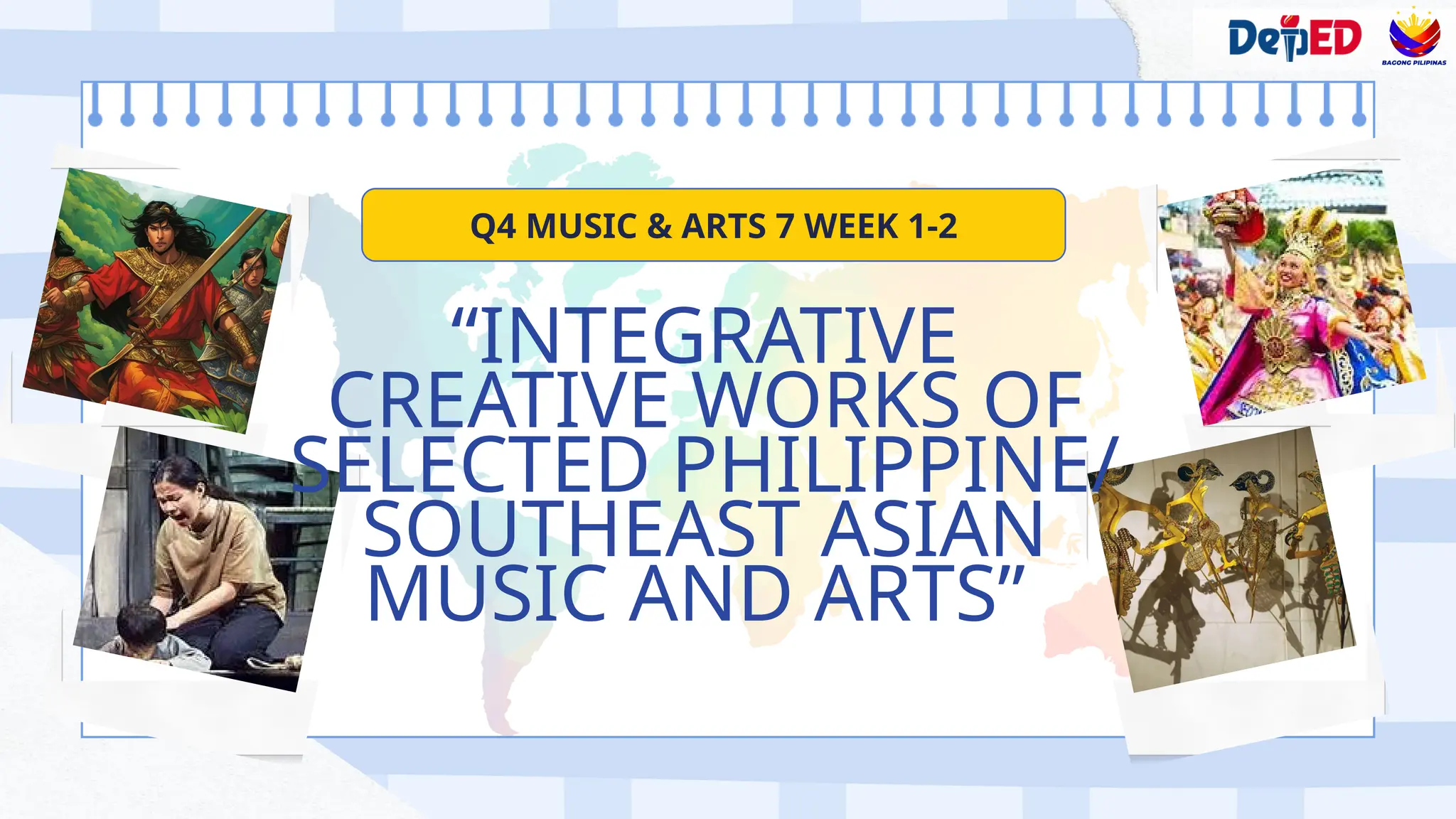
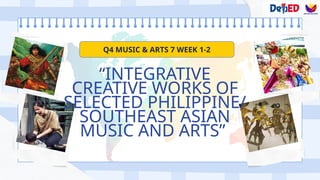
“INTEGRATIVE
CREATIVE WORKS OF
SELECTED PHILIPPINE/
SOUTHEAST ASIAN
MUSIC AND ARTS”
Q4 MUSIC & ARTS 7 WEEK 1-2
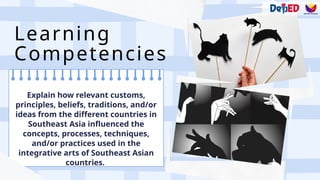
Learning
Competencies
Explain how relevant customs,
principles, beliefs, traditions, and/or
ideas from the different countries in
Southeast Asia influenced the
concepts, processes, techniques,
and/or practices used in the
integrative arts of Southeast Asian
countries.
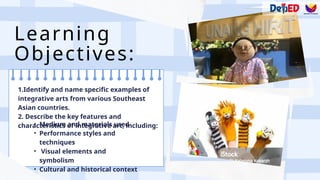
Learning
Objectives:
• Medium and materials used
• Performance styles and
techniques
• Visual elements and
symbolism
• Cultural and historical context
1.Identify and name specific examples of
integrative arts from various Southeast
Asian countries.
2. Describe the key features and
characteristics of integrative art, including:
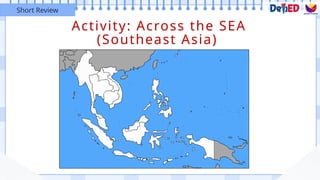
Activity: Across the SEA
(Southeast Asia)
Short Review
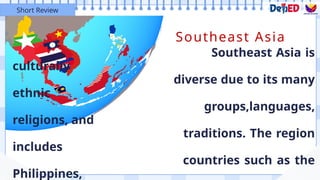
Southeast Asia
Southeast Asia is
culturally
diverse due to its many
ethnic
groups,languages,
religions, and
traditions. The region
includes
countries such as the
Philippines,
Short Review
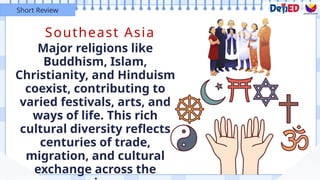
Southeast Asia
Major religions like
Buddhism, Islam,
Christianity, and Hinduism
coexist, contributing to
varied festivals, arts, and
ways of life. This rich
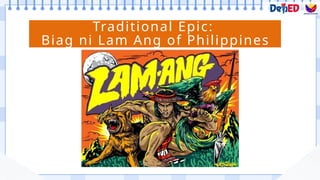
cultural diversity reflects
centuries of trade,
migration, and cultural
exchange across the
Short Review
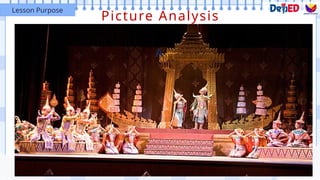
Picture Analysis
A
Lesson Purpose
What is an
integrative art?
Lesson Purpose
Dance
to move your body in a
way that goes with the
rhythm and style of
music that is being
played.
vocabulary
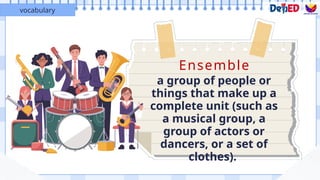
Ensemble
a group of people or
things that make up a
complete unit (such as
a musical group, a
group of actors or
dancers, or a set of
clothes).
vocabulary
Festival
a special time or event
when people gather to
celebrate something.
vocabulary
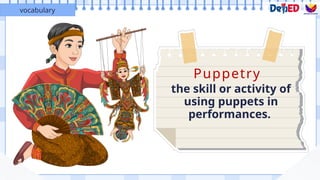
Puppetry
the skill or activity of
using puppets in
performances.
vocabulary
Theater
a collaborative form of
fine art that uses live
performers before a live
audience in a specific
place.
vocabulary
ACTIVITY
Medium Performance Stye
Visual Elements Cultural Context
Read each question carefully. Choose the correct answer from
the box.
ANSWER : VISUAL ELEMENTS
1. These are the building blocks of
communication, such as line, shape, color,
texture, space, and light.
ACTIVITY
Medium Performance Stye
Visual Elements Cultural Context
Read each question carefully. Choose the correct answer from
the box.
ANSWER : CULTURAL CONTEXT
2.It refers to the social, historical, and political
environment in which a work of art or
performance is created and experienced.
ACTIVITY
Medium Performance Stye
Visual Elements Cultural Context
Read each question carefully. Choose the correct answer from
the box.
ANSWER : MEDIUM
3.The material or channel through which an artist
or performer communicates their ideas and
expression
ACTIVITY
Medium Performance Stye
Visual Elements Cultural Context
Read each question carefully. Choose the correct answer from
the box.
ANSWER : PERFORMANCE STYLES
4.It is a particular way of performing that is
characterized by specific techniques, conventions,
and aesthetics.
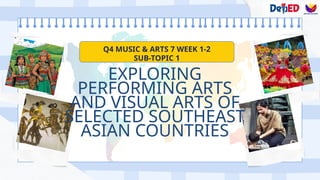
EXPLORING
PERFORMING ARTS
AND VISUAL ARTS OF
SELECTED SOUTHEAST
ASIAN COUNTRIES
Q4 MUSIC & ARTS 7 WEEK 1-2
SUB-TOPIC 1
Integrative art
• Integrative art, also referred
to as interdisciplinary art, is
a form of artistic expression
that blends two or more
traditionally separate art
forms to create a unified
whole.
Explicitation
Integrative art
• This can involve combining
mediums like painting,
sculpture, and architecture, or
performance art forms like
dance, music, and theater.
• For instance, an environmental
art installation might
incorporate elements of
sculpture, sound design, and
lighting to create an immersive
Explicitation
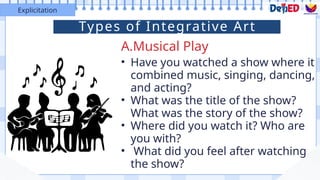
A.Musical Play
Explicitation
• Have you watched a show where it
combined music, singing, dancing,
and acting?
• What was the title of the show?
What was the story of the show?
• Where did you watch it? Who are
you with?
• What did you feel after watching
the show?
Types of Integrative Art
A.Musical Play
Explicitation
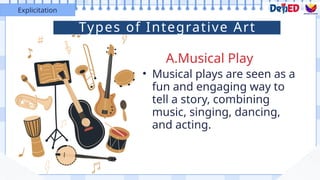
• Musical plays are seen as a
fun and engaging way to
tell a story, combining
music, singing, dancing,
and acting.
Types of Integrative Art
A.Examples of Musical Play
Explicitation
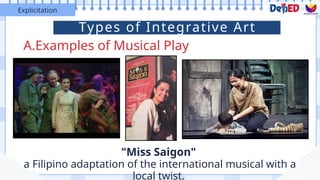
"Miss Saigon"
a Filipino adaptation of the international musical with a
local twist.
A.Examples of Musical Play
Explicitation
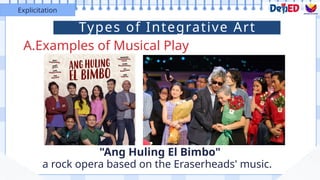
"Ang Huling El Bimbo"
a rock opera based on the Eraserheads' music.
Types of Integrative Art
A.Examples of Musical Play
Explicitation
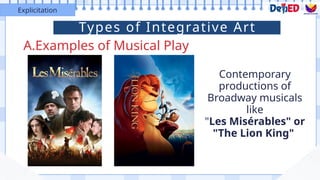
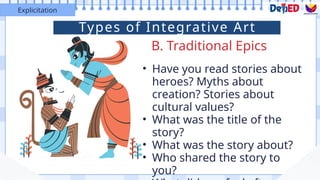
Contemporary
productions of
Broadway musicals
like
"Les Misérables" or
"The Lion King"
Types of Integrative Art
B. Traditional Epics
Explicitation
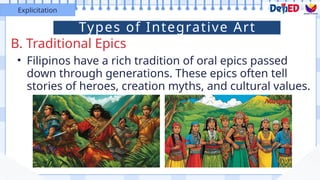
• Have you read stories about
heroes? Myths about
creation? Stories about
cultural values?
• What was the title of the
story?
• What was the story about?
• Who shared the story to
you?
Types of Integrative Art
B. Traditional Epics
Explicitation
• Filipinos have a rich tradition of oral epics passed
down through generations. These epics often tell
stories of heroes, creation myths, and cultural values.
Types of Integrative Art
B. Examples of Traditional Epics
Explicitation
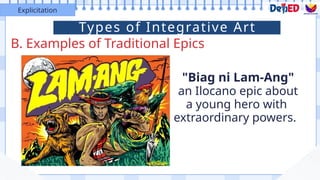
"Biag ni Lam-Ang"
an Ilocano epic about
a young hero with
extraordinary powers.
Types of Integrative Art
B. Examples of Traditional Epics
Explicitation
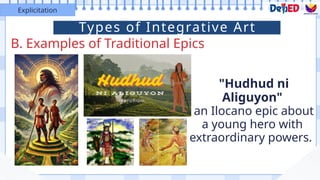
"Hudhud ni
Aliguyon"
an Ilocano epic about
a young hero with
extraordinary powers.
Types of Integrative Art
B. Examples of Traditional Epics
Explicitation
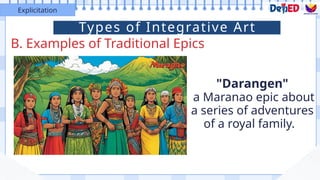
"Darangen"
a Maranao epic about
a series of adventures
of a royal family.
Types of Integrative Art
C. Puppetry
Explicitation
Are you familiar with this? What is the name of this form of
puppetry?
Types of Integrative Art
C. Puppetry
Explicitation
Are you familiar with this? What is the name of this form of
puppetry?
Types of Integrative Art
C. Puppetry
Explicitation
Are you familiar with this? What is the name of this form of
puppetry?
Types of Integrative Art
C. Puppetry
Explicitation
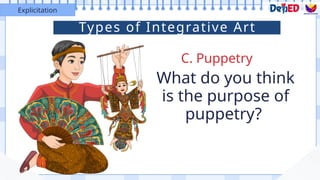
What do you think
is the purpose of
puppetry?
Types of Integrative Art
C. Puppetry
Explicitation
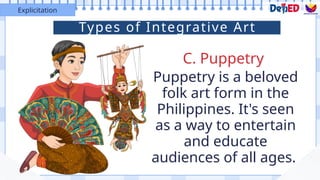
Puppetry is a beloved
folk art form in the
Philippines. It's seen
as a way to entertain
and educate
audiences of all ages.
Types of Integrative Art
C. Examples of Puppets
Explicitation
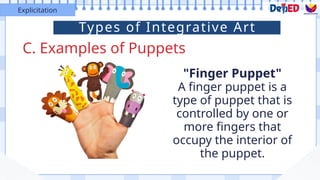
"Finger Puppet"
A finger puppet is a
type of puppet that is
controlled by one or
more fingers that
occupy the interior of
the puppet.
Types of Integrative Art
C. Examples of Puppets
Explicitation
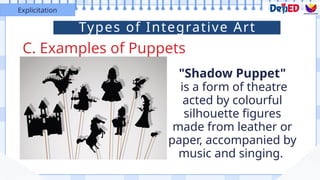
"Shadow Puppet"
is a form of theatre
acted by colourful
silhouette figures
made from leather or
paper, accompanied by
music and singing.
Types of Integrative Art
C. Examples of Puppets
Explicitation
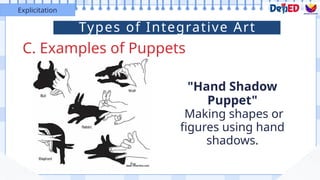
"Hand Shadow
Puppet"
Making shapes or
figures using hand
shadows.
Types of Integrative Art
C. Examples of Puppets
Explicitation
"Ventriloquism"
A performance art in
which a person makes
it appear that a voice is
coming from a puppet
or dummy while the
performer’s lips move
very little or not at all.
Types of Integrative Art
• Are you familiar with the
word ‘fiesta’?
• What do you usually
experience during a ‘fiesta’?
• Can you give me an
example of a fiesta?
D. Festivals
Explicitation
Types of Integrative Art
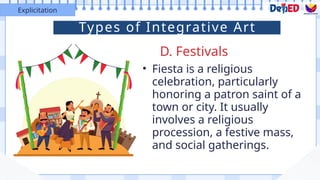
• Fiesta is a religious
celebration, particularly
honoring a patron saint of a
town or city. It usually
involves a religious
procession, a festive mass,
and social gatherings.
D. Festivals
Explicitation
Types of Integrative Art
• Festival can either be religious or secular, and it
celebrates a wider range of themes like culture,
harvest, or the arts.
• It tends to be a larger-scale event attracting broader
participation and sometimes even international
tourism.
• It may involve parades, competitions, exhibits, and a
D. Festivals
Explicitation
Types of Integrative Art
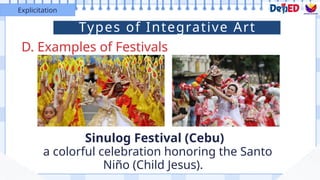
D. Examples of Festivals
Explicitation
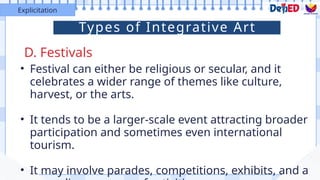
Sinulog Festival (Cebu)
a colorful celebration honoring the Santo
Niño (Child Jesus).
Types of Integrative Art
D. Examples of Festivals
Explicitation
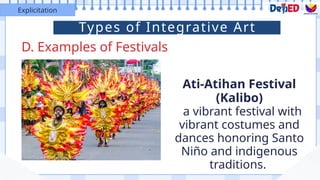
Ati-Atihan Festival
(Kalibo)
a vibrant festival with
vibrant costumes and
dances honoring Santo
Niño and indigenous
traditions.
Types of Integrative Art
D. Examples of Festivals
Explicitation
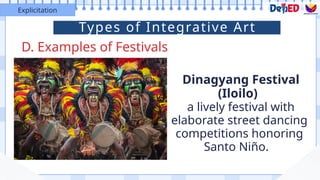
Dinagyang Festival
(Iloilo)
a lively festival with
elaborate street dancing
competitions honoring
Santo Niño.
Types of Integrative Art
D. Examples of Festivals
Explicitation
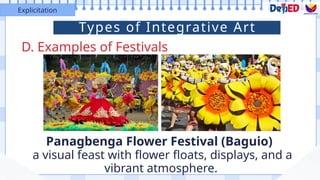
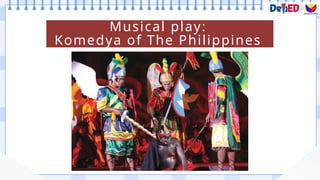
Panagbenga Flower Festival (Baguio)
a visual feast with flower floats, displays, and a
vibrant atmosphere.
Types of Integrative Art
Activity:
Article Analysis
Worked Example
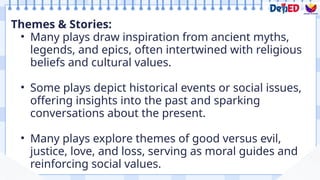
Musical play:
Komedya of The Philippines
Themes & Stories:
• Many plays draw inspiration from ancient myths,
legends, and epics, often intertwined with religious
beliefs and cultural values.
• Some plays depict historical events or social issues,
offering insights into the past and sparking
conversations about the present.
• Many plays explore themes of good versus evil,
justice, love, and loss, serving as moral guides and
reinforcing social values.
Musicality:
• Music and dance are integral parts of the
performance, often intertwined with storytelling
and character development.
• The use of traditional instruments like gongs,
drums, and flutes creates a unique soundscape.
Traditional Epic:
Biag ni Lam Ang of Philippines
Themes & Stories:
• Many epics explain the origins of the universe,
creation of mankind, and establishment of social
order.
• Epics often feature legendary heroes with
superhuman abilities who embody cultural values
and overcome challenges.
Themes & Stories:
• Epics convey moral messages and reinforce social
norms, teaching lessons about courage, loyalty,
justice, and the importance of upholding tradition.
• Gods, spirits, and mythical creaturesoften play
significant roles, reflecting the animistic beliefs
prevalent in many Southeast Asian cultures.
Narrative & Style:
• Many epics were originally passed down orally, with
singers, chanters, or storytellers performing them
from memory.
• This led to variations and regional adaptations over
time. Epics often use elevated language, metaphors,
and similes, adding beauty and depth to the
storytelling.
Narrative & Style:
• Epics are typically divided into episodes, each
focusing on a specific event or challenge faced by
the hero.
• This allows for flexibility in performance length and
audience engagement.
• Singing or chanting are often incorporated, with
specific melodies or rhythms associated with
different characters or scenes. Examples include the
gamelan in Indonesia and the kundiman in the
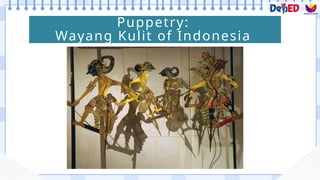
Puppetry:
Wayang Kulit of Indonesia
Storytelling:
• Many plays draw inspiration from ancient myths,
legends, and epics, often intertwined with religious
beliefs and cultural values.
• Traditional stories, fables, and folklore also find
expression, often infused with humor and social
commentary.
• Many plays incorporate themes of good versus evil,
justice, and societal issues, offering moral lessons
and sparking conversations.
Visual & Performance Elements:
• Shadow puppets are crafted from various materials
like leather, parchment, or even leaves, with intricate
designs and often vibrant colors.
• The manipulation of these figures against the light
screen creates a captivating visual experience.
Traditional instruments like gongs, drums, and flutes
accompany the performance, creating a unique
soundscape. Live singing adds another layer of
depth and emotion to the storytelling.
Visual & Performance Elements:
• Traditional instruments like gongs, drums, and flutes
accompany the performance, creating a unique
soundscape.
• Live singing adds another layer of depth and
emotion to the storytelling.
The puppeteer
• Known as the dalang, plays a crucial role in
narrating the story, voicing characters, and
manipulating the puppets.
• Their skill and artistry bring the characters to life.
• The interplay of light and shadow on the screen adds
another dimension to the performance, creating
illusions and emphasizing key moments in the
narrative.
Cultural Significance:
• Shadow puppetry performances often serve as
community gatherings, bringing people together to
celebrate, share stories, and reaffirm cultural
identities.
• Some traditions incorporate ritualistic elements,
connecting shadow puppetry to religious beliefs and
practices.
Cultural Significance:
• Offerings, prayers, and blessings might be part of
the performance.
• Shadow puppetry traditions continue to evolve,
incorporating contemporary themes and adapting to
new technologies while preserving their cultural
essence.
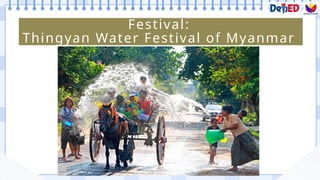
Festival:
Thingyan Water Festival of Myanmar
Themes & Significance:
• Many water festivals mark the start of a new year or
significant religious occasions, symbolizing
cleansing, purification, and renewal.
• Some water festivals celebrate bountiful harvests
and fertility, praying for good crops and prosperity.
Themes & Significance:
• Water festivals are often joyous occasions, with
people playfully drenching each other and engaging
in various activities.
• They serve as important community gatherings,
strengthening social bonds and cultural identity.
Water Activities & Traditions:
• The most common feature is the playful throwing
and splashing of water, using buckets, hoses, or even
water guns. This can be a friendly exchange or more
intense, depending on the festival.
• Religious processions with statues of deities or
offerings to spirits are often part of the celebrations.
Various traditional games and activities might be
associated with the festival, such as boat races, fish
catching, or tug-of-war. This adds to the festive
atmosphere and encourages community
Regional Variations:
• The duration and intensity of water activities vary
across regions.
• Some festivals, like Thingyan, last for several days
with continuous water play, while others are shorter
and more symbolic.
• Each festival reflects the unique cultural elements of
its region.
Regional Variations:
• For example, Thingyan incorporates Buddhist rituals
and merit-making, while Songkran has a focus on
respect for elders and washing away bad luck.
• Some festivals have specific traditions like using
scented water, offering blessings, or releasing boats
carrying wishes.
• This adds to the cultural richness and diversity of
Southeast Asian water festivals.
Activity:
Group Exploration
Lesson Activity
1. What is an integrative art in the context of
Southeast Asian countries?
a. It is a form of artistic expression that blends two or
more traditionally separate art forms to create a
unified whole.
b. It involves combining mediums like painting,
sculpture, and architecture, or performance art
forms like dance, music, and theater.
c. Both a and b
d. None of the above
Formative Assessment
2. Which integrative arts often tell stories of heroes,
creation myths, and cultural values?
a. musical play
b. traditional epics
c. shadow puppetry
d. festival
Formative Assessment
3. Which integrative arts involves manipulation of
figures against the light screen to create a
captivating visual experience?
a. musical play
b. traditional epics
c. shadow puppetry
d. festival
Formative Assessment
4. Which specific integrative arts reinforces Christian
superiority and societal hierarchy?
a. Komedya
b. hát bội
c. Sinulog
d. Thingyan
Formative Assessment
5. Which pair of integrative arts and country are
incorrectly paired?
a. Hat Boi (Indonesia)
b. Ramakien (Thailand)
c. Carillo (Philippines)
d. Sinulog (Philippines)
Formative Assessment
Key to correction:
1. a
2. b
3. c
4. a
5. a
Formative Assessment
Ang PowerPoint na ito ay orihinal na gawa ni Miss Alyssa D. Caranto at
para lamang sa personal na gamit ng gurong bumili.
Mahigpit na ipinagbabawal ang pagkopya, paggaya, pamamahagi, at
pagbebenta ng anumang bahagi nito, alinsunod sa R.A. 8293 (Intellectual
Property Code of the Philippines).
Kung may makita kayong sinumang nagbebenta o gumagamit nito nang
hindi awtorisado, mangyaring ipagbigay-alam agad sa may-akda upang
agad na maaksyunan.
Igalang po natin ang karapatang-ari at ang oras at pagod na inilaan sa
paggawa ng materyal na ito.
Maraming salamat sa inyong suporta at pag-unawa.
Paalala sa mga Gurong Bumibili
THANK
YOU

Q4_PPT MUSIC & ARTS 7 week 1-2, matatag curriculum

  • 1.
    “INTEGRATIVE CREATIVE WORKS OF SELECTEDPHILIPPINE/ SOUTHEAST ASIAN MUSIC AND ARTS” Q4 MUSIC & ARTS 7 WEEK 1-2
  • 2.
    Learning Competencies Explain how relevantcustoms, principles, beliefs, traditions, and/or ideas from the different countries in Southeast Asia influenced the concepts, processes, techniques, and/or practices used in the integrative arts of Southeast Asian countries.
  • 3.
    Learning Objectives: • Medium andmaterials used • Performance styles and techniques • Visual elements and symbolism • Cultural and historical context 1.Identify and name specific examples of integrative arts from various Southeast Asian countries. 2. Describe the key features and characteristics of integrative art, including:
  • 4.
    Activity: Across theSEA (Southeast Asia) Short Review
  • 5.
    Southeast Asia Southeast Asiais culturally diverse due to its many ethnic groups,languages, religions, and traditions. The region includes countries such as the Philippines, Short Review
  • 6.
    Southeast Asia Major religionslike Buddhism, Islam, Christianity, and Hinduism coexist, contributing to varied festivals, arts, and ways of life. This rich cultural diversity reflects centuries of trade, migration, and cultural exchange across the Short Review
  • 7.
  • 8.
    What is an integrativeart? Lesson Purpose
  • 9.
    Dance to move yourbody in a way that goes with the rhythm and style of music that is being played. vocabulary
  • 10.
    Ensemble a group ofpeople or things that make up a complete unit (such as a musical group, a group of actors or dancers, or a set of clothes). vocabulary
  • 11.
    Festival a special timeor event when people gather to celebrate something. vocabulary
  • 12.
    Puppetry the skill oractivity of using puppets in performances. vocabulary
  • 13.
    Theater a collaborative formof fine art that uses live performers before a live audience in a specific place. vocabulary
  • 14.
    ACTIVITY Medium Performance Stye VisualElements Cultural Context Read each question carefully. Choose the correct answer from the box. ANSWER : VISUAL ELEMENTS 1. These are the building blocks of communication, such as line, shape, color, texture, space, and light.
  • 15.
    ACTIVITY Medium Performance Stye VisualElements Cultural Context Read each question carefully. Choose the correct answer from the box. ANSWER : CULTURAL CONTEXT 2.It refers to the social, historical, and political environment in which a work of art or performance is created and experienced.
  • 16.
    ACTIVITY Medium Performance Stye VisualElements Cultural Context Read each question carefully. Choose the correct answer from the box. ANSWER : MEDIUM 3.The material or channel through which an artist or performer communicates their ideas and expression
  • 17.
    ACTIVITY Medium Performance Stye VisualElements Cultural Context Read each question carefully. Choose the correct answer from the box. ANSWER : PERFORMANCE STYLES 4.It is a particular way of performing that is characterized by specific techniques, conventions, and aesthetics.
  • 18.
    EXPLORING PERFORMING ARTS AND VISUALARTS OF SELECTED SOUTHEAST ASIAN COUNTRIES Q4 MUSIC & ARTS 7 WEEK 1-2 SUB-TOPIC 1
  • 19.
    Integrative art • Integrativeart, also referred to as interdisciplinary art, is a form of artistic expression that blends two or more traditionally separate art forms to create a unified whole. Explicitation
  • 20.
    Integrative art • Thiscan involve combining mediums like painting, sculpture, and architecture, or performance art forms like dance, music, and theater. • For instance, an environmental art installation might incorporate elements of sculpture, sound design, and lighting to create an immersive Explicitation
  • 21.
    A.Musical Play Explicitation • Haveyou watched a show where it combined music, singing, dancing, and acting? • What was the title of the show? What was the story of the show? • Where did you watch it? Who are you with? • What did you feel after watching the show? Types of Integrative Art
  • 22.
    A.Musical Play Explicitation • Musicalplays are seen as a fun and engaging way to tell a story, combining music, singing, dancing, and acting. Types of Integrative Art
  • 23.
    Types of IntegrativeArt A.Examples of Musical Play Explicitation "Miss Saigon" a Filipino adaptation of the international musical with a local twist.
  • 24.
    A.Examples of MusicalPlay Explicitation "Ang Huling El Bimbo" a rock opera based on the Eraserheads' music. Types of Integrative Art
  • 25.
    A.Examples of MusicalPlay Explicitation Contemporary productions of Broadway musicals like "Les Misérables" or "The Lion King" Types of Integrative Art
  • 26.
    B. Traditional Epics Explicitation •Have you read stories about heroes? Myths about creation? Stories about cultural values? • What was the title of the story? • What was the story about? • Who shared the story to you? Types of Integrative Art
  • 27.
    B. Traditional Epics Explicitation •Filipinos have a rich tradition of oral epics passed down through generations. These epics often tell stories of heroes, creation myths, and cultural values. Types of Integrative Art
  • 28.
    B. Examples ofTraditional Epics Explicitation "Biag ni Lam-Ang" an Ilocano epic about a young hero with extraordinary powers. Types of Integrative Art
  • 29.
    B. Examples ofTraditional Epics Explicitation "Hudhud ni Aliguyon" an Ilocano epic about a young hero with extraordinary powers. Types of Integrative Art
  • 30.
    B. Examples ofTraditional Epics Explicitation "Darangen" a Maranao epic about a series of adventures of a royal family. Types of Integrative Art
  • 31.
    C. Puppetry Explicitation Are youfamiliar with this? What is the name of this form of puppetry? Types of Integrative Art
  • 32.
    C. Puppetry Explicitation Are youfamiliar with this? What is the name of this form of puppetry? Types of Integrative Art
  • 33.
    C. Puppetry Explicitation Are youfamiliar with this? What is the name of this form of puppetry? Types of Integrative Art
  • 34.
    C. Puppetry Explicitation What doyou think is the purpose of puppetry? Types of Integrative Art
  • 35.
    C. Puppetry Explicitation Puppetry isa beloved folk art form in the Philippines. It's seen as a way to entertain and educate audiences of all ages. Types of Integrative Art
  • 36.
    C. Examples ofPuppets Explicitation "Finger Puppet" A finger puppet is a type of puppet that is controlled by one or more fingers that occupy the interior of the puppet. Types of Integrative Art
  • 37.
    C. Examples ofPuppets Explicitation "Shadow Puppet" is a form of theatre acted by colourful silhouette figures made from leather or paper, accompanied by music and singing. Types of Integrative Art
  • 38.
    C. Examples ofPuppets Explicitation "Hand Shadow Puppet" Making shapes or figures using hand shadows. Types of Integrative Art
  • 39.
    C. Examples ofPuppets Explicitation "Ventriloquism" A performance art in which a person makes it appear that a voice is coming from a puppet or dummy while the performer’s lips move very little or not at all. Types of Integrative Art
  • 40.
    • Are youfamiliar with the word ‘fiesta’? • What do you usually experience during a ‘fiesta’? • Can you give me an example of a fiesta? D. Festivals Explicitation Types of Integrative Art
  • 41.
    • Fiesta isa religious celebration, particularly honoring a patron saint of a town or city. It usually involves a religious procession, a festive mass, and social gatherings. D. Festivals Explicitation Types of Integrative Art
  • 42.
    • Festival caneither be religious or secular, and it celebrates a wider range of themes like culture, harvest, or the arts. • It tends to be a larger-scale event attracting broader participation and sometimes even international tourism. • It may involve parades, competitions, exhibits, and a D. Festivals Explicitation Types of Integrative Art
  • 43.
    D. Examples ofFestivals Explicitation Sinulog Festival (Cebu) a colorful celebration honoring the Santo Niño (Child Jesus). Types of Integrative Art
  • 44.
    D. Examples ofFestivals Explicitation Ati-Atihan Festival (Kalibo) a vibrant festival with vibrant costumes and dances honoring Santo Niño and indigenous traditions. Types of Integrative Art
  • 45.
    D. Examples ofFestivals Explicitation Dinagyang Festival (Iloilo) a lively festival with elaborate street dancing competitions honoring Santo Niño. Types of Integrative Art
  • 46.
    D. Examples ofFestivals Explicitation Panagbenga Flower Festival (Baguio) a visual feast with flower floats, displays, and a vibrant atmosphere. Types of Integrative Art
  • 47.
  • 48.
    Musical play: Komedya ofThe Philippines
  • 49.
    Themes & Stories: •Many plays draw inspiration from ancient myths, legends, and epics, often intertwined with religious beliefs and cultural values. • Some plays depict historical events or social issues, offering insights into the past and sparking conversations about the present. • Many plays explore themes of good versus evil, justice, love, and loss, serving as moral guides and reinforcing social values.
  • 50.
    Musicality: • Music anddance are integral parts of the performance, often intertwined with storytelling and character development. • The use of traditional instruments like gongs, drums, and flutes creates a unique soundscape.
  • 51.
    Traditional Epic: Biag niLam Ang of Philippines
  • 52.
    Themes & Stories: •Many epics explain the origins of the universe, creation of mankind, and establishment of social order. • Epics often feature legendary heroes with superhuman abilities who embody cultural values and overcome challenges.
  • 53.
    Themes & Stories: •Epics convey moral messages and reinforce social norms, teaching lessons about courage, loyalty, justice, and the importance of upholding tradition. • Gods, spirits, and mythical creaturesoften play significant roles, reflecting the animistic beliefs prevalent in many Southeast Asian cultures.
  • 54.
    Narrative & Style: •Many epics were originally passed down orally, with singers, chanters, or storytellers performing them from memory. • This led to variations and regional adaptations over time. Epics often use elevated language, metaphors, and similes, adding beauty and depth to the storytelling.
  • 55.
    Narrative & Style: •Epics are typically divided into episodes, each focusing on a specific event or challenge faced by the hero. • This allows for flexibility in performance length and audience engagement. • Singing or chanting are often incorporated, with specific melodies or rhythms associated with different characters or scenes. Examples include the gamelan in Indonesia and the kundiman in the
  • 56.
  • 57.
    Storytelling: • Many playsdraw inspiration from ancient myths, legends, and epics, often intertwined with religious beliefs and cultural values. • Traditional stories, fables, and folklore also find expression, often infused with humor and social commentary. • Many plays incorporate themes of good versus evil, justice, and societal issues, offering moral lessons and sparking conversations.
  • 58.
    Visual & PerformanceElements: • Shadow puppets are crafted from various materials like leather, parchment, or even leaves, with intricate designs and often vibrant colors. • The manipulation of these figures against the light screen creates a captivating visual experience. Traditional instruments like gongs, drums, and flutes accompany the performance, creating a unique soundscape. Live singing adds another layer of depth and emotion to the storytelling.
  • 59.
    Visual & PerformanceElements: • Traditional instruments like gongs, drums, and flutes accompany the performance, creating a unique soundscape. • Live singing adds another layer of depth and emotion to the storytelling.
  • 60.
    The puppeteer • Knownas the dalang, plays a crucial role in narrating the story, voicing characters, and manipulating the puppets. • Their skill and artistry bring the characters to life. • The interplay of light and shadow on the screen adds another dimension to the performance, creating illusions and emphasizing key moments in the narrative.
  • 61.
    Cultural Significance: • Shadowpuppetry performances often serve as community gatherings, bringing people together to celebrate, share stories, and reaffirm cultural identities. • Some traditions incorporate ritualistic elements, connecting shadow puppetry to religious beliefs and practices.
  • 62.
    Cultural Significance: • Offerings,prayers, and blessings might be part of the performance. • Shadow puppetry traditions continue to evolve, incorporating contemporary themes and adapting to new technologies while preserving their cultural essence.
  • 63.
  • 64.
    Themes & Significance: •Many water festivals mark the start of a new year or significant religious occasions, symbolizing cleansing, purification, and renewal. • Some water festivals celebrate bountiful harvests and fertility, praying for good crops and prosperity.
  • 65.
    Themes & Significance: •Water festivals are often joyous occasions, with people playfully drenching each other and engaging in various activities. • They serve as important community gatherings, strengthening social bonds and cultural identity.
  • 66.
    Water Activities &Traditions: • The most common feature is the playful throwing and splashing of water, using buckets, hoses, or even water guns. This can be a friendly exchange or more intense, depending on the festival. • Religious processions with statues of deities or offerings to spirits are often part of the celebrations. Various traditional games and activities might be associated with the festival, such as boat races, fish catching, or tug-of-war. This adds to the festive atmosphere and encourages community
  • 67.
    Regional Variations: • Theduration and intensity of water activities vary across regions. • Some festivals, like Thingyan, last for several days with continuous water play, while others are shorter and more symbolic. • Each festival reflects the unique cultural elements of its region.
  • 68.
    Regional Variations: • Forexample, Thingyan incorporates Buddhist rituals and merit-making, while Songkran has a focus on respect for elders and washing away bad luck. • Some festivals have specific traditions like using scented water, offering blessings, or releasing boats carrying wishes. • This adds to the cultural richness and diversity of Southeast Asian water festivals.
  • 69.
  • 70.
    1. What isan integrative art in the context of Southeast Asian countries? a. It is a form of artistic expression that blends two or more traditionally separate art forms to create a unified whole. b. It involves combining mediums like painting, sculpture, and architecture, or performance art forms like dance, music, and theater. c. Both a and b d. None of the above Formative Assessment
  • 71.
    2. Which integrativearts often tell stories of heroes, creation myths, and cultural values? a. musical play b. traditional epics c. shadow puppetry d. festival Formative Assessment
  • 72.
    3. Which integrativearts involves manipulation of figures against the light screen to create a captivating visual experience? a. musical play b. traditional epics c. shadow puppetry d. festival Formative Assessment
  • 73.
    4. Which specificintegrative arts reinforces Christian superiority and societal hierarchy? a. Komedya b. hát bội c. Sinulog d. Thingyan Formative Assessment
  • 74.
    5. Which pairof integrative arts and country are incorrectly paired? a. Hat Boi (Indonesia) b. Ramakien (Thailand) c. Carillo (Philippines) d. Sinulog (Philippines) Formative Assessment
  • 75.
    Key to correction: 1.a 2. b 3. c 4. a 5. a Formative Assessment
  • 76.
    Ang PowerPoint naito ay orihinal na gawa ni Miss Alyssa D. Caranto at para lamang sa personal na gamit ng gurong bumili. Mahigpit na ipinagbabawal ang pagkopya, paggaya, pamamahagi, at pagbebenta ng anumang bahagi nito, alinsunod sa R.A. 8293 (Intellectual Property Code of the Philippines). Kung may makita kayong sinumang nagbebenta o gumagamit nito nang hindi awtorisado, mangyaring ipagbigay-alam agad sa may-akda upang agad na maaksyunan. Igalang po natin ang karapatang-ari at ang oras at pagod na inilaan sa paggawa ng materyal na ito. Maraming salamat sa inyong suporta at pag-unawa. Paalala sa mga Gurong Bumibili
  • 77.

Editor's Notes

  • #1  Ang PowerPoint na ito ay orihinal na gawa ni Miss Alyssa D. Caranto at para lamang sa personal na gamit ng gurong bumili. Mahigpit na ipinagbabawal ang pagkopya, paggaya, pamamahagi, at pagbebenta ng anumang bahagi nito, alinsunod sa R.A. 8293 (Intellectual Property Code of the Philippines). Kung may makita kayong sinumang nagbebenta o gumagamit nito nang hindi awtorisado, mangyaring ipagbigay-alam agad sa may-akda upang agad na maaksyunan. Igalang po natin ang karapatang-ari at ang oras at pagod na inilaan sa paggawa ng materyal na ito. Maraming salamat sa inyong suporta at pag-unawa.
  • #4 Show a blank map of Southeast Asia. ● Ask the students to identify the different countries belonging to Southeast Asia by allowing the students to stick a small image of their flag on the map.
  • #18  Ang PowerPoint na ito ay orihinal na gawa ni Miss Alyssa D. Caranto at para lamang sa personal na gamit ng gurong bumili. Mahigpit na ipinagbabawal ang pagkopya, paggaya, pamamahagi, at pagbebenta ng anumang bahagi nito, alinsunod sa R.A. 8293 (Intellectual Property Code of the Philippines). Kung may makita kayong sinumang nagbebenta o gumagamit nito nang hindi awtorisado, mangyaring ipagbigay-alam agad sa may-akda upang agad na maaksyunan. Igalang po natin ang karapatang-ari at ang oras at pagod na inilaan sa paggawa ng materyal na ito. Maraming salamat sa inyong suporta at pag-unawa.
  • #47 Give them 5-7 minutes to read the article, and 3-5 minutes to complete the worksheet. (See Worksheet 1.1)
  • #69 CHECK THE LESSON EXEMPLAR FOR THIS ACTIVITY