Created by :Ashutosh
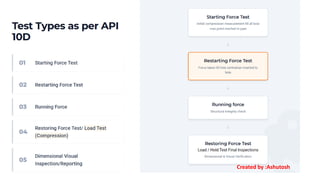
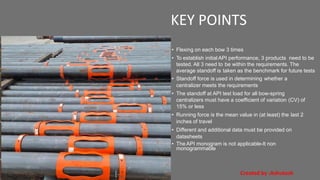
• Flexing on each bow 3 times
• To establish initial API performance, 3 products need to be
tested. All 3 need to be within the requirements. The
average standoff is taken as the benchmark for future tests
• Standoff force is used in determining whether a
centralizer meets the requirements
• The standoff at API test load for all bow-spring
centralizers must have a coefficient of variation (CV) of
15% or less
• Running force is the mean value in (at least) the last 2
inches of travel
• Different and additional data must be provided on
datasheets
• The API monogram is not applicable-It non
monogrammable
KEY POINTS
Created by :Ashutosh
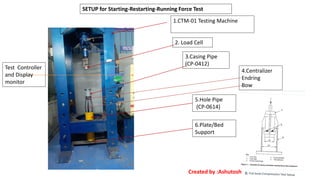
2. Load Cell
3.Casing Pipe
(CP-0412)
5.Hole Pipe
(CP-0614)
6.Plate/Bed
Support
1.CTM-01 Testing Machine
4.Centralizer
Endring
Bow
SETUP for Starting-Restarting-Running Force Test
Test Controller
and Display
monitor
Created by :Ashutosh
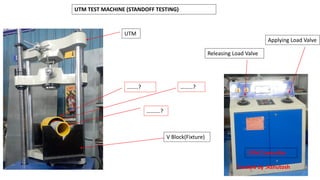
UTM TEST MACHINE (STANDOFF TESTING)
UTM
UTM Controller
……..?
……….?
V Block(Fixture)
………?
Applying Load Valve
Releasing Load Valve
Created by :Ashutosh
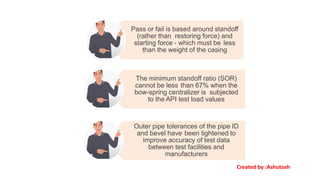
Pass or fail is based around standoff
(rather than restoring force) and
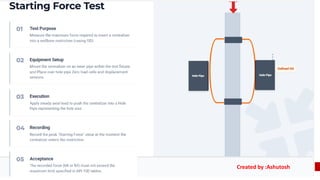
starting force - which must be less
than the weight of the casing
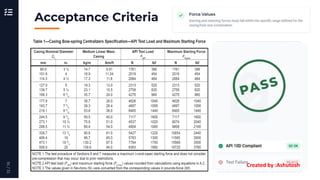
The minimum standoff ratio (SOR)
cannot be less than 67% when the
bow-spring centralizer is subjected
to the API test load values
Outer pipe tolerances of the pipe ID
and bevel have been tightened to
improve accuracy of test data
between test facilities and
manufacturers
Created by :Ashutosh
CONVENTIONAL
APPLICATIONS
• Centralizer part number
• Casing nominal diameter
• Open hole diameter (ID)
• Starting force of centralizer in open hole
• Restarting force of centralizer in open hole
• Running force of centralizer in open hole
• Centralizer installation method
• Description of centralizer coating, if present.
• Centralizer starting force test orientation (pull-in or
push-in configuration)
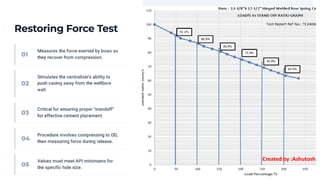
• The mean of standoff (µ) at the following
percentages of API test load; 50%, 100%, 150%,
200%, 250%, and 300%.
REPORTING
REQUIREMENTS
17
Created by :Ashutosh
Covers
Standoff must be measured
Number of flexes on each bow
Number of products needed to establish initial API performance
Minimum number of tests for design and process verification
Standoff atAPI test load for all bow-spring centralizers
Initial performance and benchmark for future tests
Pass Fail based on
Test inner pipe
Pipe bevel for starting force test
Instrumentation of the test stand allow displacement readings
Verification tests
7TH EDITION
All bow spring centralizers
Covers casing sizes between 3 1/2” & 20”
On and between every bow after flexing
3 times
3 (all 3 must be within requirements)
1 but with additional criteria
Coefficient of variation (CV) of ≤15%*
Average of standoff values at API test load
Minimum standoff and maximum starting force
Based on nominal diameter +/- 0.76mm.
30-35° x 3.2mm
1.6 mm maximum
Must all within 15% coefficient of variance
6TH EDITION
Standard bow spring centralizers
Covers casing sizes between 3 1/2” & 20”
Not specified
12 times
6
1 annually if manufactured in quantities <500
Only needs to meet minimum requirements
Restoring force at 67% standoff
Minimum standoff and maximum starting force
Specific to API 5CT.
45° maximum
1.6 mm minimum
Not applicable
*If the CV is more than 15%, 2
centralizers may be tested to
achieve the 15% CV
API TESTING STANDARD COMPARISON
Created by :Ashutosh
FOLLOW US
TO STAY UP TO DATE
Created by :Ashutosh

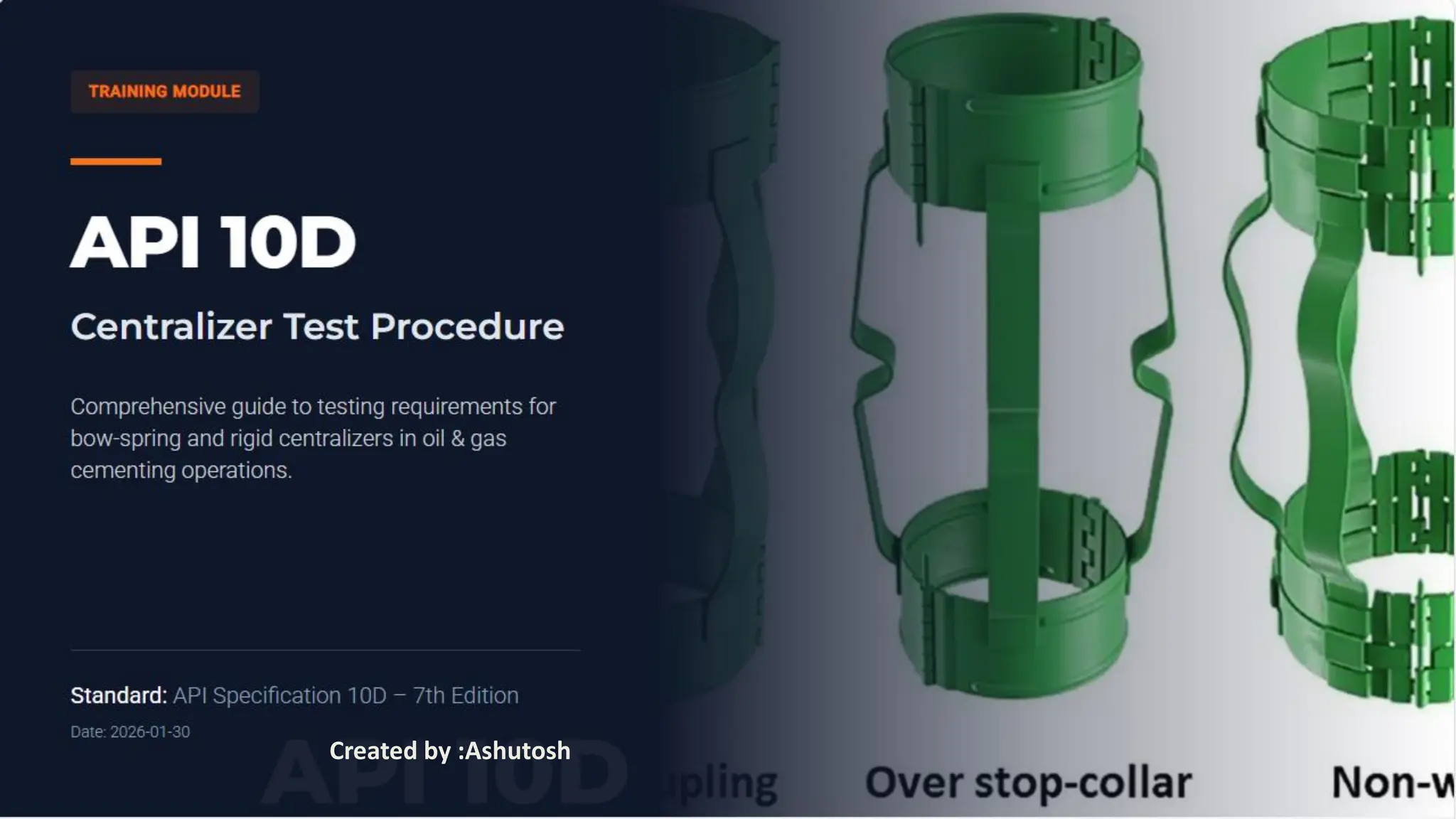
Bow Spring Centralizer -API 10d 7th edition training

  • 1.
  • 2.
  • 3.
  • 4.
  • 6.
  • 7.
  • 8.
    • Flexing oneach bow 3 times • To establish initial API performance, 3 products need to be tested. All 3 need to be within the requirements. The average standoff is taken as the benchmark for future tests • Standoff force is used in determining whether a centralizer meets the requirements • The standoff at API test load for all bow-spring centralizers must have a coefficient of variation (CV) of 15% or less • Running force is the mean value in (at least) the last 2 inches of travel • Different and additional data must be provided on datasheets • The API monogram is not applicable-It non monogrammable KEY POINTS Created by :Ashutosh
  • 9.
  • 10.
    2. Load Cell 3.CasingPipe (CP-0412) 5.Hole Pipe (CP-0614) 6.Plate/Bed Support 1.CTM-01 Testing Machine 4.Centralizer Endring Bow SETUP for Starting-Restarting-Running Force Test Test Controller and Display monitor Created by :Ashutosh
  • 11.
  • 12.
    UTM TEST MACHINE(STANDOFF TESTING) UTM UTM Controller ……..? ……….? V Block(Fixture) ………? Applying Load Valve Releasing Load Valve Created by :Ashutosh
  • 13.
  • 14.
  • 15.
    Pass or failis based around standoff (rather than restoring force) and starting force - which must be less than the weight of the casing The minimum standoff ratio (SOR) cannot be less than 67% when the bow-spring centralizer is subjected to the API test load values Outer pipe tolerances of the pipe ID and bevel have been tightened to improve accuracy of test data between test facilities and manufacturers Created by :Ashutosh
  • 16.
  • 17.
    CONVENTIONAL APPLICATIONS • Centralizer partnumber • Casing nominal diameter • Open hole diameter (ID) • Starting force of centralizer in open hole • Restarting force of centralizer in open hole • Running force of centralizer in open hole • Centralizer installation method • Description of centralizer coating, if present. • Centralizer starting force test orientation (pull-in or push-in configuration) • The mean of standoff (µ) at the following percentages of API test load; 50%, 100%, 150%, 200%, 250%, and 300%. REPORTING REQUIREMENTS 17 Created by :Ashutosh
  • 18.
  • 19.
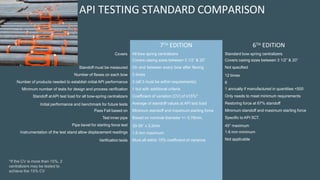
    Covers Standoff must bemeasured Number of flexes on each bow Number of products needed to establish initial API performance Minimum number of tests for design and process verification Standoff atAPI test load for all bow-spring centralizers Initial performance and benchmark for future tests Pass Fail based on Test inner pipe Pipe bevel for starting force test Instrumentation of the test stand allow displacement readings Verification tests 7TH EDITION All bow spring centralizers Covers casing sizes between 3 1/2” & 20” On and between every bow after flexing 3 times 3 (all 3 must be within requirements) 1 but with additional criteria Coefficient of variation (CV) of ≤15%* Average of standoff values at API test load Minimum standoff and maximum starting force Based on nominal diameter +/- 0.76mm. 30-35° x 3.2mm 1.6 mm maximum Must all within 15% coefficient of variance 6TH EDITION Standard bow spring centralizers Covers casing sizes between 3 1/2” & 20” Not specified 12 times 6 1 annually if manufactured in quantities <500 Only needs to meet minimum requirements Restoring force at 67% standoff Minimum standoff and maximum starting force Specific to API 5CT. 45° maximum 1.6 mm minimum Not applicable *If the CV is more than 15%, 2 centralizers may be tested to achieve the 15% CV API TESTING STANDARD COMPARISON
  • 20.
  • 21.
    FOLLOW US TO STAYUP TO DATE Created by :Ashutosh