Kitui County
2025 SHORT RAINS FOOD & NUTRITION
SECURITY ASSESSMENT
Final CSG Debrief
Thursday, January 29, 2026
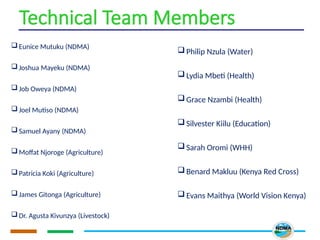
Technical Team Members
 Eunice Mutuku (NDMA)
 Joshua Mayeku (NDMA)
 Job Oweya (NDMA)
 Joel Mutiso (NDMA)
 Samuel Ayany (NDMA)
 Moffat Njoroge (Agriculture)
 Patricia Koki (Agriculture)
 James Gitonga (Agriculture)
 Dr. Agusta Kivunzya (Livestock)
 Philip Nzula (Water)
 Lydia Mbeti (Health)
 Grace Nzambi (Health)
 Silvester Kiilu (Education)
 Sarah Oromi (WHH)
 Benard Makluu (Kenya Red Cross)
 Evans Maithya (World Vision Kenya)
Supporting Partners
Logos not arranged in any specific order
Main Objective
To conduct an objective, evidence-
based and transparent FNS situation
analysis for the season, taking into
account the cumulative effect of
previous seasons, and provide
recommendations for possible
response options
Methodology
Review of existing data
• Current situation
• Briefing Kit
5
Approach
o Checklists
o Initial Briefings
o Transect drives
o Community
interviews
o Review and
analysis of data
Background Information
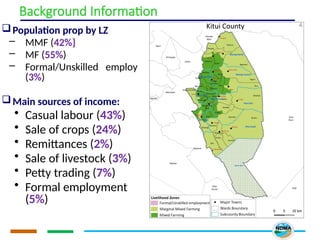
Population prop by LZ
– MMF (42%}
– MF (55%)
– Formal/Unskilled employ
(3%)
Main sources of income:
• Casual labour (43%)
• Sale of crops (24%)
• Remittances (2%)
• Sale of livestock (3%)
• Petty trading (7%)
• Formal employment
(5%)
Background Information Cont…
Area: 30,429.5 sq. Kms
 Pop density – 37 pp Km2
Borders – 7 counties
Tharaka Nithi & Meru: N
Embu: NW
Machakos & Makueni: W
Tana River: E & SE
Taita Taveta: S
 Pop: 1,229,790
(KNBS, 2025 Projections)
- 52% Female
- 47% Male
 Households : 279,192
-Household size is 4.3
 Administrative units:
⁻ 8 sub-counties
⁻ 18 sub counties (formerly
known as districts)
⁻ 40 wards
⁻ 171 locations
⁻ 247 county villages
⁻ 423 sub locations
Current Factors Affecting F&NS
1. Poor rain performance
2. Crop failure/below average crop production
3. Market dependency/high food prices
4. Livestock diseases and mortalities
5. Human wildlife conflicts
6. Insecurity/conflicts
7. Poor surface water recharge
8. Human diseases:
9. Decline in HH coping capacity
9
Rainfall Performance
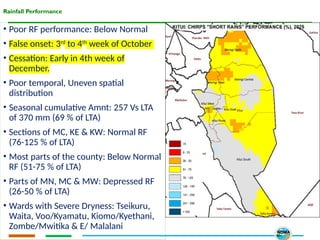
• Poor RF performance: Below Normal
• False onset: 3rd
to 4th
week of October
• Cessation: Early in 4th week of
December.
• Poor temporal, Uneven spatial
distribution
• Seasonal cumulative Amnt: 257 Vs LTA
of 370 mm (69 % of LTA)
• Sections of MC, KE & KW: Normal RF
(76-125 % of LTA)
• Most parts of the county: Below Normal
RF (51-75 % of LTA)
• Parts of MN, MC & MW: Depressed RF
(26-50 % of LTA)
• Wards with Severe Dryness: Tseikuru,
Waita, Voo/Kyamatu, Kiomo/Kyethani,
Zombe/Mwitika & E/ Malalani
Rainfall Performance
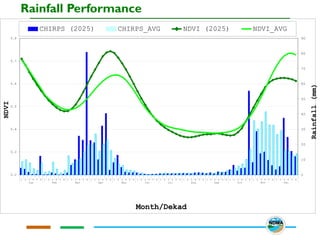
1 2 3 4 5 6 1 2 3 4 5 6 1 2 3 4 5 6 1 2 3 4 5 6 1 2 3 4 5 6 1 2 3 4 5 6 1 2 3 4 5 6 1 2 3 4 5 6 1 2 3 4 5 6 1 2 3 4 5 6 1 2 3 4 5 6 1 2 3 4 5 6
Jan Feb Mar Apr May Jun Jul Aug Sep Oct Nov Dec
0.2
0.3
0.4
0.5
0.6
0.7
0.8
0
10
20
30
40
50
60
70
80
90
CHIRPS (2025) CHIRPS_AVG NDVI (2025) NDVI_AVG
Month/Dekad
NDVI
Rainfall
(mm)
Rainfall Performance
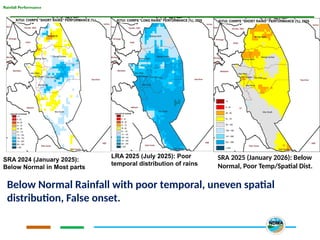
Below Normal Rainfall with poor temporal, uneven spatial
distribution, False onset.
SRA 2024 (January 2025):
Below Normal in Most parts
LRA 2025 (July 2025): Poor
temporal distribution of rains
SRA 2025 (January 2026): Below
Normal, Poor Temp/Spatial Dist.
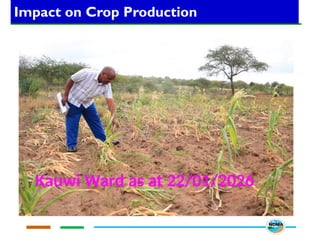
Impact on Crop Production
Kauwi Ward as at 22/01/2026
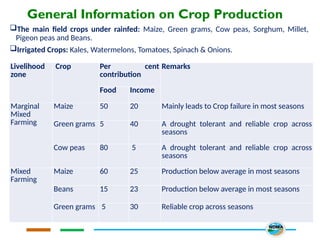
General Information on Crop Production
The main field crops under rainfed: Maize, Green grams, Cow peas, Sorghum, Millet,
Pigeon peas and Beans.
Irrigated Crops: Kales, Watermelons, Tomatoes, Spinach & Onions.
Livelihood
zone
Crop Per cent
contribution
Remarks
Food Income
Marginal
Mixed
Farming
Maize 50 20 Mainly leads to Crop failure in most seasons
Green grams 5 40 A drought tolerant and reliable crop across
seasons
Cow peas 80 5 A drought tolerant and reliable crop across
seasons
Mixed
Farming
Maize 60 25 Production below average in most seasons
Beans 15 23 Production below average in most seasons
Green grams 5 30 Reliable crop across seasons
Impact on Crop Production
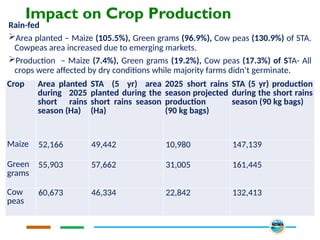
Rain-fed
Area planted – Maize (105.5%), Green grams (96.9%), Cow peas (130.9%) of STA.
Cowpeas area increased due to emerging markets.
Production – Maize (7.4%), Green grams (19.2%), Cow peas (17.3%) of STA- All
crops were affected by dry conditions while majority farms didn’t germinate.
Crop Area planted
during 2025
short rains
season (Ha)
STA (5 yr) area
planted during the
short rains season
(Ha)
2025 short rains
season projected
production
(90 kg bags)
STA (5 yr) production
during the short rains
season (90 kg bags)
Maize 52,166 49,442 10,980 147,139
Green
grams
55,903 57,662 31,005 161,445
Cow
peas
60,673 46,334 22,842 132,413
Impact on Crop Production
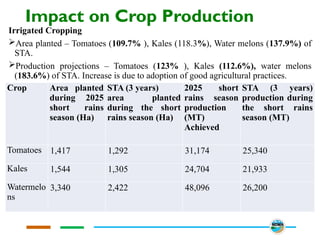
Irrigated Cropping
Area planted – Tomatoes (109.7% ), Kales (118.3%), Water melons (137.9%) of
STA.
Production projections – Tomatoes (123% ), Kales (112.6%), water melons
(183.6%) of STA. Increase is due to adoption of good agricultural practices.
Crop Area planted
during 2025
short rains
season (Ha)
STA (3 years)
area planted
during the short
rains season (Ha)
2025 short
rains season
production
(MT)
Achieved
STA (3 years)
production during
the short rains
season (MT)
Tomatoes 1,417 1,292 31,174 25,340
Kales 1,544 1,305 24,704 21,933
Watermelo
ns
3,340 2,422 48,096 26,200
Impact on Crop Production
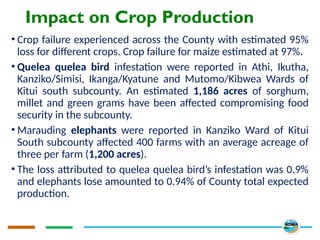
• Crop failure experienced across the County with estimated 95%
loss for different crops. Crop failure for maize estimated at 97%.
• Quelea quelea bird infestation were reported in Athi, Ikutha,
Kanziko/Simisi, Ikanga/Kyatune and Mutomo/Kibwea Wards of
Kitui south subcounty. An estimated 1,186 acres of sorghum,
millet and green grams have been affected compromising food
security in the subcounty.
• Marauding elephants were reported in Kanziko Ward of Kitui
South subcounty affected 400 farms with an average acreage of
three per farm (1,200 acres).
• The loss attributed to quelea quelea bird’s infestation was 0.9%
and elephants lose amounted to 0.94% of County total expected
production.
Stocks held in the County
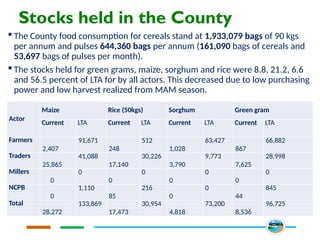
 The County food consumption for cereals stand at 1,933,079 bags of 90 kgs
per annum and pulses 644,360 bags per annum (161,090 bags of cereals and
53,697 bags of pulses per month).
 The stocks held for green grams, maize, sorghum and rice were 8.8, 21.2, 6.6
and 56.5 percent of LTA for by all actors. This decreased due to low purchasing
power and low harvest realized from MAM season.
Actor
Maize Rice (50kgs) Sorghum Green gram
Current LTA Current LTA Current LTA Current LTA
Farmers
2,407
91,671
248
512
1,028
63,427
867
66,882
Traders
25,865
41,088
17,140
30,226
3,790
9,773
7,625
28,998
Millers
0
0
0
0
0
0
0
0
NCPB
0
1,110
85
216
0
0
44
845
Total
28,272
133,869
17,473
30,954
4,818
73,200
8,536
96,725
Recommendations
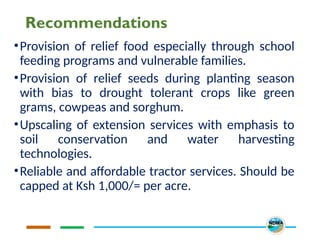
•Provision of relief food especially through school
feeding programs and vulnerable families.
•Provision of relief seeds during planting season
with bias to drought tolerant crops like green
grams, cowpeas and sorghum.
•Upscaling of extension services with emphasis to
soil conservation and water harvesting
technologies.
•Reliable and affordable tractor services. Should be
capped at Ksh 1,000/= per acre.
Impact on Livestock
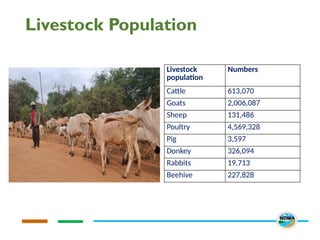
Livestock Population
Livestock
population
Numbers
Cattle 613,070
Goats 2,006,087
Sheep 131,486
Poultry 4,569,328
Pig 3,597
Donkey 326,094
Rabbits 19,713
Beehive 227,828
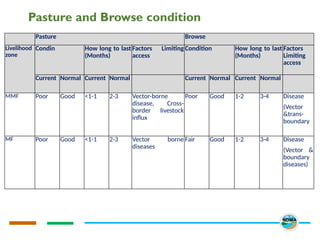
Pasture and Browse condition
Pasture Browse
Livelihood
zone
Condin How long to last
(Months)
Factors Limiting
access
Condition How long to last
(Months)
Factors
Limiting
access
Current Normal Current Normal Current Normal Current Normal
MMF Poor Good <1-1 2-3 Vector-borne
disease, Cross-
border livestock
influx
Poor Good 1-2 3-4 Disease
(Vector
&trans-
boundary
MF Poor Good <1-1 2-3 Vector borne
diseases
Fair Good 1-2 3-4 Disease
(Vector &
boundary
diseases)
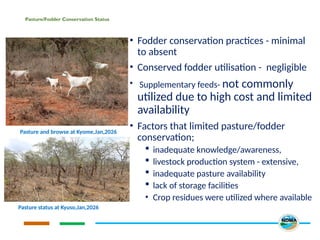
Pasture/Fodder Conservation Status
• Fodder conservation practices - minimal
to absent
• Conserved fodder utilisation - negligible
• Supplementary feeds- not commonly
utilized due to high cost and limited
availability
• Factors that limited pasture/fodder
conservation;
 inadequate knowledge/awareness,
 livestock production system - extensive,
 inadequate pasture availability
 lack of storage facilities
• Crop residues were utilized where available
Pasture status at Kyuso,Jan,2026
Pasture and browse at Kyome,Jan,2026
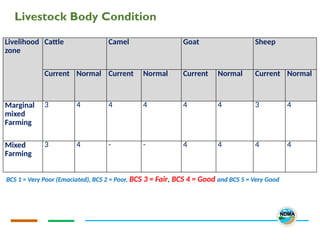
Livestock Body Condition
Livelihood
zone
Cattle Camel Goat Sheep
Current Normal Current Normal Current Normal Current Normal
Marginal
mixed
Farming
3 4 4 4 4 4 3 4
Mixed
Farming
3 4 - - 4 4 4 4
BCS 1 = Very Poor (Emaciated), BCS 2 = Poor, BCS 3 = Fair, BCS 4 = Good and BCS 5 = Very Good
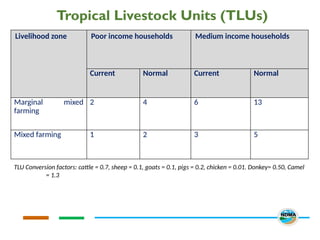
Tropical Livestock Units (TLUs)
Livelihood zone Poor income households Medium income households
Current Normal Current Normal
Marginal mixed
farming
2 4 6 13
Mixed farming 1 2 3 5
TLU Conversion factors: cattle = 0.7, sheep = 0.1, goats = 0.1, pigs = 0.2, chicken = 0.01. Donkey= 0.50, Camel
= 1.3
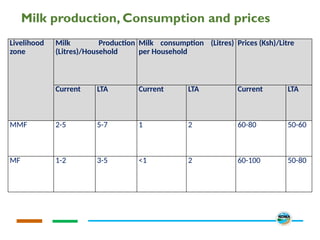
Milk production, Consumption and prices
Livelihood
zone
Milk Production
(Litres)/Household
Milk consumption (Litres)
per Household
Prices (Ksh)/Litre
Current LTA Current LTA Current LTA
MMF 2-5 5-7 1 2 60-80 50-60
MF 1-2 3-5 <1 2 60-100 50-80
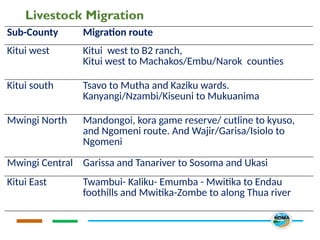
Livestock Migration
Sub-County Migration route
Kitui west Kitui west to B2 ranch,
Kitui west to Machakos/Embu/Narok counties
Kitui south Tsavo to Mutha and Kaziku wards.
Kanyangi/Nzambi/Kiseuni to Mukuanima
Mwingi North Mandongoi, kora game reserve/ cutline to kyuso,
and Ngomeni route. And Wajir/Garisa/Isiolo to
Ngomeni
Mwingi Central Garissa and Tanariver to Sosoma and Ukasi
Kitui East Twambui- Kaliku- Emumba - Mwitika to Endau
foothills and Mwitika-Zombe to along Thua river
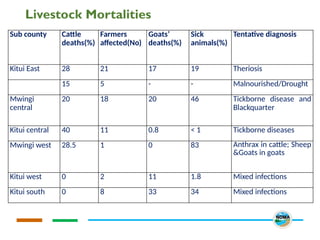
Livestock Mortalities
Sub county Cattle
deaths(%)
Farmers
affected(No)
Goats’
deaths(%)
Sick
animals(%)
Tentative diagnosis
Kitui East 28 21 17 19 Theriosis
15 5 - - Malnourished/Drought
Mwingi
central
20 18 20 46 Tickborne disease and
Blackquarter
Kitui central 40 11 0.8 < 1 Tickborne diseases
Mwingi west 28.5 1 0 83 Anthrax in cattle; Sheep
&Goats in goats
Kitui west 0 2 11 1.8 Mixed infections
Kitui south 0 8 33 34 Mixed infections
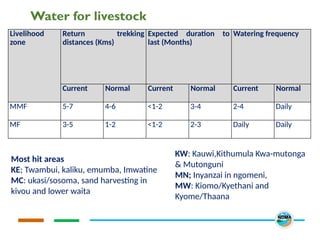
Water for livestock
Livelihood
zone
Return trekking
distances (Kms)
Expected duration to
last (Months)
Watering frequency
Current Normal Current Normal Current Normal
MMF 5-7 4-6 <1-2 3-4 2-4 Daily
MF 3-5 1-2 <1-2 2-3 Daily Daily
Most hit areas
KE; Twambui, kaliku, emumba, Imwatine
MC: ukasi/sosoma, sand harvesting in
kivou and lower waita
KW: Kauwi,Kithumula Kwa-mutonga
& Mutonguni
MN; Inyanzai in ngomeni,
MW: Kiomo/Kyethani and
Kyome/Thaana
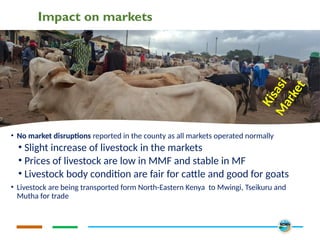
Impact on markets
• No market disruptions reported in the county as all markets operated normally
• Slight increase of livestock in the markets
• Prices of livestock are low in MMF and stable in MF
• Livestock body condition are fair for cattle and good for goats
• Livestock are being transported form North-Eastern Kenya to Mwingi, Tseikuru and
Mutha for trade
K
i
s
a
s
i
M
a
r
k
e
t
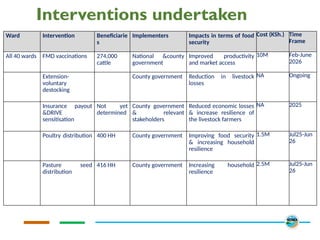
Interventions undertaken
Ward Intervention Beneficiarie
s
Implementers Impacts in terms of food
security
Cost (KSh.) Time
Frame
All 40 wards FMD vaccinations 274,000
cattle
National &county
government
Improved productivity
and market access
10M Feb-June
2026
Extension-
voluntary
destocking
County government Reduction in livestock
losses
NA Ongoing
Insurance payout
&DRIVE
sensitisation
Not yet
determined
County government
& relevant
stakeholders
Reduced economic losses
& increase resilience of
the livestock farmers
NA 2025
Poultry distribution 400 HH County government Improving food security
& increasing household
resilience
1.5M Jul25-Jun
26
Pasture seed
distribution
416 HH County government Increasing household
resilience
2.5M Jul25-Jun
26
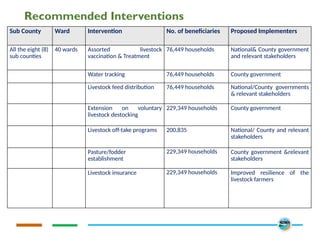
Recommended Interventions
Sub County Ward Intervention No. of beneficiaries Proposed Implementers
All the eight (8)
sub counties
40 wards Assorted livestock
vaccination & Treatment
76,449 households National& County government
and relevant stakeholders
Water tracking 76,449 households County government
Livestock feed distribution 76,449 households National/County governments
& relevant stakeholders
Extension on voluntary
livestock destocking
229,349 households County government
Livestock off-take programs 200,835 National/ County and relevant
stakeholders
Pasture/fodder
establishment
229,349 households County government &relevant
stakeholders
Livestock insurance 229,349 households Improved resilience of the
livestock farmers
Impact on Water and Sanitation
Major Water Sources
Water Accessibility and Utilization
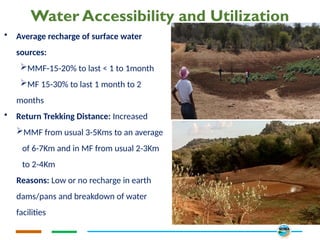
• Average recharge of surface water
sources:
MMF-15-20% to last < 1 to 1month
MF 15-30% to last 1 month to 2
months
• Return Trekking Distance: Increased
MMF from usual 3-5Kms to an average
of 6-7Km and in MF from usual 2-3Km
to 2-4Km
Reasons: Low or no recharge in earth
dams/pans and breakdown of water
facilities
Water Accessibility and Utilization Cont.
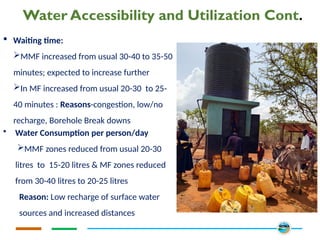
 Waiting time:
MMF increased from usual 30-40 to 35-50
minutes; expected to increase further
In MF increased from usual 20-30 to 25-
40 minutes : Reasons-congestion, low/no
recharge, Borehole Break downs
• Water Consumption per person/day
MMF zones reduced from usual 20-30
litres to 15-20 litres & MF zones reduced
from 30-40 litres to 20-25 litres
Reason: Low recharge of surface water
sources and increased distances
Water Accessibility and Utilization Cont.
Cost of water is stable (Kshs 3-5); the tariffs are preset through
community participation (Rural small scale water service
providers)
• Water Vending:
Normal for MMF zones at Kshs 15-20 except Kitui East Kshs 40-
50
Normal for MF livelihood zones at Kshs 10-20
Reason: Surface water sources provided alternative access even
though recharge was low.
Ongoing Interventions
• Drilling & equipping of borehole: Nditime BH, Kakongo BH, Kaunguni
BH, Waita BH, Kithumula BH, Kwa Mbithuka BH, Itoleka BH and Ngali BH
• Construction of sump wells- Ciiri sump well
• Pipeline extension: Kivwauni to Ndulikye, Kilawani and Mwangeni-Kalwa
• Desilting of Earth dams: Makutano ED, Kwa Musyoka ED, Kasakini ED,
Ngaani ED and Kiluilu.
• Rehabilitation of schemes: Nzeeu-Mukameni sump well, Yambuu sump
well, Koi BH, Mivuni BH, Ngelani BH and Ngaani BH
Recommended Interventions
• Repair/rehabilitation of broken down water facilities
• Pipeline extension fon the high yielding water facilities
• Borehole drilling & equipping, solarization and hybridization
• Enhance roof water harvesting at institutions and household
level
• Construction of sump wells and sand dams
• Desilting of Earth dams in anticipation of good rains
• Enhance governance in rural water schemes to ensure
sustainability
Impact on Education
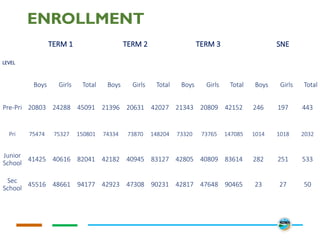
ENROLLMENT
LEVEL
TERM 1 TERM 2 TERM 3 SNE
Boys Girls Total Boys Girls Total Boys Girls Total Boys Girls Total
Pre-Pri 20803 24288 45091 21396 20631 42027 21343 20809 42152 246 197 443
Pri 75474 75327 150801 74334 73870 148204 73320 73765 147085 1014 1018 2032
Junior
School
41425 40616 82041 42182 40945 83127 42805 40809 83614 282 251 533
Sec
School
45516 48661 94177 42923 47308 90231 42817 47648 90465 23 27 50
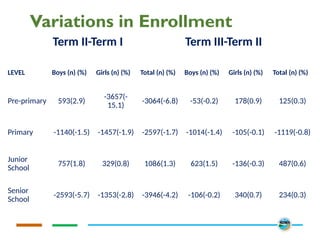
Variations in Enrollment
Term II-Term I Term III-Term II
LEVEL Boys (n) (%) Girls (n) (%) Total (n) (%) Boys (n) (%) Girls (n) (%) Total (n) (%)
Pre-primary 593(2.9)
-3657(-
15.1)
-3064(-6.8) -53(-0.2) 178(0.9) 125(0.3)
Primary -1140(-1.5) -1457(-1.9) -2597(-1.7) -1014(-1.4) -105(-0.1) -1119(-0.8)
Junior
School
757(1.8) 329(0.8) 1086(1.3) 623(1.5) -136(-0.3) 487(0.6)
Senior
School
-2593(-5.7) -1353(-2.8) -3946(-4.2) -106(-0.2) 340(0.7) 234(0.3)
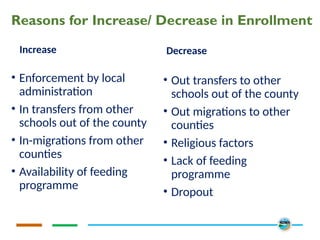
Reasons for Increase/ Decrease in Enrollment
Increase
• Enforcement by local
administration
• In transfers from other
schools out of the county
• In-migrations from other
counties
• Availability of feeding
programme
Decrease
• Out transfers to other
schools out of the county
• Out migrations to other
counties
• Religious factors
• Lack of feeding
programme
• Dropout
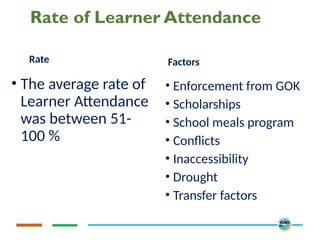
Rate of Learner Attendance
Rate
• The average rate of
Learner Attendance
was between 51-
100 %
Factors
• Enforcement from GOK
• Scholarships
• School meals program
• Conflicts
• Inaccessibility
• Drought
• Transfer factors
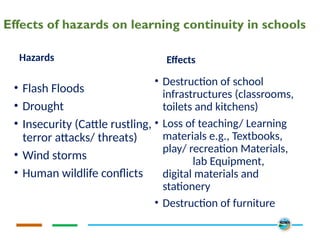
Effects of hazards on learning continuity in schools
Hazards
• Flash Floods
• Drought
• Insecurity (Cattle rustling,
terror attacks/ threats)
• Wind storms
• Human wildlife conflicts
Effects
• Destruction of school
infrastructures (classrooms,
toilets and kitchens)
• Loss of teaching/ Learning
materials e.g., Textbooks,
play/ recreation Materials,
lab Equipment,
digital materials and
stationery
• Destruction of furniture
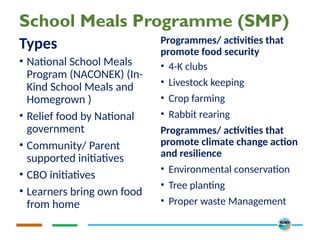
School Meals Programme (SMP)
Types
• National School Meals
Program (NACONEK) (In-
Kind School Meals and
Homegrown )
• Relief food by National
government
• Community/ Parent
supported initiatives
• CBO initiatives
• Learners bring own food
from home
Programmes/ activities that
promote food security
• 4-K clubs
• Livestock keeping
• Crop farming
• Rabbit rearing
Programmes/ activities that
promote climate change action
and resilience
• Environmental conservation
• Tree planting
• Proper waste Management
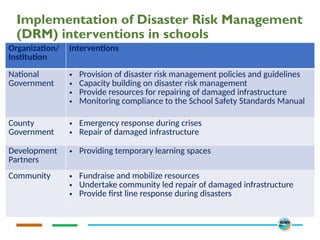
Implementation of Disaster Risk Management
(DRM) interventions in schools
Organization/
Institution
Interventions
National
Government
• Provision of disaster risk management policies and guidelines
• Capacity building on disaster risk management
• Provide resources for repairing of damaged infrastructure
• Monitoring compliance to the School Safety Standards Manual
County
Government
• Emergency response during crises
• Repair of damaged infrastructure
Development
Partners
• Providing temporary learning spaces
Community • Fundraise and mobilize resources
• Undertake community led repair of damaged infrastructure
• Provide first line response during disasters
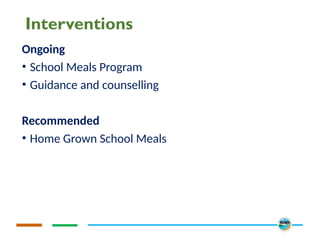
Interventions
Ongoing
• School Meals Program
• Guidance and counselling
Recommended
• Home Grown School Meals
Impact on Health and Nutrition
Morbidity Trends- Upper Respiratory Tract
Infections
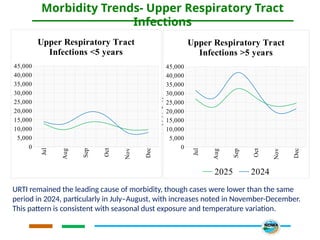
URTI remained the leading cause of morbidity, though cases were lower than the same
period in 2024, particularly in July–August, with increases noted in November-December.
This pattern is consistent with seasonal dust exposure and temperature variation.
Jul
Aug
Sep
Oct
Nov
Dec
-5,000
5,000
15,000
25,000
35,000
45,000
Upper Respiratory
Tract Infections <5
years
Jul
Aug
Sep
Oct
Nov
Dec
0
10,000
20,000
30,000
40,000
50,000
Upper Respiratory
Tract Infections >5
years
2025 2024
Jul
Aug
Sep
Oct
Nov
Dec
0
5,000
10,000
15,000
20,000
25,000
30,000
35,000
40,000
45,000
Upper Respiratory Tract
Infections <5 years
Jul
Aug
Sep
Oct
Nov
Dec
0
5,000
10,000
15,000
20,000
25,000
30,000
35,000
40,000
45,000
Upper Respiratory Tract
Infections >5 years
2025 2024
Morbidity Trend for Under
Fives
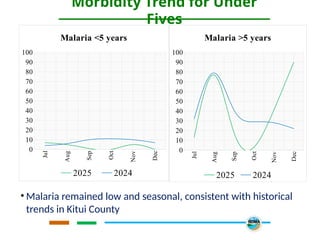
• Malaria remained low and seasonal, consistent with historical
trends in Kitui County
Jul
Aug
Sep
Oct
Nov
Dec
0
10
20
30
40
50
60
70
80
90
100
Malaria <5 years
2025 2024
Jul
Aug
Sep
Oct
Nov
Dec
0
10
20
30
40
50
60
70
80
90
100
Malaria >5 years
2025 2024
Morbidity Trend for General
Population
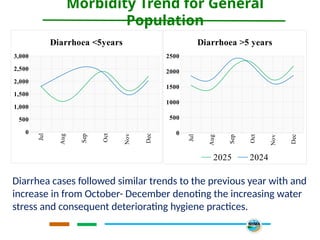
Diarrhea cases followed similar trends to the previous year with and
increase in from October- December denoting the increasing water
stress and consequent deteriorating hygiene practices.
Jul
Aug
Sep
Oct
Nov
Dec
0
500
1,000
1,500
2,000
2,500
3,000
Diarrhoea <5years
Jul
Aug
Sep
Oct
Nov
Dec
0
500
1000
1500
2000
2500
Diarrhoea >5 years
2025 2024
Trends of Epidemic and Water Borne
Diseases
Disease July-December 2024 July-December 2025
Cases Deaths Cases Deaths
Measles 22 60
Cholera 0 0
Dysentery 629 725
Diarrhoea 24,003 22,222
Malaria 274 260
Typhoid 1,328 1,283
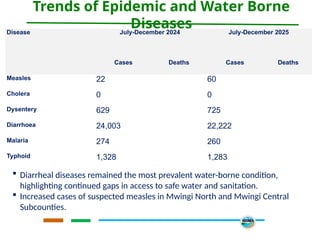
 Diarrheal diseases remained the most prevalent water-borne condition,
highlighting continued gaps in access to safe water and sanitation.
 Increased cases of suspected measles in Mwingi North and Mwingi Central
Subcounties.
Sanitation And Hygiene
Practices
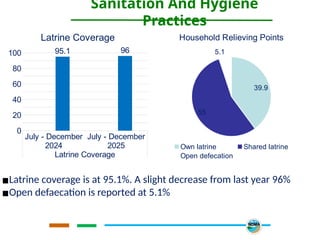
▪Latrine coverage is at 95.1%. A slight decrease from last year 96%
▪Open defaecation is reported at 5.1%
July - December
2024
July - December
2025
Latrine Coverage
0
20
40
60
80
100 95.1 96
Latrine Coverage
39.9
55
5.1
Household Relieving Points
Own latrine Shared latrine
Open defecation
Immunization Coverage
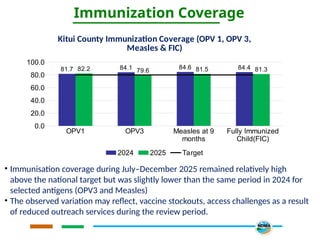
• Immunisation coverage during July–December 2025 remained relatively high
above the national target but was slightly lower than the same period in 2024 for
selected antigens (OPV3 and Measles)
• The observed variation may reflect, vaccine stockouts, access challenges as a result
of reduced outreach services during the review period.
OPV1 OPV3 Measles at 9
months
Fully Immunized
Child(FIC)
0.0
20.0
40.0
60.0
80.0
100.0
81.7 84.1 84.6 84.4
82.2 79.6 81.5 81.3
Kitui County Immunization Coverage (OPV 1, OPV 3,
Measles & FIC)
2024 2025 Target
Vitamin A Supplementation
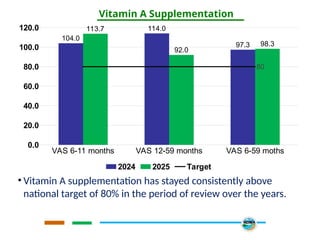
• Vitamin A supplementation has stayed consistently above
national target of 80% in the period of review over the years.
VAS 6-11 months VAS 12-59 months VAS 6-59 moths
0.0
20.0
40.0
60.0
80.0
100.0
120.0
104.0
114.0
97.3
113.7
92.0
98.3
80
2024 2025 Target
Food Consumption
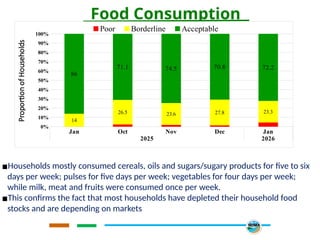
▪Households mostly consumed cereals, oils and sugars/sugary products for five to six
days per week; pulses for five days per week; vegetables for four days per week;
while milk, meat and fruits were consumed once per week.
▪This confirms the fact that most households have depleted their household food
stocks and are depending on markets
Jan Oct Nov Dec Jan
2025 2026
0%
10%
20%
30%
40%
50%
60%
70%
80%
90%
100%
14
26.5 23.6 27.8 23.3
86
71.1 74.5 70.8 72.2
Poor Borderline Acceptable
Proportion
of
Households
Impact on Health and
Nutrition
Nutrition status
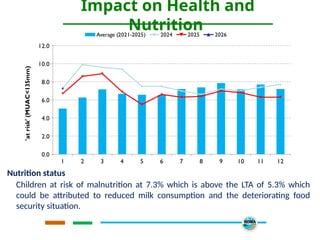
Children at risk of malnutrition at 7.3% which is above the LTA of 5.3% which
could be attributed to reduced milk consumption and the deteriorating food
security situation.
1 2 3 4 5 6 7 8 9 10 11 12
0.0
2.0
4.0
6.0
8.0
10.0
12.0
Average (2021-2025) 2024 2025 2026
'at
risk'
(MUAC<135mm)
Integrated Management of Acute Malnutrition
Admission Trends for Under Fives
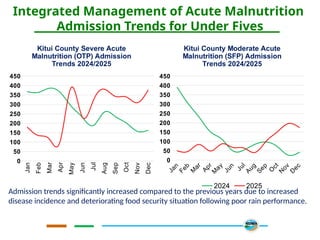
Admission trends significantly increased compared to the previous years due to increased
disease incidence and deteriorating food security situation following poor rain performance.
Jan
Feb
Mar
Apr
May
Jun
Jul
Aug
Sep
Oct
Nov
Dec
0
50
100
150
200
250
300
350
400
450
Kitui County Severe Acute
Malnutrition (OTP) Admission
Trends 2024/2025
J
a
n
F
e
b
M
a
r
A
p
r
M
a
y
J
u
n
J
u
l
A
u
g
S
e
p
O
c
t
N
o
v
D
e
c
0
50
100
150
200
250
300
350
400
450
Kitui County Moderate Acute
Malnutrition (SFP) Admission
Trends 2024/2025
2024 2025
60
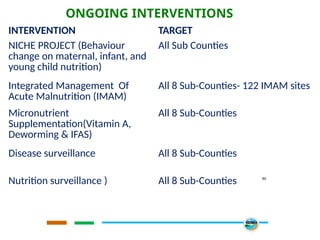
ONGOING INTERVENTIONS
INTERVENTION TARGET
NICHE PROJECT (Behaviour
change on maternal, infant, and
young child nutrition)
All Sub Counties
Integrated Management Of
Acute Malnutrition (IMAM)
All 8 Sub-Counties- 122 IMAM sites
Micronutrient
Supplementation(Vitamin A,
Deworming & IFAS)
All 8 Sub-Counties
Disease surveillance All 8 Sub-Counties
Nutrition surveillance ) All 8 Sub-Counties
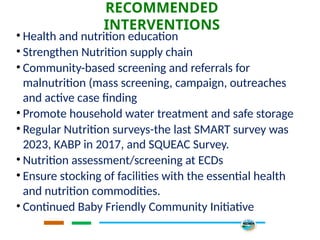
RECOMMENDED
INTERVENTIONS
• Health and nutrition education
• Strengthen Nutrition supply chain
• Community-based screening and referrals for
malnutrition (mass screening, campaign, outreaches
and active case finding
• Promote household water treatment and safe storage
• Regular Nutrition surveys-the last SMART survey was
2023, KABP in 2017, and SQUEAC Survey.
• Nutrition assessment/screening at ECDs
• Ensure stocking of facilities with the essential health
and nutrition commodities.
• Continued Baby Friendly Community Initiative
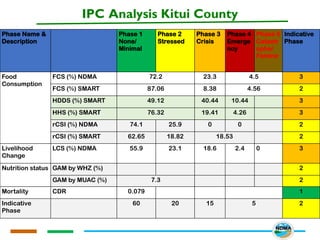
IPC Analysis Kitui County
Phase Name &
Description
Phase 1
None/
Minimal
Phase 2
Stressed
Phase 3
Crisis
Phase 4
Emerge
ncy
Phase 5
Catastr
ophe/
Famine
Indicative
Phase
Food
Consumption
FCS (%) NDMA 72.2 23.3 4.5 3
FCS (%) SMART 87.06 8.38 4.56 2
HDDS (%) SMART 49.12 40.44 10.44 3
HHS (%) SMART 76.32 19.41 4.26 3
rCSI (%) NDMA 74.1 25.9 0 0 2
rCSI (%) SMART 62.65 18.82 18.53 2
Livelihood
Change
LCS (%) NDMA 55.9 23.1 18.6 2.4 0 3
Nutrition status GAM by WHZ (%) 2
GAM by MUAC (%) 7.3 2
Mortality CDR 0.079 1
Indicative
Phase
60 20 15 5 2
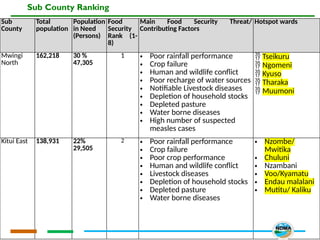
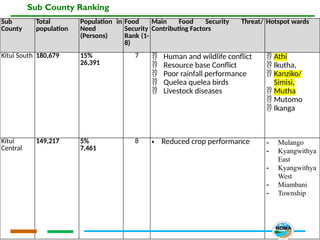
Sub County Ranking
Sub
County
Total
population
Population
in Need
(Persons)
Food
Security
Rank (1-
8)
Main Food Security Threat/
Contributing Factors
Hotspot wards
Mwingi
North
162,218 30 %
47,305
1 • Poor rainfall performance
• Crop failure
• Human and wildlife conflict
• Poor recharge of water sources
• Notifiable Livestock diseases
• Depletion of household stocks
• Depleted pasture
• Water borne diseases
• High number of suspected
measles cases
 Tseikuru
 Ngomeni
 Kyuso
 Tharaka
 Muumoni
Kitui East 138,931 22%
29,505
2 • Poor rainfall performance
• Crop failure
• Poor crop performance
• Human and wildlife conflict
• Livestock diseases
• Depletion of household stocks
• Depleted pasture
• Water borne diseases
• Nzombe/
Mwitika
• Chuluni
• Nzambani
• Voo/Kyamatu
• Endau malalani
• Mutitu/ Kaliku
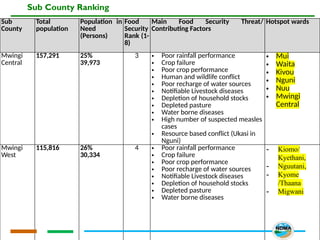
Sub County Ranking
Sub
County
Total
population
Population in
Need
(Persons)
Food
Security
Rank (1-
8)
Main Food Security Threat/
Contributing Factors
Hotspot wards
Mwingi
Central
157,291 25%
39,973
3 • Poor rainfall performance
• Crop failure
• Poor crop performance
• Human and wildlife conflict
• Poor recharge of water sources
• Notifiable Livestock diseases
• Depletion of household stocks
• Depleted pasture
• Water borne diseases
• High number of suspected measles
cases
• Resource based conflict (Ukasi in
Nguni)
• Mui
• Waita
• Kivou
• Nguni
• Nuu
• Mwingi
Central
Mwingi
West
115,816 26%
30,334
4 • Poor rainfall performance
• Crop failure
• Poor crop performance
• Poor recharge of water sources
• Notifiable Livestock diseases
• Depletion of household stocks
• Depleted pasture
• Water borne diseases
- Kiomo/
Kyethani,
- Nguutani,
- Kyome
/Thaana
- Migwani
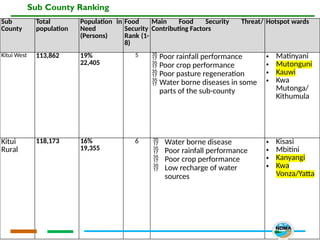
Sub County Ranking
Sub
County
Total
population
Population in
Need
(Persons)
Food
Security
Rank (1-
8)
Main Food Security Threat/
Contributing Factors
Hotspot wards
Kitui West 113,862 19%
22,405
5  Poor rainfall performance
 Poor crop performance
 Poor pasture regeneration
 Water borne diseases in some
parts of the sub-county
• Matinyani
• Mutonguni
• Kauwi
• Kwa
Mutonga/
Kithumula
Kitui
Rural
118,173 16%
19,355
6  Water borne disease
 Poor rainfall performance
 Poor crop performance
 Low recharge of water
sources
• Kisasi
• Mbitini
• Kanyangi
• Kwa
Vonza/Yatta
Sub County Ranking
Sub
County
Total
population
Population in
Need
(Persons)
Food
Security
Rank (1-
8)
Main Food Security Threat/
Contributing Factors
Hotspot wards
Kitui South 180,679 15%
26,391
7  Human and wildlife conflict
 Resource base Conflict
 Poor rainfall performance
 Quelea quelea birds
 Livestock diseases
 Athi
 Ikutha,
 Kanziko/
Simisi,
 Mutha
 Mutomo
 Ikanga
Kitui
Central
149,217 5%
7,461
8 • Reduced crop performance - Mulango
- Kyangwithya
East
- Kyangwithya
West
- Miambani
- Township
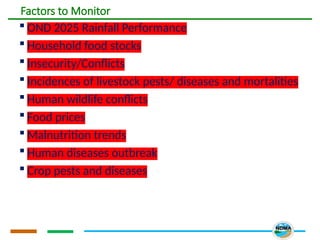
Factors to Monitor
 OND 2025 Rainfall Performance
 Household food stocks
 Insecurity/Conflicts
 Incidences of livestock pests/ diseases and mortalities
 Human wildlife conflicts
 Food prices
 Malnutrition trends
 Human diseases outbreak
 Crop pests and diseases
END
THANK YOU ALL

Kitui County SRA 2025 Debrief_29_01 _2026_WE (002).pptx

  • 1.
    Kitui County 2025 SHORTRAINS FOOD & NUTRITION SECURITY ASSESSMENT Final CSG Debrief Thursday, January 29, 2026
  • 2.
    Technical Team Members Eunice Mutuku (NDMA)  Joshua Mayeku (NDMA)  Job Oweya (NDMA)  Joel Mutiso (NDMA)  Samuel Ayany (NDMA)  Moffat Njoroge (Agriculture)  Patricia Koki (Agriculture)  James Gitonga (Agriculture)  Dr. Agusta Kivunzya (Livestock)  Philip Nzula (Water)  Lydia Mbeti (Health)  Grace Nzambi (Health)  Silvester Kiilu (Education)  Sarah Oromi (WHH)  Benard Makluu (Kenya Red Cross)  Evans Maithya (World Vision Kenya)
  • 3.
    Supporting Partners Logos notarranged in any specific order
  • 4.
    Main Objective To conductan objective, evidence- based and transparent FNS situation analysis for the season, taking into account the cumulative effect of previous seasons, and provide recommendations for possible response options
  • 5.
    Methodology Review of existingdata • Current situation • Briefing Kit 5 Approach o Checklists o Initial Briefings o Transect drives o Community interviews o Review and analysis of data
  • 6.
    Background Information Population propby LZ – MMF (42%} – MF (55%) – Formal/Unskilled employ (3%) Main sources of income: • Casual labour (43%) • Sale of crops (24%) • Remittances (2%) • Sale of livestock (3%) • Petty trading (7%) • Formal employment (5%)
  • 7.
    Background Information Cont… Area:30,429.5 sq. Kms  Pop density – 37 pp Km2 Borders – 7 counties Tharaka Nithi & Meru: N Embu: NW Machakos & Makueni: W Tana River: E & SE Taita Taveta: S  Pop: 1,229,790 (KNBS, 2025 Projections) - 52% Female - 47% Male  Households : 279,192 -Household size is 4.3  Administrative units: ⁻ 8 sub-counties ⁻ 18 sub counties (formerly known as districts) ⁻ 40 wards ⁻ 171 locations ⁻ 247 county villages ⁻ 423 sub locations
  • 8.
    Current Factors AffectingF&NS 1. Poor rain performance 2. Crop failure/below average crop production 3. Market dependency/high food prices 4. Livestock diseases and mortalities 5. Human wildlife conflicts 6. Insecurity/conflicts 7. Poor surface water recharge 8. Human diseases: 9. Decline in HH coping capacity
  • 9.
  • 10.
    Rainfall Performance • PoorRF performance: Below Normal • False onset: 3rd to 4th week of October • Cessation: Early in 4th week of December. • Poor temporal, Uneven spatial distribution • Seasonal cumulative Amnt: 257 Vs LTA of 370 mm (69 % of LTA) • Sections of MC, KE & KW: Normal RF (76-125 % of LTA) • Most parts of the county: Below Normal RF (51-75 % of LTA) • Parts of MN, MC & MW: Depressed RF (26-50 % of LTA) • Wards with Severe Dryness: Tseikuru, Waita, Voo/Kyamatu, Kiomo/Kyethani, Zombe/Mwitika & E/ Malalani
  • 11.
    Rainfall Performance 1 23 4 5 6 1 2 3 4 5 6 1 2 3 4 5 6 1 2 3 4 5 6 1 2 3 4 5 6 1 2 3 4 5 6 1 2 3 4 5 6 1 2 3 4 5 6 1 2 3 4 5 6 1 2 3 4 5 6 1 2 3 4 5 6 1 2 3 4 5 6 Jan Feb Mar Apr May Jun Jul Aug Sep Oct Nov Dec 0.2 0.3 0.4 0.5 0.6 0.7 0.8 0 10 20 30 40 50 60 70 80 90 CHIRPS (2025) CHIRPS_AVG NDVI (2025) NDVI_AVG Month/Dekad NDVI Rainfall (mm)
  • 12.
    Rainfall Performance Below NormalRainfall with poor temporal, uneven spatial distribution, False onset. SRA 2024 (January 2025): Below Normal in Most parts LRA 2025 (July 2025): Poor temporal distribution of rains SRA 2025 (January 2026): Below Normal, Poor Temp/Spatial Dist.
  • 13.
    Impact on CropProduction Kauwi Ward as at 22/01/2026
  • 14.
    General Information onCrop Production The main field crops under rainfed: Maize, Green grams, Cow peas, Sorghum, Millet, Pigeon peas and Beans. Irrigated Crops: Kales, Watermelons, Tomatoes, Spinach & Onions. Livelihood zone Crop Per cent contribution Remarks Food Income Marginal Mixed Farming Maize 50 20 Mainly leads to Crop failure in most seasons Green grams 5 40 A drought tolerant and reliable crop across seasons Cow peas 80 5 A drought tolerant and reliable crop across seasons Mixed Farming Maize 60 25 Production below average in most seasons Beans 15 23 Production below average in most seasons Green grams 5 30 Reliable crop across seasons
  • 15.
    Impact on CropProduction Rain-fed Area planted – Maize (105.5%), Green grams (96.9%), Cow peas (130.9%) of STA. Cowpeas area increased due to emerging markets. Production – Maize (7.4%), Green grams (19.2%), Cow peas (17.3%) of STA- All crops were affected by dry conditions while majority farms didn’t germinate. Crop Area planted during 2025 short rains season (Ha) STA (5 yr) area planted during the short rains season (Ha) 2025 short rains season projected production (90 kg bags) STA (5 yr) production during the short rains season (90 kg bags) Maize 52,166 49,442 10,980 147,139 Green grams 55,903 57,662 31,005 161,445 Cow peas 60,673 46,334 22,842 132,413
  • 16.
    Impact on CropProduction Irrigated Cropping Area planted – Tomatoes (109.7% ), Kales (118.3%), Water melons (137.9%) of STA. Production projections – Tomatoes (123% ), Kales (112.6%), water melons (183.6%) of STA. Increase is due to adoption of good agricultural practices. Crop Area planted during 2025 short rains season (Ha) STA (3 years) area planted during the short rains season (Ha) 2025 short rains season production (MT) Achieved STA (3 years) production during the short rains season (MT) Tomatoes 1,417 1,292 31,174 25,340 Kales 1,544 1,305 24,704 21,933 Watermelo ns 3,340 2,422 48,096 26,200
  • 17.
    Impact on CropProduction • Crop failure experienced across the County with estimated 95% loss for different crops. Crop failure for maize estimated at 97%. • Quelea quelea bird infestation were reported in Athi, Ikutha, Kanziko/Simisi, Ikanga/Kyatune and Mutomo/Kibwea Wards of Kitui south subcounty. An estimated 1,186 acres of sorghum, millet and green grams have been affected compromising food security in the subcounty. • Marauding elephants were reported in Kanziko Ward of Kitui South subcounty affected 400 farms with an average acreage of three per farm (1,200 acres). • The loss attributed to quelea quelea bird’s infestation was 0.9% and elephants lose amounted to 0.94% of County total expected production.
  • 18.
    Stocks held inthe County  The County food consumption for cereals stand at 1,933,079 bags of 90 kgs per annum and pulses 644,360 bags per annum (161,090 bags of cereals and 53,697 bags of pulses per month).  The stocks held for green grams, maize, sorghum and rice were 8.8, 21.2, 6.6 and 56.5 percent of LTA for by all actors. This decreased due to low purchasing power and low harvest realized from MAM season. Actor Maize Rice (50kgs) Sorghum Green gram Current LTA Current LTA Current LTA Current LTA Farmers 2,407 91,671 248 512 1,028 63,427 867 66,882 Traders 25,865 41,088 17,140 30,226 3,790 9,773 7,625 28,998 Millers 0 0 0 0 0 0 0 0 NCPB 0 1,110 85 216 0 0 44 845 Total 28,272 133,869 17,473 30,954 4,818 73,200 8,536 96,725
  • 19.
    Recommendations •Provision of relieffood especially through school feeding programs and vulnerable families. •Provision of relief seeds during planting season with bias to drought tolerant crops like green grams, cowpeas and sorghum. •Upscaling of extension services with emphasis to soil conservation and water harvesting technologies. •Reliable and affordable tractor services. Should be capped at Ksh 1,000/= per acre.
  • 20.
  • 21.
    Livestock Population Livestock population Numbers Cattle 613,070 Goats2,006,087 Sheep 131,486 Poultry 4,569,328 Pig 3,597 Donkey 326,094 Rabbits 19,713 Beehive 227,828
  • 22.
    Pasture and Browsecondition Pasture Browse Livelihood zone Condin How long to last (Months) Factors Limiting access Condition How long to last (Months) Factors Limiting access Current Normal Current Normal Current Normal Current Normal MMF Poor Good <1-1 2-3 Vector-borne disease, Cross- border livestock influx Poor Good 1-2 3-4 Disease (Vector &trans- boundary MF Poor Good <1-1 2-3 Vector borne diseases Fair Good 1-2 3-4 Disease (Vector & boundary diseases)
  • 23.
    Pasture/Fodder Conservation Status •Fodder conservation practices - minimal to absent • Conserved fodder utilisation - negligible • Supplementary feeds- not commonly utilized due to high cost and limited availability • Factors that limited pasture/fodder conservation;  inadequate knowledge/awareness,  livestock production system - extensive,  inadequate pasture availability  lack of storage facilities • Crop residues were utilized where available Pasture status at Kyuso,Jan,2026 Pasture and browse at Kyome,Jan,2026
  • 24.
    Livestock Body Condition Livelihood zone CattleCamel Goat Sheep Current Normal Current Normal Current Normal Current Normal Marginal mixed Farming 3 4 4 4 4 4 3 4 Mixed Farming 3 4 - - 4 4 4 4 BCS 1 = Very Poor (Emaciated), BCS 2 = Poor, BCS 3 = Fair, BCS 4 = Good and BCS 5 = Very Good
  • 25.
    Tropical Livestock Units(TLUs) Livelihood zone Poor income households Medium income households Current Normal Current Normal Marginal mixed farming 2 4 6 13 Mixed farming 1 2 3 5 TLU Conversion factors: cattle = 0.7, sheep = 0.1, goats = 0.1, pigs = 0.2, chicken = 0.01. Donkey= 0.50, Camel = 1.3
  • 26.
    Milk production, Consumptionand prices Livelihood zone Milk Production (Litres)/Household Milk consumption (Litres) per Household Prices (Ksh)/Litre Current LTA Current LTA Current LTA MMF 2-5 5-7 1 2 60-80 50-60 MF 1-2 3-5 <1 2 60-100 50-80
  • 27.
    Livestock Migration Sub-County Migrationroute Kitui west Kitui west to B2 ranch, Kitui west to Machakos/Embu/Narok counties Kitui south Tsavo to Mutha and Kaziku wards. Kanyangi/Nzambi/Kiseuni to Mukuanima Mwingi North Mandongoi, kora game reserve/ cutline to kyuso, and Ngomeni route. And Wajir/Garisa/Isiolo to Ngomeni Mwingi Central Garissa and Tanariver to Sosoma and Ukasi Kitui East Twambui- Kaliku- Emumba - Mwitika to Endau foothills and Mwitika-Zombe to along Thua river
  • 28.
    Livestock Mortalities Sub countyCattle deaths(%) Farmers affected(No) Goats’ deaths(%) Sick animals(%) Tentative diagnosis Kitui East 28 21 17 19 Theriosis 15 5 - - Malnourished/Drought Mwingi central 20 18 20 46 Tickborne disease and Blackquarter Kitui central 40 11 0.8 < 1 Tickborne diseases Mwingi west 28.5 1 0 83 Anthrax in cattle; Sheep &Goats in goats Kitui west 0 2 11 1.8 Mixed infections Kitui south 0 8 33 34 Mixed infections
  • 29.
    Water for livestock Livelihood zone Returntrekking distances (Kms) Expected duration to last (Months) Watering frequency Current Normal Current Normal Current Normal MMF 5-7 4-6 <1-2 3-4 2-4 Daily MF 3-5 1-2 <1-2 2-3 Daily Daily Most hit areas KE; Twambui, kaliku, emumba, Imwatine MC: ukasi/sosoma, sand harvesting in kivou and lower waita KW: Kauwi,Kithumula Kwa-mutonga & Mutonguni MN; Inyanzai in ngomeni, MW: Kiomo/Kyethani and Kyome/Thaana
  • 30.
    Impact on markets •No market disruptions reported in the county as all markets operated normally • Slight increase of livestock in the markets • Prices of livestock are low in MMF and stable in MF • Livestock body condition are fair for cattle and good for goats • Livestock are being transported form North-Eastern Kenya to Mwingi, Tseikuru and Mutha for trade K i s a s i M a r k e t
  • 31.
    Interventions undertaken Ward InterventionBeneficiarie s Implementers Impacts in terms of food security Cost (KSh.) Time Frame All 40 wards FMD vaccinations 274,000 cattle National &county government Improved productivity and market access 10M Feb-June 2026 Extension- voluntary destocking County government Reduction in livestock losses NA Ongoing Insurance payout &DRIVE sensitisation Not yet determined County government & relevant stakeholders Reduced economic losses & increase resilience of the livestock farmers NA 2025 Poultry distribution 400 HH County government Improving food security & increasing household resilience 1.5M Jul25-Jun 26 Pasture seed distribution 416 HH County government Increasing household resilience 2.5M Jul25-Jun 26
  • 32.
    Recommended Interventions Sub CountyWard Intervention No. of beneficiaries Proposed Implementers All the eight (8) sub counties 40 wards Assorted livestock vaccination & Treatment 76,449 households National& County government and relevant stakeholders Water tracking 76,449 households County government Livestock feed distribution 76,449 households National/County governments & relevant stakeholders Extension on voluntary livestock destocking 229,349 households County government Livestock off-take programs 200,835 National/ County and relevant stakeholders Pasture/fodder establishment 229,349 households County government &relevant stakeholders Livestock insurance 229,349 households Improved resilience of the livestock farmers
  • 33.
    Impact on Waterand Sanitation
  • 34.
  • 35.
    Water Accessibility andUtilization • Average recharge of surface water sources: MMF-15-20% to last < 1 to 1month MF 15-30% to last 1 month to 2 months • Return Trekking Distance: Increased MMF from usual 3-5Kms to an average of 6-7Km and in MF from usual 2-3Km to 2-4Km Reasons: Low or no recharge in earth dams/pans and breakdown of water facilities
  • 36.
    Water Accessibility andUtilization Cont.  Waiting time: MMF increased from usual 30-40 to 35-50 minutes; expected to increase further In MF increased from usual 20-30 to 25- 40 minutes : Reasons-congestion, low/no recharge, Borehole Break downs • Water Consumption per person/day MMF zones reduced from usual 20-30 litres to 15-20 litres & MF zones reduced from 30-40 litres to 20-25 litres Reason: Low recharge of surface water sources and increased distances
  • 37.
    Water Accessibility andUtilization Cont. Cost of water is stable (Kshs 3-5); the tariffs are preset through community participation (Rural small scale water service providers) • Water Vending: Normal for MMF zones at Kshs 15-20 except Kitui East Kshs 40- 50 Normal for MF livelihood zones at Kshs 10-20 Reason: Surface water sources provided alternative access even though recharge was low.
  • 38.
    Ongoing Interventions • Drilling& equipping of borehole: Nditime BH, Kakongo BH, Kaunguni BH, Waita BH, Kithumula BH, Kwa Mbithuka BH, Itoleka BH and Ngali BH • Construction of sump wells- Ciiri sump well • Pipeline extension: Kivwauni to Ndulikye, Kilawani and Mwangeni-Kalwa • Desilting of Earth dams: Makutano ED, Kwa Musyoka ED, Kasakini ED, Ngaani ED and Kiluilu. • Rehabilitation of schemes: Nzeeu-Mukameni sump well, Yambuu sump well, Koi BH, Mivuni BH, Ngelani BH and Ngaani BH
  • 39.
    Recommended Interventions • Repair/rehabilitationof broken down water facilities • Pipeline extension fon the high yielding water facilities • Borehole drilling & equipping, solarization and hybridization • Enhance roof water harvesting at institutions and household level • Construction of sump wells and sand dams • Desilting of Earth dams in anticipation of good rains • Enhance governance in rural water schemes to ensure sustainability
  • 40.
  • 41.
    ENROLLMENT LEVEL TERM 1 TERM2 TERM 3 SNE Boys Girls Total Boys Girls Total Boys Girls Total Boys Girls Total Pre-Pri 20803 24288 45091 21396 20631 42027 21343 20809 42152 246 197 443 Pri 75474 75327 150801 74334 73870 148204 73320 73765 147085 1014 1018 2032 Junior School 41425 40616 82041 42182 40945 83127 42805 40809 83614 282 251 533 Sec School 45516 48661 94177 42923 47308 90231 42817 47648 90465 23 27 50
  • 42.
    Variations in Enrollment TermII-Term I Term III-Term II LEVEL Boys (n) (%) Girls (n) (%) Total (n) (%) Boys (n) (%) Girls (n) (%) Total (n) (%) Pre-primary 593(2.9) -3657(- 15.1) -3064(-6.8) -53(-0.2) 178(0.9) 125(0.3) Primary -1140(-1.5) -1457(-1.9) -2597(-1.7) -1014(-1.4) -105(-0.1) -1119(-0.8) Junior School 757(1.8) 329(0.8) 1086(1.3) 623(1.5) -136(-0.3) 487(0.6) Senior School -2593(-5.7) -1353(-2.8) -3946(-4.2) -106(-0.2) 340(0.7) 234(0.3)
  • 43.
    Reasons for Increase/Decrease in Enrollment Increase • Enforcement by local administration • In transfers from other schools out of the county • In-migrations from other counties • Availability of feeding programme Decrease • Out transfers to other schools out of the county • Out migrations to other counties • Religious factors • Lack of feeding programme • Dropout
  • 44.
    Rate of LearnerAttendance Rate • The average rate of Learner Attendance was between 51- 100 % Factors • Enforcement from GOK • Scholarships • School meals program • Conflicts • Inaccessibility • Drought • Transfer factors
  • 45.
    Effects of hazardson learning continuity in schools Hazards • Flash Floods • Drought • Insecurity (Cattle rustling, terror attacks/ threats) • Wind storms • Human wildlife conflicts Effects • Destruction of school infrastructures (classrooms, toilets and kitchens) • Loss of teaching/ Learning materials e.g., Textbooks, play/ recreation Materials, lab Equipment, digital materials and stationery • Destruction of furniture
  • 46.
    School Meals Programme(SMP) Types • National School Meals Program (NACONEK) (In- Kind School Meals and Homegrown ) • Relief food by National government • Community/ Parent supported initiatives • CBO initiatives • Learners bring own food from home Programmes/ activities that promote food security • 4-K clubs • Livestock keeping • Crop farming • Rabbit rearing Programmes/ activities that promote climate change action and resilience • Environmental conservation • Tree planting • Proper waste Management
  • 47.
    Implementation of DisasterRisk Management (DRM) interventions in schools Organization/ Institution Interventions National Government • Provision of disaster risk management policies and guidelines • Capacity building on disaster risk management • Provide resources for repairing of damaged infrastructure • Monitoring compliance to the School Safety Standards Manual County Government • Emergency response during crises • Repair of damaged infrastructure Development Partners • Providing temporary learning spaces Community • Fundraise and mobilize resources • Undertake community led repair of damaged infrastructure • Provide first line response during disasters
  • 48.
    Interventions Ongoing • School MealsProgram • Guidance and counselling Recommended • Home Grown School Meals
  • 49.
    Impact on Healthand Nutrition
  • 50.
    Morbidity Trends- UpperRespiratory Tract Infections URTI remained the leading cause of morbidity, though cases were lower than the same period in 2024, particularly in July–August, with increases noted in November-December. This pattern is consistent with seasonal dust exposure and temperature variation. Jul Aug Sep Oct Nov Dec -5,000 5,000 15,000 25,000 35,000 45,000 Upper Respiratory Tract Infections <5 years Jul Aug Sep Oct Nov Dec 0 10,000 20,000 30,000 40,000 50,000 Upper Respiratory Tract Infections >5 years 2025 2024 Jul Aug Sep Oct Nov Dec 0 5,000 10,000 15,000 20,000 25,000 30,000 35,000 40,000 45,000 Upper Respiratory Tract Infections <5 years Jul Aug Sep Oct Nov Dec 0 5,000 10,000 15,000 20,000 25,000 30,000 35,000 40,000 45,000 Upper Respiratory Tract Infections >5 years 2025 2024
  • 51.
    Morbidity Trend forUnder Fives • Malaria remained low and seasonal, consistent with historical trends in Kitui County Jul Aug Sep Oct Nov Dec 0 10 20 30 40 50 60 70 80 90 100 Malaria <5 years 2025 2024 Jul Aug Sep Oct Nov Dec 0 10 20 30 40 50 60 70 80 90 100 Malaria >5 years 2025 2024
  • 52.
    Morbidity Trend forGeneral Population Diarrhea cases followed similar trends to the previous year with and increase in from October- December denoting the increasing water stress and consequent deteriorating hygiene practices. Jul Aug Sep Oct Nov Dec 0 500 1,000 1,500 2,000 2,500 3,000 Diarrhoea <5years Jul Aug Sep Oct Nov Dec 0 500 1000 1500 2000 2500 Diarrhoea >5 years 2025 2024
  • 53.
    Trends of Epidemicand Water Borne Diseases Disease July-December 2024 July-December 2025 Cases Deaths Cases Deaths Measles 22 60 Cholera 0 0 Dysentery 629 725 Diarrhoea 24,003 22,222 Malaria 274 260 Typhoid 1,328 1,283  Diarrheal diseases remained the most prevalent water-borne condition, highlighting continued gaps in access to safe water and sanitation.  Increased cases of suspected measles in Mwingi North and Mwingi Central Subcounties.
  • 54.
    Sanitation And Hygiene Practices ▪Latrinecoverage is at 95.1%. A slight decrease from last year 96% ▪Open defaecation is reported at 5.1% July - December 2024 July - December 2025 Latrine Coverage 0 20 40 60 80 100 95.1 96 Latrine Coverage 39.9 55 5.1 Household Relieving Points Own latrine Shared latrine Open defecation
  • 55.
    Immunization Coverage • Immunisationcoverage during July–December 2025 remained relatively high above the national target but was slightly lower than the same period in 2024 for selected antigens (OPV3 and Measles) • The observed variation may reflect, vaccine stockouts, access challenges as a result of reduced outreach services during the review period. OPV1 OPV3 Measles at 9 months Fully Immunized Child(FIC) 0.0 20.0 40.0 60.0 80.0 100.0 81.7 84.1 84.6 84.4 82.2 79.6 81.5 81.3 Kitui County Immunization Coverage (OPV 1, OPV 3, Measles & FIC) 2024 2025 Target
  • 56.
    Vitamin A Supplementation •Vitamin A supplementation has stayed consistently above national target of 80% in the period of review over the years. VAS 6-11 months VAS 12-59 months VAS 6-59 moths 0.0 20.0 40.0 60.0 80.0 100.0 120.0 104.0 114.0 97.3 113.7 92.0 98.3 80 2024 2025 Target
  • 57.
    Food Consumption ▪Households mostlyconsumed cereals, oils and sugars/sugary products for five to six days per week; pulses for five days per week; vegetables for four days per week; while milk, meat and fruits were consumed once per week. ▪This confirms the fact that most households have depleted their household food stocks and are depending on markets Jan Oct Nov Dec Jan 2025 2026 0% 10% 20% 30% 40% 50% 60% 70% 80% 90% 100% 14 26.5 23.6 27.8 23.3 86 71.1 74.5 70.8 72.2 Poor Borderline Acceptable Proportion of Households
  • 58.
    Impact on Healthand Nutrition Nutrition status Children at risk of malnutrition at 7.3% which is above the LTA of 5.3% which could be attributed to reduced milk consumption and the deteriorating food security situation. 1 2 3 4 5 6 7 8 9 10 11 12 0.0 2.0 4.0 6.0 8.0 10.0 12.0 Average (2021-2025) 2024 2025 2026 'at risk' (MUAC<135mm)
  • 59.
    Integrated Management ofAcute Malnutrition Admission Trends for Under Fives Admission trends significantly increased compared to the previous years due to increased disease incidence and deteriorating food security situation following poor rain performance. Jan Feb Mar Apr May Jun Jul Aug Sep Oct Nov Dec 0 50 100 150 200 250 300 350 400 450 Kitui County Severe Acute Malnutrition (OTP) Admission Trends 2024/2025 J a n F e b M a r A p r M a y J u n J u l A u g S e p O c t N o v D e c 0 50 100 150 200 250 300 350 400 450 Kitui County Moderate Acute Malnutrition (SFP) Admission Trends 2024/2025 2024 2025
  • 60.
    60 ONGOING INTERVENTIONS INTERVENTION TARGET NICHEPROJECT (Behaviour change on maternal, infant, and young child nutrition) All Sub Counties Integrated Management Of Acute Malnutrition (IMAM) All 8 Sub-Counties- 122 IMAM sites Micronutrient Supplementation(Vitamin A, Deworming & IFAS) All 8 Sub-Counties Disease surveillance All 8 Sub-Counties Nutrition surveillance ) All 8 Sub-Counties
  • 61.
    RECOMMENDED INTERVENTIONS • Health andnutrition education • Strengthen Nutrition supply chain • Community-based screening and referrals for malnutrition (mass screening, campaign, outreaches and active case finding • Promote household water treatment and safe storage • Regular Nutrition surveys-the last SMART survey was 2023, KABP in 2017, and SQUEAC Survey. • Nutrition assessment/screening at ECDs • Ensure stocking of facilities with the essential health and nutrition commodities. • Continued Baby Friendly Community Initiative
  • 62.
    IPC Analysis KituiCounty Phase Name & Description Phase 1 None/ Minimal Phase 2 Stressed Phase 3 Crisis Phase 4 Emerge ncy Phase 5 Catastr ophe/ Famine Indicative Phase Food Consumption FCS (%) NDMA 72.2 23.3 4.5 3 FCS (%) SMART 87.06 8.38 4.56 2 HDDS (%) SMART 49.12 40.44 10.44 3 HHS (%) SMART 76.32 19.41 4.26 3 rCSI (%) NDMA 74.1 25.9 0 0 2 rCSI (%) SMART 62.65 18.82 18.53 2 Livelihood Change LCS (%) NDMA 55.9 23.1 18.6 2.4 0 3 Nutrition status GAM by WHZ (%) 2 GAM by MUAC (%) 7.3 2 Mortality CDR 0.079 1 Indicative Phase 60 20 15 5 2
  • 63.
    Sub County Ranking Sub County Total population Population inNeed (Persons) Food Security Rank (1- 8) Main Food Security Threat/ Contributing Factors Hotspot wards Mwingi North 162,218 30 % 47,305 1 • Poor rainfall performance • Crop failure • Human and wildlife conflict • Poor recharge of water sources • Notifiable Livestock diseases • Depletion of household stocks • Depleted pasture • Water borne diseases • High number of suspected measles cases  Tseikuru  Ngomeni  Kyuso  Tharaka  Muumoni Kitui East 138,931 22% 29,505 2 • Poor rainfall performance • Crop failure • Poor crop performance • Human and wildlife conflict • Livestock diseases • Depletion of household stocks • Depleted pasture • Water borne diseases • Nzombe/ Mwitika • Chuluni • Nzambani • Voo/Kyamatu • Endau malalani • Mutitu/ Kaliku
  • 64.
    Sub County Ranking Sub County Total population Populationin Need (Persons) Food Security Rank (1- 8) Main Food Security Threat/ Contributing Factors Hotspot wards Mwingi Central 157,291 25% 39,973 3 • Poor rainfall performance • Crop failure • Poor crop performance • Human and wildlife conflict • Poor recharge of water sources • Notifiable Livestock diseases • Depletion of household stocks • Depleted pasture • Water borne diseases • High number of suspected measles cases • Resource based conflict (Ukasi in Nguni) • Mui • Waita • Kivou • Nguni • Nuu • Mwingi Central Mwingi West 115,816 26% 30,334 4 • Poor rainfall performance • Crop failure • Poor crop performance • Poor recharge of water sources • Notifiable Livestock diseases • Depletion of household stocks • Depleted pasture • Water borne diseases - Kiomo/ Kyethani, - Nguutani, - Kyome /Thaana - Migwani
  • 65.
    Sub County Ranking Sub County Total population Populationin Need (Persons) Food Security Rank (1- 8) Main Food Security Threat/ Contributing Factors Hotspot wards Kitui West 113,862 19% 22,405 5  Poor rainfall performance  Poor crop performance  Poor pasture regeneration  Water borne diseases in some parts of the sub-county • Matinyani • Mutonguni • Kauwi • Kwa Mutonga/ Kithumula Kitui Rural 118,173 16% 19,355 6  Water borne disease  Poor rainfall performance  Poor crop performance  Low recharge of water sources • Kisasi • Mbitini • Kanyangi • Kwa Vonza/Yatta
  • 66.
    Sub County Ranking Sub County Total population Populationin Need (Persons) Food Security Rank (1- 8) Main Food Security Threat/ Contributing Factors Hotspot wards Kitui South 180,679 15% 26,391 7  Human and wildlife conflict  Resource base Conflict  Poor rainfall performance  Quelea quelea birds  Livestock diseases  Athi  Ikutha,  Kanziko/ Simisi,  Mutha  Mutomo  Ikanga Kitui Central 149,217 5% 7,461 8 • Reduced crop performance - Mulango - Kyangwithya East - Kyangwithya West - Miambani - Township
  • 67.
    Factors to Monitor OND 2025 Rainfall Performance  Household food stocks  Insecurity/Conflicts  Incidences of livestock pests/ diseases and mortalities  Human wildlife conflicts  Food prices  Malnutrition trends  Human diseases outbreak  Crop pests and diseases
  • 68.

Editor's Notes