WHAT IS ARTIFICIAL
INTELLIGENCE?
Artificial intelligence (AI)
describes the capability of a
computer system to perform
human-like intelligent
behaviour and problem solving
by means of specific core
competencies, comprising
perception, understanding,
action, and learning.
3.
CLASSIFICATION
OF AI
Artificial NarrowIntelligence (ANI):
• Also known as Weak AI
• The intelligent behaviour is merely
modelled by humans and used by
computers to solve complex problems
• Machine intelligence that equals or
exceeds human intelligence or
efficiency at a specific task
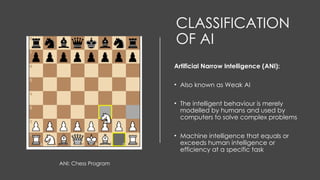
ANI: Chess Program
4.
Artificial General Intelligence(AGI):
• Also known as Strong AI
• A machine with the ability to apply
intelligence to any problem, rather than just
one specific problem (human-level
intelligence)
Artificial Super intelligence (ASI):
• An intellect that is much smarter than the
best human brains in
• Practically every field, including scientific
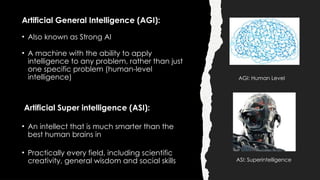
creativity, general wisdom and social skills ASI: Superintelligence
AGI: Human Level
5.
• WHAT ISA SMART CITY ?
A smart city is a urban area represented
by the four pillars of comprehensive
development - institutional, physical,
social and economic infrastructure. In
the long term, cities can work towards
developing such comprehensive
infrastructure incrementally, adding on
layers of 'smartness’.
• AIM OF THE SMART CITIES
Accordingly, the purpose of the Smart
Cities Mission is to drive economic
growth and improve the quality of life
of people by enabling local area
development and harnessing
technology, especially technology that
leads to Smart outcomes.
6.
HOW AI WILLIMPACT
SMART CITIES
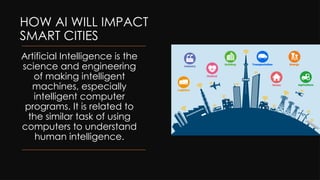
Artificial Intelligence is the
science and engineering
of making intelligent
machines, especially
intelligent computer
programs. It is related to
the similar task of using
computers to understand
human intelligence.
APPLICATION OF
AI ONCITIES
1. In traffic
• Every smart city across the world is using
or planning to use AI in mitigating traffic
density and accidents.
2. In healthcare
• As per the CB Insights report of 2016
about 86% healthcare and life science
organisations including tech providers for
healthcare are using AI.
• In healthcare, artificial intelligence has a
limitless scope. It is used in managing
medical records and patient history.
9.
3. In homes
•Home automation is nothing but the talent exhibited by artificial intelligence.
Everything from smart meters to smart security in the house is managed by AI.
4. In aviation
• Artificial intelligence is deployed in airplane simulators to process the data captured
from simulated flights.
• AI is also used in simulated aircraft warfare.
5. In solving social problems
• Many U.S academic institutions are exploiting AI to overcome some of the greatest
social and economic challenges. Stanford researchers are making use of AI in finding
out the areas concentrated with highest levels of poverty through satellite images.
10.
APPLICATION OF
AI ONPEOPLE
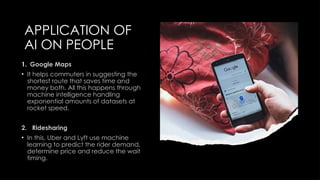
1. Google Maps
• It helps commuters in suggesting the
shortest route that saves time and
money both. All this happens through
machine intelligence handling
exponential amounts of datasets at
rocket speed.
2. Ridesharing
• In this, Uber and Lyft use machine
learning to predict the rider demand,
determine price and reduce the wait
timing.
11.
3. Voice-to-text
• Thetypical feature of today’s smartphones is Google’s voice-to-text. It
helps you in converting your recorded speech into text while performing
search functions.
4. Personal assistant
• Intelligent systems like Google Now which is replaced by a more advanced
system called Google assistant can act like your personal assistant by using
AI.
• It can help you to set reminders, make a to-do list, carry out internet
searches and much more.
12.
NEGATIVE
IMPACTS OF
AI INSMART
CITIES
• It has several issues such as invasion of
privacy, power consumption, and poor
data security.
• Globally, governments spend hundreds
of billions of dollars on smart devices,
networking equipment, hiring skilled
professionals, and upgrading and buying
new systems and resources. The global
spending on smart cities will probably
increase to $135 billion by this year.
• Another crucial aspect of sustainable
smart city development is maintenance.
13.
FUTURE PROSPECTS
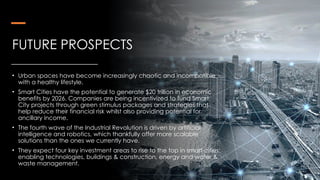
• Urbanspaces have become increasingly chaotic and incompatible
with a healthy lifestyle.
• Smart Cities have the potential to generate $20 trillion in economic
benefits by 2026. Companies are being incentivized to fund Smart
City projects through green stimulus packages and strategies that
help reduce their financial risk whilst also providing potential for
ancillary income.
• The fourth wave of the Industrial Revolution is driven by artificial
intelligence and robotics, which thankfully offer more scalable
solutions than the ones we currently have.
• They expect four key investment areas to rise to the top in smart cities:
enabling technologies, buildings & construction, energy and water &
waste management.
14.
CONCLUSION
• Technology ischanging fast, and the world is changing with it. Concepts
that were mere science fiction only a couple of decades ago like
artificial intelligence (AI) -- are quickly becoming commonplace.
• Advancements of AI in smart cities can assist the human thoughts,
human power, human resources effectively and efficiently.
• We know every advancements have both pros and cons. AI could
mean a lot of power will be in the hands of a few who are controlling it.
• In this way, The Smart City agenda entails improving the citizens' quality
of life, strengthening and diversifying the economy while prioritizing
environmental sustainability through adoption of smart solutions.