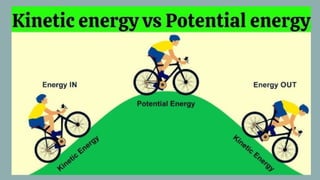
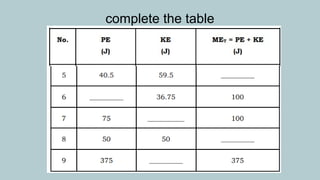
Define potential energyand kinetic energy
Identify daily activities to demonstrate
conservation of mechanical energy.
Derive a conclusion that the total mechanical
energy in a given system is the same.
objectives:
Define the total mechanical energy
3.
The conservation of
momentumstates that the
amount of momentum
remains constant inside a
problem domain.
forces and motion (conservation of momentum)
review
Energy is not created nor
destroyed, but only
altered by the action of
forces as defined by
Newton’s Law of motion.
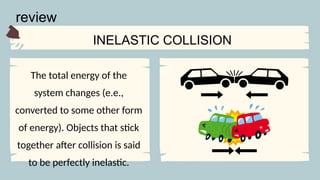
INELASTIC COLLISION
review
The totalenergy of the
system changes (e.e.,
converted to some other form
of energy). Objects that stick
together after collision is said
to be perfectly inelastic.
6.
• Moving objectspossess
momentum.
• Moving objects also have energy.
• All objects regardless of their
state of motion (at rest of in
motion) possess a certain amount
I should know that...
7.
• Energy canbe
transformed from one
form to another.
• In such transformations,
energy is said to be
conserved.
I should know that...
8.
• One formof energy is mechanical
energy.
• Mechanical Energy is energy
acquired by objects upon which
work is done.
I should know that...
9.
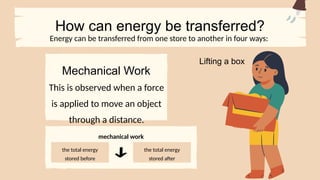
the total energy
storedbefore
the total energy
stored after
How can energy be transferred?
This is observed when a force
is applied to move an object
through a distance.
Mechanical Work
Energy can be transferred from one store to another in four ways:
Lifting a box
mechanical work
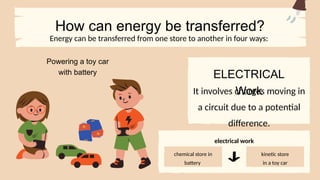
10.
chemical store in
battery
kineticstore
in a toy car
How can energy be transferred?
It involves charges moving in
a circuit due to a potential
difference.
ELECTRICAL
Work
Energy can be transferred from one store to another in four ways:
electrical work
Powering a toy car
with battery
11.
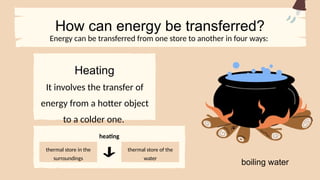
How can energybe transferred?
It involves the transfer of
energy from a hotter object
to a colder one.
Heating
Energy can be transferred from one store to another in four ways:
heating
boiling water
thermal store in the
surroundings
thermal store of the
water
12.
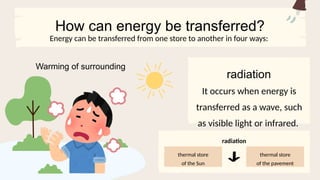
How can energybe transferred?
It occurs when energy is
transferred as a wave, such
as visible light or infrared.
radiation
Energy can be transferred from one store to another in four ways:
radiation
Warming of surrounding
thermal store
of the Sun
thermal store
of the pavement
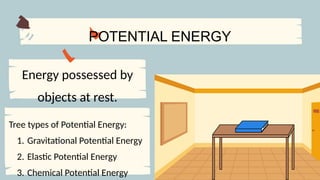
Energy possessed by
objectsat rest.
POTENTIAL ENERGY
Tree types of Potential Energy:
1. Gravitational Potential Energy
2. Elastic Potential Energy
3. Chemical Potential Energy
15.
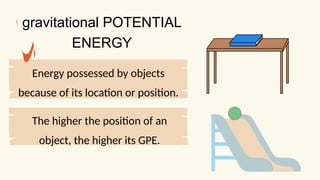
Energy possessed byobjects
because of its location or position.
gravitational POTENTIAL
ENERGY
The higher the position of an
object, the higher its GPE.
16.
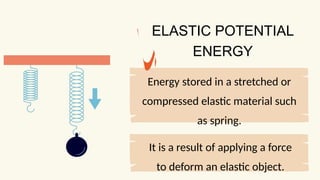
Energy stored ina stretched or
compressed elastic material such
as spring.
ELASTIC POTENTIAL
ENERGY
It is a result of applying a force
to deform an elastic object.
17.
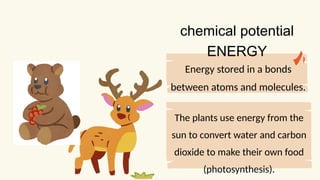
Energy stored ina bonds
between atoms and molecules.
chemical potential
ENERGY
The plants use energy from the
sun to convert water and carbon
dioxide to make their own food
(photosynthesis).
18.
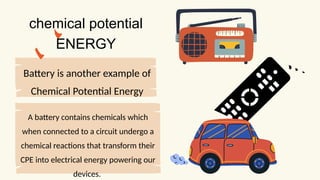
Battery is anotherexample of
Chemical Potential Energy
A battery contains chemicals which
when connected to a circuit undergo a
chemical reactions that transform their
CPE into electrical energy powering our
devices.
chemical potential
ENERGY
19.
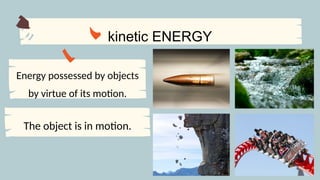
Energy possessed byobjects
by virtue of its motion.
kinetic ENERGY
The object is in motion.
20.
the total
energy stored
before
thetotal
energy stored
after
The total amount of
energy in a system is:
Energy is neither created nor
destroyed. It just transfers
between different stores of
energy.
This is known as the Law of
Conservation of Energy.
What happens
to energy?
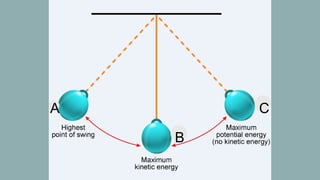
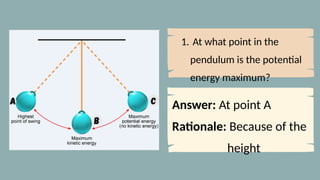
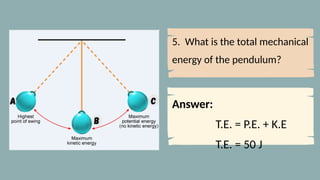
1. At whatpoint in the
pendulum is the potential
energy maximum?
Answer: At point A
Rationale: Because of the
height
25.
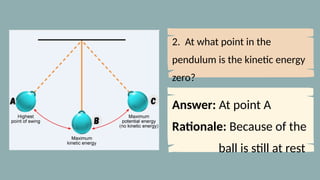
2. At whatpoint in the
pendulum is the kinetic energy
zero?
Answer: At point A
Rationale: Because of the
ball is still at rest
26.
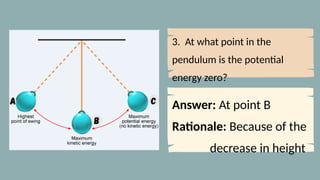
3. At whatpoint in the
pendulum is the potential
energy zero?
Answer: At point B
Rationale: Because of the
decrease in height
27.
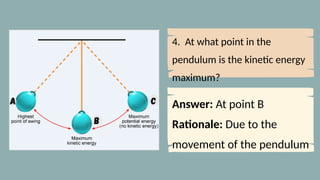
4. At whatpoint in the
pendulum is the kinetic energy
maximum?
Answer: At point B
Rationale: Due to the
movement of the pendulum
28.
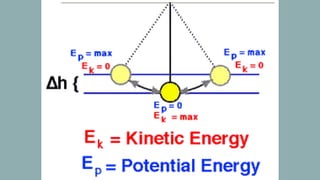
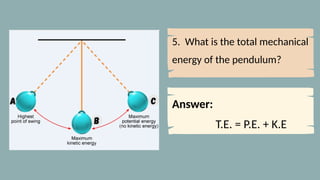
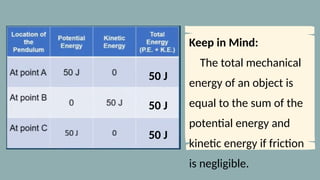
5. What isthe total mechanical
energy of the pendulum?
Answer:
T.E. = P.E. + K.E
29.
Keep in Mind:
Thetotal mechanical
energy of an object is
equal to the sum of the
potential energy and
kinetic energy if friction
is negligible.
50 J
50 J
50 J
30.
5. What isthe total mechanical
energy of the pendulum?
Answer:
T.E. = P.E. + K.E
T.E. = 50 J
31.
6. Describe theLaw of Conservation of Mechanical Energy.
Answer:
The Law of Conservation of Mechanical Energy
states that in the absence of dissipative forces (such as
friction or air resistance), the total amount of
mechanical energy in a closed system remains
constant.
32.
6. Describe theLaw of Conservation of Mechanical Energy.
Implication:
This means that potential energy can become
kinetic energy, or vice versa, but energy cannot
“disappear”.
33.
The most commonapplication
of gravitational potential
energy is for an object at the
Earth’s surface with a constant
gravitational acceleration of
9.8 m/s .
2
34.
Equation:
GPE = 1/2mgh
Where:
m - mass of the object
g - acceleration due to gravity
h - height or elevation of object
35.
PE = mgh
Where:
m- mass of the object
g - acceleration due to gravity
h - height or elevation of object
POTENTIAL ENERGY of an
object is determined by the
equation:
36.
KE = 1/2mv
Where:
m - mass of the object
v - velocity of the object
kinetic ENERGY of an object is
determined by the equation:
2
37.
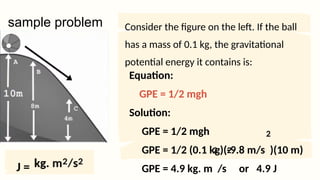
Equation:
GPE = 1/2mgh
Solution:
GPE = 1/2 mgh
GPE = 1/2 (0.1 kg)(-9.8 m/s )(10 m)
GPE = 4.9 kg. m /s or 4.9 J
sample problem
2
Consider the figure on the left. If the ball
has a mass of 0.1 kg, the gravitational
potential energy it contains is:
2 2
J =
38.
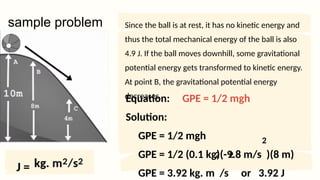
Equation: GPE =1/2 mgh
Solution:
GPE = 1/2 mgh
GPE = 1/2 (0.1 kg)(-9.8 m/s )(8 m)
GPE = 3.92 kg. m /s or 3.92 J
sample problem
2
Since the ball is at rest, it has no kinetic energy and
thus the total mechanical energy of the ball is also
4.9 J. If the ball moves downhill, some gravitational
potential energy gets transformed to kinetic energy.
At point B, the gravitational potential energy
decreases.
2 2
J =
39.
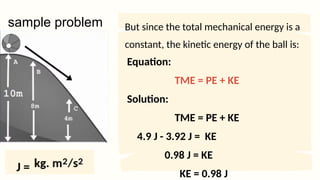
Equation:
TME = PE+ KE
Solution:
TME = PE + KE
4.9 J - 3.92 J = KE
0.98 J = KE
KE = 0.98 J
sample problem But since the total mechanical energy is a
constant, the kinetic energy of the ball is:
J =
#15 The absence of gravitational pull will make the object float.
#17 When these bonds are broken during a chemical reaction, these stored energy is release and can be put to use.
Glucose - is a stored CPE.
Chemical reaction within the plant release the chemical potential energy which the plant use to grow and carry out life processes.
#18 The devices convert the electrical energy into other forms of energy when they moves, light up, or make sounds.