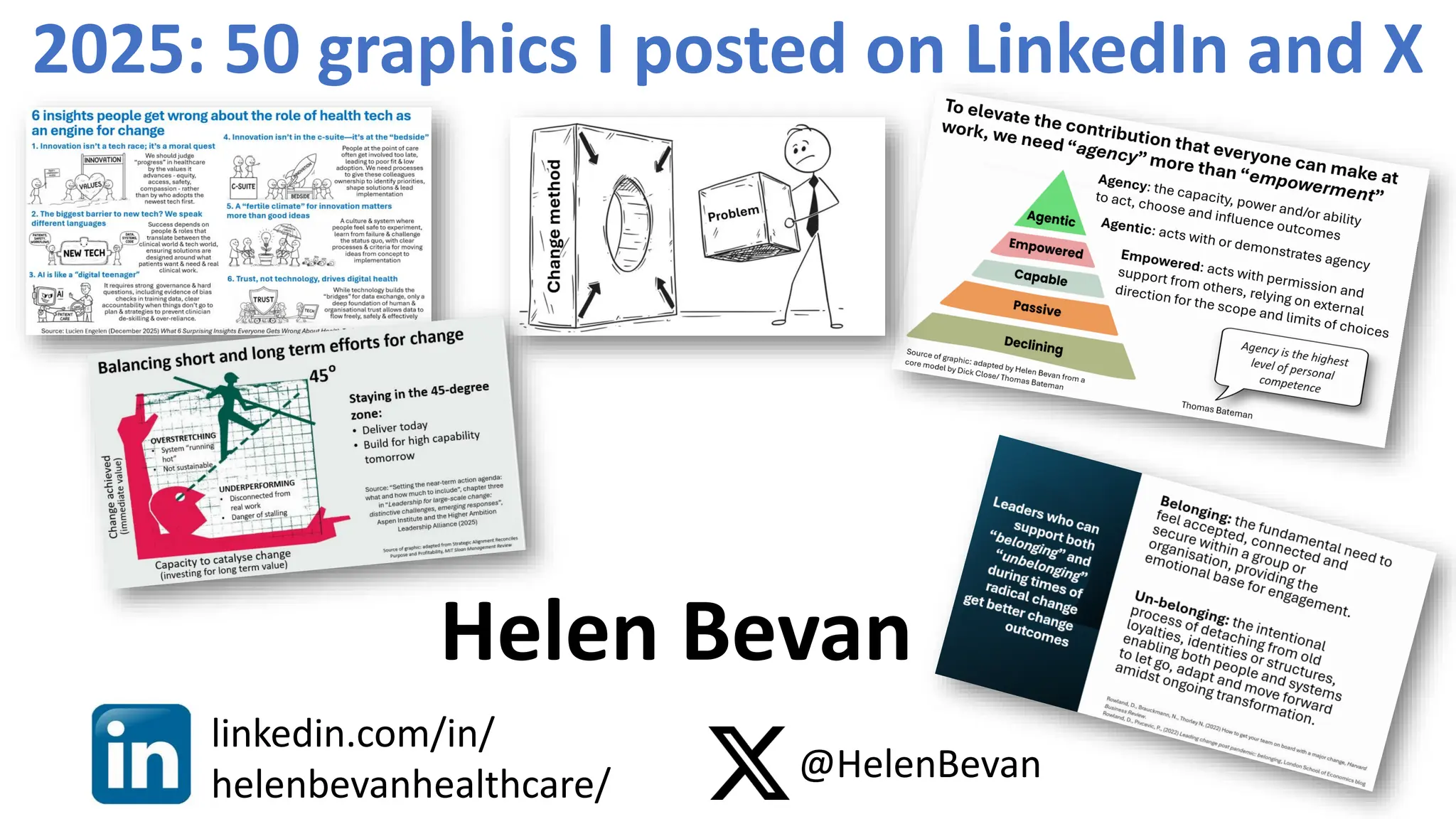
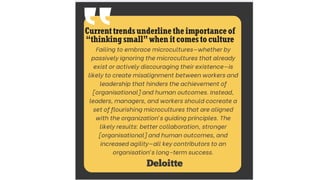
2025: 50 graphicsI posted on LinkedIn and X
Helen Bevan
@HelenBevan
linkedin.com/in/
helenbevanhealthcare/
2.
Introduction
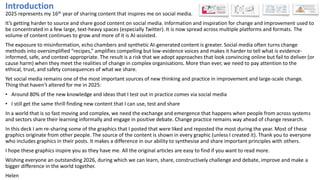
2025 represents my16th year of sharing content that inspires me on social media.
It’s getting harder to source and share good content on social media. Information and inspiration for change and improvement used to
be concentrated in a few large, text-heavy spaces (especially Twitter). It is now spread across multiple platforms and formats. The
volume of content continues to grow and more of it is AI-assisted.
The exposure to misinformation, echo chambers and synthetic AI-generated content is greater. Social media often turns change
methods into oversimplified “recipes,” amplifies compelling but low-evidence voices and makes it harder to tell what is evidence-
informed, safe, and context-appropriate. The result is a risk that we adopt approaches that look convincing online but fail to deliver (or
cause harm) when they meet the realities of change in complex organisations. More than ever, we need to pay attention to the
ethical, trust, and safety consequences of what we share.
Yet social media remains one of the most important sources of new thinking and practice in improvement and large-scale change.
Thing that haven’t altered for me in 2025:
• Around 80% of the new knowledge and ideas that I test out in practice comes via social media
• I still get the same thrill finding new content that I can use, test and share
In a world that is so fast moving and complex, we need the exchange and emergence that happens when people from across systems
and sectors share their learning informally and engage in positive debate. Change practice remains way ahead of change research.
In this deck I am re-sharing some of the graphics that I posted that were liked and reposted the most during the year. Most of these
graphics originate from other people. The source of the content is shown in every graphic (unless I created it). Thank you to everyone
who includes graphics in their posts. It makes a difference in our ability to synthesise and share important principles with others.
I hope these graphics inspire you as they have me. All the original articles are easy to find if you want to read more.
Wishing everyone an outstanding 2026, during which we can learn, share, constructively challenge and debate, improve and make a
bigger difference in the world together.
Helen
3.
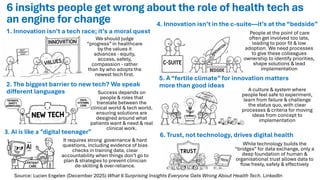
6 insights peopleget wrong about the role of health tech as
an engine for change
Source: Lucien Engelen (December 2025) What 6 Surprising Insights Everyone Gets Wrong About Health Tech. LinkedIn
2. The biggest barrier to new tech? We speak
different languages
1. Innovation isn’t a tech race; it’s a moral quest
3. AI is like a “digital teenager”
4. Innovation isn’t in the c-suite—it’s at the“bedside”
5. A“fertile climate”for innovation matters
more than good ideas
6. Trust, not technology, drives digital health
It requires strong governance & hard
questions, including evidence of bias
checks in training data, clear
accountability when things don’t go to
plan & strategies to prevent clinician
de-skilling & over-reliance.
While technology builds the
“bridges” for data exchange, only a
deep foundation of human &
organisational trust allows data to
flow freely, safely & effectively
Success depends on
people & roles that
translate between the
clinical world & tech world,
ensuring solutions are
designed around what
patients want & need & real
clinical work.
We should judge
“progress” in healthcare
by the values it
advances - equity,
access, safety,
compassion - rather
than by who adopts the
newest tech first.
A culture & system where
people feel safe to experiment,
learn from failure & challenge
the status quo, with clear
processes & criteria for moving
ideas from concept to
implementation
People at the point of care
often get involved too late,
leading to poor fit & low
adoption. We need processes
to give these colleagues
ownership to identify priorities,
shape solutions & lead
implementation
4.
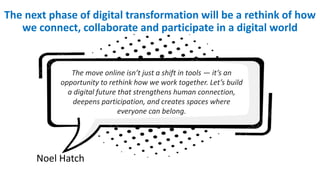
The next phaseof digital transformation will be a rethink of how
we connect, collaborate and participate in a digital world
Noel Hatch
The move online isn’t just a shift in tools — it’s an
opportunity to rethink how we work together. Let’s build
a digital future that strengthens human connection,
deepens participation, and creates spaces where
everyone can belong.
5.
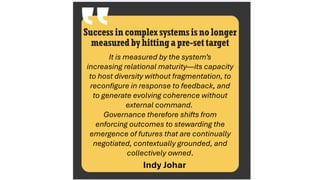
It is measuredby the system’s
increasing relational maturity—its capacity
to host diversity without fragmentation, to
reconfigure in response to feedback, and
to generate evolving coherence without
external command.
Governance therefore shifts from
enforcing outcomes to stewarding the
emergence of futures that are continually
negotiated, contextually grounded, and
collectively owned.
Success in complex systemsis no longer
measuredby hittinga pre-set target
Indy Johar
6.
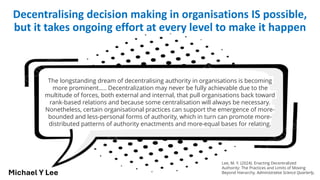
The longstanding dreamof decentralising authority in organisations is becoming
more prominent….. Decentralization may never be fully achievable due to the
multitude of forces, both external and internal, that pull organisations back toward
rank-based relations and because some centralisation will always be necessary.
Nonetheless, certain organisational practices can support the emergence of more-
bounded and less-personal forms of authority, which in turn can promote more-
distributed patterns of authority enactments and more-equal bases for relating.
Decentralising decision making in organisations IS possible,
but it takes ongoing effort at every level to make it happen
Lee, M. Y. (2024). Enacting Decentralized
Authority: The Practices and Limits of Moving
Beyond Hierarchy. Administrative Science Quarterly,
Michael Y Lee
7.
How to reducepower gradients at work
Micro-practices:
Everyday, individual actions
• Use people’s names not their job
titles, job grade or pay banding
when talking with & about them.
• Ask more questions: Asking
questions from a place of genuine
curiosity humbles us to the person
whose answer/perspective we are
seeking. We cede power to them.
• Acknowledge when we don’t
know something: Saying “I don’t
know – what do you think?”
Models humility & flattens power
differentials.
• Narrate your decision-
making: Explaining our reasoning
demystifies authority & invites
discussion.
• Give credit generously: Recognise
contributions openly, ensuring
those with less status are
acknowledged for their ideas/work.
Meso-practices:
Teams and group practices
• Share & rotate responsibilities around
the group such as chairing meetings.
• Ask everyone to introduce
themselves at the beginning of a
group meeting, sending out a clear
message that everyone matters.
• Use techniques such as a “round
robin” to structure turn taking &
ensuring everyone has protected
space to speak before more open
discussion.
• Beware of the HIPPO (Highest Paid
Person’s Opinion counts the most)
• Rotate who speaks first, ensuring the
most senior or dominant voices don’t
stifle newer or quieter team members.
• Provide silent “think time” after
posing a question & before open
discussion, to allow more of the team
to engage with the question &
formulate their response.
Macro-practices:
organisational approaches
• Move the authority to where the
knowledge is, devolving decision
making to those closest to the
sharp end of work/point of care.
• Co-create new approaches, ways of
working & solutions to problems,
don’t just “consult”.
• Hold open forums for
discussion with people at all levels.
• Redesign physical & virtual spaces:
e.g., remove hierarchical seating
arrangements in meetings (no
“head of the table”), & ensure
online meetings don’t visually
prioritise certain participants by
defaulting to speaker view.
• Turn the org chart on its side or
upside down: Visually reframing the
pyramid hierarchy into something
less “top-down” reinforces
collective responsibility.
Source: Jade Garratt “Reducing Power Gradients”, Psychological Safety Newsletter, February 2025
8.
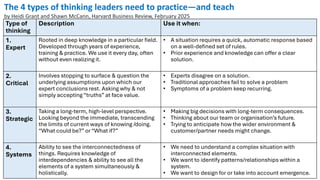
Type of
thinking
Description Useit when:
1.
Expert
Rooted in deep knowledge in a particular field.
Developed through years of experience,
training & practice. We use it every day, often
without even realizing it.
• A situation requires a quick, automatic response based
on a well-defined set of rules.
• Prior experience and knowledge can offer a clear
solution.
2.
Critical
Involves stopping to surface & question the
underlying assumptions upon which our
expert conclusions rest. Asking why & not
simply accepting “truths” at face value.
• Experts disagree on a solution.
• Traditional approaches fail to solve a problem
• Symptoms of a problem keep recurring.
3.
Strategic
Taking a long-term, high-level perspective.
Looking beyond the immediate, transcending
the limits of current ways of knowing /doing.
“What could be?” or “What if?”
• Making big decisions with long-term consequences.
• Thinking about our team or organisation’s future.
• Trying to anticipate how the wider environment &
customer/partner needs might change.
4.
Systems
Ability to see the interconnectedness of
things. Requires knowledge of
interdependencies & ability to see all the
elements of a system simultaneously &
holistically.
• We need to understand a complex situation with
interconnected elements.
• We want to identify patterns/relationships within a
system.
• We want to design for or take into account emergence.
The 4 types of thinking leaders need to practice—and teach
by Heidi Grant and Shawn McCann, Harvard Business Review, February 2025
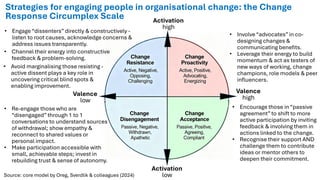
Valence
low
Valence
high
Activation
high
Activation
low
• Involve“advocates” inco-
designing changes &
communicating benefits.
• Leverage their energy to build
momentum & act as testers of
new ways of working, change
champions, role models & peer
influencers.
• Encourage those in“passive
agreement” to shift to more
active participation by inviting
feedback & involving them in
actions linked to the change.
• Recognise their support AND
challenge them to contribute
ideas or mentor others to
deepen their commitment.
• Engage “dissenters” directly & constructively -
listen to root causes, acknowledge concerns &
address issues transparently.
• Re-engage those who are
“disengaged” through 1 to 1
conversations to understand sources
of withdrawal; show empathy &
reconnect to shared values or
personal impact.
• Make participation accessible with
small, achievable steps; invest in
rebuilding trust & sense of autonomy.
• Channel their energy into constructive
feedback & problem-solving.
• Avoid marginalising those resisting -
active dissent plays a key role in
uncovering critical blind spots &
enabling improvement.
Strategies for engaging people in organisational change: the Change
Response Circumplex Scale
Source: core model by Oreg, Sverdlik & colleagues (2024)
.
11.
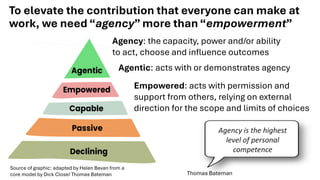
To elevate thecontribution that everyone can make at
work, we need “agency” more than“empowerment”
Source of graphic: adapted by Helen Bevan from a
core model by Dick Close/ Thomas Bateman
Agency: the capacity, power and/or ability
to act, choose and influence outcomes
Agentic: acts with or demonstrates agency
Empowered: acts with permission and
support from others, relying on external
direction for the scope and limits of choices
Agency is the highest
level of personal
competence
Thomas Bateman
12.
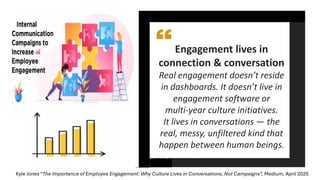
Engagement lives in
connection& conversation
Real engagement doesn’t reside
in dashboards. It doesn’t live in
engagement software or
multi-year culture initiatives.
It lives in conversations — the
real, messy, unfiltered kind that
happen between human beings.
Kyle Jones “The Importance of Employee Engagement: Why Culture Lives in Conversations, Not Campaigns”, Medium, April 2025
Graphic by
Springboard
13.
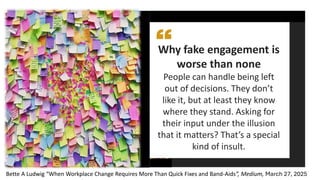
Why fake engagementis
worse than none
People can handle being left
out of decisions. They don’t
like it, but at least they know
where they stand. Asking for
their input under the illusion
that it matters? That’s a special
kind of insult.
Bette A Ludwig “When Workplace Change Requires More Than Quick Fixes and Band-Aids”, Medium, March 27, 2025
Graphic by
Springboard
14.
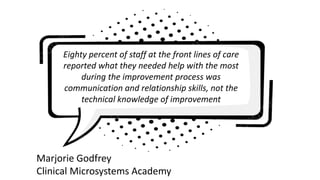
Eighty percent ofstaff at the front lines of care
reported what they needed help with the most
during the improvement process was
communication and relationship skills, not the
technical knowledge of improvement
Marjorie Godfrey
Clinical Microsystems Academy
15.
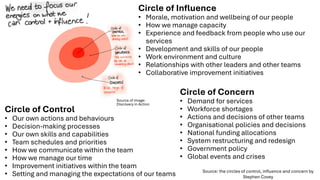
Circle of Control
•Our own actions and behaviours
• Decision-making processes
• Our own skills and capabilities
• Team schedules and priorities
• How we communicate within the team
• How we manage our time
• Improvement initiatives within the team
• Setting and managing the expectations of our teams
Circle of Influence
• Morale, motivation and wellbeing of our people
• How we manage capacity
• Experience and feedback from people who use our
services
• Development and skills of our people
• Work environment and culture
• Relationships with other leaders and other teams
• Collaborative improvement initiatives
Circle of Concern
• Demand for services
• Workforce shortages
• Actions and decisions of other teams
• Organisational policies and decisions
• National funding allocations
• System restructuring and redesign
• Government policy
• Global events and crises
Source of image:
Discovery in Action
Source: the circles of control, influence and concern by
Stephen Covey
16.
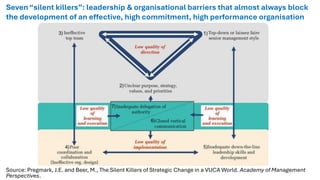
Source: Pregmark, J.E.and Beer, M., The Silent Killers of Strategic Change in a VUCA World. Academy of Management
Perspectives.
1)
7)
3)
2)
5)
4)
6)
Seven“silent killers”: leadership & organisational barriers that almost always block
the development of an effective, high commitment, high performance organisation
17.
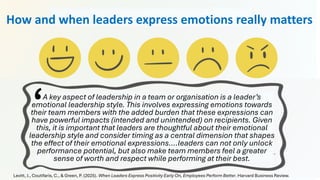
How and whenleaders express emotions really matters
A key aspect of leadership in a team or organisation is a leader’s
emotional leadership style. This involves expressing emotions towards
their team members with the added burden that these expressions can
have powerful impacts (intended and unintended) on recipients. Given
this, it is important that leaders are thoughtful about their emotional
leadership style and consider timing as a central dimension that shapes
the effect of their emotional expressions….leaders can not only unlock
performance potential, but also make team members feel a greater
sense of worth and respect while performing at their best.
Levitt, J., Coutifaris, C., & Green, P. (2025). When Leaders Express Positivity Early On, Employees Perform Better. Harvard Business Review.
‘
18.
.
.
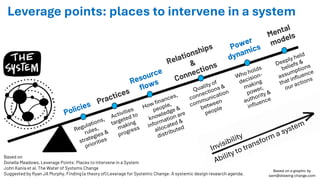
Based on
Donella Meadows,Leverage Points: Places to Intervene in a System
John Kania et al, The Water of Systems Change
Suggested by Ryan JA Murphy, Finding (a theory of) Leverage for Systemic Change: A systemic design research agenda.
Leverage points: places to intervene in a system
Based on a graphic by
sam@drawing change.com
19.
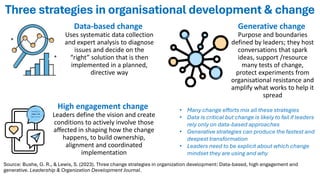
Three strategies inorganisational development & change
Data-based change
Uses systematic data collection
and expert analysis to diagnose
issues and decide on the
“right” solution that is then
implemented in a planned,
directive way
High engagement change
Leaders define the vision and create
conditions to actively involve those
affected in shaping how the change
happens, to build ownership,
alignment and coordinated
implementation
Generative change
Purpose and boundaries
defined by leaders; they host
conversations that spark
ideas, support /resource
many tests of change,
protect experiments from
organisational resistance and
amplify what works to help it
spread
Source: Bushe, G. R., & Lewis, S. (2023). Three change strategies in organization development: Data-based, high engagement and
generative. Leadership & Organization Development Journal.
• Many change efforts mix all these strategies
• Data is critical but change is likely to fail if leaders
rely only on data-based approaches
• Generative strategies can produce the fastest and
deepest transformation
• Leaders need to be explicit about which change
mindset they are using and why
20.
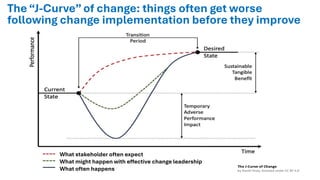
The “J-Curve”of change:things often get worse
following change implementation before they improve
What stakeholder often expect
What might happen with effective change leadership
What often happens
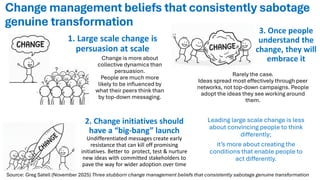
Change management beliefsthat consistently sabotage
genuine transformation
3. Once people
understand the
change, they will
embrace it
Source: Greg Satell (November 2025) Three stubborn change management beliefs that consistently sabotage genuine transformation
Leading large scale change is less
about convincing people to think
differently;
it’s more about creating the
conditions that enable people to
act differently.
Rarely the case.
Ideas spread most effectively through peer
networks, not top-down campaigns. People
adopt the ideas they see working around
them.
2. Change initiatives should
have a “big-bang” launch
Undifferentiated messages create early
resistance that can kill off promising
initiatives. Better to protect, test & nurture
new ideas with committed stakeholders to
pave the way for wider adoption over time
Change is more about
collective dynamics than
persuasion.
People are much more
likely to be influenced by
what their peers think than
by top-down messaging.
1. Large scale change is
persuasion at scale
24.
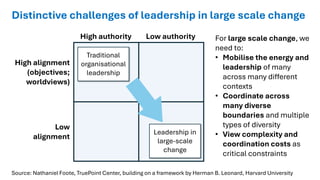
Distinctive challenges ofleadership in large scale change
High authority Low authority
Low
alignment
High alignment
(objectives;
worldviews)
Traditional
organisational
leadership
Leadership in
large-scale
change
For large scale change, we
need to:
• Mobilise the energy and
leadership of many
across many different
contexts
• Coordinate across
many diverse
boundaries and multiple
types of diversity
• View complexity and
coordination costs as
critical constraints
Source: Nathaniel Foote, TruePoint Center, building on a framework by Herman B. Leonard, Harvard University
25.
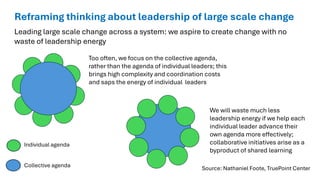
Reframing thinking aboutleadership of large scale change
Leading large scale change across a system: we aspire to create change with no
waste of leadership energy
Individual agenda
Collective agenda
Too often, we focus on the collective agenda,
rather than the agenda of individual leaders; this
brings high complexity and coordination costs
and saps the energy of individual leaders
We will waste much less
leadership energy if we help each
individual leader advance their
own agenda more effectively;
collaborative initiatives arise as a
byproduct of shared learning
Source: Nathaniel Foote, TruePoint Center
26.
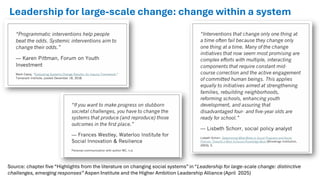
Source: chapter five“Highlights from the literature on changing social systems” in “Leadership for large-scale change: distinctive
challenges, emerging responses” Aspen Institute and the Higher Ambition Leadership Alliance (April 2025)
Leadership for large-scale change: change within a system
27.
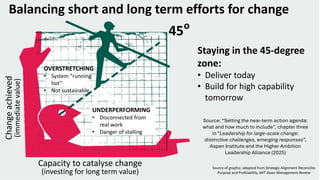
Source of graphic:adapted from Strategic Alignment Reconciles
Purpose and Profitability, MIT Sloan Management Review
Capacity to catalyse change
(investing for long term value)
Change
achieved
(immediate
value)
Balancing short and long term efforts for change
Staying in the 45-degree
zone:
• Deliver today
• Build for high capability
tomorrow
45o
OVERSTRETCHING
• System “running
hot”
• Not sustainable
UNDERPERFORMING
• Disconnected from
real work
• Danger of stalling
Source: “Setting the near-term action agenda:
what and how much to include”, chapter three
in “Leadership for large-scale change:
distinctive challenges, emerging responses”,
Aspen Institute and the Higher Ambition
Leadership Alliance (2025)
28.
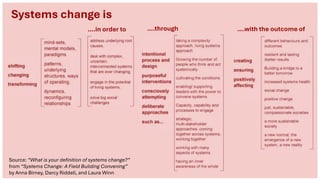
….in order to….through ….with the outcome of
Systems change is
Source: “What is your definition of systems change?”
from “Systems Change: A Field Building Convening”
by Anna Birney, Darcy Riddell, and Laura Winn
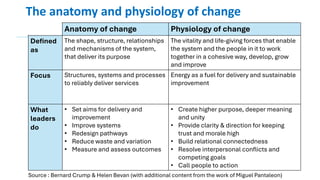
The anatomy andphysiology of change
Anatomy of change Physiology of change
Defined
as
The shape, structure, relationships
and mechanisms of the system,
that deliver its purpose
The vitality and life-giving forces that enable
the system and the people in it to work
together in a cohesive way, develop, grow
and improve
Focus Structures, systems and processes
to reliably deliver services
Energy as a fuel for delivery and sustainable
improvement
What
leaders
do
• Set aims for delivery and
improvement
• Improve systems
• Redesign pathways
• Reduce waste and variation
• Measure and assess outcomes
• Create higher purpose, deeper meaning
and unity
• Provide clarity & direction for keeping
trust and morale high
• Build relational connectedness
• Resolve interpersonal conflicts and
competing goals
• Call people to action
Source : Bernard Crump & Helen Bevan (with additional content from the work of Miguel Pantaleon)
31.
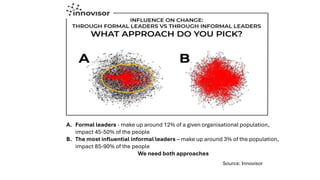
A. Formal leaders- make up around 12% of a given organisational population,
impact 45-50% of the people
B. The most influential informal leaders – make up around 3% of the population,
impact 85-90% of the people
We need both approaches
Source: Innovisor
32.
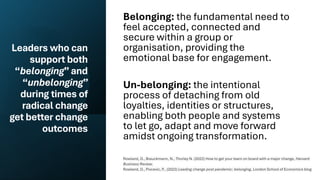
Leaders who can
supportboth
“belonging”and
“unbelonging”
during times of
radical change
get better change
outcomes
Belonging: the fundamental need to
feel accepted, connected and
secure within a group or
organisation, providing the
emotional base for engagement.
Un-belonging: the intentional
process of detaching from old
loyalties, identities or structures,
enabling both people and systems
to let go, adapt and move forward
amidst ongoing transformation.
Rowland, D., Brauckmann, N., Thorley N. (2022) How to get your team on board with a major change, Harvard
Business Review.
Rowland, D., Pivcevic, P., (2022) Leading change post pandemic: belonging, London School of Economics blog
33.
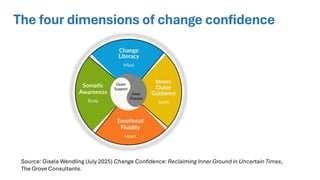
The four dimensionsof change confidence
Source: Gisela Wendling (July 2025) Change Confidence: Reclaiming Inner Ground in Uncertain Times,
The Grove Consultants.
34.
‘‘
We should leadorganisational
change through loss, not logic
When you dismiss [people’s] concerns or treat them as
irrational, you’re ignoring what research shows us
about how people handle loss.
The issue was never their attitude. They want evolution,
not to be replaced. They need you to listen to their grief,
not lecture them about what they’ll gain. They want to
help build the bridge between past and future, not
watch someone burn it all down.
Next time someone resists your change initiative, don’t
reach for more facts and figures. Ask yourself: What are
they afraid of losing? How can you acknowledge that
loss? And what benefits might they gain that they don’t
see yet?
Stop fighting their feelings of loss. Respect them
instead.
Gustavo Razzetti
35.
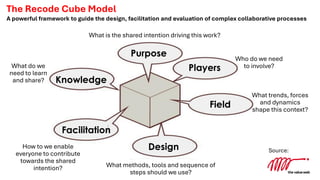
Purpose
Players
Knowledge
Facilitation
Field
Design
What is theshared intention driving this work?
Who do we need
to involve?
What trends, forces
and dynamics
shape this context?
What methods, tools and sequence of
steps should we use?
How to we enable
everyone to contribute
towards the shared
intention?
What do we
need to learn
and share?
Source:
The Recode Cube Model
A powerful framework to guide the design, facilitation and evaluation of complex collaborative processes
36.
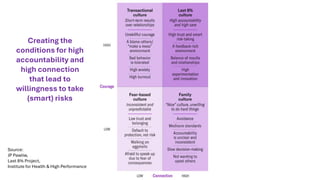
Creating the
conditions forhigh
accountability and
high connection
that lead to
willingness to take
(smart) risks
Source:
JP Pawliw,
Last 8% Project,
Institute for Health & High Performance
37.
‘‘
Frontline (team) leadersare
our most powerful asset in
turning purpose into performance
Addressing the challenge of operationalising
corporate purpose throughout an organisation
fundamentally hinges on effective dialogue at the
team level. Resolving the tension that corporate
purpose finds at team leadership levels requires
leaders to foster consistent, meaningful dialogue
about corporate goals at the team level and
beyond. Leaders who actively involve team
members in purpose discussions, consciously
manage equitable relationships, and promote
employee autonomy significantly enhance team
commitment and alignment around corporate
purpose and [results].
Rodolphe Durand and colleagues
38.
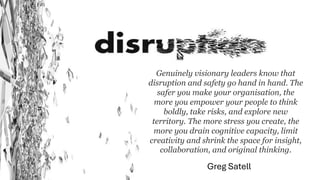
Genuinely visionary leadersknow that
disruption and safety go hand in hand. The
safer you make your organisation, the
more you empower your people to think
boldly, take risks, and explore new
territory. The more stress you create, the
more you drain cognitive capacity, limit
creativity and shrink the space for insight,
collaboration, and original thinking.
Greg Satell
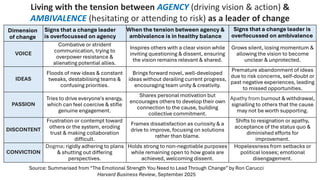
39.
Living with thetension between AGENCY (driving vision & action) &
AMBIVALENCE (hesitating or attending to risk) as a leader of change
VOICE
Combative or strident
communication, trying to
overpower resistance &
alienating potential allies.
Inspires others with a clear vision while
inviting questioning & dissent, ensuring
the vision remains relevant & shared.
Grows silent, losing momentum &
allowing the vision to become
unclear & unprotected.
IDEAS
Floods of new ideas & constant
tweaks, destabilising teams &
confusing priorities.
Brings forward novel, well-developed
ideas without derailing current progress,
encouraging team unity & creativity.
Premature abandonment of ideas
due to risk concerns, self-doubt or
past negative experiences, leading
to missed opportunities.
PASSION
Tries to drive everyone's energy,
which can feel coercive & stifle
genuine engagement.
Shares personal motivation but
encourages others to develop their own
connection to the cause, building
collective commitment.
Apathy from burnout & withdrawal,
signalling to others that the cause
may not be worth supporting.
DISCONTENT
Frustration or contempt toward
others or the system, eroding
trust & making collaboration
difficult.
Frames dissatisfaction as curiosity & a
drive to improve, focusing on solutions
rather than blame.
Shifts to resignation or apathy,
acceptance of the status quo &
diminished efforts for
improvement.
CONVICTION
Dogma; rigidly adhering to plans
& shutting out differing
perspectives.
Holds strong to non-negotiable purposes
while remaining open to how goals are
achieved, welcoming dissent.
Hopelessness from setbacks or
political losses; emotional
disengagement.
Signs that a change leader is
overfocussed on ambivalence
Signs that a change leader
is overfocussed on agency
When the tension between agency &
ambivalence is in healthy balance
Dimension
of change
Source: Summarised from “The Emotional Strength You Need to Lead Through Change” by Ron Carucci
Harvard Business Review, September 2025
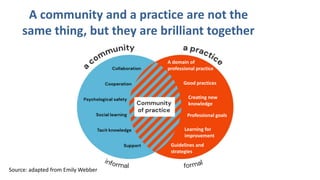
Source: adapted fromEmily Webber
Good practices
Creating new
knowledge
Learning for
improvement
Guidelines and
strategies
A domain of
professional practice
Professional goals
A community and a practice are not the
same thing, but they are brilliant together
50.
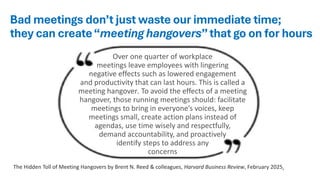
Bad meetings don’tjust waste our immediate time;
they can create“meeting hangovers”that go on for hours
Over one quarter of workplace
meetings leave employees with lingering
negative effects such as lowered engagement
and productivity that can last hours. This is called a
meeting hangover. To avoid the effects of a meeting
hangover, those running meetings should: facilitate
meetings to bring in everyone’s voices, keep
meetings small, create action plans instead of
agendas, use time wisely and respectfully,
demand accountability, and proactively
identify steps to address any
concerns
The Hidden Toll of Meeting Hangovers by Brent N. Reed & colleagues, Harvard Business Review, February 2025,
51.
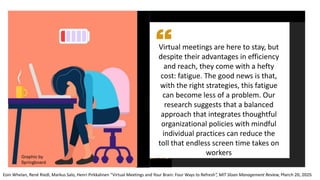
Virtual meetings arehere to stay, but
despite their advantages in efficiency
and reach, they come with a hefty
cost: fatigue. The good news is that,
with the right strategies, this fatigue
can become less of a problem. Our
research suggests that a balanced
approach that integrates thoughtful
organizational policies with mindful
individual practices can reduce the
toll that endless screen time takes on
workers
Eoin Whelan, René Riedl, Markus Salo, Henri Pirkkalinen “Virtual Meetings and Your Brain: Four Ways to Refresh”, MIT Sloan Management Review, March 20, 2025
Graphic by
Springboard


![‘‘
We should lead organisational
change through loss, not logic
When you dismiss [people’s] concerns or treat them as
irrational, you’re ignoring what research shows us
about how people handle loss.
The issue was never their attitude. They want evolution,
not to be replaced. They need you to listen to their grief,
not lecture them about what they’ll gain. They want to
help build the bridge between past and future, not
watch someone burn it all down.
Next time someone resists your change initiative, don’t
reach for more facts and figures. Ask yourself: What are
they afraid of losing? How can you acknowledge that
loss? And what benefits might they gain that they don’t
see yet?
Stop fighting their feelings of loss. Respect them
instead.
Gustavo Razzetti](https://image.slidesharecdn.com/helenbevangraphicsposted20252-251231121213-8d95e188/85/Helen-Bevan-graphics-posted-2025-2-pdf-34-320.jpg)
![‘‘
Frontline (team) leaders are
our most powerful asset in
turning purpose into performance
Addressing the challenge of operationalising
corporate purpose throughout an organisation
fundamentally hinges on effective dialogue at the
team level. Resolving the tension that corporate
purpose finds at team leadership levels requires
leaders to foster consistent, meaningful dialogue
about corporate goals at the team level and
beyond. Leaders who actively involve team
members in purpose discussions, consciously
manage equitable relationships, and promote
employee autonomy significantly enhance team
commitment and alignment around corporate
purpose and [results].
Rodolphe Durand and colleagues](https://image.slidesharecdn.com/helenbevangraphicsposted20252-251231121213-8d95e188/85/Helen-Bevan-graphics-posted-2025-2-pdf-37-320.jpg)