DEPED MEMORANDUM NO. 89, S. 2025
GUIDELINES ON THE
MULTI YEAR PMES FOR
‑
TEACHERS
(SY 2025–2026 TO 2027–2028)
BACKGROUND & PURPOSE
• Establishes a multi year Performance
‑
Management &
Evaluation System (PMES) for teachers.
• Aligns teacher assessment with multi year
‑
professional
development and school improvement goals.
• Promotes transparent, consistent performance
evaluation across SY 2025–2026 to 2027–2028.
SCOPE & COVERAGE
Applies to:
• All public school teachers covered by DepEd
PMES.
• Multi year cycle covering three school years:
‑
2025–2026, 2026–2027, 2027–2028.
• Roles from teacher level to school and division
offices in planning, monitoring, and evaluation.
PMES — KEY COMPONENTS
Core elements:
• Performance planning and targets
(multi year).
‑
• Cyclical performance assessment
(observations, outputs, accomplishments).
• Professional development linked to identified
needs.
• Data use, reporting, and safeguards for fair
scoring.
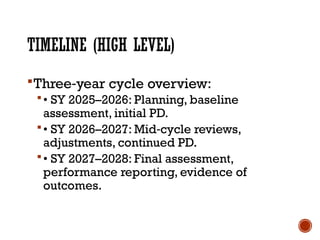
TIMELINE (HIGH LEVEL)
Three year cycle overview:
‑
• SY 2025–2026: Planning, baseline
assessment, initial PD.
• SY 2026–2027: Mid cycle reviews,
‑
adjustments, continued PD.
• SY 2027–2028: Final assessment,
performance reporting, evidence of
outcomes.
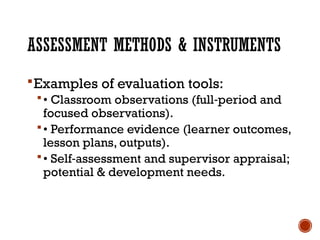
ASSESSMENT METHODS & INSTRUMENTS
Examples of evaluation tools:
• Classroom observations (full period and
‑
focused observations).
• Performance evidence (learner outcomes,
lesson plans, outputs).
• Self assessment and supervisor appraisal;
‑
potential & development needs.
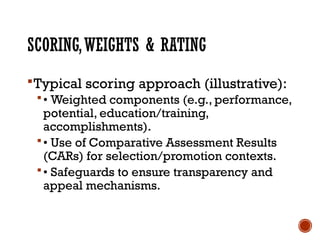
SCORING,WEIGHTS & RATING
Typical scoring approach (illustrative):
• Weighted components (e.g., performance,
potential, education/training,
accomplishments).
• Use of Comparative Assessment Results
(CARs) for selection/promotion contexts.
• Safeguards to ensure transparency and
appeal mechanisms.
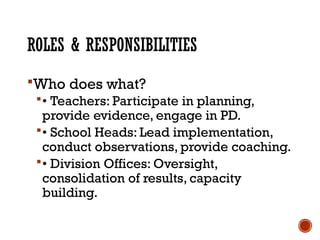
ROLES & RESPONSIBILITIES
Who does what?
• Teachers: Participate in planning,
provide evidence, engage in PD.
• School Heads: Lead implementation,
conduct observations, provide coaching.
• Division Offices: Oversight,
consolidation of results, capacity
building.
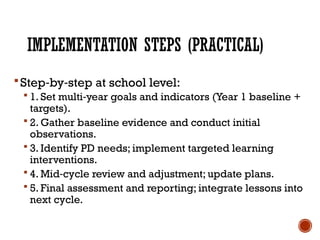
IMPLEMENTATION STEPS (PRACTICAL)
Step by step at school level:
‑ ‑
 1. Set multi year goals and indicators (Year 1 baseline +
‑
targets).
 2. Gather baseline evidence and conduct initial
observations.
 3. Identify PD needs; implement targeted learning
interventions.
 4. Mid cycle review and adjustment; update plans.
‑
 5. Final assessment and reporting; integrate lessons into
next cycle.
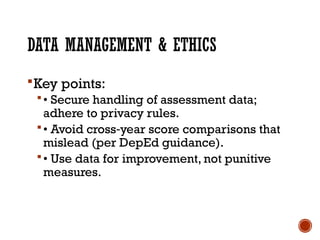
DATA MANAGEMENT & ETHICS
Key points:
• Secure handling of assessment data;
adhere to privacy rules.
• Avoid cross year score comparisons that
‑
mislead (per DepEd guidance).
• Use data for improvement, not punitive
measures.
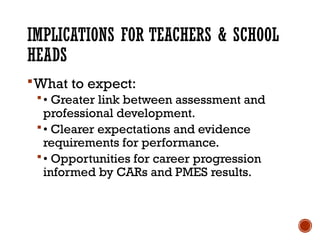
IMPLICATIONS FOR TEACHERS & SCHOOL
HEADS
What to expect:
• Greater link between assessment and
professional development.
• Clearer expectations and evidence
requirements for performance.
• Opportunities for career progression
informed by CARs and PMES results.
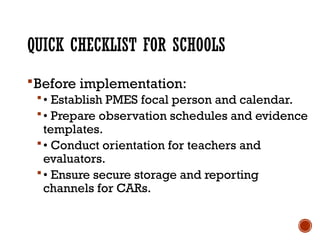
QUICK CHECKLIST FOR SCHOOLS
Before implementation:
• Establish PMES focal person and calendar.
• Prepare observation schedules and evidence
templates.
• Conduct orientation for teachers and
evaluators.
• Ensure secure storage and reporting
channels for CARs.
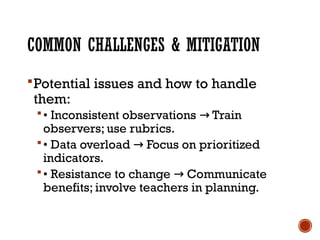
COMMON CHALLENGES & MITIGATION
Potential issues and how to handle
them:
• Inconsistent observations Train
→
observers; use rubrics.
• Data overload Focus on prioritized
→
indicators.
• Resistance to change Communicate
→
benefits; involve teachers in planning.
SUGGESTED PD ACTIONS (EXAMPLES)
Align PD to assessment findings:
• Targeted coaching for identified
classroom practice gaps.
• Peer learning groups and lesson study.
• Evidence based workshops (assessment
‑
literacy, formative assessment).
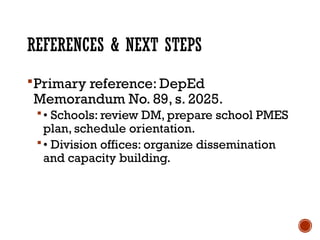
REFERENCES & NEXT STEPS
Primary reference: DepEd
Memorandum No. 89, s. 2025.
• Schools: review DM, prepare school PMES
plan, schedule orientation.
• Division offices: organize dissemination
and capacity building.
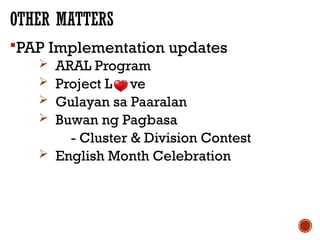
OTHER MATTERS
PAP Implementation updates
 ARAL Program
 Project L ve
 Gulayan sa Paaralan
 Buwan ng Pagbasa
- Cluster & Division Contest
 English Month Celebration
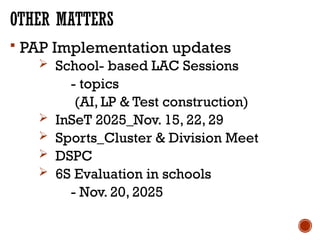
OTHER MATTERS
 PAP Implementation updates
 School- based LAC Sessions
- topics
(AI, LP & Test construction)
 InSeT 2025_Nov. 15, 22, 29
 Sports_Cluster & Division Meet
 DSPC
 6S Evaluation in schools
- Nov. 20, 2025
OTHER MATTERS
GRANTEE of Fo Guang Shan Foundation
under the Three Act of Goodness Program
with approved proposal titled
Project MURAL
(Manifesting Unity, Respect, and Love
through Art and Learning)
OTHER MATTERS
SSLG Empowerment on Mental Health
Issues and Concerns

The SALIENT FEATURES OF DEPED MEMORANDUM_No_89_s_2025_Presentation.pptx

  • 2.
    DEPED MEMORANDUM NO.89, S. 2025 GUIDELINES ON THE MULTI YEAR PMES FOR ‑ TEACHERS (SY 2025–2026 TO 2027–2028)
  • 3.
    BACKGROUND & PURPOSE •Establishes a multi year Performance ‑ Management & Evaluation System (PMES) for teachers. • Aligns teacher assessment with multi year ‑ professional development and school improvement goals. • Promotes transparent, consistent performance evaluation across SY 2025–2026 to 2027–2028.
  • 4.
    SCOPE & COVERAGE Appliesto: • All public school teachers covered by DepEd PMES. • Multi year cycle covering three school years: ‑ 2025–2026, 2026–2027, 2027–2028. • Roles from teacher level to school and division offices in planning, monitoring, and evaluation.
  • 5.
    PMES — KEYCOMPONENTS Core elements: • Performance planning and targets (multi year). ‑ • Cyclical performance assessment (observations, outputs, accomplishments). • Professional development linked to identified needs. • Data use, reporting, and safeguards for fair scoring.
  • 6.
    TIMELINE (HIGH LEVEL) Threeyear cycle overview: ‑ • SY 2025–2026: Planning, baseline assessment, initial PD. • SY 2026–2027: Mid cycle reviews, ‑ adjustments, continued PD. • SY 2027–2028: Final assessment, performance reporting, evidence of outcomes.
  • 7.
    ASSESSMENT METHODS &INSTRUMENTS Examples of evaluation tools: • Classroom observations (full period and ‑ focused observations). • Performance evidence (learner outcomes, lesson plans, outputs). • Self assessment and supervisor appraisal; ‑ potential & development needs.
  • 8.
    SCORING,WEIGHTS & RATING Typicalscoring approach (illustrative): • Weighted components (e.g., performance, potential, education/training, accomplishments). • Use of Comparative Assessment Results (CARs) for selection/promotion contexts. • Safeguards to ensure transparency and appeal mechanisms.
  • 9.
    ROLES & RESPONSIBILITIES Whodoes what? • Teachers: Participate in planning, provide evidence, engage in PD. • School Heads: Lead implementation, conduct observations, provide coaching. • Division Offices: Oversight, consolidation of results, capacity building.
  • 10.
    IMPLEMENTATION STEPS (PRACTICAL) Stepby step at school level: ‑ ‑  1. Set multi year goals and indicators (Year 1 baseline + ‑ targets).  2. Gather baseline evidence and conduct initial observations.  3. Identify PD needs; implement targeted learning interventions.  4. Mid cycle review and adjustment; update plans. ‑  5. Final assessment and reporting; integrate lessons into next cycle.
  • 11.
    DATA MANAGEMENT &ETHICS Key points: • Secure handling of assessment data; adhere to privacy rules. • Avoid cross year score comparisons that ‑ mislead (per DepEd guidance). • Use data for improvement, not punitive measures.
  • 12.
    IMPLICATIONS FOR TEACHERS& SCHOOL HEADS What to expect: • Greater link between assessment and professional development. • Clearer expectations and evidence requirements for performance. • Opportunities for career progression informed by CARs and PMES results.
  • 13.
    QUICK CHECKLIST FORSCHOOLS Before implementation: • Establish PMES focal person and calendar. • Prepare observation schedules and evidence templates. • Conduct orientation for teachers and evaluators. • Ensure secure storage and reporting channels for CARs.
  • 14.
    COMMON CHALLENGES &MITIGATION Potential issues and how to handle them: • Inconsistent observations Train → observers; use rubrics. • Data overload Focus on prioritized → indicators. • Resistance to change Communicate → benefits; involve teachers in planning.
  • 15.
    SUGGESTED PD ACTIONS(EXAMPLES) Align PD to assessment findings: • Targeted coaching for identified classroom practice gaps. • Peer learning groups and lesson study. • Evidence based workshops (assessment ‑ literacy, formative assessment).
  • 16.
    REFERENCES & NEXTSTEPS Primary reference: DepEd Memorandum No. 89, s. 2025. • Schools: review DM, prepare school PMES plan, schedule orientation. • Division offices: organize dissemination and capacity building.
  • 17.
    OTHER MATTERS PAP Implementationupdates  ARAL Program  Project L ve  Gulayan sa Paaralan  Buwan ng Pagbasa - Cluster & Division Contest  English Month Celebration
  • 18.
    OTHER MATTERS  PAPImplementation updates  School- based LAC Sessions - topics (AI, LP & Test construction)  InSeT 2025_Nov. 15, 22, 29  Sports_Cluster & Division Meet  DSPC  6S Evaluation in schools - Nov. 20, 2025
  • 19.
    OTHER MATTERS GRANTEE ofFo Guang Shan Foundation under the Three Act of Goodness Program with approved proposal titled Project MURAL (Manifesting Unity, Respect, and Love through Art and Learning)
  • 20.
    OTHER MATTERS SSLG Empowermenton Mental Health Issues and Concerns