Your Picture HereAnd Send To Back Your Picture Here And Send To Back Your Picture Here And Send To Back
Suhan
Sawod
Sonia
Adhikari
Suravi
Shrestha
The Team:
3.
WE WOULD LIKETO THANK UNIGLOBE COLLEGE AND THE
SUBJECT TEACHER FOR PROVIDING US WITH THIS
OPPORTUNITY
4.
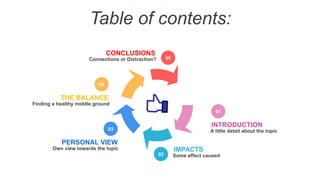
Table of contents:
Connectionsor Distraction?
CONCLUSIONS
05
Finding a healthy middle ground
THE BALANCE
04
Own view towards the topic
PERSONAL VIEW
03
Some effect caused
IMPACTS
02
A little detail about the topic
INTRODUCTION
01
5.
INTRODUCTION Let’s faceit—mobile phones are a huge part of our
daily lives. Whether we’re texting friends, checking
social media, watching videos, or just scrolling
through random stuff, our phones are always within
reach. They're convenient, entertaining, and help us
stay in touch with people no matter where they are.
But here’s something to think about: even though
we’re more “connected” than ever, are we actually
becoming less social in real life? Have you ever
been in a room where everyone’s sitting together,
but each person is just staring at their phone? It
happens a lot—and it raises some important
questions.
Are our phones helping us build stronger
relationships, or are they getting in the way of real
conversations? Are we spending more time online
than we are connecting face-to-face?
In this presentation, we’ll look at both sides of the
story. We’ll talk about how mobile phones might be
making us less social, but also how they can help us
6.
IMPACTS:
People spend mostof their
time in screen than in real
conversation
Weakened
Relationship
Lack of attention and
meaningful conversation can
hurt the relation ship
Phubbing
Ignoring people
around while focusing
on your phone
Mental Health
Issue
Overuse is linked to
anxiety, depression and
loneliness
Addiction &
Distraction
Constant notification disrupts real
world engagement
Sleep & Focus
problem
Late night screen use
affects sleep, energy and
attention span
3 4 5 6
Negative impacts:-
Reduced Face-
to-Face
Interaction
1 2
7.
Positive impacts:-
Share lifeupdates, photos and
achievements instantly
Real time sharing
Connects people with similar
interests (e.g. hobbies, support
group)
Building Online Communities
Simplifies planning meet
ups, events are group
activities
Organizing social
events
Staying connected with
family, and friends all
around the world
Staying Connected
Quick help during crisis or
urgent situation
Emergency
communication
Access to news, education
and new ideas
Learn and grow
8.
Personal view:
In myopinion, mobile phones are not entirely making us less
social—but they are changing the way we interact. On one
hand, they offer amazing tools to stay in touch with family and
friends, especially across long distances. Social media,
messaging apps, and video calls allow us to feel close to people
even when we're far apart.
However, I also notice how easy it is to get distracted by
screens and ignore the people physically around us.
Sometimes, even when we are with friends or family, we’re
more focused on our phones than on the conversation. This can
reduce the quality of our real-life relationships and create
emotional distance.
I think the key is balance. Mobile phones are powerful tools, but
we should be mindful of how and when we use them. Being
present in the moment—talking face-to-face, listening, and
sharing real experiences—is still very important. If we use our
phones to support, not replace, real social interaction, they can
actually help us become more connected, not less.
9.
THE BALANCE:-
Finding theright balance between using mobile phones and
maintaining real-life social connections is crucial in today’s
digital age. While mobile phones provide a convenient way to
stay connected with loved ones, they should not replace face-
to-face interactions. It’s important to set boundaries and be
mindful of our screen time, making time for real-world
conversations and activities. Regular digital detoxes and tech-
free moments, like during meals or social gatherings, can help
us avoid becoming overly absorbed in our phones. Using
phones intentionally—for staying in touch with friends,
organizing events, or learning new things—is beneficial, but we
must not let technology take over our personal connections.
The key is to use phones to enhance, not replace, social
interactions, and to ensure that we are present, engaged, and
actively participating in the world around us.
10.
Conclusion:-
In conclusion, mobilephones are not inherently making us less social, but they are transforming
how we interact. While they offer many benefits, such as staying connected with loved ones and
accessing information, they also present challenges, like reducing face-to-face conversations and
creating distractions. The key is finding a healthy balance—using phones to enhance
communication without allowing them to replace real, meaningful interactions. By being mindful of
our phone use and prioritizing genuine connections, we can ensure that technology serves us, not
the other way around. In the end, it’s about being present in both the digital and physical worlds,
fostering stronger relationships, and using phones to connect, not disconnect.