Proses Pemesinan
(Machining)
 Klasifikasi proses pemesinan
 Elemen dasar mesin perkakas
 Elemen dasar proses pemesinan
Proses Pemesinan (Machining)
Material Removal Processes
 Material Removal Processes common
feature is that excess material is
removed from a starting workpiece
so that the remaining part has the
desired shape.
Proses Pemesinan (Machining)
3 Types Machining Processes
 Cutting (Machining): a sharp cutting tool is used to
mechanically remove material to leave the desired part
shape. Turning, Milling, Drilling, Shaping/Planing,
Boring, Broaching and Sawing
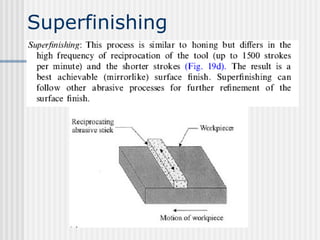
 Abrasive Processes : the action of hard and abrasive
particles is used to mechanically remove material to
achieved the desired quality of surface finish of
previously processed surfaces. Grinding, Honing,
Lapping, Polishing, Buffing and Superfinishing
 Non-traditional machining processes: Variety of
energy forms other than a sharp cutting tool or
abrasive particles to remove material. Chemical Milling,
Electrochemical Machining, Electrical Discharge
Machining
Cutting (Machining)
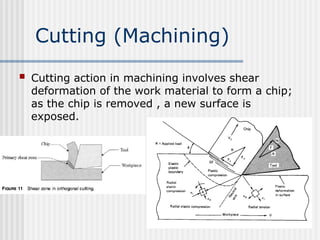
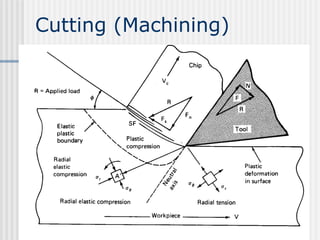
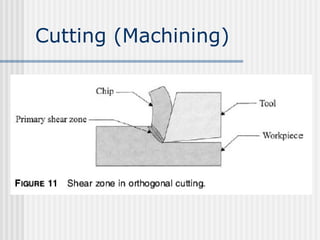
 Cutting action in machining involves shear
deformation of the work material to form a chip;
as the chip is removed , a new surface is
exposed.
Cutting (Machining)
Cutting (Machining)
Machining
 The common feature is the use of a cutting tool to
form a chip that is removed from a starting
workpiece. To perform the operation, relative
motion is required between the tool and workpiece.
 The relative motion is achieved in most machining
operations by means of a primary motion (speed
motion) and a secondary motion (feed motion)
 Cutting speed the speed at which the cutting
→
edge of the tool passes over the surface of the
workpiece (menghasilkan permukaan baru).
 Feed rate a speed at which the cutting tool
→
penetrates the workpiece.
Machining
 The shape of tools and its penetration
into the work surface, combined with
the speed and feed motion, produces
the desired shape of the resulting
workpiece
Machining
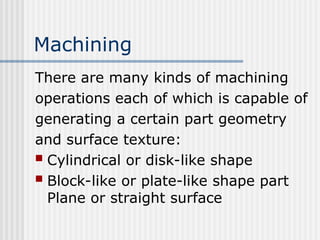
There are many kinds of machining
operations each of which is capable of
generating a certain part geometry
and surface texture:
 Cylindrical or disk-like shape
 Block-like or plate-like shape part
Plane or straight surface
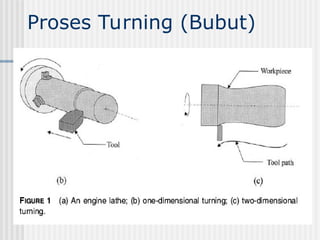
Proses Turning (Bubut)
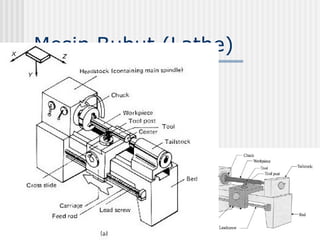
Mesin Bubut (Lathe)
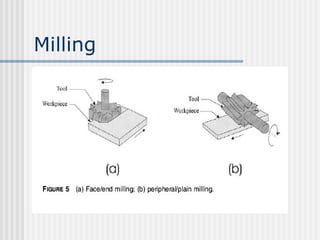
Milling
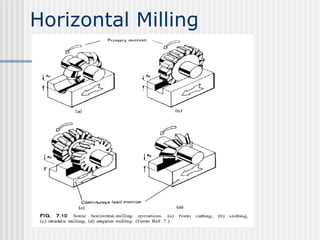
Horizontal Milling
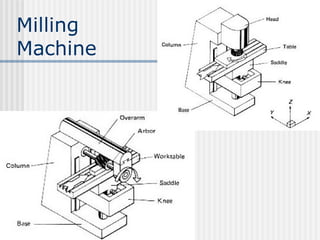
Milling
Machine
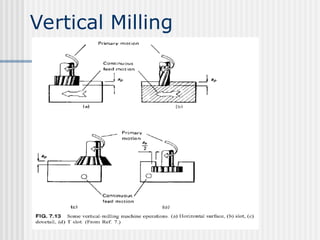
Vertical Milling
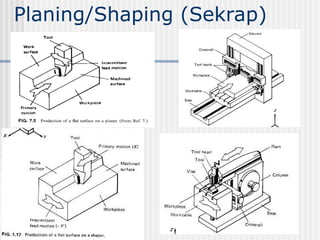
Planing/Shaping (Sekrap)
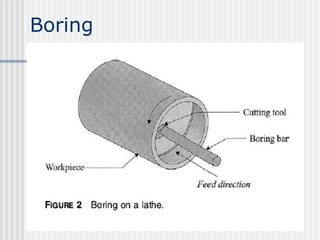
Boring
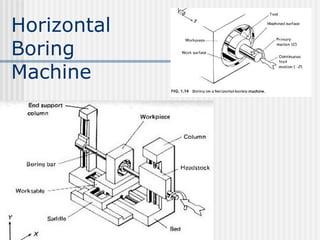
Horizontal
Boring
Machine
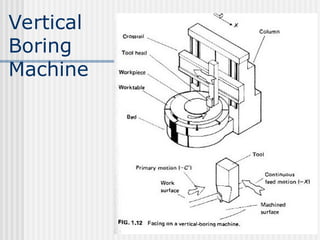
Vertical
Boring
Machine
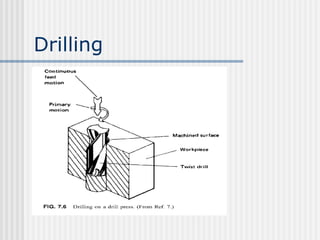
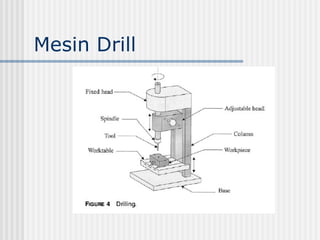
Drilling
Mesin Drill
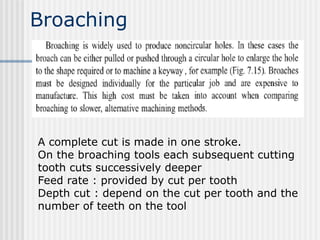
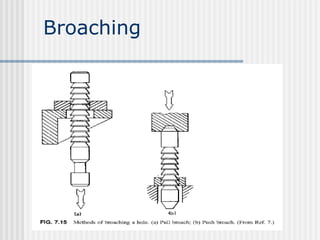
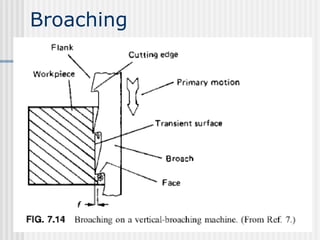
Broaching
A complete cut is made in one stroke.
On the broaching tools each subsequent cutting
tooth cuts successively deeper
Feed rate : provided by cut per tooth
Depth cut : depend on the cut per tooth and the
number of teeth on the tool
Broaching
Broaching
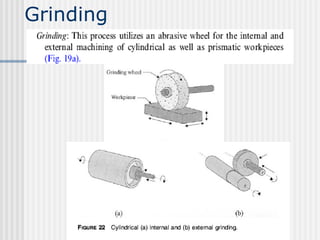
Grinding
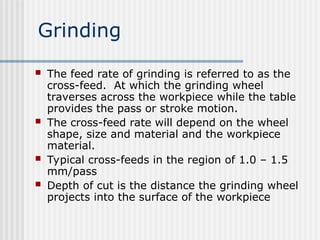
Grinding
 The feed rate of grinding is referred to as the
cross-feed. At which the grinding wheel
traverses across the workpiece while the table
provides the pass or stroke motion.
 The cross-feed rate will depend on the wheel
shape, size and material and the workpiece
material.
 Typical cross-feeds in the region of 1.0 – 1.5
mm/pass
 Depth of cut is the distance the grinding wheel
projects into the surface of the workpiece
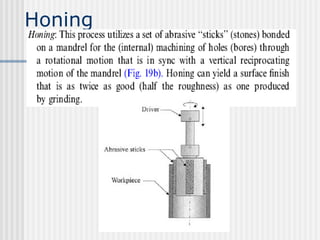
Honing
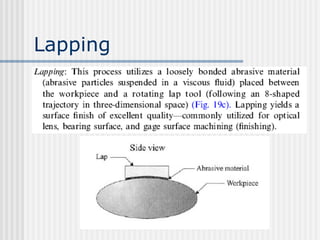
Lapping
Superfinishing
Types of Machining
 Berdasarkan gerak relatif pahat
terhadap benda kerja
 Berdasarkan jenis mesin perkakas
yang digunakan
 Berdasarkan proses terbentuknya
permukaan (surface generation)
 Berdasarkan gerak relatif dan jenis
pahat
Types of Machining
Berdasarkan gerak relatif pahat pahat
terhadap benda kerja:
 Proses membubut (Turning)
 Proses menggurdi (Drilling)
 Proses menyekrap (shaping atau planning)
 Proses mengefreis (Milling)
 Proses menggergaji atau memarut
(sawing atau broaching)
 Proses menggerinda rata (Surface grinding)
 Proses menggerinda silindris (cylindrical
grinding)
Types of Machining
Berdasarkan mesin perkakas yang digunakan:
 Membubut (Turning)
 Menggurdi (Drilling)
 Menyekrap (shaping/ planning)
 Mengefreis (Milling)
 Menggergaji (Sawing)
 Mengkoter/memperbesar lubang (Boring)
 Memarut (Broaching)
 Menggerinda (Grinding)
 Mengasah (Honing)
 Mengasah Halus (Lapping)
 Mengasah super halus (Super Finishing)
 Mengkilapkan (Polishing dan Buffing)
Types of Machining
Berdasarkan proses terbentuknya permukaan
(surface generation) :
 Generasi permukaan silindris atau konis
 Generasi permukaan rata atau lurus
dengan atau tanpa putaran benda kerja
Types of Machining
 Generasi permukaan silindris
• Single point generation
• Parallel to the axis of rotation
• External: Turning, Threading, Doving
• Internal: Boring, Threading, Grooving, Gundrilling
• Non-parallel to the axis of rotation
• Straight but intersecting: Facing, Surfacing, Taper, Turning,
Fly cutting
• Complex shapes: Copying, Contour, Forming
• Multiple point generation
• Two-edge cutting: Drilling, Counter boring, Spot facing
• Multi-edge cutting:
• Sizeable chips (milling) : Cutter axis perpendicular to
generated surface: Face milling
• Ground chips (filing, grinding) : Cutter axis parallel to
generated surface: Slab milling, cylindrical and peripheral
surface grinding
Berdasarkan gerak relatif dan jenis pahat:
Types of Machining
 Generasi permukaan rata atau lurus dengan atau
tanpa putaran benda kerja silindris
• Job held cutter reciprocates
• Shaping
• Broaching
• Slotting
• Keyseating
• Sawing
• Tool held, job moves
• Planing
• Broaching
• Job and tool moves
• Gear cutting
Berdasarkan gerak relatif dan jenis pahat:
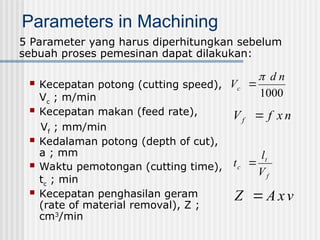
Parameters in Machining
 Kecepatan potong (cutting speed),
Vc
; m/min
 Kecepatan makan (feed rate),
Vf
; mm/min
 Kedalaman potong (depth of cut),
a ; mm
 Waktu pemotongan (cutting time),
tc
; min
 Kecepatan penghasilan geram
(rate of material removal), Z ;
cm3
/min
1000
n
d
Vc


n
x
f
Vf 
f
t
c
V
l
t 
v
x
A
Z 
5 Parameter yang harus diperhitungkan sebelum
sebuah proses pemesinan dapat dilakukan:
 Cutting speed the speed at which the cutting
→
edge of the tool passes over the surface of the
workpiece (menghasilkan permukaan baru).
 Feed rate a speed at which the cutting tool
→
penetrates the workpiece.
 Depth of cut (there are a number variations
definition depending on the specific process)
 General: the difference between the original
surface and that being produced by the cutting tool
 Turning and boring: the radial distance that cutting
edge is set from outer diameter
 Milling: the distance the tool projects beneath the
original surface
Parameters in Machining
Basic Elements of Machine Tools
(Elemen dasar mesin perkakas)
Komponen yang selalu ada pada setiap
mesin perkakas
 Rangka mesin
 Penggerak
 Peralatan Pemegang benda kerja
 Pengontrol
Basic Elements of Machine Tools
(Elemen dasar mesin perkakas)
Struktur:
 Dasar
 Bangku
 Kolom
 Kepala tetap
 Meja
 Peluncur silang
Bahan:
 besi cor
kelabu
 baja
 baja las
Rangka Mesin
Basic Elements of Machine Tools
(Elemen dasar mesin perkakas)
Penggerak:
 Mekanis
 Listrik
 Hidrolis
 Pneumatis
Basic Elements of Machine Tools
(Elemen dasar mesin perkakas)
Peralatan pemegang benda kerja :
 Pada benda kerja berputar
 Diantara pusat
 Mandril
 Plat Penyetel
 Pencekam
 Leher
 Arbor
 Peralatan Khusus
 Pada Benda Kerja Ulang Alik
Basic Elements of Machine Tools
(Elemen dasar mesin perkakas)
Peralatan pemegang benda kerja :
 Pada benda kerja berputar
 Pada benda kerja ulang alik
 Ragum
 Celah T
 Pencekam magnet
• Magnet tetap
• Arus searah
Basic Elements of Machine Tools
(Elemen dasar mesin perkakas)
Metode pengendalian:
 Dengan tangan
 Mekanis
 Hidrolis
 Gerakan nok (cam)
 Daur pemilih waktu
 Pengendali numerik
Bentuk-bentuk geometri yang umum
produk hasil pemotongan
 Permukaan datar (plane atau flat)
 Silindris (cylindrical)
 Konis (conical)
 Tak beraturan (irregular, curve atau
warped)
Ketelitian mesin-mesin
perkakas
 Ketelitian produk yang dihasilkan sampai 0.001 inci
atau kurang.
 untuk menghasilkan ketelitian tersebut mesin
perkakas harus memenuhi persyaratan sbb antara
lain:
 Fungsional
 Kekakuan
 Bentuk
 Kemudahan dalam pengoperasian
 Kemudahan pengeluaran serpihan (geram)
 Keselamatan
Kekakuan mesin perkakas
 Kekakuan statis dan kekakuan
dinamis untuk:
 Ketepatan dan ketelitian
 Kemantapan struktur dari mesin
perkakas untuk mencegah getaran.
Hal ini untuk mencegah terjadinya
penyimpangan geometri dan kualitas
dari produk yang diproduksi.
Bab 3 Proses Pemesinan kelompok 3 fakultas teknik

Bab 3 Proses Pemesinan kelompok 3 fakultas teknik

  • 1.
    Proses Pemesinan (Machining)  Klasifikasiproses pemesinan  Elemen dasar mesin perkakas  Elemen dasar proses pemesinan
  • 2.
    Proses Pemesinan (Machining) MaterialRemoval Processes  Material Removal Processes common feature is that excess material is removed from a starting workpiece so that the remaining part has the desired shape.
  • 3.
    Proses Pemesinan (Machining) 3Types Machining Processes  Cutting (Machining): a sharp cutting tool is used to mechanically remove material to leave the desired part shape. Turning, Milling, Drilling, Shaping/Planing, Boring, Broaching and Sawing  Abrasive Processes : the action of hard and abrasive particles is used to mechanically remove material to achieved the desired quality of surface finish of previously processed surfaces. Grinding, Honing, Lapping, Polishing, Buffing and Superfinishing  Non-traditional machining processes: Variety of energy forms other than a sharp cutting tool or abrasive particles to remove material. Chemical Milling, Electrochemical Machining, Electrical Discharge Machining
  • 4.
    Cutting (Machining)  Cuttingaction in machining involves shear deformation of the work material to form a chip; as the chip is removed , a new surface is exposed.
  • 5.
  • 6.
  • 7.
    Machining  The commonfeature is the use of a cutting tool to form a chip that is removed from a starting workpiece. To perform the operation, relative motion is required between the tool and workpiece.  The relative motion is achieved in most machining operations by means of a primary motion (speed motion) and a secondary motion (feed motion)  Cutting speed the speed at which the cutting → edge of the tool passes over the surface of the workpiece (menghasilkan permukaan baru).  Feed rate a speed at which the cutting tool → penetrates the workpiece.
  • 8.
    Machining  The shapeof tools and its penetration into the work surface, combined with the speed and feed motion, produces the desired shape of the resulting workpiece
  • 9.
    Machining There are manykinds of machining operations each of which is capable of generating a certain part geometry and surface texture:  Cylindrical or disk-like shape  Block-like or plate-like shape part Plane or straight surface
  • 10.
  • 11.
  • 12.
  • 13.
  • 14.
  • 15.
  • 16.
  • 17.
  • 18.
  • 19.
  • 20.
  • 21.
  • 22.
    Broaching A complete cutis made in one stroke. On the broaching tools each subsequent cutting tooth cuts successively deeper Feed rate : provided by cut per tooth Depth cut : depend on the cut per tooth and the number of teeth on the tool
  • 23.
  • 24.
  • 25.
  • 26.
    Grinding  The feedrate of grinding is referred to as the cross-feed. At which the grinding wheel traverses across the workpiece while the table provides the pass or stroke motion.  The cross-feed rate will depend on the wheel shape, size and material and the workpiece material.  Typical cross-feeds in the region of 1.0 – 1.5 mm/pass  Depth of cut is the distance the grinding wheel projects into the surface of the workpiece
  • 27.
  • 28.
  • 29.
  • 30.
    Types of Machining Berdasarkan gerak relatif pahat terhadap benda kerja  Berdasarkan jenis mesin perkakas yang digunakan  Berdasarkan proses terbentuknya permukaan (surface generation)  Berdasarkan gerak relatif dan jenis pahat
  • 31.
    Types of Machining Berdasarkangerak relatif pahat pahat terhadap benda kerja:  Proses membubut (Turning)  Proses menggurdi (Drilling)  Proses menyekrap (shaping atau planning)  Proses mengefreis (Milling)  Proses menggergaji atau memarut (sawing atau broaching)  Proses menggerinda rata (Surface grinding)  Proses menggerinda silindris (cylindrical grinding)
  • 32.
    Types of Machining Berdasarkanmesin perkakas yang digunakan:  Membubut (Turning)  Menggurdi (Drilling)  Menyekrap (shaping/ planning)  Mengefreis (Milling)  Menggergaji (Sawing)  Mengkoter/memperbesar lubang (Boring)  Memarut (Broaching)  Menggerinda (Grinding)  Mengasah (Honing)  Mengasah Halus (Lapping)  Mengasah super halus (Super Finishing)  Mengkilapkan (Polishing dan Buffing)
  • 33.
    Types of Machining Berdasarkanproses terbentuknya permukaan (surface generation) :  Generasi permukaan silindris atau konis  Generasi permukaan rata atau lurus dengan atau tanpa putaran benda kerja
  • 34.
    Types of Machining Generasi permukaan silindris • Single point generation • Parallel to the axis of rotation • External: Turning, Threading, Doving • Internal: Boring, Threading, Grooving, Gundrilling • Non-parallel to the axis of rotation • Straight but intersecting: Facing, Surfacing, Taper, Turning, Fly cutting • Complex shapes: Copying, Contour, Forming • Multiple point generation • Two-edge cutting: Drilling, Counter boring, Spot facing • Multi-edge cutting: • Sizeable chips (milling) : Cutter axis perpendicular to generated surface: Face milling • Ground chips (filing, grinding) : Cutter axis parallel to generated surface: Slab milling, cylindrical and peripheral surface grinding Berdasarkan gerak relatif dan jenis pahat:
  • 35.
    Types of Machining Generasi permukaan rata atau lurus dengan atau tanpa putaran benda kerja silindris • Job held cutter reciprocates • Shaping • Broaching • Slotting • Keyseating • Sawing • Tool held, job moves • Planing • Broaching • Job and tool moves • Gear cutting Berdasarkan gerak relatif dan jenis pahat:
  • 36.
    Parameters in Machining Kecepatan potong (cutting speed), Vc ; m/min  Kecepatan makan (feed rate), Vf ; mm/min  Kedalaman potong (depth of cut), a ; mm  Waktu pemotongan (cutting time), tc ; min  Kecepatan penghasilan geram (rate of material removal), Z ; cm3 /min 1000 n d Vc   n x f Vf  f t c V l t  v x A Z  5 Parameter yang harus diperhitungkan sebelum sebuah proses pemesinan dapat dilakukan:
  • 37.
     Cutting speedthe speed at which the cutting → edge of the tool passes over the surface of the workpiece (menghasilkan permukaan baru).  Feed rate a speed at which the cutting tool → penetrates the workpiece.  Depth of cut (there are a number variations definition depending on the specific process)  General: the difference between the original surface and that being produced by the cutting tool  Turning and boring: the radial distance that cutting edge is set from outer diameter  Milling: the distance the tool projects beneath the original surface Parameters in Machining
  • 38.
    Basic Elements ofMachine Tools (Elemen dasar mesin perkakas) Komponen yang selalu ada pada setiap mesin perkakas  Rangka mesin  Penggerak  Peralatan Pemegang benda kerja  Pengontrol
  • 39.
    Basic Elements ofMachine Tools (Elemen dasar mesin perkakas) Struktur:  Dasar  Bangku  Kolom  Kepala tetap  Meja  Peluncur silang Bahan:  besi cor kelabu  baja  baja las Rangka Mesin
  • 40.
    Basic Elements ofMachine Tools (Elemen dasar mesin perkakas) Penggerak:  Mekanis  Listrik  Hidrolis  Pneumatis
  • 41.
    Basic Elements ofMachine Tools (Elemen dasar mesin perkakas) Peralatan pemegang benda kerja :  Pada benda kerja berputar  Diantara pusat  Mandril  Plat Penyetel  Pencekam  Leher  Arbor  Peralatan Khusus  Pada Benda Kerja Ulang Alik
  • 42.
    Basic Elements ofMachine Tools (Elemen dasar mesin perkakas) Peralatan pemegang benda kerja :  Pada benda kerja berputar  Pada benda kerja ulang alik  Ragum  Celah T  Pencekam magnet • Magnet tetap • Arus searah
  • 43.
    Basic Elements ofMachine Tools (Elemen dasar mesin perkakas) Metode pengendalian:  Dengan tangan  Mekanis  Hidrolis  Gerakan nok (cam)  Daur pemilih waktu  Pengendali numerik
  • 44.
    Bentuk-bentuk geometri yangumum produk hasil pemotongan  Permukaan datar (plane atau flat)  Silindris (cylindrical)  Konis (conical)  Tak beraturan (irregular, curve atau warped)
  • 45.
    Ketelitian mesin-mesin perkakas  Ketelitianproduk yang dihasilkan sampai 0.001 inci atau kurang.  untuk menghasilkan ketelitian tersebut mesin perkakas harus memenuhi persyaratan sbb antara lain:  Fungsional  Kekakuan  Bentuk  Kemudahan dalam pengoperasian  Kemudahan pengeluaran serpihan (geram)  Keselamatan
  • 46.
    Kekakuan mesin perkakas Kekakuan statis dan kekakuan dinamis untuk:  Ketepatan dan ketelitian  Kemantapan struktur dari mesin perkakas untuk mencegah getaran. Hal ini untuk mencegah terjadinya penyimpangan geometri dan kualitas dari produk yang diproduksi.