Executive
Perspectives
What the Evolution of Travel
Means for Business
June 2021
Executive
Perspectives
BCG Executive
Perspectives
IN THIS DOCUMENT
TRAVEL & TOURISM RECOVERING AFTER DIFFICULT YEAR
Travel and tourism, including hospitality and leisure, was one of the
areas most severely impacted by COVID-19, as lockdowns and travel
restrictions slowed activity to a trickle or stopped it altogether. This
led to a direct loss of $4.5T in global GDP, and ripple effects were felt
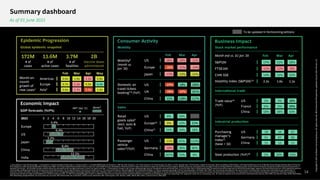
across companies and industries as organizations struggled to find
new ways to connect with their customers and employees. Now with
COVID-19 vaccinations and cases controlled in some areas, short- to
medium-term demand spikes are expected, accompanying the
longer-term sustained changes needed to navigate the new world.
WIDE-REACHING IMPLICATIONS OF CHANGES
IN TRAVEL IMPACT MANY INDUSTRIES
The changes in global travel patterns will have broader impacts
throughout organizations worldwide. Leisure and business travel
spending reallocated during the pandemic is starting to return.
Other industries can apply learning from the travel industry, such as
on navigating large demand fluctuations. Companies can also think
about changes to their business travel operating model and ways to
make business travel more sustainable.
1
Sources: WTTC, BCG analysis and case experience
Copyright
©
2021
by
Boston
Consulting
Group.
All
rights
reserved.
BCG
Executive
Perspectives
updated
10
June
2021
Version
2.0
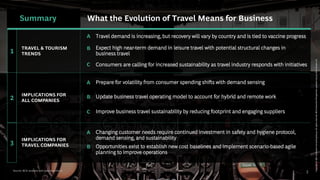
Summary What the Evolution of Travel Means for Business
2
Source: BCG analysis and case experience
TRAVEL & TOURISM
TRENDS
Expect high near-term demand in leisure travel with potential structural changes in
business travel
Consumers are calling for increased sustainability as travel industry responds with initiatives
A
1
Travel demand is increasing, but recovery will vary by country and is tied to vaccine progress
B
C
2
3
IMPLICATIONS FOR
TRAVEL COMPANIES
Prepare for volatility from consumer spending shifts with demand sensing
Update business travel operating model to account for hybrid and remote work
Improve business travel sustainability by reducing footprint and engaging suppliers
IMPLICATIONS FOR
ALL COMPANIES
A
B
C
Changing customer needs require continued investment in safety and hygiene protocol,
demand sensing, and sustainability
Opportunities exist to establish new cost baselines and implement scenario-based agile
planning to improve operations
A
B
Copyright
©
2021
by
Boston
Consulting
Group.
All
rights
reserved.
BCG
Executive
Perspectives
updated
10
June
2021
Version
2.0
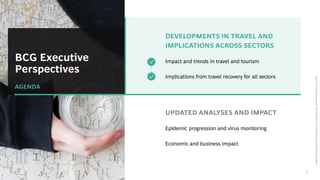
BCG Executive
Perspectives
AGENDA
Copyright
©
2021
by
Boston
Consulting
Group.
All
rights
reserved.
Updated
19
May
2021
Version
11.1.
3
DEVELOPMENTS IN TRAVEL AND
IMPLICATIONS ACROSS SECTORS
Impact and trends in travel and tourism
Implications from travel recovery for all sectors
UPDATED ANALYSES AND IMPACT
Epidemic progression and virus monitoring
Economic and business impact
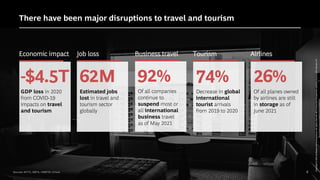
There have been major disruptions to travel and tourism
62M
Estimated jobs
lost in travel and
tourism sector
globally
Job loss
92%
Of all companies
continue to
suspend most or
all international
business travel
as of May 2021
Business travel
74%
Decrease in global
international
tourist arrivals
from 2019 to 2020
Tourism
26%
Of all planes owned
by airlines are still
in storage as of
June 2021
Airlines
Sources: WTTC, GBTA, UNWTO, Cirium
-$4.5T
GDP loss in 2020
from COVID-19
impacts on travel
and tourism
Economic impact
4
Copyright
©
2021
by
Boston
Consulting
Group.
All
rights
reserved.
BCG
Executive
Perspectives
updated
10
June
2021
Version
2.0
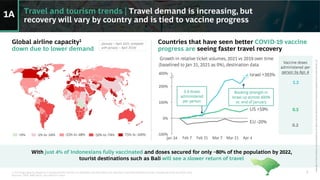
Global airline capacity1
down due to lower demand
Travel and tourism trends | Travel demand is increasing, but
recovery will vary by country and is tied to vaccine progress
1A
(January – April 2021 compared
with January – April 2019)
0%
Feb 21
Jan 24 Feb 7 Mar 7 Mar 21 Apr 4
-100%
100%
200%
400%
Growth in relative ticket volumes, 2021 vs 2019 over time
(baselined to Jan 31, 2021 as 0%), destination data
Israel +393%
US +59%
EU -20%
Booking strength in
Israel up almost 400%
vs. end of January
Countries that have seen better COVID-19 vaccine
progress are seeing faster travel recovery
1.2
0.5
0.2
Vaccine doses
administered per
person by Apr. 4
0.9 doses
administered
per person
With just 4% of Indonesians fully vaccinated and doses secured for only ~80% of the population by 2022,
tourist destinations such as Bali will see a slower return of travel
Copyright
©
2021
by
Boston
Consulting
Group.
All
rights
reserved.
BCG
Executive
Perspectives
updated
10
June
2021
Version
2.0
1. Carrying capacity based on a measurement of ASKs or available seat kilometers for domestic and international arrivals, comparing 2019 and 2021 data
Sources: TRIP, ARC/IATA, Our World in Data
5
1. As of May 2021
Sources: BCG COVID-19-related measures survey of 300+ global companies, TRIP, ARC/IATA, GBTA (April 2021), BCG analysis
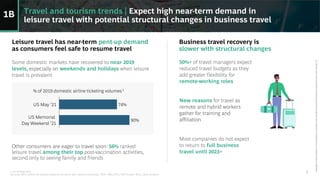
Leisure travel has near-term pent-up demand
as consumers feel safe to resume travel
Travel and tourism trends | Expect high near-term demand in
leisure travel with potential structural changes in business travel
Some domestic markets have recovered to near 2019
levels, especially on weekends and holidays when leisure
travel is prevalent
1B
Business travel recovery is
slower with structural changes
50%+ of travel managers expect
reduced travel budgets as they
add greater flexibility for
remote-working roles
New reasons for travel as
remote and hybrid workers
gather for training and
affiliation
Most companies do not expect
to return to full business
travel until 2023+
74%
90%
% of 2019 domestic airline ticketing volumes1
US May '21
US Memorial
Day Weekend '21
Other consumers are eager to travel soon: 56% ranked
leisure travel among their top post-vaccination activities,
second only to seeing family and friends
Copyright
©
2021
by
Boston
Consulting
Group.
All
rights
reserved.
BCG
Executive
Perspectives
updated
10
June
2021
Version
2.0
6
Sources: SCI Verker Gmbh, American Express Global Travel Trends Report (March 2021), press search, CLIA
Travel and tourism trends | Consumers are calling for increased
sustainability as travel industry responds with initiatives
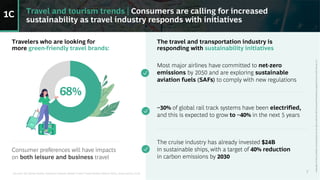
Consumer preferences will have impacts
on both leisure and business travel
7
Most major airlines have committed to net-zero
emissions by 2050 and are exploring sustainable
aviation fuels (SAFs) to comply with new regulations
Travelers who are looking for
more green-friendly travel brands:
The travel and transportation industry is
responding with sustainability initiatives
68%
~30% of global rail track systems have been electrified,
and this is expected to grow to ~40% in the next 5 years
The cruise industry has already invested $24B
in sustainable ships, with a target of 40% reduction
in carbon emissions by 2030
1C
Copyright
©
2021
by
Boston
Consulting
Group.
All
rights
reserved.
BCG
Executive
Perspectives
updated
10
June
2021
Version
2.0
2A Implications for all companies | Prepare for volatility
from consumer spending shifts with demand sensing
Consumer
spending
shifts
Demand
sensing
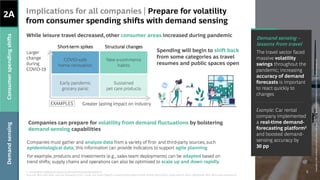
Demand sensing –
lessons from travel
The travel sector faced
massive volatility
swings throughout the
pandemic; increasing
accuracy of demand
forecasts is important
to react quickly to
changes
Example: Car rental
company implemented
a real-time demand-
forecasting platform1
and boosted demand-
sensing accuracy by
30 pp
1. Using BCG Lighthouse real-time demand-forecasting platform
Sources: BCG and Skift, How the Disruption of Air, Cruise, and Hotel Capacity Created Unique Opportunities article (April 2021), press search, BCG Lighthouse, BHI, BCG case experience
8
While leisure travel decreased, other consumer areas increased during pandemic
Companies can prepare for volatility from demand fluctuations by bolstering
demand-sensing capabilities
Companies must gather and analyze data from a variety of first- and third-party sources, such
epidemiological data; this information can provide indicators to support agile planning
For example, products and investments (e.g., sales team deployments) can be adapted based on
trend shifts; supply chains and operations can also be optimized to scale up and down rapidly
Spending will begin to shift back
from some categories as travel
resumes and public spaces open
Greater lasting impact on industry
Larger
change
during
COVID-19
New e-commerce
habits
COVID-safe
home renovation
Sustained
pet care products
Early pandemic
grocery panic
Short-term spikes Structural changes
EXAMPLES
Copyright
©
2021
by
Boston
Consulting
Group.
All
rights
reserved.
BCG
Executive
Perspectives
updated
10
June
2021
Version
2.0
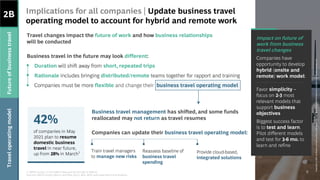
2B Implications for all companies | Update business travel
operating model to account for hybrid and remote work
Future
of
business
travel
Travel
operating
model
1. GBTA survey, (n=457-486 in May and N=253-362 in March)
Sources: GBTA survey (March and May 2021), BHI, BCG case experience and analysis
9
of companies in May
2021 plan to resume
domestic business
travel in near future,
up from 28% in March1
42%
Business travel management has shifted, and some funds
reallocated may not return as travel resumes
Companies can update their business travel operating model:
Train travel managers
to manage new risks
Reassess baseline of
business travel
spending
Provide cloud-based,
integrated solutions
Travel changes impact the future of work and how business relationships
will be conducted
Business travel in the future may look different:
• Duration will shift away from short, repeated trips
• Rationale includes bringing distributed/remote teams together for rapport and training
• Companies must be more flexible and change their business travel operating model
Impact on future of
work from business
travel changes
Companies have
opportunity to develop
hybrid (onsite and
remote) work model:
Favor simplicity –
focus on 2-3 most
relevant models that
support business
objectives
Biggest success factor
is to test and learn.
Pilot different models
and test for 3-6 mo. to
learn and refine
Copyright
©
2021
by
Boston
Consulting
Group.
All
rights
reserved.
BCG
Executive
Perspectives
updated
10
June
2021
Version
2.0
s
2C Implications for all companies | Improve business travel
sustainability by reducing footprint and engaging suppliers
1. Business Travel News (BTN), 2021, Sustainable Business Travel Survey, based on 315 buyer respondents (Feb – Mar, 2021). 2. Travel management companies. 3. Sustainable aviation fuel
Sources: Business Travel News, press search, BCG case experience
Business
travel
sustainability
Supplier
engagement
Sustainability efforts
– examples:
Technology company
shares sustainability
initiatives with
travelers and is
pushing hotels to
provide better data
and emissions
reduction targets
11 large corporations
partnered with a global
airline to accelerate
solutions that
decarbonize aviation
by allowing partners to
pay additional for SAF3
10
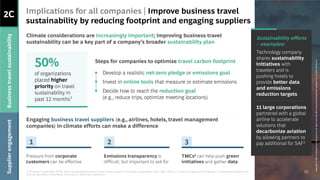
Climate considerations are increasingly important; improving business travel
sustainability can be a key part of a company’s broader sustainability plan
Steps for companies to optimize travel carbon footprint:
• Develop a realistic net-zero pledge or emissions goal
• Invest in online tools that measure or estimate emissions
• Decide how to reach the reduction goal
(e.g., reduce trips, optimize meeting locations)
of organizations
placed higher
priority on travel
sustainability in
past 12 months1
50%
Engaging business travel suppliers (e.g., airlines, hotels, travel management
companies) in climate efforts can make a difference
Emissions transparency is
difficult, but important to ask for
TMCs2 can help push green
initiatives and gather data
Pressure from corporate
customers can be effective
1 2 3
Copyright
©
2021
by
Boston
Consulting
Group.
All
rights
reserved.
BCG
Executive
Perspectives
updated
10
June
2021
Version
2.0
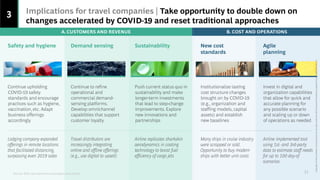
3 Implications for travel companies | Take opportunity to double down on
changes accelerated by COVID-19 and reset traditional approaches
Sources: BCG case experience and analysis, press search
11
Demand sensing
Continue to refine
operational and
commercial demand-
sensing platforms.
Develop omnichannel
capabilities that support
customer loyalty
Travel distributors are
increasingly integrating
online and offline offerings
(e.g., use digital to upsell)
New cost
standards
Institutionalize lasting
cost structure changes
brought on by COVID-19
(e.g., organization and
staffing models, capital
assets) and establish
new baselines
Many ships in cruise industry
were scrapped or sold.
Opportunity to buy modern
ships with better unit costs
Safety and hygiene
Continue upholding
COVID-19 safety
standards and encourage
practices such as hygiene,
vaccination, etc. Adapt
business offerings
accordingly
Lodging company expanded
offerings in remote locations
that facilitated distancing,
surpassing even 2019 sales
Agile
planning
Invest in digital and
organization capabilities
that allow for quick and
accurate planning for
any possible scenario
and scaling up or down
of operations as needed
Airline implemented tool
using 1st- and 3rd-party
data to estimate staff needs
for up to 100 day-of
scenarios
Sustainability
Push current status quo in
sustainability and make
longer-term investments
that lead to step-change
improvements. Explore
new innovations and
partnerships
Airline replicates sharkskin
aerodynamics in coating
technology to boost fuel
efficiency of cargo jets
B. COST AND OPERATIONS
A. CUSTOMERS AND REVENUE
Copyright
©
2021
by
Boston
Consulting
Group.
All
rights
reserved.
BCG
Executive
Perspectives
updated
10
June
2021
Version
2.0
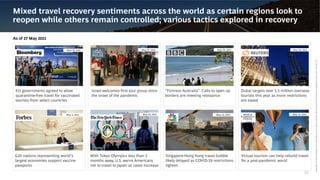
EU governments agreed to allow
quarantine-free travel for vaccinated
tourists from select countries
May 21, 2021
Virtual tourism can help rebuild travel
for a post-pandemic world
"Fortress Australia": Calls to open up
borders are meeting resistance
May 4, 2021
Dubai targets over 5.5 million overseas
tourists this year as more restrictions
are eased
As of 27 May 2021
Singapore-Hong Kong travel bubble
likely delayed as COVID-19 restrictions
tighten
May 14, 2021
Israel welcomes first tour group since
the onset of the pandemic
May 27, 2021
May 19, 2021 May 18, 2021
May 24, 2021
May 26, 2021
Mixed travel recovery sentiments across the world as certain regions look to
reopen while others remain controlled; various tactics explored in recovery
12
With Tokyo Olympics less than 2
months away, U.S. warns Americans
not to travel to Japan as cases increase
G20 nations representing world's
largest economies support vaccine
passports
Copyright
©
2021
by
Boston
Consulting
Group.
All
rights
reserved.
BCG
Executive
Perspectives
updated
10
June
2021
Version
2.0
BCG Executive
Perspectives
AGENDA
13
DEVELOPMENTS IN TRAVEL AND
IMPLICATIONS ACROSS SECTORS
Impact and trends in travel and tourism
Implications from travel recovery for all sectors
UPDATED ANALYSES AND IMPACT
Epidemic progression and virus monitoring
Economic and business impact
Copyright
©
2021
by
Boston
Consulting
Group.
All
rights
reserved.
BCG
Executive
Perspectives
updated
10
June
2021
Version
2.0
Domestic air
travel tickets
booking7,8 (YoY)
As of 01 June 2021
To be updated in forthcoming editions
Consumer Activity
Mobility
Business Impact
Stock market performance
Month end vs. 02 Jan '20
International trade
Volatility Index (S&P500)13
S&P500
FTSE100
Feb Mar Apr
CHN SSE
Trade value14
(YoY)
US
Passenger
vehicle
sales12(YoY)
US
Germany
China
France
China
Steel production (YoY)16
Purchasing
manager’s
index15
(base = 50)
Industrial production
China
US
Germany
1.5x
28%
-8%
12%
Sales
Apr
Feb
-13%
397%
61%
36%
75%
UK
US
China
Mar
2.2x
17%
-15%
14%
2%
0%
56%
51
59
61
5%
1.6x
22%
-12%
12%
26%
52
59
67
16%
113%
90%
9%
2% 18%
29%
51
61
66
-19%
24%
Retail
goods sales9
(excl. auto &
fuel, YoY)
US
Europe10
China11
6%
0%
19%
12%
Mobility6
(month vs.
Jan '20)
US
Europe
Japan
--24%
-12%
-26%
--30%
-17%
-18%
-25%
-12%
-15%
Epidemic Progression
3.7M
# of
fatalities
2B
Vaccine doses
administered
Global epidemic snapshot
172M
# of
cases
13.6M
# of
active cases
Month-on-
month
growth of
new cases2
Americas
Europe
Asia3
Feb
0.6x
0.7x
0.9x
Mar
1.0x
1.3x
1.7x
Apr
1.2x
0.9x
3.3x
34%
3%
1. Calculated as 7-day rolling average; 2. Calculated as monthly average of daily cases vs. previous month; 3. Includes Middle East and Oceania; 4. IMF Apr 2021 forecast; 5. For India, forecast is for financial year; for others, it is for calendar year; YoY forecasts; range from forecasts (where available) of World Bank, International Monetary Fund, JP Morgan Chase; Morgan Stanley; Bank of America;
Fitch Solutions; Credit Suisse; Danske Bank; ING Group; HSBC; As of reports dated 08 June 2020 to Mar 01 2021; For India's GDP forecast, World Bank's 2020 forecast from 08 June provides the upper bound of the forecast range; 6. Mobility values are calculated as the average of mean monthly mobilities in workplace, public transit, retail & recreation, and grocery & pharmacy and compared to a
baseline from 03 Jan – 06 Feb 2020; Europe mobility values are calculated as the average of Germany, France, UK, Spain, and Italy; 7. Calculated as change in last 14 days rolling average value as compared to same period last year; 8. As of 01 Mar 2021; 9. Retail goods sales include online & offline sales and comprise food & beverages, apparel, cosmetics & personal care, home appliances, general
merchandise, building material; do not include auto, fuel & food services; 10. Europe includes 27 countries currently in EU; 11. For China, Jan & Feb are reported together due to National Holidays. 12. Figures represent passenger vehicle (including sedan, hatchback, SUV, MPV, van and pickup) sales data for over same month in previous year; Europe value calculated as cumulative sales in
Germany, France, UK, Spain, and Italy; 13. Underlying data is from Chicago Board Options Exchange Volatility Index (VIX); Volatility Index is a real-time market index that represents the market's expectation of 30-day forward-looking volatility and provides a measure of market risk and investors' sentiments; 14. Calculated as sum of imports and exports, measured in USD and compared to
previous year period; EU trade values between EU and all outside countries 15. PMI (Purchasing Manager's Index) is a diffusion index that summarizes whether market conditions, as viewed by purchasing managers, are expanding (>50), staying the same (50), or contracting (<50); 16. Data corresponds to G-20 countries (minus Indonesia). Sources: JHU CSSE, Our World in Data, WHO, World Bank,
IMF, Bloomberg, Google Mobility, US Census Bureau, Eurostat, PRC National Bureau of Statistics, ACEA actuals, Marklines, ARC ticketing data, STR, Statista, CBOE, OECD, BEA, GACC (customs) China, ONS, BCG
Summary dashboard
189%
157%
-37%
15%
-78%
18%
138%
-47%
May
0.8x
0.4x
1.0x
Economic Impact
GDP forecasts (YoY%)
IMF4 (Apr '21) Banks5
2021
Europe
US
Japan
China
20
0 10 12 14 16 18
8
2 4 6
4.4%
6.4%
India
3.3%
8.4%
12.5%
18%
181%
21%
34% 34%
Copyright
©
2021
by
Boston
Consulting
Group.
All
rights
reserved.
BCG
Executive
Perspectives
updated
10
June
2021
Version
2.0
14
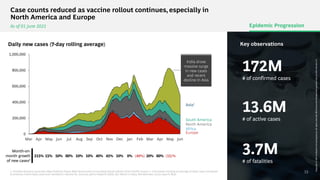
Case counts reduced as vaccine rollout continues, especially in
North America and Europe
As of 01 June 2021
Daily new cases (7-day rolling average)
North
America
South
America
Africa
North
America
215% 15% 50% 60% 10%
Month-on-
month growth
of new cases2
10% 40% 45%
0
200,000
400,000
600,000
800,000
1,000,000
Asia1
Africa
Europe
Apr May Jun Jul Aug Oct
Sep
Mar Nov Dec Jan Feb Mar Apr
10% 0% (40%)
1. Includes Oceania (Australia, New Zealand, Papua New Guinea and surrounding island nations of the Pacific ocean); 2. Calculated monthly as average of daily cases compared
to previous month daily cases and rounded to nearest 5%. Sources: Johns Hopkins CSSE; Our World in Data; Worldometer; press search; BCG
North America
South America
20%
India drove
massive surge
in new cases
and recent
decline in Asia
Key observations
172M
# of confirmed cases
13.6M
# of active cases
3.7M
# of fatalities
Epidemic Progression
May Jun
60% (15)%
Copyright
©
2021
by
Boston
Consulting
Group.
All
rights
reserved.
BCG
Executive
Perspectives
updated
10
June
2021
Version
2.0
15
As of 23 May 2021
Copyright
©
2021
by
Boston
Consulting
Group.
All
rights
reserved.
BCG
Executive
Perspectives
updated
30
April
2021
Version
2.0
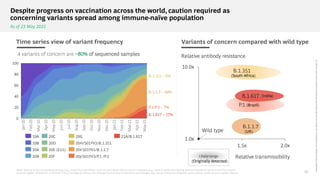
Despite progress on vaccination across the world, caution required as
concerning variants spread among immune-naïve population
4 variants of concern are ~80% of sequenced samples
1.0x
10.0x
1.5x 2.0x
Relative transmissibility
Wild type
Relative antibody resistance
B.1.1.7
B.1.351
B.1.617
P.1
Likely range
Time series view of variant frequency
Note: Several of the concerning variants (e.g., those first identified in the UK and South Africa) share mutations (e.g., N501Y) while also having distinct mutations (some more than others)
Sources: JAMA, Nextstrain, Financial Times, Virological; Centers for Disease Control and Prevention; cov-lineages.org, Lancet Infectious Diseases, press search; Axios variant tracker; Nature
Variants of concern compared with wild type
20A
19A
20B
19B 20H/501YV2/B.1.351
20C
20D
20E (EU1)
21A/B.1.617
20F
20G
20I/501YV1/B.1.1.7
20J/501YV3/P.1 /P.2
100
60
80
20
0
40
Jan-20
Feb-20
Mar-20
Apr-20
May-20
Jun-20
Jul-20
Aug-20
Sep-20
Oct-20
Nov-20
Dec-20
Jan-21
Feb-21
Mar-21
Apr-21
May-21
B.1.617 – 17%
B.1.1.7 – 48%
P.1/P.2 – 7%
B.1.351 – 6% (South Africa)
(India)
(Brazil)
(UK)
(Originally detected)
Copyright
©
2021
by
Boston
Consulting
Group.
All
rights
reserved.
BCG
Executive
Perspectives
updated
10
June
2021
Version
2.0
16
0
500
1,000
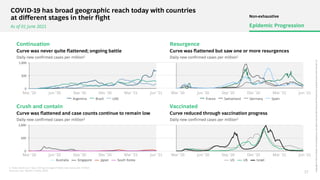
Curve was never quite flattened; ongoing battle
Germany
France Spain
Switzerland
Argentina Brazil UAE
Curve was flattened but saw one or more resurgences
Daily new confirmed cases per million1
Resurgence
Continuation
1. Data shown as 7 day rolling average of daily new cases per million
Sources: Our World in Data; BCG
COVID-19 has broad geographic reach today with countries
at different stages in their fight
As of 01 June 2021
Daily new confirmed cases per million1
Jun ‘20 Sep ‘20 Dec ‘20
Mar ‘20
Non-exhaustive
Epidemic Progression
Jun ‘21
Mar ‘21
Curve was flattened and case counts continue to remain low
Crush and contain
Daily new confirmed cases per million1
Jun ‘20 Sep ‘20 Dec ‘20
Mar ‘20 Jun ‘21
Mar ‘21
0
500
1,000
Jun ‘20 Sep ‘20 Dec ‘20
Mar ‘20 Jun ‘21
Mar ‘21
Singapore
Australia Japan South Korea
Curve reduced through vaccination progress
Vaccinated
Daily new confirmed cases per million1
Israel
US UK
Jun ‘20 Sep ‘20 Dec ‘20
Mar ‘20 Jun ‘21
Mar ‘21
Copyright
©
2021
by
Boston
Consulting
Group.
All
rights
reserved.
BCG
Executive
Perspectives
updated
10
June
2021
Version
2.0
17
US Europe China Japan India1
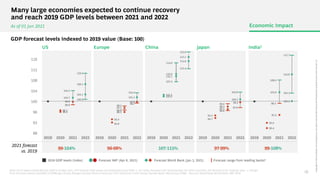
GDP forecast levels indexed to 2019 value (Base: 100)
99-104% 96-98% 107-115% 97-99% 99-108%
2021 forecast
vs. 2019
2019 2020 2021 2022 2019 2020 2021 2022 2019 2020 2021 2022 2019 2020 2021 2022 2019 2020 2021 2022
99.8
110.1
110.9
103.6
97.1
96.2
100
96
104
92
108
112
88
97.5
95.3
98.3
102.7
106.3
103.1
101.3
99.7
116
117.1
115.8
100.7
99.3
110.8
100.2
110.4
100.9
98.8
104.2
98.2
103.4
99.8
107.4
114.6
112.4
122.6
96.6
99.0
103.8
97.6
99.2
108.0
117.7
103.2
92.6
102.3
94.7
90.4
92.0
102.0
95.2
93.4
96.5
96.4
Forecast World Bank (Jan 5, 2021)
Forecast IMF (Apr 6, 2021) Forecast range from leading banks2
2019 GDP levels (Index)
Note: As of reports dated 08 June 2020 to 01 Mar 2021, YoY forecast 2020 values are estimated actual GDP; 1. For India, forecast is for financial year; for other countries, the forecast is for calendar year; 2. Range
from forecasts (where available) of JPMorgan Chase; Morgan Stanley; Bank of America; Fitch Solutions; Credit Suisse; Danske Bank; ING Group; HSBC; Sources: Bloomberg; World Bank; IMF; BCG
Many large economies expected to continue recovery
and reach 2019 GDP levels between 2021 and 2022
As of 01 Jun 2021 Economic Impact
96.8
Copyright
©
2021
by
Boston
Consulting
Group.
All
rights
reserved.
BCG
Executive
Perspectives
updated
10
June
2021
Version
2.0
18
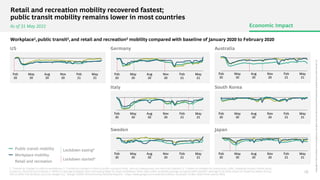
Workplace1, public transit2, and retail and recreation3 mobility compared with baseline of January 2020 to February 2020
1. Tracked as changes in visits to workplaces; 2. Tracked as changes in visits to public transport hubs, such as underground, bus and train stations; 3. Tracked as changes for restaurants, cafés, shopping centers, theme parks,
museums, libraries and cinemas; 4. Refers to average lockdown start and easing dates for larger lockdowns; Note: Data taken as weekly average compared with baseline (average of all daily values of respective weeks during
Feb 15 2020–Feb 28 2021); Sources: Google LLC "Google COVID-19 Community Mobility Reports". https://www.google.com/covid19/mobility/ Accessed: 01 Mar 2020; Press search; BCG
Retail and recreation mobility recovered fastest;
public transit mobility remains lower in most countries
As of 31 May 2021 Economic Impact
Australia
Germany
US
Italy South Korea
Sweden Japan
Retail and recreation
Lockdown started4
Lockdown easing4
Workplace mobility
Public transit mobility
Feb
20
May
20
Aug
20
Nov
20
May
21
Feb
20
May
20
Aug
20
Nov
20
May
21
Aug
20
Feb
20
May
20
May
21
Nov
20
Nov
20
Aug
20
Feb
20
May
21
May
20
Feb
20
May
20
May
21
Aug
20
Nov
20
Feb
20
May
21
May
20
Aug
20
Nov
20
Aug
20
Feb
20
May
20
Nov
20
May
21
Feb
21
Feb
21
Feb
21
Feb
21
Feb
21
Feb
21
Feb
21
Copyright
©
2021
by
Boston
Consulting
Group.
All
rights
reserved.
BCG
Executive
Perspectives
updated
10
June
2021
Version
2.0
19
2
1 1 1 1 1
2 1
2 2
1
1
2
1 1
May
Mar
Apr
Jun
July
Aug
Sep
Oct
Nov
Dec
Jan
Feb
Mar
Apr
May
-6 -8 -9 -7
-3 -2 0
1 3 3 3 5 5 5 4
Apr
Mar
Nov
May
Oct
July
Jun
Aug
Sep
Dec
Jan
Feb
Mar
Apr
May
-5
-8
-12
-10
-5 -3 -2 -1 -1
1 3 4 3
Apr
Mar
July
May
Jun
Feb
Aug
Oct
Sep
Nov
Dec
Jan
Mar
Apr
May
0
-0
.2
-10
-19
-5 -3
2 3 3 4 2 3 5 7 10 11 12
Jun
Mar
Oct
May
Apr
July
Sep
May
Aug
Nov
Dec
Jan
Feb
Mar
Apr
-7
-13
-10
-2
2 4 6 9 10
15 13 12 14
19 16
Mar
Aug
Mar
July
May
Apr
Jun
Sep
Oct
Nov
Dec
Jan
Feb
Apr
May
-5
-16 -13
-5
1 2
6 8 8 8 7 11
17 16 14
Sep
Aug
Apr
Mar
Oct
May
Jun
July
Nov
Dec
Jan
Feb
Mar
Apr
May
Germany
-2
-14
-10
0
1 3 3 3 7 7 9 9 9 11 12
Oct
Sep
Aug
Mar
Apr
May
July
Jun
Nov
Dec
Jan
Feb
Apr
Mar
May
China1
Neutral
level = 50
Italy
Neutral
level = 50
South Korea
Neutral
level = 50
Neutral
level = 50
Neutral
level = 50
Neutral
level = 50
Neutral
level = 50
Japan
Sweden
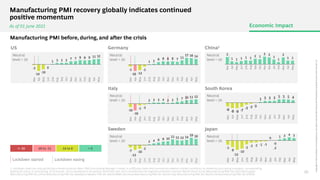
Manufacturing PMI before, during, and after the crisis
US
1. Lockdown dates are only pertaining to Hubei province; Note: PMI (Purchasing Manager's Index) is a diffusion index that summarizes whether market conditions, as viewed by purchasing managers, are expanding,
staying the same, or contracting. 50 is neutral, >50 is considered to be positive sentiment and <50 is considered to be negative sentiment; Sources: Markit South Korea Manufacturing PMI SA; Jibun Bank Japan
Manufacturing PMI SA; China Manufacturing PMI SA; Swedbank Sweden PMI SA; Markit/BME Germany Manufacturing PMI SA; Markit Italy Manufacturing PMI SA; Markit US Manufacturing PMI SA; EIKON
Manufacturing PMI recovery globally indicates continued
positive momentum
As of 01 June 2021 Economic Impact
-29 to -15 -14 to 0 > 0
≤ -30
Lockdown started Lockdown easing
Copyright
©
2021
by
Boston
Consulting
Group.
All
rights
reserved.
BCG
Executive
Perspectives
updated
10
June
2021
Version
2.0
20
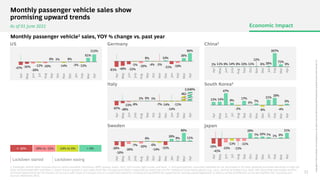
Monthly passenger vehicle sales show
promising upward trends
China2
South Korea3
Japan
Germany
Italy
Sweden
US
May
Sep
-26%
Aug
1%
Apr
Jun
Oct
Jul
Apr
Nov
Dec
Jan
Feb
Mar
-47% -30% -12% -20%
6%
-14%
6%
113%
-3% -13%
61%
Apr
Jun
May
Aug
July
Sep
Nov
Oct
Dec
Jan
10%
Feb
Mar
Apr
11%
1% 11% 9% 6%
14% 9%
12%
28%
397%
75%
9%
21%
13%
Apr
Jul
Oct
May
Jun
Aug
Nov
Sep
Dec
Jan
Feb
Mar
Apr
14%
47%
9%
-2%
17%
0% 7%
-6%
29%
-4%
6%
1%
Nov
Apr
6%
-15%
May
Sep
Jun
Aug
31%
-13%
Jul
Oct
Dec
Jan
Feb
Mar
Apr
-29%
-45%
-23% -15%
7%
29%
7% 10%
Monthly passenger vehicle1 sales, YOY % change vs. past year
-29% to -15% -14% to 0% > 0%
≤ -30%
36%
Nov
90%
Sep
May
Apr
Aug
Jun
July
Oct
Dec
Jan
Feb
Mar
Apr
-61% -49% -32%
-5% -20%
8%
-4% -3%
10%
-31% -19%
Aug
Sep
Oct
Nov
Dec
Jan
Feb
Mar
-7%
-97% -48%
-23%
2% 9% 1%
-14%
-11%
2,646%
Jun
July
Apr
-14%
-8%
May
461
Apr
Oct
Mar
Aug
Jun
Apr
May
July
Nov
Sep
Dec
Jan
Feb
Apr
-35%
-38%
-50%
-26%
-7% -20%
6%
-6%
-14%
26%
9%
86%
11%
As of 01 June 2021
1. Passenger vehicle sales includes data on, where available, hatchback, MPV, pickup, sedan, SUV, mini trucks, light trucks, and vans; 2. Stimulus policies: Launched subsidies for car purchases in 10 cities, lessened purchase restriction in high tier
cities and extended NEV subsidies; 3. South Korea's growth in auto sales from Mar through June 2020 is supported by recent tax cuts for individual consumption goods (e.g., cars), several carmakers (e.g. Audi, VW) launching new models and the
increased appreciation by the Koreans of cars as a safe mode of transport and as a travel alternative for camping during COVID-19, supported by recently passed legislation to allow a variety of different cars to be modified into 'camping cars'
Sources: Marklines; BCG
Economic Impact
Lockdown started Lockdown easing
Copyright
©
2021
by
Boston
Consulting
Group.
All
rights
reserved.
BCG
Executive
Perspectives
updated
10
June
2021
Version
2.0
21
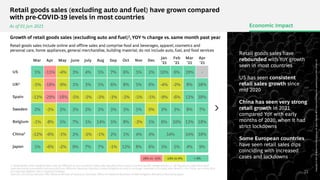
Retail goods sales (excluding auto and fuel) have grown compared
with pre-COVID-19 levels in most countries
Growth of retail goods sales (excluding auto and fuel)1, YOY % change vs. same month past year
Retail goods sales include online and offline sales and comprise food and beverages, apparel, cosmetics and
personal care, home appliances, general merchandise, building material; do not include auto, fuel, and food services
US 1% -15% -4% 3% 4% 5% 7% 6% 5% 2% 10% 6% 19% -
UK2
-5% -18% -9% 1% 3% 5% 6% 8% 5% 6% -4% -2% 8% 38%
Spain -13% -29% -18% -5% -3% -3% -3% -2% -5% -1% -9% -6% 13% 38%
Sweden 2% -3% 2% 3% 2% 2% 3% 3% 5% 0% 2% 3% 8% 7%
Belgium -1% -8% 5% 7% 1% 14% 5% 8% -3% 5% 6% 10% 13% 18%
China3
-12% -6% -1% 2% -2% -1% 2% 1% 4% 4% 34% 34% 18%
Japan 1% -6% -2% 9% 7% 7% -1% 12% 8% 6% 3% 5% 4% 9%
As of 01 Jun 2021
Mar Apr May June July Aug Sep Oct Nov Dec
Jan
'21
Feb
'21
Mar
'21
Apr
'21
1. Retail goods sales categorization may be different across countries; seasonally adjusted values taken; country-specific categorization; 2. UK figures includes total retail
sales excluding automotive fuels sourced from Office for National Statistics United Kingdom as data is no longer reported in Eurostat after Brexit 3. For China, Jan & Feb 2021
are reported together due to national holidays
Sources: US Census Bureau; PRC National Bureau of Statistics; Eurostat; Office for National Statistics United Kingdom; Ministry of Economy Japan
-29% to -15% -14% to 0% > 0%
Retail goods sales have
rebounded with YoY growth
seen in most countries
US has seen consistent
retail sales growth since
mid 2020
China has seen very strong
retail growth in 2021
compared YoY with early
months of 2020, when it had
strict lockdowns
Some European countries
have seen retail sales dips
coinciding with increased
cases and lockdowns
Economic Impact
Copyright
©
2021
by
Boston
Consulting
Group.
All
rights
reserved.
BCG
Executive
Perspectives
updated
10
June
2021
Version
2.0
22
DE-AVERAGED VIEW
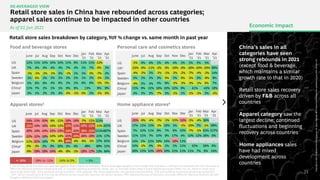
Retail store sales in China have rebounded across categories;
apparel sales continue to be impacted in other countries
As of 01 Jun 2021
June Jul Aug Sep Oct Nov Dec
Jan
'21
Feb
'21
Mar
'21
Apr
'21
US -20% -6% -4% -7% -5% -10% -16% -3% -4% 36% -
UK 17% 13% 13% -3% 16% 5% -1% -16% 7% -5% 69%
Spain 7% 10% 11% 9% 7% 6% 10% -7% -5% 93% 357%
Sweden 15% 15% 7% 10% 9% 17% 4% 10% 12% 26% 9%
Belgium 14% 2% 23% 19% 16% -18% 11% - - - -
China1 10% -2% 4% -3% 1% 5% 11% 43% 39% 6%
Japan 26% 12% 10% -29% 29% 25% 15% 11% 7% 9% 24%
June Jul Aug Sep Oct Nov Dec
Jan
'21
Feb
'21
Mar
'21
Apr
'21
US -1% 4% 4% 5% 4% 4% 5% 5% 2% 5% -
UK2 -23% -9% -11% -2% 0% -16% -9% -36% -20% -20% 68%
Spain -4% -2% 1% -1% -1% -2% -2% -7% -4% -2% 14%
Sweden 3% 1% 2% 3% 0% 1% 0% -3% 2% -6% 8%
Belgium -4% 2% 2% 2% 9% -2% -3% -3% -1% 0% 7%
China1 21% 9% 22% 16% 20% 32% 9% 41% 43% 18%
Japan 3% 1% 2% -7% 3% -1% 1% -1% -5% 2% -2%
Food and beverage stores Personal care and cosmetics stores
Apparel stores3 Home appliance stores4
June Jul Aug Sep Oct Nov Dec
Jan
'21
Feb
'21
Mar
'21
Apr
'21
US 12% 11% 10% 10% 10% 11% 9% 11% 11% -12% -
UK 7% 4% 4% 4% 4% 7% 4% 5% 7% 0% 3%
Spain -1% -1% -3% -1% 2% -1% 5% 1% 0% -7% 2%
Sweden 1% 0% 2% 3% 2% 2% 2% 1% 2% -3% 2%
Belgium 5% 6% 6% 4% 6% 2% 5% 6% 6% -5% 0%
China1 11% 7% 2% 5% 5% 9% 9% 13% 9% 9%
Japan 3% 1% 2% 2% 4% 0% -1% 0% 2% -1% 0%
June Jul Aug Sep Oct Nov Dec
Jan
'21
Feb
'21
Mar
'21
Apr
'21
US -24% -23% -20% -9% -11% -16% -16% -7% -11% 115% -
UK -35% -24% -16% -14% -13% -32% -15% -47% -53% -11% 207%
Spain -29% -24% -24% -23% -23% -34% -22% -36% -35% 111%667%
Sweden -22% -22% -18% -14% -14% -25% -30% -26% -20% 21% 17%
Belgium -11% -25% -16% -7% -8% -48% -4% -6% -5% 57% 91%
China1 0% -3% 2% 6% 10% 5% 4% 48% 69% 31%
Japan -6% -19% -18% -24% -4% -8% -5% -18% -17% 13% 64%
Retail store sales breakdown by category, YoY % change vs. same month in past year
1. For China, Jan & Feb 2021 are reported together due to National Holidays, Food & beverages category only includes food & grains; 2. UK data set switched over from Eurostat to
Office for National Statistics following Brexit. 3. Includes clothing accessories, shoes, etc.; 4. Includes audio video & home appliances stores; Note: For US, share in retail store
sales in Q4 2019: F&B ~25%, personal care & cosmetics ~12%, apparel ~6%, home appliances ~3%, general merchandising ~25% and building material & gardening equipment
~13%. Sector classification & mix may be different across countries; Sources: US Census Bureau; PRC National Bureau of Statistics; Eurostat; Office for National Statistics United
Kingdom, Ministry of Economy Japan
-29% to -15% -14% to 0% > 0%
≤ -30%
China’s sales in all
categories have seen
strong rebounds in 2021
(except food & beverage,
which maintains a similar
growth rate to that in 2020)
Retail store sales recovery
driven by F&B across all
countries
Apparel category saw the
largest decline; continued
fluctuations and beginning
recovery across countries
Home appliances sales
have had mixed
development across
countries
Economic Impact
Copyright
©
2021
by
Boston
Consulting
Group.
All
rights
reserved.
BCG
Executive
Perspectives
updated
10
June
2021
Version
2.0
23
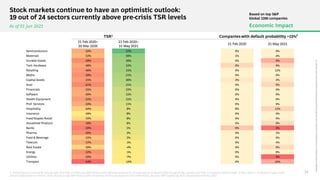
Stock markets continue to have an optimistic outlook:
19 out of 24 sectors currently above pre-crisis TSR levels
As of 01 Jun 2021
Based on top S&P
Global 1200 companies
1. Performance is tracked for two periods, first from 21 February 2020 (before international acceleration of outbreak) to 20 March 2020 (trough of the market) and from 21 February 2020 through 31 May 2021; 2. Implied by 5-year credit
default swap based on median; Note: Based on top S&P Global 1200 companies; sectors are based on GICS definitions; Sources: S&P Capital IQ; BCG ValueScience Center; BCG
Economic Impact
Companies with default probability >15%2
TSR1
21 Feb 2020–
20 Mar 2020
21 Feb 2020–
31 May 2021
21 Feb 2020 31 May 2021
Semiconductors -30% 57% 0% 0%
Materials -32% 39% 5% 4%
Durable Goods -39% 36% 0% 0%
Tech Hardware -26% 32% 0% 0%
Retailing -40% 31% 0% 12%
Media -36% 31% 0% 0%
Capital Goods -35% 26% 2% 2%
Auto -41% 25% 0% 0%
Financials -35% 22% 0% 0%
Software -30% 15% 0% 0%
Health Equipment -31% 15% 0% 0%
Prof. Services -30% 11% 0% 0%
Hospitality -44% 9% 8% 15%
Insurance -39% 8% 0% 0%
Food/Staples Retail -10% 8% 0% 0%
Household Products -16% 6% 0% 0%
Banks -39% 5% 0% 2%
Pharma -20% 3% 0% 5%
Food & Beverage -23% 3% 0% 0%
Telecom -17% -3% 0% 4%
Real Estate -39% -4% 0% 0%
Energy -52% -5% 0% 9%
Utilities -30% -7% 0% 0%
Transport -34% -14% 0% 24%
Copyright
©
2021
by
Boston
Consulting
Group.
All
rights
reserved.
BCG
Executive
Perspectives
updated
10
June
2021
Version
2.0
24
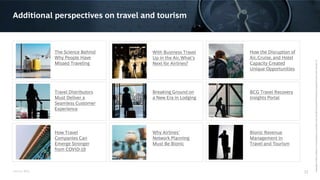
The Science Behind
Why People Have
Missed Traveling
Travel Distributors
Must Deliver a
Seamless Customer
Experience
How Travel
Companies Can
Emerge Stronger
from COVID-19
With Business Travel
Up in the Air, What's
Next for Airlines?
Breaking Ground on
a New Era in Lodging
Why Airlines’
Network Planning
Must Be Bionic
BCG Travel Recovery
Insights Portal
Bionic Revenue
Management in
Travel and Tourism
How the Disruption of
Air, Cruise, and Hotel
Capacity Created
Unique Opportunities
Source: BCG 25
Additional perspectives on travel and tourism
Copyright
©
2021
by
Boston
Consulting
Group.
All
rights
reserved.
BCG
Executive
Perspectives
updated
10
June
2021
Version
2.0
The services and materials provided by Boston Consulting Group (BCG) are subject to BCG's Standard Terms
(a copy of which is available upon request) or such other agreement as may have been previously executed by BCG.
BCG does not provide legal, accounting, or tax advice. The Client is responsible for obtaining independent advice concerning
these matters. This advice may affect the guidance given by BCG. Further, BCG has made no undertaking
to update these materials after the date hereof, notwithstanding that such information may become outdated
or inaccurate.
The materials contained in this presentation are designed for the sole use by the board of directors or senior management of
the Client and solely for the limited purposes described in the presentation. The materials shall not be copied or given to any
person or entity other than the Client (“Third Party”) without the prior written consent of BCG. These materials serve only as
the focus for discussion; they are incomplete without the accompanying oral commentary and may not be relied on as a
stand-alone document. Further, Third Parties may not, and it is unreasonable for any Third Party to, rely on these materials
for any purpose whatsoever. To the fullest extent permitted by law (and except to the extent otherwise agreed in a signed
writing by BCG), BCG shall have no liability whatsoever to any Third Party, and any Third Party hereby waives any rights and
claims it may have at any time against BCG with regard to the services, this presentation, or other materials, including the
accuracy or completeness thereof. Receipt and review of this document shall be deemed agreement with and consideration
for the foregoing.
BCG does not provide fairness opinions or valuations of market transactions, and these materials should not be relied on or
construed as such. Further, the financial evaluations, projected market and financial information, and conclusions contained
in these materials are based upon standard valuation methodologies, are not definitive forecasts, and are not guaranteed by
BCG. BCG has used public and/or confidential data and assumptions provided to BCG by the Client. BCG has not
independently verified the data and assumptions used in these analyses. Changes in the underlying data or operating
assumptions will clearly impact the analyses and conclusions.
The situation surrounding COVID-19 is dynamic and rapidly evolving, on a daily basis. Although we have taken great care
prior to producing this presentation, it represents BCG’s view at a particular point in time. This presentation is not intended
to: (i) constitute medical or safety advice, nor be a substitute for the same; nor (ii) be seen as a formal endorsement or
recommendation of a particular response. As such you are advised to make your own assessment as to the appropriate
course of action to take, using this presentation as guidance. Please carefully consider local laws and guidance in your area,
particularly the most recent advice issued by your local (and national) health authorities, before making any decision.
Disclaimer
Copyright
©
2021
by
Boston
Consulting
Group.
All
rights
reserved.
BCG
Executive
Perspectives
updated
30
April
2021
Version
2.0
26
Executive
Perspectives
29

BCG’s Evolution of Travel: Rethinking Business Travel in a Post-Pandemic World

  • 1.
    Executive Perspectives What the Evolutionof Travel Means for Business June 2021 Executive Perspectives
  • 2.
    BCG Executive Perspectives IN THISDOCUMENT TRAVEL & TOURISM RECOVERING AFTER DIFFICULT YEAR Travel and tourism, including hospitality and leisure, was one of the areas most severely impacted by COVID-19, as lockdowns and travel restrictions slowed activity to a trickle or stopped it altogether. This led to a direct loss of $4.5T in global GDP, and ripple effects were felt across companies and industries as organizations struggled to find new ways to connect with their customers and employees. Now with COVID-19 vaccinations and cases controlled in some areas, short- to medium-term demand spikes are expected, accompanying the longer-term sustained changes needed to navigate the new world. WIDE-REACHING IMPLICATIONS OF CHANGES IN TRAVEL IMPACT MANY INDUSTRIES The changes in global travel patterns will have broader impacts throughout organizations worldwide. Leisure and business travel spending reallocated during the pandemic is starting to return. Other industries can apply learning from the travel industry, such as on navigating large demand fluctuations. Companies can also think about changes to their business travel operating model and ways to make business travel more sustainable. 1 Sources: WTTC, BCG analysis and case experience Copyright © 2021 by Boston Consulting Group. All rights reserved. BCG Executive Perspectives updated 10 June 2021 Version 2.0
  • 3.
    Summary What theEvolution of Travel Means for Business 2 Source: BCG analysis and case experience TRAVEL & TOURISM TRENDS Expect high near-term demand in leisure travel with potential structural changes in business travel Consumers are calling for increased sustainability as travel industry responds with initiatives A 1 Travel demand is increasing, but recovery will vary by country and is tied to vaccine progress B C 2 3 IMPLICATIONS FOR TRAVEL COMPANIES Prepare for volatility from consumer spending shifts with demand sensing Update business travel operating model to account for hybrid and remote work Improve business travel sustainability by reducing footprint and engaging suppliers IMPLICATIONS FOR ALL COMPANIES A B C Changing customer needs require continued investment in safety and hygiene protocol, demand sensing, and sustainability Opportunities exist to establish new cost baselines and implement scenario-based agile planning to improve operations A B Copyright © 2021 by Boston Consulting Group. All rights reserved. BCG Executive Perspectives updated 10 June 2021 Version 2.0
  • 4.
    BCG Executive Perspectives AGENDA Copyright © 2021 by Boston Consulting Group. All rights reserved. Updated 19 May 2021 Version 11.1. 3 DEVELOPMENTS INTRAVEL AND IMPLICATIONS ACROSS SECTORS Impact and trends in travel and tourism Implications from travel recovery for all sectors UPDATED ANALYSES AND IMPACT Epidemic progression and virus monitoring Economic and business impact
  • 5.
    There have beenmajor disruptions to travel and tourism 62M Estimated jobs lost in travel and tourism sector globally Job loss 92% Of all companies continue to suspend most or all international business travel as of May 2021 Business travel 74% Decrease in global international tourist arrivals from 2019 to 2020 Tourism 26% Of all planes owned by airlines are still in storage as of June 2021 Airlines Sources: WTTC, GBTA, UNWTO, Cirium -$4.5T GDP loss in 2020 from COVID-19 impacts on travel and tourism Economic impact 4 Copyright © 2021 by Boston Consulting Group. All rights reserved. BCG Executive Perspectives updated 10 June 2021 Version 2.0
  • 6.
    Global airline capacity1 downdue to lower demand Travel and tourism trends | Travel demand is increasing, but recovery will vary by country and is tied to vaccine progress 1A (January – April 2021 compared with January – April 2019) 0% Feb 21 Jan 24 Feb 7 Mar 7 Mar 21 Apr 4 -100% 100% 200% 400% Growth in relative ticket volumes, 2021 vs 2019 over time (baselined to Jan 31, 2021 as 0%), destination data Israel +393% US +59% EU -20% Booking strength in Israel up almost 400% vs. end of January Countries that have seen better COVID-19 vaccine progress are seeing faster travel recovery 1.2 0.5 0.2 Vaccine doses administered per person by Apr. 4 0.9 doses administered per person With just 4% of Indonesians fully vaccinated and doses secured for only ~80% of the population by 2022, tourist destinations such as Bali will see a slower return of travel Copyright © 2021 by Boston Consulting Group. All rights reserved. BCG Executive Perspectives updated 10 June 2021 Version 2.0 1. Carrying capacity based on a measurement of ASKs or available seat kilometers for domestic and international arrivals, comparing 2019 and 2021 data Sources: TRIP, ARC/IATA, Our World in Data 5
  • 7.
    1. As ofMay 2021 Sources: BCG COVID-19-related measures survey of 300+ global companies, TRIP, ARC/IATA, GBTA (April 2021), BCG analysis Leisure travel has near-term pent-up demand as consumers feel safe to resume travel Travel and tourism trends | Expect high near-term demand in leisure travel with potential structural changes in business travel Some domestic markets have recovered to near 2019 levels, especially on weekends and holidays when leisure travel is prevalent 1B Business travel recovery is slower with structural changes 50%+ of travel managers expect reduced travel budgets as they add greater flexibility for remote-working roles New reasons for travel as remote and hybrid workers gather for training and affiliation Most companies do not expect to return to full business travel until 2023+ 74% 90% % of 2019 domestic airline ticketing volumes1 US May '21 US Memorial Day Weekend '21 Other consumers are eager to travel soon: 56% ranked leisure travel among their top post-vaccination activities, second only to seeing family and friends Copyright © 2021 by Boston Consulting Group. All rights reserved. BCG Executive Perspectives updated 10 June 2021 Version 2.0 6
  • 8.
    Sources: SCI VerkerGmbh, American Express Global Travel Trends Report (March 2021), press search, CLIA Travel and tourism trends | Consumers are calling for increased sustainability as travel industry responds with initiatives Consumer preferences will have impacts on both leisure and business travel 7 Most major airlines have committed to net-zero emissions by 2050 and are exploring sustainable aviation fuels (SAFs) to comply with new regulations Travelers who are looking for more green-friendly travel brands: The travel and transportation industry is responding with sustainability initiatives 68% ~30% of global rail track systems have been electrified, and this is expected to grow to ~40% in the next 5 years The cruise industry has already invested $24B in sustainable ships, with a target of 40% reduction in carbon emissions by 2030 1C Copyright © 2021 by Boston Consulting Group. All rights reserved. BCG Executive Perspectives updated 10 June 2021 Version 2.0
  • 9.
    2A Implications forall companies | Prepare for volatility from consumer spending shifts with demand sensing Consumer spending shifts Demand sensing Demand sensing – lessons from travel The travel sector faced massive volatility swings throughout the pandemic; increasing accuracy of demand forecasts is important to react quickly to changes Example: Car rental company implemented a real-time demand- forecasting platform1 and boosted demand- sensing accuracy by 30 pp 1. Using BCG Lighthouse real-time demand-forecasting platform Sources: BCG and Skift, How the Disruption of Air, Cruise, and Hotel Capacity Created Unique Opportunities article (April 2021), press search, BCG Lighthouse, BHI, BCG case experience 8 While leisure travel decreased, other consumer areas increased during pandemic Companies can prepare for volatility from demand fluctuations by bolstering demand-sensing capabilities Companies must gather and analyze data from a variety of first- and third-party sources, such epidemiological data; this information can provide indicators to support agile planning For example, products and investments (e.g., sales team deployments) can be adapted based on trend shifts; supply chains and operations can also be optimized to scale up and down rapidly Spending will begin to shift back from some categories as travel resumes and public spaces open Greater lasting impact on industry Larger change during COVID-19 New e-commerce habits COVID-safe home renovation Sustained pet care products Early pandemic grocery panic Short-term spikes Structural changes EXAMPLES Copyright © 2021 by Boston Consulting Group. All rights reserved. BCG Executive Perspectives updated 10 June 2021 Version 2.0
  • 10.
    2B Implications forall companies | Update business travel operating model to account for hybrid and remote work Future of business travel Travel operating model 1. GBTA survey, (n=457-486 in May and N=253-362 in March) Sources: GBTA survey (March and May 2021), BHI, BCG case experience and analysis 9 of companies in May 2021 plan to resume domestic business travel in near future, up from 28% in March1 42% Business travel management has shifted, and some funds reallocated may not return as travel resumes Companies can update their business travel operating model: Train travel managers to manage new risks Reassess baseline of business travel spending Provide cloud-based, integrated solutions Travel changes impact the future of work and how business relationships will be conducted Business travel in the future may look different: • Duration will shift away from short, repeated trips • Rationale includes bringing distributed/remote teams together for rapport and training • Companies must be more flexible and change their business travel operating model Impact on future of work from business travel changes Companies have opportunity to develop hybrid (onsite and remote) work model: Favor simplicity – focus on 2-3 most relevant models that support business objectives Biggest success factor is to test and learn. Pilot different models and test for 3-6 mo. to learn and refine Copyright © 2021 by Boston Consulting Group. All rights reserved. BCG Executive Perspectives updated 10 June 2021 Version 2.0
  • 11.
    s 2C Implications forall companies | Improve business travel sustainability by reducing footprint and engaging suppliers 1. Business Travel News (BTN), 2021, Sustainable Business Travel Survey, based on 315 buyer respondents (Feb – Mar, 2021). 2. Travel management companies. 3. Sustainable aviation fuel Sources: Business Travel News, press search, BCG case experience Business travel sustainability Supplier engagement Sustainability efforts – examples: Technology company shares sustainability initiatives with travelers and is pushing hotels to provide better data and emissions reduction targets 11 large corporations partnered with a global airline to accelerate solutions that decarbonize aviation by allowing partners to pay additional for SAF3 10 Climate considerations are increasingly important; improving business travel sustainability can be a key part of a company’s broader sustainability plan Steps for companies to optimize travel carbon footprint: • Develop a realistic net-zero pledge or emissions goal • Invest in online tools that measure or estimate emissions • Decide how to reach the reduction goal (e.g., reduce trips, optimize meeting locations) of organizations placed higher priority on travel sustainability in past 12 months1 50% Engaging business travel suppliers (e.g., airlines, hotels, travel management companies) in climate efforts can make a difference Emissions transparency is difficult, but important to ask for TMCs2 can help push green initiatives and gather data Pressure from corporate customers can be effective 1 2 3 Copyright © 2021 by Boston Consulting Group. All rights reserved. BCG Executive Perspectives updated 10 June 2021 Version 2.0
  • 12.
    3 Implications fortravel companies | Take opportunity to double down on changes accelerated by COVID-19 and reset traditional approaches Sources: BCG case experience and analysis, press search 11 Demand sensing Continue to refine operational and commercial demand- sensing platforms. Develop omnichannel capabilities that support customer loyalty Travel distributors are increasingly integrating online and offline offerings (e.g., use digital to upsell) New cost standards Institutionalize lasting cost structure changes brought on by COVID-19 (e.g., organization and staffing models, capital assets) and establish new baselines Many ships in cruise industry were scrapped or sold. Opportunity to buy modern ships with better unit costs Safety and hygiene Continue upholding COVID-19 safety standards and encourage practices such as hygiene, vaccination, etc. Adapt business offerings accordingly Lodging company expanded offerings in remote locations that facilitated distancing, surpassing even 2019 sales Agile planning Invest in digital and organization capabilities that allow for quick and accurate planning for any possible scenario and scaling up or down of operations as needed Airline implemented tool using 1st- and 3rd-party data to estimate staff needs for up to 100 day-of scenarios Sustainability Push current status quo in sustainability and make longer-term investments that lead to step-change improvements. Explore new innovations and partnerships Airline replicates sharkskin aerodynamics in coating technology to boost fuel efficiency of cargo jets B. COST AND OPERATIONS A. CUSTOMERS AND REVENUE Copyright © 2021 by Boston Consulting Group. All rights reserved. BCG Executive Perspectives updated 10 June 2021 Version 2.0
  • 13.
    EU governments agreedto allow quarantine-free travel for vaccinated tourists from select countries May 21, 2021 Virtual tourism can help rebuild travel for a post-pandemic world "Fortress Australia": Calls to open up borders are meeting resistance May 4, 2021 Dubai targets over 5.5 million overseas tourists this year as more restrictions are eased As of 27 May 2021 Singapore-Hong Kong travel bubble likely delayed as COVID-19 restrictions tighten May 14, 2021 Israel welcomes first tour group since the onset of the pandemic May 27, 2021 May 19, 2021 May 18, 2021 May 24, 2021 May 26, 2021 Mixed travel recovery sentiments across the world as certain regions look to reopen while others remain controlled; various tactics explored in recovery 12 With Tokyo Olympics less than 2 months away, U.S. warns Americans not to travel to Japan as cases increase G20 nations representing world's largest economies support vaccine passports Copyright © 2021 by Boston Consulting Group. All rights reserved. BCG Executive Perspectives updated 10 June 2021 Version 2.0
  • 14.
    BCG Executive Perspectives AGENDA 13 DEVELOPMENTS INTRAVEL AND IMPLICATIONS ACROSS SECTORS Impact and trends in travel and tourism Implications from travel recovery for all sectors UPDATED ANALYSES AND IMPACT Epidemic progression and virus monitoring Economic and business impact Copyright © 2021 by Boston Consulting Group. All rights reserved. BCG Executive Perspectives updated 10 June 2021 Version 2.0
  • 15.
    Domestic air travel tickets booking7,8(YoY) As of 01 June 2021 To be updated in forthcoming editions Consumer Activity Mobility Business Impact Stock market performance Month end vs. 02 Jan '20 International trade Volatility Index (S&P500)13 S&P500 FTSE100 Feb Mar Apr CHN SSE Trade value14 (YoY) US Passenger vehicle sales12(YoY) US Germany China France China Steel production (YoY)16 Purchasing manager’s index15 (base = 50) Industrial production China US Germany 1.5x 28% -8% 12% Sales Apr Feb -13% 397% 61% 36% 75% UK US China Mar 2.2x 17% -15% 14% 2% 0% 56% 51 59 61 5% 1.6x 22% -12% 12% 26% 52 59 67 16% 113% 90% 9% 2% 18% 29% 51 61 66 -19% 24% Retail goods sales9 (excl. auto & fuel, YoY) US Europe10 China11 6% 0% 19% 12% Mobility6 (month vs. Jan '20) US Europe Japan --24% -12% -26% --30% -17% -18% -25% -12% -15% Epidemic Progression 3.7M # of fatalities 2B Vaccine doses administered Global epidemic snapshot 172M # of cases 13.6M # of active cases Month-on- month growth of new cases2 Americas Europe Asia3 Feb 0.6x 0.7x 0.9x Mar 1.0x 1.3x 1.7x Apr 1.2x 0.9x 3.3x 34% 3% 1. Calculated as 7-day rolling average; 2. Calculated as monthly average of daily cases vs. previous month; 3. Includes Middle East and Oceania; 4. IMF Apr 2021 forecast; 5. For India, forecast is for financial year; for others, it is for calendar year; YoY forecasts; range from forecasts (where available) of World Bank, International Monetary Fund, JP Morgan Chase; Morgan Stanley; Bank of America; Fitch Solutions; Credit Suisse; Danske Bank; ING Group; HSBC; As of reports dated 08 June 2020 to Mar 01 2021; For India's GDP forecast, World Bank's 2020 forecast from 08 June provides the upper bound of the forecast range; 6. Mobility values are calculated as the average of mean monthly mobilities in workplace, public transit, retail & recreation, and grocery & pharmacy and compared to a baseline from 03 Jan – 06 Feb 2020; Europe mobility values are calculated as the average of Germany, France, UK, Spain, and Italy; 7. Calculated as change in last 14 days rolling average value as compared to same period last year; 8. As of 01 Mar 2021; 9. Retail goods sales include online & offline sales and comprise food & beverages, apparel, cosmetics & personal care, home appliances, general merchandise, building material; do not include auto, fuel & food services; 10. Europe includes 27 countries currently in EU; 11. For China, Jan & Feb are reported together due to National Holidays. 12. Figures represent passenger vehicle (including sedan, hatchback, SUV, MPV, van and pickup) sales data for over same month in previous year; Europe value calculated as cumulative sales in Germany, France, UK, Spain, and Italy; 13. Underlying data is from Chicago Board Options Exchange Volatility Index (VIX); Volatility Index is a real-time market index that represents the market's expectation of 30-day forward-looking volatility and provides a measure of market risk and investors' sentiments; 14. Calculated as sum of imports and exports, measured in USD and compared to previous year period; EU trade values between EU and all outside countries 15. PMI (Purchasing Manager's Index) is a diffusion index that summarizes whether market conditions, as viewed by purchasing managers, are expanding (>50), staying the same (50), or contracting (<50); 16. Data corresponds to G-20 countries (minus Indonesia). Sources: JHU CSSE, Our World in Data, WHO, World Bank, IMF, Bloomberg, Google Mobility, US Census Bureau, Eurostat, PRC National Bureau of Statistics, ACEA actuals, Marklines, ARC ticketing data, STR, Statista, CBOE, OECD, BEA, GACC (customs) China, ONS, BCG Summary dashboard 189% 157% -37% 15% -78% 18% 138% -47% May 0.8x 0.4x 1.0x Economic Impact GDP forecasts (YoY%) IMF4 (Apr '21) Banks5 2021 Europe US Japan China 20 0 10 12 14 16 18 8 2 4 6 4.4% 6.4% India 3.3% 8.4% 12.5% 18% 181% 21% 34% 34% Copyright © 2021 by Boston Consulting Group. All rights reserved. BCG Executive Perspectives updated 10 June 2021 Version 2.0 14
  • 16.
    Case counts reducedas vaccine rollout continues, especially in North America and Europe As of 01 June 2021 Daily new cases (7-day rolling average) North America South America Africa North America 215% 15% 50% 60% 10% Month-on- month growth of new cases2 10% 40% 45% 0 200,000 400,000 600,000 800,000 1,000,000 Asia1 Africa Europe Apr May Jun Jul Aug Oct Sep Mar Nov Dec Jan Feb Mar Apr 10% 0% (40%) 1. Includes Oceania (Australia, New Zealand, Papua New Guinea and surrounding island nations of the Pacific ocean); 2. Calculated monthly as average of daily cases compared to previous month daily cases and rounded to nearest 5%. Sources: Johns Hopkins CSSE; Our World in Data; Worldometer; press search; BCG North America South America 20% India drove massive surge in new cases and recent decline in Asia Key observations 172M # of confirmed cases 13.6M # of active cases 3.7M # of fatalities Epidemic Progression May Jun 60% (15)% Copyright © 2021 by Boston Consulting Group. All rights reserved. BCG Executive Perspectives updated 10 June 2021 Version 2.0 15
  • 17.
    As of 23May 2021 Copyright © 2021 by Boston Consulting Group. All rights reserved. BCG Executive Perspectives updated 30 April 2021 Version 2.0 Despite progress on vaccination across the world, caution required as concerning variants spread among immune-naïve population 4 variants of concern are ~80% of sequenced samples 1.0x 10.0x 1.5x 2.0x Relative transmissibility Wild type Relative antibody resistance B.1.1.7 B.1.351 B.1.617 P.1 Likely range Time series view of variant frequency Note: Several of the concerning variants (e.g., those first identified in the UK and South Africa) share mutations (e.g., N501Y) while also having distinct mutations (some more than others) Sources: JAMA, Nextstrain, Financial Times, Virological; Centers for Disease Control and Prevention; cov-lineages.org, Lancet Infectious Diseases, press search; Axios variant tracker; Nature Variants of concern compared with wild type 20A 19A 20B 19B 20H/501YV2/B.1.351 20C 20D 20E (EU1) 21A/B.1.617 20F 20G 20I/501YV1/B.1.1.7 20J/501YV3/P.1 /P.2 100 60 80 20 0 40 Jan-20 Feb-20 Mar-20 Apr-20 May-20 Jun-20 Jul-20 Aug-20 Sep-20 Oct-20 Nov-20 Dec-20 Jan-21 Feb-21 Mar-21 Apr-21 May-21 B.1.617 – 17% B.1.1.7 – 48% P.1/P.2 – 7% B.1.351 – 6% (South Africa) (India) (Brazil) (UK) (Originally detected) Copyright © 2021 by Boston Consulting Group. All rights reserved. BCG Executive Perspectives updated 10 June 2021 Version 2.0 16
  • 18.
    0 500 1,000 Curve was neverquite flattened; ongoing battle Germany France Spain Switzerland Argentina Brazil UAE Curve was flattened but saw one or more resurgences Daily new confirmed cases per million1 Resurgence Continuation 1. Data shown as 7 day rolling average of daily new cases per million Sources: Our World in Data; BCG COVID-19 has broad geographic reach today with countries at different stages in their fight As of 01 June 2021 Daily new confirmed cases per million1 Jun ‘20 Sep ‘20 Dec ‘20 Mar ‘20 Non-exhaustive Epidemic Progression Jun ‘21 Mar ‘21 Curve was flattened and case counts continue to remain low Crush and contain Daily new confirmed cases per million1 Jun ‘20 Sep ‘20 Dec ‘20 Mar ‘20 Jun ‘21 Mar ‘21 0 500 1,000 Jun ‘20 Sep ‘20 Dec ‘20 Mar ‘20 Jun ‘21 Mar ‘21 Singapore Australia Japan South Korea Curve reduced through vaccination progress Vaccinated Daily new confirmed cases per million1 Israel US UK Jun ‘20 Sep ‘20 Dec ‘20 Mar ‘20 Jun ‘21 Mar ‘21 Copyright © 2021 by Boston Consulting Group. All rights reserved. BCG Executive Perspectives updated 10 June 2021 Version 2.0 17
  • 19.
    US Europe ChinaJapan India1 GDP forecast levels indexed to 2019 value (Base: 100) 99-104% 96-98% 107-115% 97-99% 99-108% 2021 forecast vs. 2019 2019 2020 2021 2022 2019 2020 2021 2022 2019 2020 2021 2022 2019 2020 2021 2022 2019 2020 2021 2022 99.8 110.1 110.9 103.6 97.1 96.2 100 96 104 92 108 112 88 97.5 95.3 98.3 102.7 106.3 103.1 101.3 99.7 116 117.1 115.8 100.7 99.3 110.8 100.2 110.4 100.9 98.8 104.2 98.2 103.4 99.8 107.4 114.6 112.4 122.6 96.6 99.0 103.8 97.6 99.2 108.0 117.7 103.2 92.6 102.3 94.7 90.4 92.0 102.0 95.2 93.4 96.5 96.4 Forecast World Bank (Jan 5, 2021) Forecast IMF (Apr 6, 2021) Forecast range from leading banks2 2019 GDP levels (Index) Note: As of reports dated 08 June 2020 to 01 Mar 2021, YoY forecast 2020 values are estimated actual GDP; 1. For India, forecast is for financial year; for other countries, the forecast is for calendar year; 2. Range from forecasts (where available) of JPMorgan Chase; Morgan Stanley; Bank of America; Fitch Solutions; Credit Suisse; Danske Bank; ING Group; HSBC; Sources: Bloomberg; World Bank; IMF; BCG Many large economies expected to continue recovery and reach 2019 GDP levels between 2021 and 2022 As of 01 Jun 2021 Economic Impact 96.8 Copyright © 2021 by Boston Consulting Group. All rights reserved. BCG Executive Perspectives updated 10 June 2021 Version 2.0 18
  • 20.
    Workplace1, public transit2,and retail and recreation3 mobility compared with baseline of January 2020 to February 2020 1. Tracked as changes in visits to workplaces; 2. Tracked as changes in visits to public transport hubs, such as underground, bus and train stations; 3. Tracked as changes for restaurants, cafés, shopping centers, theme parks, museums, libraries and cinemas; 4. Refers to average lockdown start and easing dates for larger lockdowns; Note: Data taken as weekly average compared with baseline (average of all daily values of respective weeks during Feb 15 2020–Feb 28 2021); Sources: Google LLC "Google COVID-19 Community Mobility Reports". https://www.google.com/covid19/mobility/ Accessed: 01 Mar 2020; Press search; BCG Retail and recreation mobility recovered fastest; public transit mobility remains lower in most countries As of 31 May 2021 Economic Impact Australia Germany US Italy South Korea Sweden Japan Retail and recreation Lockdown started4 Lockdown easing4 Workplace mobility Public transit mobility Feb 20 May 20 Aug 20 Nov 20 May 21 Feb 20 May 20 Aug 20 Nov 20 May 21 Aug 20 Feb 20 May 20 May 21 Nov 20 Nov 20 Aug 20 Feb 20 May 21 May 20 Feb 20 May 20 May 21 Aug 20 Nov 20 Feb 20 May 21 May 20 Aug 20 Nov 20 Aug 20 Feb 20 May 20 Nov 20 May 21 Feb 21 Feb 21 Feb 21 Feb 21 Feb 21 Feb 21 Feb 21 Copyright © 2021 by Boston Consulting Group. All rights reserved. BCG Executive Perspectives updated 10 June 2021 Version 2.0 19
  • 21.
    2 1 1 11 1 2 1 2 2 1 1 2 1 1 May Mar Apr Jun July Aug Sep Oct Nov Dec Jan Feb Mar Apr May -6 -8 -9 -7 -3 -2 0 1 3 3 3 5 5 5 4 Apr Mar Nov May Oct July Jun Aug Sep Dec Jan Feb Mar Apr May -5 -8 -12 -10 -5 -3 -2 -1 -1 1 3 4 3 Apr Mar July May Jun Feb Aug Oct Sep Nov Dec Jan Mar Apr May 0 -0 .2 -10 -19 -5 -3 2 3 3 4 2 3 5 7 10 11 12 Jun Mar Oct May Apr July Sep May Aug Nov Dec Jan Feb Mar Apr -7 -13 -10 -2 2 4 6 9 10 15 13 12 14 19 16 Mar Aug Mar July May Apr Jun Sep Oct Nov Dec Jan Feb Apr May -5 -16 -13 -5 1 2 6 8 8 8 7 11 17 16 14 Sep Aug Apr Mar Oct May Jun July Nov Dec Jan Feb Mar Apr May Germany -2 -14 -10 0 1 3 3 3 7 7 9 9 9 11 12 Oct Sep Aug Mar Apr May July Jun Nov Dec Jan Feb Apr Mar May China1 Neutral level = 50 Italy Neutral level = 50 South Korea Neutral level = 50 Neutral level = 50 Neutral level = 50 Neutral level = 50 Neutral level = 50 Japan Sweden Manufacturing PMI before, during, and after the crisis US 1. Lockdown dates are only pertaining to Hubei province; Note: PMI (Purchasing Manager's Index) is a diffusion index that summarizes whether market conditions, as viewed by purchasing managers, are expanding, staying the same, or contracting. 50 is neutral, >50 is considered to be positive sentiment and <50 is considered to be negative sentiment; Sources: Markit South Korea Manufacturing PMI SA; Jibun Bank Japan Manufacturing PMI SA; China Manufacturing PMI SA; Swedbank Sweden PMI SA; Markit/BME Germany Manufacturing PMI SA; Markit Italy Manufacturing PMI SA; Markit US Manufacturing PMI SA; EIKON Manufacturing PMI recovery globally indicates continued positive momentum As of 01 June 2021 Economic Impact -29 to -15 -14 to 0 > 0 ≤ -30 Lockdown started Lockdown easing Copyright © 2021 by Boston Consulting Group. All rights reserved. BCG Executive Perspectives updated 10 June 2021 Version 2.0 20
  • 22.
    Monthly passenger vehiclesales show promising upward trends China2 South Korea3 Japan Germany Italy Sweden US May Sep -26% Aug 1% Apr Jun Oct Jul Apr Nov Dec Jan Feb Mar -47% -30% -12% -20% 6% -14% 6% 113% -3% -13% 61% Apr Jun May Aug July Sep Nov Oct Dec Jan 10% Feb Mar Apr 11% 1% 11% 9% 6% 14% 9% 12% 28% 397% 75% 9% 21% 13% Apr Jul Oct May Jun Aug Nov Sep Dec Jan Feb Mar Apr 14% 47% 9% -2% 17% 0% 7% -6% 29% -4% 6% 1% Nov Apr 6% -15% May Sep Jun Aug 31% -13% Jul Oct Dec Jan Feb Mar Apr -29% -45% -23% -15% 7% 29% 7% 10% Monthly passenger vehicle1 sales, YOY % change vs. past year -29% to -15% -14% to 0% > 0% ≤ -30% 36% Nov 90% Sep May Apr Aug Jun July Oct Dec Jan Feb Mar Apr -61% -49% -32% -5% -20% 8% -4% -3% 10% -31% -19% Aug Sep Oct Nov Dec Jan Feb Mar -7% -97% -48% -23% 2% 9% 1% -14% -11% 2,646% Jun July Apr -14% -8% May 461 Apr Oct Mar Aug Jun Apr May July Nov Sep Dec Jan Feb Apr -35% -38% -50% -26% -7% -20% 6% -6% -14% 26% 9% 86% 11% As of 01 June 2021 1. Passenger vehicle sales includes data on, where available, hatchback, MPV, pickup, sedan, SUV, mini trucks, light trucks, and vans; 2. Stimulus policies: Launched subsidies for car purchases in 10 cities, lessened purchase restriction in high tier cities and extended NEV subsidies; 3. South Korea's growth in auto sales from Mar through June 2020 is supported by recent tax cuts for individual consumption goods (e.g., cars), several carmakers (e.g. Audi, VW) launching new models and the increased appreciation by the Koreans of cars as a safe mode of transport and as a travel alternative for camping during COVID-19, supported by recently passed legislation to allow a variety of different cars to be modified into 'camping cars' Sources: Marklines; BCG Economic Impact Lockdown started Lockdown easing Copyright © 2021 by Boston Consulting Group. All rights reserved. BCG Executive Perspectives updated 10 June 2021 Version 2.0 21
  • 23.
    Retail goods sales(excluding auto and fuel) have grown compared with pre-COVID-19 levels in most countries Growth of retail goods sales (excluding auto and fuel)1, YOY % change vs. same month past year Retail goods sales include online and offline sales and comprise food and beverages, apparel, cosmetics and personal care, home appliances, general merchandise, building material; do not include auto, fuel, and food services US 1% -15% -4% 3% 4% 5% 7% 6% 5% 2% 10% 6% 19% - UK2 -5% -18% -9% 1% 3% 5% 6% 8% 5% 6% -4% -2% 8% 38% Spain -13% -29% -18% -5% -3% -3% -3% -2% -5% -1% -9% -6% 13% 38% Sweden 2% -3% 2% 3% 2% 2% 3% 3% 5% 0% 2% 3% 8% 7% Belgium -1% -8% 5% 7% 1% 14% 5% 8% -3% 5% 6% 10% 13% 18% China3 -12% -6% -1% 2% -2% -1% 2% 1% 4% 4% 34% 34% 18% Japan 1% -6% -2% 9% 7% 7% -1% 12% 8% 6% 3% 5% 4% 9% As of 01 Jun 2021 Mar Apr May June July Aug Sep Oct Nov Dec Jan '21 Feb '21 Mar '21 Apr '21 1. Retail goods sales categorization may be different across countries; seasonally adjusted values taken; country-specific categorization; 2. UK figures includes total retail sales excluding automotive fuels sourced from Office for National Statistics United Kingdom as data is no longer reported in Eurostat after Brexit 3. For China, Jan & Feb 2021 are reported together due to national holidays Sources: US Census Bureau; PRC National Bureau of Statistics; Eurostat; Office for National Statistics United Kingdom; Ministry of Economy Japan -29% to -15% -14% to 0% > 0% Retail goods sales have rebounded with YoY growth seen in most countries US has seen consistent retail sales growth since mid 2020 China has seen very strong retail growth in 2021 compared YoY with early months of 2020, when it had strict lockdowns Some European countries have seen retail sales dips coinciding with increased cases and lockdowns Economic Impact Copyright © 2021 by Boston Consulting Group. All rights reserved. BCG Executive Perspectives updated 10 June 2021 Version 2.0 22
  • 24.
    DE-AVERAGED VIEW Retail storesales in China have rebounded across categories; apparel sales continue to be impacted in other countries As of 01 Jun 2021 June Jul Aug Sep Oct Nov Dec Jan '21 Feb '21 Mar '21 Apr '21 US -20% -6% -4% -7% -5% -10% -16% -3% -4% 36% - UK 17% 13% 13% -3% 16% 5% -1% -16% 7% -5% 69% Spain 7% 10% 11% 9% 7% 6% 10% -7% -5% 93% 357% Sweden 15% 15% 7% 10% 9% 17% 4% 10% 12% 26% 9% Belgium 14% 2% 23% 19% 16% -18% 11% - - - - China1 10% -2% 4% -3% 1% 5% 11% 43% 39% 6% Japan 26% 12% 10% -29% 29% 25% 15% 11% 7% 9% 24% June Jul Aug Sep Oct Nov Dec Jan '21 Feb '21 Mar '21 Apr '21 US -1% 4% 4% 5% 4% 4% 5% 5% 2% 5% - UK2 -23% -9% -11% -2% 0% -16% -9% -36% -20% -20% 68% Spain -4% -2% 1% -1% -1% -2% -2% -7% -4% -2% 14% Sweden 3% 1% 2% 3% 0% 1% 0% -3% 2% -6% 8% Belgium -4% 2% 2% 2% 9% -2% -3% -3% -1% 0% 7% China1 21% 9% 22% 16% 20% 32% 9% 41% 43% 18% Japan 3% 1% 2% -7% 3% -1% 1% -1% -5% 2% -2% Food and beverage stores Personal care and cosmetics stores Apparel stores3 Home appliance stores4 June Jul Aug Sep Oct Nov Dec Jan '21 Feb '21 Mar '21 Apr '21 US 12% 11% 10% 10% 10% 11% 9% 11% 11% -12% - UK 7% 4% 4% 4% 4% 7% 4% 5% 7% 0% 3% Spain -1% -1% -3% -1% 2% -1% 5% 1% 0% -7% 2% Sweden 1% 0% 2% 3% 2% 2% 2% 1% 2% -3% 2% Belgium 5% 6% 6% 4% 6% 2% 5% 6% 6% -5% 0% China1 11% 7% 2% 5% 5% 9% 9% 13% 9% 9% Japan 3% 1% 2% 2% 4% 0% -1% 0% 2% -1% 0% June Jul Aug Sep Oct Nov Dec Jan '21 Feb '21 Mar '21 Apr '21 US -24% -23% -20% -9% -11% -16% -16% -7% -11% 115% - UK -35% -24% -16% -14% -13% -32% -15% -47% -53% -11% 207% Spain -29% -24% -24% -23% -23% -34% -22% -36% -35% 111%667% Sweden -22% -22% -18% -14% -14% -25% -30% -26% -20% 21% 17% Belgium -11% -25% -16% -7% -8% -48% -4% -6% -5% 57% 91% China1 0% -3% 2% 6% 10% 5% 4% 48% 69% 31% Japan -6% -19% -18% -24% -4% -8% -5% -18% -17% 13% 64% Retail store sales breakdown by category, YoY % change vs. same month in past year 1. For China, Jan & Feb 2021 are reported together due to National Holidays, Food & beverages category only includes food & grains; 2. UK data set switched over from Eurostat to Office for National Statistics following Brexit. 3. Includes clothing accessories, shoes, etc.; 4. Includes audio video & home appliances stores; Note: For US, share in retail store sales in Q4 2019: F&B ~25%, personal care & cosmetics ~12%, apparel ~6%, home appliances ~3%, general merchandising ~25% and building material & gardening equipment ~13%. Sector classification & mix may be different across countries; Sources: US Census Bureau; PRC National Bureau of Statistics; Eurostat; Office for National Statistics United Kingdom, Ministry of Economy Japan -29% to -15% -14% to 0% > 0% ≤ -30% China’s sales in all categories have seen strong rebounds in 2021 (except food & beverage, which maintains a similar growth rate to that in 2020) Retail store sales recovery driven by F&B across all countries Apparel category saw the largest decline; continued fluctuations and beginning recovery across countries Home appliances sales have had mixed development across countries Economic Impact Copyright © 2021 by Boston Consulting Group. All rights reserved. BCG Executive Perspectives updated 10 June 2021 Version 2.0 23
  • 25.
    Stock markets continueto have an optimistic outlook: 19 out of 24 sectors currently above pre-crisis TSR levels As of 01 Jun 2021 Based on top S&P Global 1200 companies 1. Performance is tracked for two periods, first from 21 February 2020 (before international acceleration of outbreak) to 20 March 2020 (trough of the market) and from 21 February 2020 through 31 May 2021; 2. Implied by 5-year credit default swap based on median; Note: Based on top S&P Global 1200 companies; sectors are based on GICS definitions; Sources: S&P Capital IQ; BCG ValueScience Center; BCG Economic Impact Companies with default probability >15%2 TSR1 21 Feb 2020– 20 Mar 2020 21 Feb 2020– 31 May 2021 21 Feb 2020 31 May 2021 Semiconductors -30% 57% 0% 0% Materials -32% 39% 5% 4% Durable Goods -39% 36% 0% 0% Tech Hardware -26% 32% 0% 0% Retailing -40% 31% 0% 12% Media -36% 31% 0% 0% Capital Goods -35% 26% 2% 2% Auto -41% 25% 0% 0% Financials -35% 22% 0% 0% Software -30% 15% 0% 0% Health Equipment -31% 15% 0% 0% Prof. Services -30% 11% 0% 0% Hospitality -44% 9% 8% 15% Insurance -39% 8% 0% 0% Food/Staples Retail -10% 8% 0% 0% Household Products -16% 6% 0% 0% Banks -39% 5% 0% 2% Pharma -20% 3% 0% 5% Food & Beverage -23% 3% 0% 0% Telecom -17% -3% 0% 4% Real Estate -39% -4% 0% 0% Energy -52% -5% 0% 9% Utilities -30% -7% 0% 0% Transport -34% -14% 0% 24% Copyright © 2021 by Boston Consulting Group. All rights reserved. BCG Executive Perspectives updated 10 June 2021 Version 2.0 24
  • 26.
    The Science Behind WhyPeople Have Missed Traveling Travel Distributors Must Deliver a Seamless Customer Experience How Travel Companies Can Emerge Stronger from COVID-19 With Business Travel Up in the Air, What's Next for Airlines? Breaking Ground on a New Era in Lodging Why Airlines’ Network Planning Must Be Bionic BCG Travel Recovery Insights Portal Bionic Revenue Management in Travel and Tourism How the Disruption of Air, Cruise, and Hotel Capacity Created Unique Opportunities Source: BCG 25 Additional perspectives on travel and tourism Copyright © 2021 by Boston Consulting Group. All rights reserved. BCG Executive Perspectives updated 10 June 2021 Version 2.0
  • 27.
    The services andmaterials provided by Boston Consulting Group (BCG) are subject to BCG's Standard Terms (a copy of which is available upon request) or such other agreement as may have been previously executed by BCG. BCG does not provide legal, accounting, or tax advice. The Client is responsible for obtaining independent advice concerning these matters. This advice may affect the guidance given by BCG. Further, BCG has made no undertaking to update these materials after the date hereof, notwithstanding that such information may become outdated or inaccurate. The materials contained in this presentation are designed for the sole use by the board of directors or senior management of the Client and solely for the limited purposes described in the presentation. The materials shall not be copied or given to any person or entity other than the Client (“Third Party”) without the prior written consent of BCG. These materials serve only as the focus for discussion; they are incomplete without the accompanying oral commentary and may not be relied on as a stand-alone document. Further, Third Parties may not, and it is unreasonable for any Third Party to, rely on these materials for any purpose whatsoever. To the fullest extent permitted by law (and except to the extent otherwise agreed in a signed writing by BCG), BCG shall have no liability whatsoever to any Third Party, and any Third Party hereby waives any rights and claims it may have at any time against BCG with regard to the services, this presentation, or other materials, including the accuracy or completeness thereof. Receipt and review of this document shall be deemed agreement with and consideration for the foregoing. BCG does not provide fairness opinions or valuations of market transactions, and these materials should not be relied on or construed as such. Further, the financial evaluations, projected market and financial information, and conclusions contained in these materials are based upon standard valuation methodologies, are not definitive forecasts, and are not guaranteed by BCG. BCG has used public and/or confidential data and assumptions provided to BCG by the Client. BCG has not independently verified the data and assumptions used in these analyses. Changes in the underlying data or operating assumptions will clearly impact the analyses and conclusions. The situation surrounding COVID-19 is dynamic and rapidly evolving, on a daily basis. Although we have taken great care prior to producing this presentation, it represents BCG’s view at a particular point in time. This presentation is not intended to: (i) constitute medical or safety advice, nor be a substitute for the same; nor (ii) be seen as a formal endorsement or recommendation of a particular response. As such you are advised to make your own assessment as to the appropriate course of action to take, using this presentation as guidance. Please carefully consider local laws and guidance in your area, particularly the most recent advice issued by your local (and national) health authorities, before making any decision. Disclaimer Copyright © 2021 by Boston Consulting Group. All rights reserved. BCG Executive Perspectives updated 30 April 2021 Version 2.0 26
  • 28.