Thefutureof
supplychain
September 2023
kpmg.com
Enter
Foreword
A lot has changed in the world since we
published the previous edition of this report
in 2021. Between the COVID-19 pandemic,
extreme weather events, and multiple
geopolitical disruptions, the world’s supply
chains have been tested in so many ways,
yet many have emerged stronger and more
resilient than ever.
Although many events occurred that we didn’t anticipate,
three themes we predicted would be major concerns for
supply chain leaders did end up being extremely important:
a growing focus on Environmental, Social and Governance
(ESG) commitments; the level of investment in advanced
robotics and automation; and the evolution of the supply
chain workforce. As we look ahead to the next one-to-two
years, we see these themes becoming even more critical.
However, the world is not standing still. Beyond the immediate
changes, in the next three to five years, we expect supply chain
leaders will be thinking about the use of distributed ledger
technologies (DLTs) and digital money (DM) for security and
monitoring of cross-border trade flows; how the supply chains
of entire sectors will change amid technological innovation;
and the potential of the metaverse as a supporting technology.
This report starts by contextualizing the big picture challenges
and opportunities that supply chain leaders are facing, from
building resilience, to incorporating ESG, to future readiness,
and more. It then goes into detail about the six themes
outlined above. We hope you will use this report as a guide
to where you should invest your time and energy now, whilst
preparing to make the most of the emerging trends.This
report draws on the KPMG Future of Supply Chain Survey
conducted in November 2022. We reached out to 300 supply
chain executives globally to ask about future trends in supply
chain operations, and the key opportunities and issues that
companies are prioritizing in the short and long term.
It’s an anxious time in the supply chain world, but an exciting
one as well. Within the function, we are on the verge of a
variety of dramatic technological advances. At the same time,
many of the industries that supply chains support are on the
brink of innovative change. Companies that hope to maintain
a competitive advantage should keep a very close eye on
how technologies are developing, and which innovations they
can embrace.
Wehopeyoufindthisreportas
stimulatingtoreadanddiscuss
aswedidtoresearchandwrite.
Ifyouseesomethingthat
sparksanidea,pleasedon’t
hesitatetogetintouch.We’ll
bedelightedtohelpyouthink
itthrough. PeterLiddell
Global Operations Center of Excellence Lead,
KPMG International, Partner, KPMG Australia
© 2023 Copyright owned by one or more of the KPMG International entities. KPMG International entities provide no services to clients. All rights reserved.
2
The future of supply chain
Foreword Executive summary Current context
Sustainable
supply chains
Advanced
robotics and
automation
Workforce of
the future
Distributed ledger
technologies and
digital money
Sectoral
transformations
Metaverse Conclusion Contacts
Executive
summary
Core themes: one-to-two-year focus................................ 4
Emerging trends: three-to-five-year focus....................... 4
Survey details.................................................................... 4
Chapter1
© 2023 Copyright owned by one or more of the KPMG International entities. KPMG International entities provide no services to clients. All rights reserved.
3
The future of supply chain
Executive summary
Foreword Current context
Sustainable
supply chains
Advanced
robotics and
automation
Workforce of
the future
Distributed ledger
technologies and
digital money
Sectoral
transformations
Metaverse Conclusion Contacts
Core themes: one-to-two-year focus Emerging trends: three-to-five-year focus Survey details
Executive summary
Executive
summary
We begin by exploring
the current context of the
supply chain world and
the issues faced daily by
supply chain leaders.These
challenges range from the
need to build resilience,
to meeting ever-growing
multi-national regulations,
bringing ESG concerns into
supply chain operations,
and preparing for an
unknown future.
We then dive into the three key themes
that supply chain leaders will need to
address in the next year or two, before
exploring three emerging trends that
will likely become front of mind in the
next three-to-five years.
Core themes:
one-to-two-year focus
Chapter 1 ESG
Three years ago, an ESG program was a “nice to
have”
. Now, it is a “must have”
. Between stakeholder
demands and regulatory mandates, ESG goals are
an increasingly important part of doing business.The
supply chain can play a leading role in meeting ESG
expectations.
Chapter 2 Advanced robotics and automation
The supply chain was once highly manual. Now, it’s
increasingly automated, with robots stacking pallets in
the warehouse, and picking and sorting. Algorithms are
planning pickups, and machines are studying years of
results to optimize daily transport routing and future
warehouse operations schedules.
Chapter 3 Workforce of the future
The “rise of the robots” was supposed to put people
out of work. Instead, we are seeing humans and
robots collaborate in new and innovative ways for
more efficient and effective supply chains. Meanwhile,
humans are increasingly turning to more strategic and
value-adding tasks.
Emerging trends:
three-to-five-year focus
Chapter 4 
Distributed ledger technologies and digital money
DLTs, such as blockchain, have largely been viewed as an alternative to
traditional money; however, they may have a more important future as a
guarantor of trust in global supply chains.The ability of DLTs and DM to
provide traceability could see them become enablers of smooth and secure
global commerce.
Chapter 5 Sectoral transformations
Changes faced by different sectors are likely to directly influence their
supply chains. For example, in healthcare and life sciences, precision
medicine appears to be more complex and nuanced to deliver. In retail and
distribution, retailers need to create a seamless experience around a unified
commerce approach. In aerospace and defense, geopolitical issues are
driving greater supply chain scrutiny and the need for advanced technology.
Chapter 6 Metaverse
In the beginning, the metaverse appeared to simply be an immersive
gaming platform. Now we know better. Whatever its entertainment potential,
supply chain leaders are increasingly excited about its prospect as a tool for
designing and monitoring the supply chain, pinpointing weaknesses, and
streamlining services in real time.
Surveydetails
The foundation of this
report is the findings from
the KPMG Future of Supply
Chain Survey conducted in
November 2022.
We surveyed 300 global supply
chain professionals across
industries including retail,
industrials/manufacturing,
healthcare/life sciences, technology,
energy, power and utilities,
and telecommunications.
The questions covered their current
supply chain operations, how they
plan to respond to changes, their
supply chain visibility, their level of
automation, use of the metaverse
and digital twins, and their use of
cryptocurrencies in supply chain
operations. Findings from the
survey are shared throughout
the report.
© 2023 Copyright owned by one or more of the KPMG International entities. KPMG International entities provide no services to clients. All rights reserved.
4
The future of supply chain
Executive summary
Core themes: one-to-two-year focus
Executive summary Emerging trends: three-to-five-year focus Survey details
Foreword Current context
Sustainable
supply chains
Advanced
robotics and
automation
Workforce of
the future
Distributed ledger
technologies and
digital money
Sectoral
transformations
Metaverse Conclusion Contacts
Current
context
Current context.................................................................. 6
Survival and resilience...................................................... 6
Macro mandates...............................................................10
Future ready..................................................................... 12
Conclusion.........................................................................14
Chapter2
© 2023 Copyright owned by one or more of the KPMG International entities. KPMG International entities provide no services to clients. All rights reserved.
5
The future of supply chain
Current context
Foreword Executive summary
Sustainable
supply chains
Advanced
robotics and
automation
Workforce of
the future
Distributed ledger
technologies and
digital money
Sectoral
transformations
Metaverse Conclusion Contacts
Current context Survival and resilience Macro mandates Future ready Conclusion
Currentcontext
Years of supply chain disruption and
variability in customer demand have led
to a feeling of permanent crisis for many
organizations. Many supply chain leaders
don’t believe the rollercoaster will stop
anytime soon.
Amid the complexities, they have three
immediate concerns:
• Survival and resilience
• Macro mandates
• Future ready
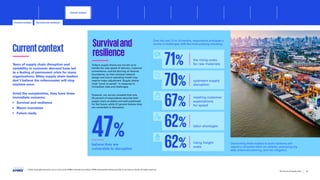
Over the next 12 to 18 months, respondents anticipate a
variety of challenges, with the most pressing including:
Survivaland
resilience
believe they are
vulnerable to disruption
47%
71% the rising costs
for raw materials
62% labor shortages
67%
meeting customer
expectations
for speed
70% upstream supply
disruption
62% rising freight
costs
Today’s supply chains are not set up to
handle the new speed of delivery, customer
convenience, and the blurring of channel
boundaries, so their physical network
design and future operating model may
require major adjustment. Supply chains
must “pivot or perish” in response to
immediate risks and challenges.
However, our survey revealed that only
55 percent of respondents describe their
supply chain as stable and well-positioned
for the future, while 47 percent believe they
are vulnerable to disruption.
© 2023 Copyright owned by one or more of the KPMG International entities. KPMG International entities provide no services to clients. All rights reserved.
6
The future of supply chain
Overcoming these matters to build resilience will
require a concerted effort on visibility, embracing big
data, enhanced planning, and risk mitigation.
Current context
Survival and resilience
Current context
Foreword Executive summary
Sustainable
supply chains
Advanced
robotics and
automation
Workforce of
the future
Distributed ledger
technologies and
digital money
Sectoral
transformations
Metaverse Conclusion Contacts
Macro mandates Future ready Conclusion
Visibility
Extended supply chain
visibility and continuous
monitoring of product
flow supports resilience.
Understanding how products
flow across the value chain,
with forward-looking/
sensing capabilities, is
essential for organizations
that depend on global/
regional complex supply
chains with long lead times,
as well as those exposed to
volatile environments.
This makes it possible to
redeploy goods en route in
response to real-time shifts
in market demand. Our
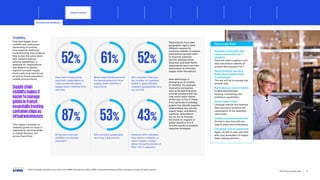
survey found that:
European companies will
need to work withTier 1
suppliers.
They will need to gather more
data and extend visibility of
product flow beyond Tier 1.
North American and Asia
Pacific firms should invest
in technology.
The key will be to process and
analyze data.
Build decision control towers.
Embed sophisticated
sensing, monitoring, and
predictive capabilities.
Create digital twins.
Leverage internal and external
data sources to enhance the
visualization of the extended
value chain.
Collect and disseminate data.
Do this in real time with the
help of alerts and notifications.
Use digital tools to collaborate.
Again, do this in near real time
with your ecosystem of supply
chain trading partners.
How to get there
Respondents from each
geographic region have
different reasons for
pursuing visibility. European
participants typically want
to improve customer
service, whereas North
American and Asia Pacific
respondents want real-time
information to minimize
supply chain disruptions.
New technology is
emerging as an enabler
of visibility. For example,
innovative companies
such as Versed AI already
provide solutions that can
map entire value chains
all the way toTier 4.These
firms generate knowledge
graphs that identify supplier
relationships, key sub-tier
supply flows, and factory
locations. Simulations
can be run to forecast
the knock-on impacts of
global events toTier 4,
and the results of possible
response strategies.
Supplychain
visibilitymakesit
easiertomanage
goodsin-transit,
essentiallytreating
containershipsas
virtualwarehouses.
Over half of executives
said their organization is
more concerned about
supply chain visibility than
last year
52%
87 percent now see
visibility as critically
important
87%
Most respondents consider
the development of more
supply chain visibility a
top priority
61%
53% consider sustainable
sourcing a top priority
53%
52% consider reducing
the number of suppliers
based in geopolitically
unstable geographies as a
top priority
52%
However 43% indicated
they had no visibility, or
were “largely unclear”
about the performance of
their Tier 1 suppliers
43%
© 2023 Copyright owned by one or more of the KPMG International entities. KPMG International entities provide no services to clients. All rights reserved.
7
The future of supply chain
Current context
Survival and resilience
Foreword Executive summary
Sustainable
supply chains
Advanced
robotics and
automation
Workforce of
the future
Distributed ledger
technologies and
digital money
Sectoral
transformations
Metaverse Conclusion Contacts
Current context Macro mandates Future ready Conclusion
Embracing big data for collaboration
Supply chain leaders know they need to gather data,
analyze it, and use the insights to fast-track decisions
and be more responsive to unplanned events and
opportunities. Some companies that we surveyed have
collaborated with manufacturers to track inventory and
fulfilment of orders using the closest warehouse to the
customer to reduce logistics costs.This developed into
a service offering that provides customers and suppliers
with a variety of data uses and applications.This
ranges from data warehousing and smart applications
with predictive capabilities, to clickstream analysis for
improved digital customer experiences and a better
understanding of website performance.
Create a data value proposition.
This should be grounded in business imperatives
that holistically describe the challenges, problems,
or hypotheses that the data will help address.
Build a scalable, flexible, and secure data
architecture.
This should take advantage of technologies
that already influence supply chains, such as
automation, advanced analytics, AI and machine
learning (ML), supply chain control towers, and
Internet ofThings (IoT) devices.
Improve your team’s data fluency.
This requires a culture that respects data and
has developed a capacity for genuine skills
assessment, leadership development, curriculum
design, and tools and data training.
How to get there
Planning and
prediction
Along with supply
chain visibility and
big data, companies
are enthusiastic about
advanced planning
systems and predictive
capabilities. Companies
are investing in predictive
tools that harness big
data to create digitally
enabled and predictive
supply chain networks
with the customer at the
center. Such systems can
better predict customer
demand, improve forecast
accuracy, increase supply
stability, and drive data-
led decision-making.
Refine your internal
planning capability.
Anticipate events that might
disrupt supply and demand.
Drive better, faster planning.
Achieve this through decision
automation, using advanced
analytics supported by AI and
ML, to enable real-time end-to-
end transparency and visibility of
product flows and cost-to-serve
insights.
Model scenarios and simulate
strategic outcomes.
Understand the impact
disruptions, risks, and other
unplanned events could have on
the supply chain.Test changes
to node locations and network
structure/flows, or the impact of
swapping a supplier.
Leverage machine learning.
Automate repetitive decisions so
your team can focus on higher
value-add projects and higher-
level strategy.
Develop multiple sources of
supply for critical raw materials
or products.
Assess near-shoring options to
reduce geographic dependence
and shorten cycle times.
Evolve sourcing strategies that
help drive value for customers.
Collaborate with other
organizations, explore new
international sources, and leverage
local content.
Segment customers and develop
purpose-built supply chain
solutions.
Create interconnected, digitally
enabled, and predictive networks,
with the customer at the center.
Consider additional inventory at
key nodes.
Move from just-in-time (JIT)
to just-in-case (JIC) to protect
against material access issues for
critical components.
Build a contingent labor force.
Ensure this can be scaled up
or down as needed to respond
to disruptions.
How to get there
© 2023 Copyright owned by one or more of the KPMG International entities. KPMG International entities provide no services to clients. All rights reserved.
8
The future of supply chain
Current context
Survival and resilience
Foreword Executive summary
Sustainable
supply chains
Advanced
robotics and
automation
Workforce of
the future
Distributed ledger
technologies and
digital money
Sectoral
transformations
Metaverse Conclusion Contacts
Current context Macro mandates Future ready Conclusion
Mitigate future
supply chain risks
With so much change to
supply chains, including
strategy, structure, new
trading partners and service
providers, new supply chain
and third-party risks such
as cyber, material scarcity,
and geopolitical issues have
emerged.These threats
are likely to continue as
companies operationalize
further changes to suppliers,
adjust their manufacturing
footprint, and implement
new technologies. Mitigating
these risks will require
a multifaceted approach
including advanced
automation and robotics,
predictive capabilities,
cyber security, and
supplier engagement and
industry collaboration.
Mitigating
cyber risks
Scan here
and listen to our
latest podcasts
Extend the supply chain risk strategy.
Reach the broader value chain ecosystem of partners to
ensure threats are managed as widely as possible.This
may include a broader assessment of geographic, financial,
operational, workforce, brand, and regulatory risks.
Consider adopting AI or ML as part of the standard
onboarding process of new suppliers.
Automation can help identify supply chain risks and
potential threats. Provide real-time notifications and updates
on factors that may affect the supply chain.
Ensure cyber risk mitigation strategies keep pace with
new technology.
Some organizations have added IoT devices to enhance
warehouse operations without being vetted for cyber
vulnerability. Any new parties in the supply chain must
undergo appropriate cyber risk assessment.
Deploy a consistent approach to risk management.
This should ensure consistency in language and common
ways of talking about supply chain risk. What is “critical” can
mean different things to different people and functions.
Collaborate across the value chain to share insights
and innovate.
Participate in industry sharing sessions, treat stakeholders
and suppliers as partners to collaborate on solutions,
drive collective approaches in areas of mutual benefit,
and focus on building trusted supply chain networks. For
example, consider joining the Cybersecurity Infrastructure
Security Agency’s Shields Up campaign, the Minerals
Security Partnership, and Intel and/or ASML
’s semiconductor
technology collaboration.
How to get there
© 2023 Copyright owned by one or more of the KPMG International entities. KPMG International entities provide no services to clients. All rights reserved.
9
The future of supply chain
Current context
Survival and resilience
Foreword Executive summary
Sustainable
supply chains
Advanced
robotics and
automation
Workforce of
the future
Distributed ledger
technologies and
digital money
Sectoral
transformations
Metaverse Conclusion Contacts
Current context Macro mandates Future ready Conclusion
Macro
mandates
Macroeconomic and
macroenvironmental factors
require supply chain leaders
to adapt to new realities such
as geopolitics, regulatory
changes, and ESG mandates.
The manufacturing footprint across
many sectors is also shifting because of
limited access to critical materials, rising
energy prices, and uncertain access to
major supply routes.To protect against
rising geopolitical tensions, supply chain
leaders are pursuing shorter-range supply
sources to create a more secure supply
chain network. Network flows will likely be
reshaped in the next few years by political
alignments and evolving ideologies. Supply
chain leaders may also need to prepare
for even more ambitious sustainability
goals, tighter industry regulation, incoming
multinational tax initiatives, and changing
customer demands.
Cooperate closely.
Work with industry allies and supply chain partners that share your values.
Embrace external supply chain data collection and analysis.
This can be a powerful tool to navigate constant change and disruption.
Look for technological solutions that can monitor changes.
For example, tariffs, regulations, and shipping routes.The right tools can
send alerts to the business with the news and a recommended response.
Closely consider multinational tax implications.
It is vital that supply chain and tax functions come together to avoid
suboptimization and reduce the risk of losing previous gains across tax
and transfer pricing.
How to get there
Prepare for tensions and regulations
Rising geopolitical tensions are likely to affect supply chains as governments pick
where makers of strategic products will and will not conduct business. How and
where items flow, the location of key source/production sites, and selections of
new partners for products and services will depend in part on these larger forces.
Supply chains will need to be reengineered to balance economic advantages
with proximity and reliability of supply. For example,Taiwan Semiconductor
Manufacturing’s (TSMC) decision to build a semi-conductor plant in the US is
likely a good business decision, but it’s also a response to US trade sanctions that
have limitedTSMC’s access to the Chinese market1
.
Supply chain leaders will also need to prepare for new tax regulations (such as
Base Erosion and Profit Shifting (BEPS) 2.0), and new legislation (especially for
precious cargo and dangerous goods).
1
TSMC,TSMC Announces Updates forTSMC Arizona, Dec. 2022
2
BMAS - Supply Chain Act
3
Uyghur Forced Labor Prevention Act | U.S. Customs and Border Protection (cbp.gov)
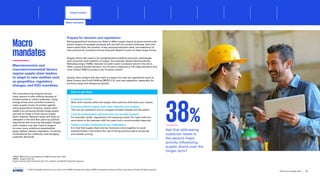
feel that addressing
customer needs is
the second major
priority influencing
supply chains over the
longer term?
38%
© 2023 Copyright owned by one or more of the KPMG International entities. KPMG International entities provide no services to clients. All rights reserved.
10
The future of supply chain
Current context
Macro mandates
Foreword Executive summary
Sustainable
supply chains
Advanced
robotics and
automation
Workforce of
the future
Distributed ledger
technologies and
digital money
Sectoral
transformations
Metaverse Conclusion Contacts
Survival and resilience
Current context Future ready Conclusion
ESG concerns
Supply chain and procurement strategies will likely be heavily
influenced by new corporate ESG initiatives as boards seek
more environmentally and socially acceptable supply chains.
Leaders are under pressure from regulators and investors to
prove organizations are acting responsibly and are responding
to ESG standards and expectations. Regulations such as
Germany’s new supply chain law, Lieferkettengesetz,2
and the
US’s Uyghur Forced Labor Prevention Act3
will likely grow
in importance.To respond to regulations like these, it will
become increasingly important to comprehensively perform
carbon accounting, measure operational KPIs, and deliver
ESG reporting.
Promote wide-ranging product traceability.
Identify the source and distribution channels of
products to ensure full traceability throughout the value
chain, then identify ESG issues and concerns (e.g.,
high-energy-use sites, waste, carbon emissions, plastic
usage, and human rights issues).
Capture real time operational data.
Do this along the supply chain to support
measurement and reporting requirements for ESG
improvement objectives.
Create a decarbonization strategy.
For example, establish a supplier evaluation criterion,
understand partner sustainability credentials, and set a
carbon price for products that have the most impact on
the environment.
How to get there
Design the supply chain to deliver a seamless
customer experience.
Make the brand experience consistent across
different channels.
Maximize customer insights.
Use them to drive supply chain planning and
product/service offering enhancements.
Broaden retail and distribution channels to
respond to growing consumption mechanisms.
Consider how best to get goods into the hands of
consumers.This could mean re-thinking warehouse
and fulfilment locations and ensuring your future
logistics strategy meets customer needs.
Delivering on customer needs
Beyond convenience and price, consumers are choosing
brands that align with their values. Companies must
design their supply chains around customer needs,
starting with the customer first, and focusing on seamless
processes, consistent experiences across channels, and
customer-tailored delivery.
How to get there
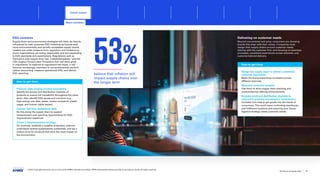
believe that inflation will
impact supply chains over
the longer term
53%
© 2023 Copyright owned by one or more of the KPMG International entities. KPMG International entities provide no services to clients. All rights reserved.
11
The future of supply chain
Current context
Macro mandates
Foreword Executive summary
Sustainable
supply chains
Advanced
robotics and
automation
Workforce of
the future
Distributed ledger
technologies and
digital money
Sectoral
transformations
Metaverse Conclusion Contacts
Survival and resilience
Current context Future ready Conclusion
Acceleration of
digital foundations
Supply chain leaders are
investing in core digital
capabilities that advance the
maturity of the planning team
and set the foundations for
long-term success (e.g., data
and analytics supported by AI
and ML, solutions to manage
warehousing, transportation,
and logistics, and leveraging
automation to improve
workforce outcomes).
There is little debate about the
value of digital investment.
For example, 94 percent of our
survey respondents are optimistic
that digital twins will add value in
supply chain planning by making
supply simulations easier to run.
Future
ready
In our survey, many respondents
expressed concerns about how they
should address emerging issues of global
warming, geopolitical cooling, new
regulatory demands, and the need for
digital transformation.
Many are focused on creating operating model capabilities that
set them up for longer-term success. Leading organizations are
already investing in future readiness through the acceleration
of digital foundations, understanding technology trends, and
automating to unlock value.
4
Gartner Press Release, Gartner Reveals theTop Supply ChainTrends for 2023, May 2023. GARTNER is a registered trademark and service mark of Gartner Inc. and/or its
affiliates in the US and internationally and is used herein with permission. All rights reserved.
Establish a strategy to rapidly automate
your manual supply chain activities.
Fast-track data management capabilities.
Work toward a single view of the customer
and stronger synergies between the front,
middle, and back-office.
Align technology initiatives to make sure
the full investment is realized.
According to Gartner, the last three years of
uncertainty have blurred the lines between
business and technology strategies to the
point that they must be considered together4
.
To avoid significant value loss, merging
strategic, disruptive, and unavoidable
technologies can help to mitigate
underperformance, (e.g., merging digital
supply chain and control tower initiatives).
Develop a roadmap for both emerging and
mature technology solutions.
Digitize manual tasks to become more agile
and responsive.
Advance supply chain risk management.
Allow your supply chain risk management
function to support continuous supply chain
monitoring that uses control towers, planning
systems, supply chain risk management
tools, AI-driven predictive analytics and
advanced track and trace systems to create
visibility and highlight where the organization
has gaps to guide future investment.
How to get there
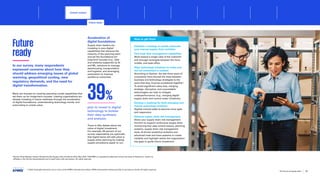
plan to invest in digital
technology to bolster
their data synthesis
and analysis
39%
© 2023 Copyright owned by one or more of the KPMG International entities. KPMG International entities provide no services to clients. All rights reserved.
12
The future of supply chain
Current context
Future ready
Foreword Executive summary
Sustainable
supply chains
Advanced
robotics and
automation
Workforce of
the future
Distributed ledger
technologies and
digital money
Sectoral
transformations
Metaverse Conclusion Contacts
Survival and resilience
Current context Macro mandates Conclusion
Automate to unlock value
Automation isn’t just for reducing inefficiencies; it
can enable the wholesale removal of redundant and
mundane activities from the workforce, making it
possible to do more with less. More importantly,
it can help employees make better decisions and
provide better customer service so that organizations
can further build on value propositions and create a
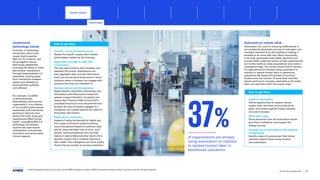
competitive edge. Our survey shows that 37 percent
of organizations are already using automation or
robotics to replace human labor in warehouse
operations. We expect this growth to continue.
Furthermore, the number of automated activities
should continue to increase, applicable to all nodes,
sites, and activities within the supply chain.
of organizations are already
using automation or robotics
to replace human labor in
warehouse operations
37%
Invest in automation.
Define opportunities to replace manual
supply chain activities, drive productivity
gains, and protect against margin squeeze
and cost increases.
Start with a pilot.
Show personnel how the automation works,
give them confidence, and support the
change journey.
Evaluate the overall health of the network
infrastructure.
Identify areas of improvement that further
optimize network flows using robotics
and automation.
How to get there
Understand
technology trends
Evolution in technology
should also inform how
supply chains operate.
Web 3.0, for instance, will
bring together several
technology capabilities,
including the ability to make
peer-to-peer transactions
through decentralization of
ownership, moving away
from interactions between
people and websites to
those between software
and software.
For example, CureDAO
(a permissionless,
decentralized autonomous
organization), is an alliance
of non-profits, governments,
businesses, and individuals
working to discover how
factors like food, drugs and
supplements affect human
health. Leveraging Web 3.0
technology, the alliance
incentivizes open-source
collaboration to accelerate
innovation and democratize
clinical research.
Conduct a cross-functional survey.
Assess the specific supply-chain-related
technologies needed by the business.
Apply bots and apps to help with
e-commerce.
The way users interact with browsers and
websites will evolve. Applications can
help aggregate data, provide informative
links, and recommend showrooms or store
locations where a shopper can engage with
products that they are interested in.
Increase privacy and transparency.
Digital identity, blockchain technology, and
tokenization will likely boost transaction
speeds, support allocation of capital, and
reduce fees.Thanks to Web 3.0 and DLTs,
processes should be more streamlined and
simplify the way all parties engaged in a
transaction are tracked without the need for
third-party intervention.
Deliver AI for customers.
Instead of being bombarded by digital ads
from large ecommerce players pushing
recommendations based on customer data
and AI, users will likely rely on AI to “pull”
specific recommendations from the web
based on data preferences they feed to AI to
develop content that’s uniquely tailored to
their needs.This intelligence can drive supply
chains that are smarter at serving customers.
How to get there
© 2023 Copyright owned by one or more of the KPMG International entities. KPMG International entities provide no services to clients. All rights reserved.
13
The future of supply chain
Current context
Future ready
Foreword Executive summary
Sustainable
supply chains
Advanced
robotics and
automation
Workforce of
the future
Distributed ledger
technologies and
digital money
Sectoral
transformations
Metaverse Conclusion Contacts
Survival and resilience
Current context Macro mandates Conclusion
Conclusion
For the foreseeable future, there will likely be more
disruptions brought on by geopolitical conflicts,
inflationary pressures, the economic environment,
climate change weather events, or other issues yet
to emerge.
However, as we have explored, supply chain leaders can take control
and respond in three ways:
Survival and resilience.
Build end-to-end visibility of the extended value chain,
enhance the supply chain planning function, use big data to
enable collaboration and improve risk management practices
Macro mandates.
Reshape network flows, navigate geopolitical tensions,
address ESG concerns and deliver on evolving
customer needs
Future-readiness.
Accelerate digital foundations, understand and act
upon technology trends, and embed automation in the
supply chain.
As short-term supply chain issues dominate board-level discussions, it
is easy to lose focus on building capability for the longer term. Instead,
act on the lessons learned in recent crises while preparing to respond
to future crises with longer-term strategic thinking.
© 2023 Copyright owned by one or more of the KPMG International entities. KPMG International entities provide no services to clients. All rights reserved.
14
The future of supply chain
Current context
Conclusion
Foreword Executive summary
Sustainable
supply chains
Advanced
robotics and
automation
Workforce of
the future
Distributed ledger
technologies and
digital money
Sectoral
transformations
Metaverse Conclusion Contacts
Survival and resilience
Current context Macro mandates Future ready
Sustainable
supplychains
Sustainable supply chains.............................................. 16
Responsible sourcing...................................................... 16
Due diligence................................................................... 17
Decarbonization............................................................... 18
Circular economy..............................................................19
Human rights in manufacturing and production.......... 20
Technology enabled ESG reporting............................... 22
Conclusion........................................................................ 23
Chapter3
15
The future of supply chain
Sustainable
supply chains
© 2023 Copyright owned by one or more of the KPMG International entities. KPMG International entities provide no services to clients. All rights reserved.
Foreword Executive summary Current context
Advanced
robotics and
automation
Workforce of
the future
Distributed ledger
technologies and
digital money
Sectoral
transformations
Metaverse Conclusion Contacts
Sustainable supply chains Responsible sourcing Due diligence Decarbonization Circular economy Human rights in manufacturing and production Technology enabled ESG reporting Conclusion
Sustainable
supplychains
Shareholders, consumers, and employees
have increasingly high expectations of the
businesses they invest in, buy from, and are
employed by. As a result, business leaders
face more pressure from regulators and the
market to prove that their organizations are
acting responsibly and sustainably.
Many of those Environmental, Social and Governance (ESG)
concerns fall under the purview of the supply chain. It is
inevitable that ESG agendas will affect supply chain and
network designs.
In the next one-to-two years, companies need to be ready to
make substantive advances on the following six fronts:
• Responsible sourcing
• Due diligence
• Decarbonization
• Circular economy
• Human rights in manufacturing and production
• Technology enabled ESG reporting
Responsible
sourcing
Businesses are grappling with
how to respond to growing
demand from regulators,
shareholders, and customers to
ensure what they produce and
procure is free from exploitation.
Underlying the ever-increasing range of human
rights regulations is the UN Guiding Principles
Reporting Framework (UNGP),5
which provides
businesses with a pragmatic framework to
approach responsible sourcing.
5
UN Guiding Principles Reporting Framework
Whatresponsiblesourcing
meansforsupplychainleaders:
Have a clear policy commitment
and framework.
Include guidelines about the role
each actor (staff, suppliers, and
industry associations) can play to
achieve objectives.
Develop a clear supplier code
of conduct that takes ESG into
account.
Include guidelines about how to
apply that code to sub-suppliers.
Take a top-down approach to
embedding your responsible
sourcing strategy.
Leadership support that considers
both risk and impact is required to
embed commitments.
Identify and prioritize material
risks and impact.
Focus on where material ESG
issues are most prevalent in the
supply chain and where you
can have the most influence in
driving change.
Keep people at the center of
your response.
Deeper engagement and
collaboration with government,
NGOs and workers throughout
the supply chain can lead to
greater capability for suppliers
and better outcomes for directly
affected workers. Engagement with
affected stakeholders may prove
challenging if not impossible,
particularly in complex and
extended supply chains. A lack
of first-hand information about
workers’ experiences should be
interpreted as a signal that greater
scrutiny is required.
Create grievance mechanisms
to remedy and prevent future
human rights violations.
Make sure the concerns of
workers can be heard. Establish
remediation frameworks to
remedy prior harm and prevent
future harm.
Measure impact.
Regular monitoring and reporting
of responsible sourcing on
business operations, workers, and
broader communities is key to
driving improvement.
The UNGP demands that companies
undertake a three-part effort that includes:
1. A policy commitment to respect human rights
2. A human rights due diligence process to
identify, prevent, mitigate, and account for
any adverse human rights impact
3. Clear and accessible processes for the
remediation of any human rights violations
plan to increase their
focus on sustainable
sourcing as part of
their future supply
chain strategy
1/3
© 2023 Copyright owned by one or more of the KPMG International entities. KPMG International entities provide no services to clients. All rights reserved.
16
The future of supply chain
Sustainable
supply chains
Responsible sourcing
Sustainable supply chains
Foreword Executive summary Current context
Advanced
robotics and
automation
Workforce of
the future
Distributed ledger
technologies and
digital money
Sectoral
transformations
Metaverse Conclusion Contacts
Circular economy
Due diligence Human rights in manufacturing and production
Decarbonization Technology enabled ESG reporting Conclusion
Due
diligence
Regulations requiring due diligence and
mandatory disclosures have strengthened
over time, with further regulations pending.
(See figure to the right.) New regulations
are requiring companies to assess, identify,
prevent, remedy, and report on human
rights risks.
6
Corporate sustainability reporting (europa.eu)
Directive on Non-financial
Reporting (2014/95/E)
Supply Chain
Act 2021
Forced Labour and Supply
Chain Reporting 2023
Responsible
and Sustainable
International Business
Conduct Bill (draft)
Corporate Sustainability Due
Diligence Directive (draft)
964bi se e t seq. of the
Swiss Code of Obligations
Duty of
Vigilance 2017
Transparency Act 2017
Dodd Frank Act 2010
Modern Slavery Act 2015
Transparency in
Supply Chain Act 2010
Modern Slavery Act
2018
Regulatory
view
Disclosure
o
n
l
y
M
a
n
d
a
t
o
r
y
d
i
s
c
l
o
s
u
r
e
a
n
d
m
a
n
d
a
t
o
r
y
d
i
s
c
l
o
s
u
r
e
r
e
q
u
i
r
e
m
e
n
t
s
a
n
d
m
a
n
datory due diligence
Mandatory disclosure and mandator
y
d
i
s
c
l
o
s
u
r
e
r
e
q
u
i
r
e
m
e
n
t
s
Notablecompliancerequirementsnowmandate:
• Stakeholder engagement (EU).
• Timely responses to public inquiries relating to human rights
practices (Norway).
• Reports on human rights key performance indicators (Canada).
However, obeying the law is only the beginning of truly responsible
sourcing. A process to understand the inherent and residual risks present
in a company’s supply chain should be conducted regularly. Due diligence
should also reflect the company’s understanding of the relative risks that
different suppliers pose. A useful guide to that process is the EU Corporate
Sustainability Reporting Directive (CSRD), adopted by the EU parliament
in November 20226
. CSRD demands detailed sustainability reporting and
expands the companies required to submit sustainability reports, including
many non-EU companies. One requirement is to report on the due diligence
processes implemented to identify actual and potential sustainability issues
in the company’s operations and supply chain.
Establish internal policies and a governance structure.
This needs to support due diligence practices within the supply chain, be
purpose-led to mitigate the risk of harm to people, and be completed at
least annually.
Build transparency across the supply chain.
Achieve this with collaboration with suppliers, and the use of data solutions
like Versed AI to support identification of suppliers down toTier 4.
Monitor the regulatory landscape.
Cover all countries of operations to ensure compliance with regulations as
they come into effect globally.
Integrate due diligence into enterprise risk management (ERM)
processes.
Consider the risks to the rights-holders.
Whatduediligencemeansforsupplychainleaders:
© 2023 Copyright owned by one or more of the KPMG International entities. KPMG International entities provide no services to clients. All rights reserved.
17
The future of supply chain
Sustainable
supply chains
Due diligence
Foreword Executive summary Current context
Advanced
robotics and
automation
Workforce of
the future
Distributed ledger
technologies and
digital money
Sectoral
transformations
Metaverse Conclusion Contacts
Responsible sourcing
Sustainable supply chains Circular economy Human rights in manufacturing and production
Decarbonization Technology enabled ESG reporting Conclusion
Decarbonization
A growing number of organizations have
formally committed to ESG outcomes
through voluntary global standards
such as Science BasedTargets (SBTi) for
emissions reduction.
Many are also working to stay compliant with the regulations
driving greenhouse gas (GHG) emission reductions, like
the CSRD. While Scope 1 and 2 emissions are frequently
monitored and reported, Scope 3 emissions are more complex
to determine.
Many governments are also considering the implementation
of a carbon tax, which could directly affect how organizations
run their supply chains. For example, the Carbon Boarder
Adjustment Mechanism (CBAM) is one of several tax and
carbon reforms proposed as part of the EU’s Green Deal.
7
NHS, Supply Chain Business Plan 2022/2023, July 2022
Manygovernmentsarealsoconsideringthe
implementationofacarbontax,whichcoulddirectly
affecthoworganizationsruntheirsupplychains.
Decarbonization plans will need to
identify the categories, products,
materials and/or countries where risks
are greatest.
Plans will require partnerships with
prioritized suppliers and industry groups
to support a more effective transition
to a lower GHG emission footprint.
Organizations can streamline this by
leveraging the work of other major
buyers, such as government agencies.
The UK’s National Health Service (NHS),
for example, is identifying the source and
distribution channel for 80 percent of its
supplies to map its ESG risks.7
It is also
installing track and trace technologies to
identify opportunities to reduce waste.
Technology can underpin
sustainability strategies.
Leveraging technology can help with
routing products through different logistics
lanes and nodes based on emissions and
carbon footprint.
Data-based insights can drive logistics
and last mile strategy.
Innovative last mile delivery solutions
such as Adiona help supply chain
leaders to create more energy efficient
transport management and route
optimization decisions.
They apply data analytics to optimize
existing delivery fleets and make smarter
use of their resources, redesigning their
distribution networks, or switching from
diesel fuel-based vehicles to electric
vehicles.These insights can drive
consumer choice and price/speed offerings
by providing visibility into how much
carbon is emitted by each delivery option.
Furthermore, there is an opportunity
to bundle deliveries into a service
offering that reduces the firm’s overall
environmental footprint.
Set expectations that suppliers must
deliver strong ESG performance.
Integrate a supplier code of conduct
into the contracting process and provide
suppliers with insights into ESG learning
opportunities. For more strategic suppliers,
consider ESG performance audits and
data-sharing. For critical suppliers,
consider offering direct investment to
drive better ESG performance. It may
prove advantageous to fund the supplier’s
training, contract incentives, or joint
business planning.
Development and collaboration.
To ensure carbon reduction initiatives
reach maximum scale, consider
working with other companies with
common suppliers to pool technical and
financial support.
Whatdecarbonizationmeansforsupplychainleaders:
© 2023 Copyright owned by one or more of the KPMG International entities. KPMG International entities provide no services to clients. All rights reserved.
18
The future of supply chain
Sustainable
supply chains
Decarbonization
Foreword Executive summary Current context
Advanced
robotics and
automation
Workforce of
the future
Distributed ledger
technologies and
digital money
Sectoral
transformations
Metaverse Conclusion Contacts
Responsible sourcing
Sustainable supply chains Circular economy
Due diligence Human rights in manufacturing and production Technology enabled ESG reporting Conclusion
8
Lacy, Peter and Jakob Rutqvist, Waste to Wealth, Published by Accenture Strategy, 2015
9
European Union, Critical raw materials for the EU - EPRS, 2022
10
Trivedi, Shantanu, Sustainable Packaging and Its Importance in Supply Chain, Management Enthusiast, Nov. 2022
11
ACO, Australia’s 2025 National PackagingTargets
12
Circle Economy  KPMG, Circular Metrics for Businesses, Introduction to the CircularTransition Indicators
Framework, Nov. 2021
Circular
economy
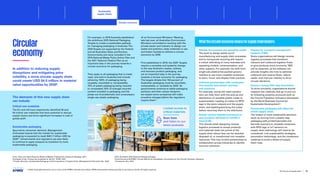
In addition to reducing supply
disruptions and mitigating price
volatility, a more circular supply chain
could create USD $4.5 trillion in material
value opportunities by 20308
.
The elements of this new supply chain
can include:
Critical raw materials
The EU and US have respectively identified 30 and
50 critical raw materials that have potential to disrupt
supply chains and drive significant increases in cost of
goods sold9
.
Sustainable packaging
Spurred by consumer demand, Management
Enthusiast reports that the market for sustainable
packaging is expected to reach $451.7 billion USD by
202810
. Governments and regulators are also likely
to continue to apply pressure to transition to more
sustainable packaging.
Limited access to
critical materials
Scan here
and listen to our
latest podcasts
Rethink the business and operating model.
The push to design waste out of
manufacturing and supply chain processes
and to incorporate recycling will require
a critical rethinking of many business and
operating models, containerization, and
other logistics. For example, the shift from
single-use plastics has pushed grocery
retailers to use more reusable containers
to store, move, and display fresh produce.
Cultivate partnerships with companies
that provide new assets, services,
and solutions.
For example, stores will need vendors
who can help them with the pick-up and
distribution of reusable plastic crates to
supermarkets, tracking of crates via RFID
tags in the store network and the supply
chain, and washing/servicing the crates
before returning them to the distributor.
Design reverse logistics processes to
give products destined for landfill a
second life.
This should entail designing reverse
logistics processes to accept products
and materials back into points of the
supply chain where they can be recycled,
disposed of, or transformed into reusable
resources.This may involve partnerships or
collaboration across industries to identify
common solutions.
Prepare for transport management
systems (TMS).
Some organizations will design reverse
logistics processes that transform
inbound and outbound logistics flows
to give products more circularity.TMS
will be essential, as the software can
provide insights into how to optimize
outbound and reverse flows, reduce
waste, and improve visibility to drive
circular decisions.
Ensure a strong ESG data foundation.
To drive circularity, organizations should
measure the materials that go in and out
by following analytics protocols such as
the CircularTransition Indicators developed
by the World Business Council for
Sustainable Development12
.
Sustainable packaging will affect the
whole supply chain.
The impact of more sustainable solutions
(such as moving from a plastic bag/
packaging with printed barcodes and
barcode scanners to reusable containers
with RFID tags or IoT sensors) on
supply chain technology will need to be
considered. Link sustainability strategies,
automation technology, and the investment
roadmap to build a whole-of-supply-
chain view.
Whatthecirculareconomymeansforsupplychainleaders:
For example, in 2018 Australia established
the ambitious 2025 National Packaging
Targets to create a sustainable pathway
for managing packaging in Australia.The
2025Targets are supported by the Federal
and all Australian State andTerritory
Governments and were included in the
2019 National Waste Policy Action Plan and
the 2021 National Plastics Plan as an
important step in the journey towards a
circular economy for packaging.
They apply to all packaging that is made,
used, and sold in Australia and include
achieving 100% of packaging being
reusable, recyclable or compostable;
70% of plastic packaging being recycled
or composted; 50% of average recycled
content included in packaging and the
phase out of problematic and unnecessary
single-use plastic packaging.
At an Environment Ministers’ Meeting
late last year, all Australian Environment
Ministers committed to working with the
private sector and industry to design out
waste and pollution, keep materials in use,
and foster markets to achieve a circular
economy by 2030.
First established in 2018, the 2025 Targets
require a complete and systemic change
to the way Australia creates, collects,
and recovers product packaging, and
are an important step in the journey
towards a circular economy for packaging.
The targets dictate that 100 percent of
Australian packaging must be recyclable,
compostable, or reusable by 2025. As
governments continue to tackle packaging
pollution and their carbon footprint,
we expect some companies will make
proactive changes before the regulators
require them11
.
© 2023 Copyright owned by one or more of the KPMG International entities. KPMG International entities provide no services to clients. All rights reserved.
19
The future of supply chain
Sustainable
supply chains
Circular economy
Foreword Executive summary Current context
Advanced
robotics and
automation
Workforce of
the future
Distributed ledger
technologies and
digital money
Sectoral
transformations
Metaverse Conclusion Contacts
Responsible sourcing
Sustainable supply chains Due diligence Human rights in manufacturing and production
Decarbonization Technology enabled ESG reporting Conclusion
Humanrightsin
manufacturing
andproduction
Businesses are now expected to ensure
that high standards of human rights,
decent work, and labor rights are upheld
throughout their supply chains, but they
aren’t there yet.
The harvesting of agricultural materials and mining of
minerals are characterized by a range of human rights risks.
This includes the presence of often vulnerable workforces,
poor transparency and regulation in source countries, and
the lack of supplier visibility. At least 22 percent of forced
labor victims work in the harvesting and production of raw
materials, including agriculture, forestry, textiles, mining,
and quarrying, due to a reliance on migrant and base-skill
workers, who are often hired through recruitment agencies
on temporary or informal bases in high-risk geographies.14
New labor risks are also emerging where the mining and
agricultural industries intersect with the transition to
renewable energy – for example, the global increase in
demand for materials such as cobalt for lithium batteries,
primarily from the Democratic Republic of Congo. With
visibility of these areas of supply chains limited, businesses
need to be proactive in identifying and acting to mitigate the
risks of human rights violations.
In addition to resources,
there are also issues in
the areas of low-cost
manufacturing of finished
goods and last mile delivery,
where only low-skilled labor
is required. Some companies
are experimenting with
blockchain as a tracking
device to create more
transparency and reduce
exploitation. Ford, for
example, is partnering
with suppliers and service
providers to implement
blockchain technology to
prevent child labor in cobalt
mining.15
This blockchain
technology facilitates wide-ranging traceability of cobalt
mined in the Democratic Republic of Congo, all along the
supply chain, up to the finished batteries used in Ford’s
electric vehicles.
Vulnerable populations
People whose personal characteristics
or circumstances may make them more
susceptible to harm, and who may face
additional barriers to reporting their
experience of harm such as language, level
of education and literacy, visa insecurity
and disability.
High-risk products
Exploitative labor practices
are more likely in particular
categories of operations
and procurement (including
specific raw materials,
manufacturing, services,
and goods not for resale).
Another risk area is
industries with low barriers
to entry.
High-risk business models
Using offshore centers, contracting,
subcontracting and third-party agents and
business partners such as brokers, agents, and
dealers can create layers between businesses
and their workforce.This limits visibility over
labor practices and is more likely to expose
companies to association with exploitative
treatment of workers.
High-risk geographies
Conditions including
weak rule of law, high
levels of corruption
or conflict, internal
displacement of
people, and high
cross-border migration
expose businesses
to a heightened risk
of modern slavery in
their value chain, as
do business activities
conducted in remote
areas.
13
World Benchmarking Alliance,The SocialTransformation Baseline Assessment 2022
14
Australian Human Rights Commission  KPMG, Property, construction  modern slavery, 2020
15
Baydakova, Anna, Ford, LG to Pilot IBM Blockchain in Fight Against Child Labor, Coin Desk, September 13, 2021
Human rights are at greatest risk in any sector
where one or more of these factors is present:
of forced labor victims
work in the harvesting
and production of raw
materials, including
agriculture, forestry,
textiles, mining,
and quarrying
22%
A recent study by the World
Benchmarking Alliance found
that ~99 percent of 1,000 key
companies across more than 60
countries failed to demonstrate
the fundamentals of socially
responsible business conduct13
99%
© 2023 Copyright owned by one or more of the KPMG International entities. KPMG International entities provide no services to clients. All rights reserved.
20
The future of supply chain
Sustainable
supply chains
Human rights in manufacturing and production
Foreword Executive summary Current context
Advanced
robotics and
automation
Workforce of
the future
Distributed ledger
technologies and
digital money
Sectoral
transformations
Metaverse Conclusion Contacts
Responsible sourcing
Sustainable supply chains Circular economy
Due diligence Decarbonization Technology enabled ESG reporting Conclusion
Identify risk hot spots and
improve traceability.
KPMG has found that the
most significant human rights
risks stem from raw materials,
products, and services imported
from developing countries. Hot
spots include the mining of metals
and minerals for the electronics
industry and renewable energy,
the entire apparel supply chain
– from cotton fields to factories
– and certain food and beverage
ingredients that are typically
produced by small holder farmers,
such as cocoa, tea, coffee,
vanilla, and tropical fruits. In such
supply chains, child labor and
extreme poverty are common,
making input traceability critical.
ChainPoint, Versed AI and other
specialist software providers offer
wide-ranging solutions to trace
raw materials back to the source
for specific sustainability labels.
Furthermore, technologies such as
KPMG Origins and Supply Chain
Predictor provide digital twins
that can add visibility.These tools
should become a core component
not only for managing day-to-day
operations, but to further embed
ESG within a broad range of the
company’s operations.
Leverage AI and data analytics
to tackle ESG at scale.
Data analytics will likely in future
be used to systematically analyze
supplier audit results and predict
which companies may subject
workers to long working hours,
poor environmental management,
and other problems.This insight
should help companies remain
vigilant against potential risks
when onboarding new suppliers.
Likewise, data analytics can help
identify strong supply chain
auditors versus those that are
reluctant to cite a client for non-
compliance, or worse, those
that are corrupt.The application
of advanced analytics to data
captured in real-time can
facilitate longer-term and smarter
management of weak nodes – for
example, by leveraging data to
visualize offshore manufacturing
sites that have started to miss
delivery schedules on days with
abnormally high temperatures.
Such an early warning could
enable the buyer to help the
contractor keep its labor force
cool and get its shipments back
on schedule.
Whathumanrightsriskmeansforsupplychainleaders:
Dataanalyticscanhelp
identifystrongsupply
chainauditorsversus
thosethatarereluctant
tociteaclientfornon-
compliance,orworse,
thosethatarecorrupt.
© 2023 Copyright owned by one or more of the KPMG International entities. KPMG International entities provide no services to clients. All rights reserved.
21
The future of supply chain
Sustainable
supply chains
Human rights in manufacturing and production
Foreword Executive summary Current context
Advanced
robotics and
automation
Workforce of
the future
Distributed ledger
technologies and
digital money
Sectoral
transformations
Metaverse Conclusion Contacts
Responsible sourcing
Sustainable supply chains Circular economy
Due diligence Decarbonization Technology enabled ESG reporting Conclusion
Technologyenabled
ESGreporting
The application of technology in supply
chains will likely be a key factor that creates
transparency to show whether companies
are meeting their ESG goals. Supported
by governance, risk and compliance
(GRC) systems, ESG considerations will
likely be part of every business function.
Together, functions can control, monitor,
and trace performance across wide-ranging
supply chain interactions. A robust GRC
system can create transparency that gives
stakeholders and investors confidence in a
company’s reports.
Now is a good time to find and implement the right
technologies to standardize, rationalize and analyze large
volumes of vendor data. New Scope 3 emissions intelligence
solutions like Avarni can enable supply chain leaders to not
only better manage spend categories, but also provide a
deeper level of supplier emissions calculations, material flow
and transparency to ensure ESG goals can be achieved, and
that progress can be verified.
ERP-supported ESG reports.
The supply chain and procurement functions
will likely be the source of much of the data
generated for measuring and reporting ESG
matters, but they won’t have to carry this
responsibility alone.They need to work with
Finance, HR, IT,Transport, Manufacturing,
and Commercial teams to embed ESG into
both their day-to-day activities and their
long-term strategy.
Distributed ledger technologies.
Ledger-based solutions can be used to
build more transparency and traceability
into supply chains while enabling data
standardization. Longer term, we are
likely to see multiple blockchain platforms
harnessed to support reporting of emissions
through a single blockchain super-platform,
and the creation of a standardized space for
data to be collected and tracked. Companies
can leverage these tools with real time
supply chain data to validate and report
key KPIs.
ESG data traceability.
A strong ESG foundation can allow
companies to effectively pinpoint
sustainability attributes tailored to customer
and consumer needs.
Supply chain visibility.
Traceability can be vital to identifying,
managing, and measuring the most material
ESG issues up and down the value chain.
Visibility also enables a “control tower”
view of the supply chain in real-time to deal
with fast emerging supply chain disruptions.
This tech-enabled visibility can help solve
real supply chain challenges while driving
critical ESG performance improvements.
Advanced data and analytics to identify
risk hot spots in supply chains.
When you systematically analyze your
supplier audit results, you can predict which
risks related to long working hours, poor
environmental management, and other
problems you can expect to find in other
suppliers in the same region. Advanced
data analytics can also help predict supply
chain disruptions due to physical risks from
extreme weather, including floods and
extreme temperatures.
Advanced technology to support
ESG reporting.
From start-ups (Versed AI, Adiona, Avarni,
etc.) to major platform providers (SAP
,
Salesforce, Oracle) technology may vastly
improve the tracking and reporting of
ESG progress.
WhattechnologyenabledESGreportingmeansforsupplychainleaders:
© 2023 Copyright owned by one or more of the KPMG International entities. KPMG International entities provide no services to clients. All rights reserved.
22
The future of supply chain
Sustainable
supply chains
Technology enabled ESG reporting
Foreword Executive summary Current context
Advanced
robotics and
automation
Workforce of
the future
Distributed ledger
technologies and
digital money
Sectoral
transformations
Metaverse Conclusion Contacts
Responsible sourcing
Sustainable supply chains Circular economy
Due diligence Human rights in manufacturing and production
Decarbonization Conclusion
Conclusion
The impact of key strategic supply chain decisions on ESG goals needs
to be understood at the time of the decision.Therefore, the formal supply
chain planning processes will need to include sustainability goals and
initiatives, incorporating the six areas outlined above.To recap, these are:
Responsible sourcing
Ensuring production and
procurement are free
from exploitation
Due diligence
Assurance that businesses
are acting responsibly and
sustainably along the entire
value chain and are compliant
Decarbonization
Committing to a reduction of
carbon emissions from activity
across the supply chain
Circular economy
Creating a closed-loop supply
chain to unlock residual
material value
ESG is now a must-have, not a nice-to-have. Investors, regulators, consumers, and
employees are showing increasing interest in how companies are performing in all
six of these areas. Successful ESG leaders will likely view their interest as a trigger for
greater risk mitigation, and as an opportunity for value creation – a shift that will bring
the supply chain into the heart of ESG strategy.
Human rights in manufacturing
and production
Ensuring that global standards
of human rights, decent work,
and labor rights are upheld
Technology enabled
ESG reporting
Utilizing technology to
create transparency of ESG
goal performance.
ESGisnowamust-have,
notanice-to-have.
© 2023 Copyright owned by one or more of the KPMG International entities. KPMG International entities provide no services to clients. All rights reserved.
23
The future of supply chain
Sustainable
supply chains
Conclusion
Foreword Executive summary Current context
Advanced
robotics and
automation
Workforce of
the future
Distributed ledger
technologies and
digital money
Sectoral
transformations
Metaverse Conclusion Contacts
Responsible sourcing
Sustainable supply chains Circular economy
Due diligence Human rights in manufacturing and production
Decarbonization Technology enabled ESG reporting
Advanced
roboticsand
automation
Advanced robotics and automation............................... 25
Advancing sectors........................................................... 26
Ecosystems of smart devices for efficiency................... 27
Allocating activities for machines and humans............ 27
Rise of the cobots............................................................ 28
Generative AI................................................................... 29
Conclusion........................................................................ 31
Chapter4
© 2023 Copyright owned by one or more of the KPMG International entities. KPMG International entities provide no services to clients. All rights reserved.
24
The future of supply chain
Advanced
robotics and
automation
Foreword Executive summary Current context
Sustainable
supply chains
Workforce of
the future
Distributed ledger
technologies and
digital money
Sectoral
transformations
Metaverse Conclusion Contacts
Advanced robotics and automation Advancing sectors Ecosystems of smart devices for efficiency Allocating activities for machines and humans Rise of the cobots Generative AI Conclusion
Many businesses have worked to automate key middle- and back-
office processes such as transport and route planning, trade tax
reconciliations, and supply chain analytics. Automated storage and
retrieval systems (ASRS) are being used in warehouses to increase
inventory turns and manage complexity of inventory mix.
Advanced
roboticsand
automation When ASRS are tied in with warehouse automation on conveyors,
automated guided vehicles
(AGVs) and bots, they
generate productivity
benefits. Automated
warehouses also benefit
from integrating 5G
technology with IoT devices
to reduce latency and deliver
real-time tracking and tracing
of goods, especially when
coupled with warehouse
management systems
(WMS) and transport
management systems
(TMS). AI, machine learning,
and cognitive algorithms
are increasingly used to
take customer orders, and
chatbots and social media
apps are assisting with
customer service support.
Over the longer term, we expect substantial growth in the number
of companies taking up advanced robotics and automation,
expanding the range of activities these tools will perform across
the supply chain. Robotic process automation (RPA) should take
over mundane tasks from humans, driving more responsiveness
and efficiency throughout the value chain. Importantly, we expect
to see ecosystems of smart devices proliferate, while there
will be recognition that the challenge is not to have humans
versus machines, but humans working with machines in a
collaborative ecosystem.
Weexpectto
seehighlevels
ofroboticsand
automationin:
Supply chain planning
Analytics evaluation and decision-making, scenario planning/
modeling, demand forecasting, and market intelligence can all
be handled increasingly by AI and ML, with bots making many
prescriptive decisions.
Warehousing/middle mile
The “middle mile” between manufacturers, suppliers, and
last mile delivery offers great potential for automation to
drive efficiencies in order processing, warehousing, and
logistics tasks. Initially, organizations will likely invest in
islands of automation to mechanize key parts of this supply
chain. Eventually, we expect these islands may evolve into
intelligent ecosystems that enable automated network tools,
devices, and applications, such as drones, robots, or connected
vehicles to work seamlessly with each other. Drones are being
leveraged by some retailers to perform inventory counts within
warehouses to manage diverse and complex mixes of SKUs.
Distribution/last mile
Rising labor costs should accelerate automation – particularly
in the warehouse where there is a higher proportion of manual
tasks performed – with advanced conveyor sorting, packing/
stacking, and automated guided vehicles leading the way.
Automated
warehousesalso
benefitfrom
integrating5G
technologywithIoT
devicestoreduce
latencyanddeliver
real-timetracking
andtracingofgoods.
The KPMG Future of
Supply Chain Survey
revealed that 37
percent of companies
have recently replaced
manual labor with
advanced robotics or
automation in their
warehouse operations.
37%
© 2023 Copyright owned by one or more of the KPMG International entities. KPMG International entities provide no services to clients. All rights reserved.
25
The future of supply chain
Advanced
robotics and
automation
Advanced robotics and automation
Foreword Executive summary Current context
Sustainable
supply chains
Workforce of
the future
Distributed ledger
technologies and
digital money
Sectoral
transformations
Metaverse Conclusion Contacts
Allocating activities for machines and humans
Advancing sectors Rise of the cobots
Ecosystems of smart devices for efficiency Generative AI Conclusion
Advancing sectors
The future of robotics and automation will be different in
every industry. We have seen automotive and consumer and
retail leading the way. in this space, but these five sectors are
following in close pursuit:
16
Home | Agency for Healthcare Research and Quality (ahrq.gov)
Fiveadvancingsectors
Agriculture
Although agriculture in
developed countries is
already highly automated,
more is on the way. One
case in point is Robs4Crops,
a robotic platform that can
assist farmers with different
tasks, which is now being
piloted in Greece, Spain,
France, and the Netherlands.
The solution offers two
different approaches to
automation: a partially
automated option, where
tractors are still driven
by human farmers but
retrofitted with a smart
box that takes over some
processes, including
navigation if desired, and
a fully automated solution,
where unassisted robots
weed and spray.
01 Food and beverage
In many harsh environments,
from humid greenhouses to
freezing meatpacking plants,
automation can help relieve
employees of repetitive,
sometimes dangerous tasks.
For example, deep learning
for machine vision enables
bots to classify, segment,
and detect abnormalities in
food products and packaging.
From flagging foreign objects
in bulk raw ingredients
to identifying damaged
products, AI can help food
and beverage manufacturers
improve quality control while
reducing associated costs and
enhancing worker safety. Meat
packing plants, for example,
can now use robotic saws
to prepare difficult cuts of
frozen meat, decreasing the
risk of worker injury while
boosting productivity.
02 Healthcare
Leading healthcare
organizations are accelerating
adoption of automation to
increase capacity, respond to
healthcare challenges, and
build a flexible and secure
digital workforce. Hospitals
and clinics are leveraging
bots to reduce compliance
risk and update records
with 100 percent accuracy,
monitor compliance with
quality protocols – such as
ones from the US Agency
for Healthcare Research and
Quality16 (part of the US
Department of Health and
Human Services) – and improve
the patient experience by
reducing heavy administrative
workloads and streamlining
interactions between healthcare
professionals and their patients.
03 Manufacturing
In the next one-to-two years, site
operations will likely be reimagined to
maximize productivity and minimize
errors by leveraging advanced
robotics and automation. Leading
manufacturers are automating back
office and operational processes to
eliminate waste, accelerate speed to
market, and help innovation flourish.
Companies are leveraging bots
to work around the clock to track
inventory, deliver real-time inventory
analysis, and keep pace with demand
fluctuations.They are also automating
customer/vendor support with RPA,
and deploying virtual assistants to
handle data and systems. Cyber
physical systems or intelligent systems
(mechanisms controlled or monitored
by computer-based algorithms)
can also be used to oversee quality
and new product manufacturing
simulations. Factories and plants can be
reshaped to reflect multi-autonomous
mobile robot capabilities. Digital twins
can be used to enhance productivity
and upgrade safety.
04 Public sector
Automation is also being
used to improve government
services. Both RPA and AI chat
bots are reducing contractor
costs by handling complex
government process tasks
quickly and securely.
05
Despitethesegains,
everyindustry
willneedahuman
workforce,and
humansandrobots
willlikelywork
side-by-sideforthe
foreseeablefuture.
© 2023 Copyright owned by one or more of the KPMG International entities. KPMG International entities provide no services to clients. All rights reserved.
26
The future of supply chain
Advanced
robotics and
automation
Advancing sectors
Foreword Executive summary Current context
Sustainable
supply chains
Workforce of
the future
Distributed ledger
technologies and
digital money
Sectoral
transformations
Metaverse Conclusion Contacts
Advanced robotics and automation Allocating activities for machines and humans Rise of the cobots
Ecosystems of smart devices for efficiency Generative AI Conclusion
Ecosystemsofsmart
devicesforefficiency
Allocatingactivitiesfor
machinesandhumans
The next wave of supply chain automation
will likely involve teaching devices that are
already deployed to work seamlessly as a single
ecosystem. AI programs and devices can capture
vast amounts of data and share it in ways that
make the entire supply chain smarter.
For example, smart watches/vests/lanyards may be connected to other
technologies operating in warehouses, such as RFID or location beacons.
They could monitor safety risks and human fatigue, and send products
to packing stations only when humans are ready for them, reducing or
eliminating backlogs.These technologies will also be applied in transport.
Smart vehicles can measure truck utilization, while equipment such as
“smart pallets” can pinpoint the location of a particular pallet in the
supply chain.
A large Australian logistics company is already exploring such capabilities
to track containers/loading devices across its national network. Vypex,
an Australian tech company, provides the logistics firm with smart pallet
technologies that leverage GPS tracking, motion detection, Wi-Fi, and
Bluetooth.The smart pallet devices know when they are on a company
site and turn off when tracking is not required. When the containers leave
the site, the devices automatically turn on again to enable tracking until
the pallet reaches its destination. Unlike previous GPS-alone solutions,
which were too expensive for companies to deploy at scale across an
entire supply chain, these smart devices are more economical to operate,
and can create greater value for the business.
We believe this shift will be a
gradual process that may include
steps such as:
• Redefining human roles
to focus on higher-value
customer services
• Preparing for transition by
focusing on training and
redesigning human roles;
new jobs should emerge
that require the acquisition
of new skills even as some
jobs disappear
• Placing an emphasis on talent
and capability management
that prioritizes strategic
and value-adding skills and
enables collaboration between
humans and machines
• Teaching employees
and machines to
collaborate smoothly.
In addition, 59 percent
expect activities that
have a high risk of injury
will become automated
59%
Our survey shows
that 63 percent of
respondents believe
many repetitive tasks
humans do will be
replaced by automation
63%
© 2023 Copyright owned by one or more of the KPMG International entities. KPMG International entities provide no services to clients. All rights reserved.
27
The future of supply chain
Advanced
robotics and
automation
Allocating activities for machines and humans
Ecosystems of smart devices for efficiency
Foreword Executive summary Current context
Sustainable
supply chains
Workforce of
the future
Distributed ledger
technologies and
digital money
Sectoral
transformations
Metaverse Conclusion Contacts
Advanced robotics and automation Advancing sectors Rise of the cobots Generative AI Conclusion
The range of potential
applications is wide
BMW Mini:
At a Mini factory in the UK, one riveting
process used to be performed entirely by
workers. Autoworkers would first load the
rivets into the jig and then drive the rivets in.
Now, thanks to cobots, these tasks are done
side-by-side.The human employee loads one
side of the jig as the cobot begins to drive
rivets on the other side of the assembly.
L’Oréal:
Cobots are being applied across the company’s
fast-moving consumer goods supply chain
in a wide range of secondary processes such
as material handling (packaging, palletizing,
and bin-picking), quality inspection (testing,
measuring), assembly and machine tending.
The L
’Oréal team can disassemble and
relocate a cobot in a matter of hours, adding
more flexibility to its manufacturing and
shipping lines17
.
17
Universal Robots, Cobots do the Heavy Lifting at L’Oréal India, March, 2020
Riseof
thecobots
Early adopters of robotics and automation
within supply chains are building an
environment where “collaborative robots”
,
or “cobots” actively assist workers.
Cobots can help workers pick, pack, and
palletize items or transport goods across
the warehouse.
These machines can complement human capabilities and
provide relief from strenuous and risky tasks.Typically
available for a fraction of the cost of an industrial robot, cobots
can be deployed and programmed within hours, allowing
organizations to quickly realize benefits. Cobots are highly
versatile, flexible, and easy to reprogram and relocate.They
provide businesses with the ability to respond to changing
needs by automating new processes and accommodating
small batch runs and frequent line changes.They require
much less space than conventional robotics and automation
solutions, which allows them to be applied in smaller nodes
of the supply chain or in new settings (such as outlets where
retailers are converting stores to a combined DC and customer
collection point).
Define use cases and ensure the best
match with automation solutions.
With a fragmented automation domain
and niche solutions offered by multiple
companies, specific use cases should be
defined to determine which automation
solution is best aligned to drive ROI, and
then tailor solutions that are fit for purpose.
Plan to deploy robotics across your
extended supply chain.
Investment in automation, robotics, and
smart devices will likely lead to a smart
supply chain.To unlock broader benefits,
consider engaging with the capabilities of
supply chain partners.
Secure advanced technologies.
IoT devices and robotics have typically been
overlooked in cyber strategies, so many
robotic devices remain open to cyberattacks.
Be sure to secure these devices and keep
security updated.
Know your roadmap.
In adopting automated solutions and
building the ecosystem, defining your long-
term vision can help ensure new capabilities
brought into the supply chain fit within your
goal of building a connected ecosystem and
smart supply chain.
Pilot your strategy and implementation plan.
Consider where best to test and pilot
hardware and software to help inform your
scale-up strategy.
How to get there
© 2023 Copyright owned by one or more of the KPMG International entities. KPMG International entities provide no services to clients. All rights reserved.
28
The future of supply chain
Advanced
robotics and
automation
Rise of the cobots
Foreword Executive summary Current context
Sustainable
supply chains
Workforce of
the future
Distributed ledger
technologies and
digital money
Sectoral
transformations
Metaverse Conclusion Contacts
Advanced robotics and automation Allocating activities for machines and humans
Advancing sectors Ecosystems of smart devices for efficiency Generative AI Conclusion
Generative AI applications can be roughly divided
into five categories:
Content generators
Where generative pretrained transformer tools
generate content such as blog posts, emails, social
media posts, images, web copy, and ads.
Information extractors
These applications can create short- and long-
form summaries of news articles, blog posts, legal
documents, and more. Some companies use them
to develop and analyze legal documents.
Smart chatbots
Companies are increasingly using smart chatbots
as consumer assistants.The chatbots interact in
a conversational way and can answer followup
questions, admit mistakes, challenge incorrect
ideas and reject inappropriate requests.
Language translators
Multilingual tools that can translate many
languages.They have the potential to build entire
website interfaces, including translation sites.
Code generators
Generative AI models can convert natural text
inputs into code snippets or applications. With
a basic description or small program function
input, these models can produce code in various
programming languages, and identify and fix bugs.
However, it will take time and
human expertise to unlock their full
potential in a way that’s responsible,
trustworthy and safe. If you’re
considering using generative AI,
it’s important to establish a set of
internal processes and controls
for everyone in your organization
to follow.
Generative AI
Generative AI refers to artificial intelligence that can generate
content rather than simply analyze or act on existing data.
Generative AI models, such as GPT-4, are built and trained on a
collated set of data.
They can be generalists or specialists built on predefined data
collections and are designed to produce output that helps
realize certain human-directed requests.
Some models can, for example, predict the next word based on
previous phrases or the next image based on descriptions of
images that came before. We believe that generative AI models
have the potential to transform businesses through automating
and executing certain tasks with unprecedented speed and
efficiency.This is particularly true when human expertise and
ingenuity is paired with deep understanding of how to use
these programs and effectively harness their capabilities.
WebelievethatgenerativeAImodels
havethepotentialtotransform
businessesthroughautomating
andexecutingcertaintaskswith
unprecedentedspeedandefficiency
© 2023 Copyright owned by one or more of the KPMG International entities. KPMG International entities provide no services to clients. All rights reserved.
29
The future of supply chain
Advanced
robotics and
automation
Generative AI
Foreword Executive summary Current context
Sustainable
supply chains
Workforce of
the future
Distributed ledger
technologies and
digital money
Sectoral
transformations
Metaverse Conclusion Contacts
Advanced robotics and automation Allocating activities for machines and humans
Advancing sectors Rise of the cobots
Ecosystems of smart devices for efficiency Conclusion
When it comes to the
supply chain, generative
AI may offer supply chain
managers an opportunity to
reimagine many aspects of
their operational processes.
Some early possibilities
being considered across
industry include:
Procurement
• Query product vendors, compare features and
contracts, or generate purchase requisition, orders
and invoices
• Undertake category/product research and initiate
the Source to Contract process prior to key vendor
contracts expiring
Humanresources
• Create tailored learning content for operations
team members based on functional KPI measures
• Other content generation such as job descriptions
and KPIs
Supplychainplanningandreporting
• Automate report generation for internal and
external supply chain measures
• Automate the periodic supply chain planning
cycles leveraging ERP and external data sources
Frauddetection
• Identify unusual trends in supply chain analytics
data to identify new areas or participants to be
reviewed for fraudulent behaviors
• Produce new training data for unseen fraud
examples
Customerserviceandaccountmanagement
• Provide a hyper-personalized concierge for order
delivery enquiries, ‘how-to’ directions, and
language translations
Ultimately, Generative AI should
help to support supply chain leaders
to accelerate their productivity and
cost management agendas while
supporting value protection and
identifying differentiated value creation
strategies. Of course, it is still at a very
early stage in development and while
the pace of improvement is moving
quickly, there is a lot of work to be
done in terms of understanding all the
risk factors versus benefit trade-offs.
For example, we have already seen
how generative AI can be used to
create “deep fake” images which could
be misleading, and auto-generated
copy is not always verified for
accuracy, while the source material can
be hard to track. It is also not possible
to produce wholly original data, as
Generative AI requires input data
which it blends to create new output.
It can also be difficult to manage the
behaviors of Generative AI, and it
requires an immense amount of data,
deeper computational power, and
importantly, robust data governance
and ethics.
While there are challenges, there is
also potential, and innovative supply
chain leaders will find ways to make
Generative AI deliver an impact.
© 2023 Copyright owned by one or more of the KPMG International entities. KPMG International entities provide no services to clients. All rights reserved.
30
The future of supply chain
Advanced
robotics and
automation
Generative AI
Foreword Executive summary Current context
Sustainable
supply chains
Workforce of
the future
Distributed ledger
technologies and
digital money
Sectoral
transformations
Metaverse Conclusion Contacts
Advanced robotics and automation Allocating activities for machines and humans
Advancing sectors Rise of the cobots
Ecosystems of smart devices for efficiency Conclusion
Conclusion
Connectivity and automation bring agility and efficiency that
leading supply chain leaders are seeking. Future supply chains will
likely no longer be focused on what technology solution will be
needed, but on the skills and competencies required to enable this
vision of the future – and what can be performed by technology/
automation and humans? Future supply chains will likely:
Involve automation and advanced robotics. What this looks like within
each sector will vary – from helping navigate harsh environments within
food and beverage, to increasing capacity for patient care within the
healthcare sector
Smart ecosystems will connect smart devices and new technologies,
making supply chains smarter and more efficient
As more of the supply chain becomes automated, roles can be redefined
to focus on higher-value customer services, and new roles will emerge
for humans that drive strategy and innovation. Automation should
not replace humans, but rather complement and collaborate with
human capabilities.
The next generation of supply chains are set to harness the power of
automation to analyze and synthesize large amounts of data, perform
repetitive tasks, learn, and make recommendations – all whilst humans
oversee and manage the supply chain and make key decisions.
© 2023 Copyright owned by one or more of the KPMG International entities. KPMG International entities provide no services to clients. All rights reserved.
31
The future of supply chain
Advanced
robotics and
automation
Conclusion
Foreword Executive summary Current context
Sustainable
supply chains
Workforce of
the future
Distributed ledger
technologies and
digital money
Sectoral
transformations
Metaverse Conclusion Contacts
Advanced robotics and automation Allocating activities for machines and humans
Advancing sectors Rise of the cobots
Ecosystems of smart devices for efficiency Generative AI
Workforce
ofthefuture
Workforce of the future................................................... 33
Digital and human coexistence...................................... 34
Building a blended workforce – humans and digital.... 34
Workforce impacts from automation............................. 35
Reshaping roles............................................................... 36
The 5Bs of workforce shaping........................................ 37
Power of People data....................................................... 37
Tech for enhancing the EVP............................................ 38
Soft skills and innovation................................................ 38
Culture to drive transformation...................................... 39
Conclusion........................................................................ 40
Chapter5
© 2023 Copyright owned by one or more of the KPMG International entities. KPMG International entities provide no services to clients. All rights reserved.
32
The future of supply chain
Workforce of
the future
Foreword Executive summary Current context
Sustainable
supply chains
Advanced
robotics and
automation
Distributed ledger
technologies and
digital money
Sectoral
transformations
Metaverse Conclusion Contacts
Workforce of the future Digital and human coexistence Building a blended workforce – humans and digital Workforce impacts from automation Reshaping roles The 5Bs of workforce shaping Power of People data Tech for enhancing the EVP
Soft skills and innovation Culture to drive transformation Conclusion
Workforceof
thefuture
As supply chain transformation agendas
move forward, new roles and skills will
be required to help execute new activities
and tasks. Companies are approaching
this challenge in different
ways, for example, trying to
manage short-term pressures
while planning for the long-
term, recruiting and hiring
resources who are prepared
to work within a more
digitally enabled supply chain.
As companies implement advanced
robotics and automation, they must
reinvent roles to cater for digital and
human coexistence.They will need to
address the impact on the workforce and
think about how technology can inform a
future Employee Value Proposition (EVP).
Enhancing soft skills, supporting innovation, rethinking roles,
and creating a culture that drives transformation will all need
to be on the agenda.
Ascompaniesimplement
advancedroboticsand
automation,theymustreinvent
rolestocaterfordigitaland
humancoexistence.
Labor shortages impacting
supply chains - 36% believe
this is an issue in the
short-term and 37% in the
longer term
36%
© 2023 Copyright owned by one or more of the KPMG International entities. KPMG International entities provide no services to clients. All rights reserved.
33
The future of supply chain
Workforce of
the future
Workforce of the future
Foreword Executive summary Current context
Sustainable
supply chains
Advanced
robotics and
automation
Distributed ledger
technologies and
digital money
Sectoral
transformations
Metaverse Conclusion Contacts
Digital and human coexistence Building a blended workforce – humans and digital The 5Bs of workforce shaping
Culture to drive transformation
Workforce impacts from automation Tech for enhancing the EVP
Power of People data
Reshaping roles
Soft skills and innovation Conclusion
01
02 04
05
06
07
08
09
03
Buildingablendedworkforce–
humansanddigital
Digitalandhuman
coexistence
With supply chains expected to evolve
from islands of automation to integrated
ecosystems (i.e., connecting warehouse
automation, smart devices, IoT sensors,
and wearable technologies, etc.), a better
understanding of how humans and
machines will communicate with each
other is critical. It is time to move towards
a human-led, digitally enabled way of
working, delivering services that provide a
better customer experience.
Organizations can look at processes through intelligent design
to understand whether to eliminate, optimize, or automate
tasks across the front-, middle-, and back-office to reduce costs,
improve efficiency, and focus on customer centricity.This
may require adoption of a blended human-robot workforce.
Knowledge work can be performed by humans in leadership,
management, and team lead roles, with human and digital
labor in sales, operations, transactions, and compliance. With
the progression of AI technology, what would previously have
been an algorithm could morph into a “digital human” that
can work across different roles. An example is “Nola,
” a virtual
shopping assistant in Noel Leeming stores in New Zealand,
created by AI company UneeQ.
Break down work into
component tasks
Automate tasks according
to ease, impact, and
technology feasibility
Apply cognitive
augmentation to tasks
requiring humans and
machines working
together to achieve
outcomes
Innovate new
products and services
Consider groupings
of tasks that require
similar capabilities
Consider team and skill-
based organization and
outcomes to enrich the
employee experience
and promote agility
Redesign new roles
based on rebuilding
tasks from the ground
upwards: think human
and machine roles, and
new human roles
Manage an agile
skills-based talent
marketplace as opposed
to a more traditional
jobs-based model
Redesign the overall
operating model and
adjacent processes
© 2023 Copyright owned by one or more of the KPMG International entities. KPMG International entities provide no services to clients. All rights reserved.
34
The future of supply chain
Workforce of
the future
Digital and human coexistence Building a blended workforce – humans and digital
Foreword Executive summary Current context
Sustainable
supply chains
Advanced
robotics and
automation
Distributed ledger
technologies and
digital money
Sectoral
transformations
Metaverse Conclusion Contacts
Workforce of the future The 5Bs of workforce shaping
Culture to drive transformation
Workforce impacts from automation Tech for enhancing the EVP
Power of People data
Reshaping roles
Soft skills and innovation Conclusion
Workforceimpacts
fromautomation
The impact of automation and digital
transformation means organizations
need to recognize that the workforce
they have at any one point in time is
not what they will need in just a few
years. Supply chain leaders and their
teams will likely need new skills, while
roles will need to be reshaped.
To support the creation of a future fit workforce, supply chain
leaders need to adopt a digital mindset that involves:
Emphasis on the power of human skills
Creativity, innovation, human-centered
approaches and design, collaboration, and
leadership are and will remain critical capabilities
that cannot be replicated by machines.
Awareness that everyone is an innovator
The breakdown of tasks between humans and
digital solutions may create new roles or jobs and
can support the delivery of products and services
across new or existing supply channels.
A growth mindset
Create a cohesive work environment in which
roles can evolve and people can collaborate
across role boundaries, e.g., warehouse
operations, fulfilment centers, and customer
facing roles.
Courage to act and challenge
Employees must have autonomy and the freedom
to act, while being accountable to meet business
objectives (e.g., being able to respond to post-
service delivery needs).
A people strategy that includes industrial
relations and employee relations
Proactively review roles that may be reshaped to
help future-proof the workforce. Demonstrating
how transformation can create sustainable
jobs will be key in engaging employees
and stakeholders.
Supplychainleadersandtheir
teamswilllikelyneednewskills,
whileroleswillneedtobereshaped.
© 2023 Copyright owned by one or more of the KPMG International entities. KPMG International entities provide no services to clients. All rights reserved.
35
The future of supply chain
Workforce of
the future
Workforce impacts from automation
Foreword Executive summary Current context
Sustainable
supply chains
Advanced
robotics and
automation
Distributed ledger
technologies and
digital money
Sectoral
transformations
Metaverse Conclusion Contacts
Workforce of the future Digital and human coexistence Building a blended workforce – humans and digital The 5Bs of workforce shaping
Culture to drive transformation
Tech for enhancing the EVP
Power of People data
Reshaping roles
Soft skills and innovation Conclusion
Reshaping
roles
With the coexistence of humans
and machines the way forward,
human roles will need to be
reshaped accordingly.
WithAIadvancingthequality
ofplanningdecisions,human
rolescanfocusonstrategy,
longertermdecision-making,
andmanagingalerts.
Planning
The future supply chain planner’s role
will likely leverage AI to predict supply
chain disruptions and identify not only
impacts but the next best course of
action. With AI advancing the quality of
planning decisions, human roles can
focus on strategy, longer term decision-
making, and managing alerts. As a result,
planners can manage the supply chain
with greater speed and responsiveness,
with a deeper and more accurate view of
what is occurring across it.
Team members can utilize data that
drives business outcomes, solve
supply-demand balancing issues,
analyze problems down to root causes,
and better serve
customers. Advanced
skills in data and
analytics will become
a core competency,
enabling planners to
take data-rich outputs
and translate them
into different business
functions to help
facilitate improved
decision-making. Role
success measures
will likely move from metrics that focus
on forecast accuracy to the commercial
impact and benefits generated for
the business.
Manufacturing
Factory managers will likely be
supported by advanced automation,
bots, and algorithms to help optimize
plant operations. Managers may
leverage simulations in the metaverse
to model different options that drive
efficiencies. Similarly, they may
implement new automation/tools in
the manufacturing process virtually
to determine the best outcome before
making changes to production, or to
collaborate with the best skilled team
members from around the globe in
virtual factories or warehouses.
Warehousing
The warehousing workforce could
be digitally fluent and focused on
overseeing activities performed by
automation. Staff could work side-by-
side with robots, relying on automation
to perform unsafe, dirty, and repetitive
tasks so they can focus on higher
value activities.
Managers could use the ecosystem
of connected sensors, IoT devices,
automation, and wearable technologies
to drive efficiencies, ensure safe site
operations, and see a macro view
of service, costs, and productivity
through the data collected across
these technologies and fed into the
control tower.
Logistics and last mile
Logistics roles will likely be reshaped with
the adoption of DLT such as blockchain. For
example, roles connected to managing customs
and trade activities will likely become totally
automated and leverage blockchain solutions to
complete manually intensive tasks in managing
compliance requirements.
These roles may also support the digitization of
logistics processes, control tower implementation,
management of semi/automated logistics
technologies, and “training” of AI to support
decision-making and monitoring across the
supply chain.
Those working in last mile could become
customer service leaders and customer
concierges. With services being bundled (i.e.,
leveraging the last mile network and fleet to
perform pick-up, deliveries, returns), these
customer concierges/customer service officers
could work with customers to fulfill needs and
provide troubleshooting support.
Last mile leaders can be equipped with the latest
TMS systems that are connected within the
organization, enabling them to optimize delivery
fleets and activities across cost and service, and
to proactively manage risks/issues.These roles
can also act as the operational front line of ESG,
with a focus on driving transformation through
circularity initiatives such as reverse logistics and
repurposing materials or products.
© 2023 Copyright owned by one or more of the KPMG International entities. KPMG International entities provide no services to clients. All rights reserved.
36
The future of supply chain
Workforce of
the future
Reshaping roles
Foreword Executive summary Current context
Sustainable
supply chains
Advanced
robotics and
automation
Distributed ledger
technologies and
digital money
Sectoral
transformations
Metaverse Conclusion Contacts
Workforce of the future Digital and human coexistence Building a blended workforce – humans and digital The 5Bs of workforce shaping
Culture to drive transformation
Workforce impacts from automation Tech for enhancing the EVP
Power of People data
Soft skills and innovation Conclusion
Powerof
Peopledata
With the growing adoption
of new technologies in
the supply chain, and
the subsequent need to
reshape roles and provide
appropriate training, it
will be important to utilize
People data to help make
the best decisions for both
people and the business.
The5Bsof
workforceshaping
Workforce shaping is an ongoing scenario-
and probabilistic-based activity. Workforce
shaping should be undertaken by a small,
dedicated team to constantly update the
most likely workforce scenarios.The aim is to
inform and make decisions about the optimal
composition of the workforce. Five helpful
considerations are:
1.The right questions
Understanding exactly what the business units need to know is the first step
to ensure you produce analytics with real commercial value. Who to have
conversations with will vary from project to project, however in many cases, it
will be the business partners. Not all business partners will be data literate and
may need to be trained in what analytics can and cannot answer, and how to
ask the analytics team the right questions.
2. Relational analytics
The future of workforce analytics is relational, with insight drawn together
from different sources to create a clearer picture of what is really happening.
3. Rich presentation
The deeper insights from relational analytics can be presented in more
meaningful ways. Setting out the narrative behind the data creates a visceral
connection for decision makers and gives them a clearer understanding of the
actions to take.
4. Agile execution
Playing back your findings is not the end of the analytics value chain.The
next stage is to move from insight to action.This is best done in small,
multidisciplinary teams, working in agile sprints to rapidly deliver what is
needed.These teams will sit outside the workforce analytics unit.
5. Robust data integrity
An analytics team’s “license to operate” is based on trust. Employees must
believe that the team is doing the right thing by them and the business and is
treating their data securely and confidentially. Without that level of integrity,
employees won’t feel comfortable disclosing their data, which means you
won’t be able to provide meaningful insights.
Supply chain leaders can work with HR leaders to consider people
analytics as a value chain consisting of five key parts:
Buy
Build
Borrow
Bot
Base
Who to recruit from the
external market
Who to upskill and reskill, and in
what areas
Which tasks to outsource
Which tasks to automate or
cognitively enable
Where to locate roles, and where
the base of operations, including
hybrid, virtual, etc., is located
© 2023 Copyright owned by one or more of the KPMG International entities. KPMG International entities provide no services to clients. All rights reserved.
37
The future of supply chain
Workforce of
the future
The 5Bs of workforce shaping Power of People data
Foreword Executive summary Current context
Sustainable
supply chains
Advanced
robotics and
automation
Distributed ledger
technologies and
digital money
Sectoral
transformations
Metaverse Conclusion Contacts
Workforce of the future Digital and human coexistence Building a blended workforce – humans and digital
Culture to drive transformation
Workforce impacts from automation Tech for enhancing the EVP
Reshaping roles
Soft skills and innovation Conclusion
18
Samsung, Samsung Biologics hosts its first metaverse Job Fair, March 2022
Techfor
enhancingtheEVP
Softskills
andinnovation
Not only can new technologies reshape
roles, they can also be used to form part
of the new EVP
. The metaverse offers a
good example.The initial applications
of the metaverse within supply chain
organizations are well suited to training,
collaboration, and engagement. Companies
are exploring the metaverse to run virtual
inductions and site tours, and to facilitate
more engaging, collaborative meetings in
a virtual immersive space. For example,
Samsung uses metaverse platform Gather.
Town to create a virtual job fair as a
recruitment pathway to meet job seekers18
.
Potential recruits can meet with human resources managers
from other companies through their avatars. Other 3D
experiences may also be used to further build on the EVP
, such
as moving from a job description to a virtual “day in the life of
a typical employee,
” or reimagining the employee experience
during onboarding to virtually showcase the various facilities
and work environments the employee can visit, while also
completing induction and training through simulations.
As automation and digital capabilities are
adopted, data analysis and repetitive or
manual tasks can be given to machines,
bots, and RPA. Meanwhile, humans can
focus on agility, transformation, customers
and innovation. Skills that are difficult for
machines to replicate, such as sociability
and emotional awareness, will likely rise
in value.
Capabilities such as strategic value creation,
entrepreneurship, decision-making, and creativity may also
be in high demand. Humans may need to learn to manage
an ecosystem of automated and digital solutions to drive
customer outcomes, and work across a hybrid workforce of
humans, digital technologies, and automation.The ability
to collaborate and drive outcomes may become a core
competency, and companies could build interpersonal
resilience by coming together to collaborate across functions.
This will require truly connected organizations across front-,
middle-, and back-office functions to drive faster and more
agile transformation. We are likely to see more organizations
leverage the metaverse to establish collaboration hubs as
a way for employees, clients, and communities to connect,
engage and explore opportunities for growth.
Understand the key components of EVPs.
EVPs are vital when attracting, developing, and retaining talent,
including culture, company values and purpose, fair pay, and
flexible working.
EVPs should be human-centered.
They should focus on all types of workers to create competitive
advantage in a climate of low unemployment and skills shortages.
Ensure as many people as possible can find a career path.
This is essential amid the fragmentation of work into skills and tasks.
How to get there
Nurture soft skills development.
Deliver this with a high level of
control for the learner to shape
their learning and their working
environment. Encourage continual
growth in the face of challenges.
Consider InnovationTime Off
(ITO).
Companies such as 3M and
Atlassian all leverage the time
allowed by automation activities
to provide employees with ITO.
Collaborative innovation forums
can be established to solve
customer problems, enhance
service, and work on new products
or business ideas.
How to get there
© 2023 Copyright owned by one or more of the KPMG International entities. KPMG International entities provide no services to clients. All rights reserved.
38
The future of supply chain
Workforce of
the future
Tech for enhancing the EVP
Soft skills and innovation
Foreword Executive summary Current context
Sustainable
supply chains
Advanced
robotics and
automation
Distributed ledger
technologies and
digital money
Sectoral
transformations
Metaverse Conclusion Contacts
Workforce of the future Digital and human coexistence Building a blended workforce – humans and digital The 5Bs of workforce shaping
Culture to drive transformation
Workforce impacts from automation Power of People data
Reshaping roles
Conclusion
Culturetodrive
transformation
Culture and leadership will likely be used to
drive transformation into supply chains and
be the keys to how organizations develop
the workforce of the future.This includes
how companies view talent, how they
create a strong sense of purpose, and how
they define where the business and future
supply chain is headed.
Prospective employees are drawn to companies that prioritize
people, give back to the community and broader society, and
treat their mission with the same seriousness they reserve
for business performance. Purpose and culture can become a
source of competitive advantage, with stakeholders, investors,
customers, and potential employees using these credentials to
decide if they should do business with, work with, or invest in
the organization.
Modify how you attract and
manage talent to align with
culture and purpose.
Review internal core services,
consider the best mix of workforce
strategies across gig economies,
and refine how you work with
external partners.
Adopt a “grow your own”
approach to talent in an ever-
competitive labor market that
has previously focused on
recruitment and external search.
Organizations that leverage
data and analytics can also
build a digital view of workforce
capabilities, current skill levels,
and plans to close skill gaps.
How to get there
© 2023 Copyright owned by one or more of the KPMG International entities. KPMG International entities provide no services to clients. All rights reserved.
39
The future of supply chain
Workforce of
the future
Culture to drive transformation
Foreword Executive summary Current context
Sustainable
supply chains
Advanced
robotics and
automation
Distributed ledger
technologies and
digital money
Sectoral
transformations
Metaverse Conclusion Contacts
Workforce of the future Digital and human coexistence Building a blended workforce – humans and digital The 5Bs of workforce shaping
Workforce impacts from automation Tech for enhancing the EVP
Power of People data
Reshaping roles
Soft skills and innovation Conclusion
Conclusion
Future supply chains will still need people working closely with
technology to accelerate business outcomes. Organizations need
to place people at the heart of their supply chain strategies, as it’s
people who can make supply chain technologies succeed, drive
innovation, and focus on the customer.
The future of the supply chain workforce will likely be characterized by:
The coexistence of digital and humans.
Supply chains will likely merge the best of both worlds, driving
efficiencies and streamlining operations through automation and
digitizing, while leveraging human talent to drive strategic value
and innovation
The reorganization of digital and human work.
Success with tomorrow’s automated supply chains will depend on how
well you train your people today
Fostering soft skills and innovation.
Knowledge and information sharing and freedom from repetitive work
should enable employees to drive more value, personalize service, and
identify new business offerings
Culture and purpose.
People will likely value organizations that put culture and purpose at the
forefront.
Supply chain leaders need to prepare their teams for these shifts to make the most
of the opportunities they present for both the business and their people.
© 2023 Copyright owned by one or more of the KPMG International entities. KPMG International entities provide no services to clients. All rights reserved.
40
The future of supply chain
Workforce of
the future
Conclusion
Foreword Executive summary Current context
Sustainable
supply chains
Advanced
robotics and
automation
Distributed ledger
technologies and
digital money
Sectoral
transformations
Metaverse Conclusion Contacts
Workforce of the future Digital and human coexistence Building a blended workforce – humans and digital The 5Bs of workforce shaping
Culture to drive transformation
Workforce impacts from automation Tech for enhancing the EVP
Power of People data
Reshaping roles
Soft skills and innovation
Distributedledger
technologiesand
digitalmoney
Distributed ledger technologies
and digital money............................................................ 42
Enable supply chain visibility
with enhanced traceability.............................................. 42
Optimizing inter-company coordination........................ 43
Improve access to financing........................................... 45
SunRice embracing DLT.................................................. 46
Conclusion........................................................................ 47
Chapter6
© 2023 Copyright owned by one or more of the KPMG International entities. KPMG International entities provide no services to clients. All rights reserved.
41
The future of supply chain
Distributed ledger
technologies and
digital money
Foreword Executive summary Current context
Sustainable
supply chains
Advanced
robotics and
automation
Workforce of
the future
Sectoral
transformations
Metaverse Conclusion Contacts
Distributed ledger technologies and digital money Enable supply chain visibility with enhanced traceability Optimizing inter-company coordination Improve access to financing SunRice embracing DLT Conclusion
Distributedledger
technologiesand
digitalmoney
For almost a decade, the global
supply chain community has cast
a skeptical eye on the potential of
digital ledger technologies (such
as blockchain) and digital money
as mechanisms to promote trade
flows. Despite some logical use
cases (such as anti-counterfeit,
serialization, tracking, etc.), only
a handful of companies have
successfully managed to use DLTs
and DM.This is unfortunate because
there are a variety of validated
potential applications.
Bilateral and regional trade regimes
continue to thrive, leading to a proliferation
of standards, rules of origin, and tariff
and non-tariff measures. For supply
chain leaders, such cross-border trade
also involves significant documentation
that varies by market, including customs
declarations, manifests, product licenses,
packaging requirements, export evidence
and invoices, to name a few. Certain product
categories (e.g., alcohol and tobacco,
critical minerals, etc.) and hazardous goods
(e.g., fertilizers, chemicals, etc.) are heavily
regulated and their restriction/prohibition
into certain markets needs to be checked
before documentation is finalized.This
makes supply chain and logistics activities
more time- and labor-intensive, as much
of this documentation is still prepared and
managed manually.
To help with this complexity, we expect to
see DLT and DM investments grow over the
next three-to-five years, facilitating trusted
trade by standardizing data across the value
chain. DLTs and DM can assist with supply
chain visibility and enhanced traceability,
optimizing inter-company coordination, and
improving access to financing among many
other potential benefits.
Enablesupply
chainvisibilitywith
enhancedtraceability
According to our survey,
only 28 percent of
companies had clear
visibility into theirTier
2 suppliers, while 43
percent of companies
had no visibility or were
“largely unclear” about
the visibility of even
theirTier 1 suppliers.
This may change as
some early adopters are
already using DLTs to
extend their visibility
intoTier 2 and beyond.
The ability offered by DLTs for data
visibility, to trace every transaction,
and identify the actors involved can
enhance the reliability and accuracy
of product traceability and tracking.
of companies had clear
visibility into their
Tier 2 suppliers
28%
of companies had
no visibility or were
“largely unclear” about
the visibility of even
their Tier 1 suppliers
43%
© 2023 Copyright owned by one or more of the KPMG International entities. KPMG International entities provide no services to clients. All rights reserved.
42
The future of supply chain
Distributed ledger
technologies and
digital money
Distributed ledger technologies and digital money Enable supply chain visibility with enhanced traceability
Foreword Executive summary Current context
Sustainable
supply chains
Advanced
robotics and
automation
Workforce of
the future
Sectoral
transformations
Metaverse Conclusion Contacts
Optimizing inter-company coordination Improve access to financing SunRice embracing DLT Conclusion
Optimizing
inter-company
coordination
The immutability and automated
execution of blockchain optimizes inter-
company coordination by enabling real-
time communication and collaboration
between stakeholders.
Standardization of data for ESG
As companies seek to better track their environmental impact,
DLTs are being used to create digital assets that capture data
and support corporate ESG strategies. Detailed origin tracing
allows companies to identify issues or risks associated with raw
materials used in their products. Organizations connected to
ecosystem platforms can understand the true flow of products,
identify opportunities to measure and reduce various asset
carbon emissions, reduce waste and optimize energy usage.
An example of such multi-party collaboration using ecosystem
platforms is the construction sector. Measuring embodied carbon
(Scope 3) for a building is complex, takes time and is expensive.
To address such a broad sector-based challenge, the NSW
Government Office of Building Commissioner in Australia
collaborated with KPMG Origins and various industry players
(developers, builders, and material producers) to bring a new
product to the sector (Asset Impact) to measure easily and
accurately the “as-designed” and “as-built” embodied carbon
of construction projects. Asset Impact combines data about
building materials, and improves calculation accuracy by
combining supply chain data, latest Environmental Product
Declarations, and a rich set of generic emissions factors.
02
Common registry
of ownership
The use of blockchain
technology provides a common
registry of ownership, enabling
stakeholders to reduce stocks
and improve JIT inventory
management. It can help to
speed up the flow of imports
and exports, improve access
to trade finance for SMEs, and
digitize other trade documents
(such as purchase orders,
invoices, packing lists and
transport documents), helping
to reduce inventory holding
costs and improve cash flows.
01
Here are three examples of how
blockchain can assist:
Organizationsconnectedtoecosystem
platformscanunderstandthetrueflow
ofproducts,identifyopportunitiesto
measureandreducevariousasset
carbonemissions,reducewasteand
optimizeenergyusage.
© 2023 Copyright owned by one or more of the KPMG International entities. KPMG International entities provide no services to clients. All rights reserved.
43
The future of supply chain
Distributed ledger
technologies and
digital money
Optimizing inter-company coordination
Foreword Executive summary Current context
Sustainable
supply chains
Advanced
robotics and
automation
Workforce of
the future
Sectoral
transformations
Metaverse Conclusion Contacts
Distributed ledger technologies and digital money Enable supply chain visibility with enhanced traceability Improve access to financing SunRice embracing DLT Conclusion
Technology
perspective
Scan here
and listen to our
latest podcasts
Overthenextthree-to-five
years,weexpecttosee
manygovernmentsand
industriesincorporate
DLTsintotheirsystems.
Supply chain resilience and trust
The use of blockchain technology can
enhance supply chain resilience by
enabling stakeholders to anticipate
bottlenecks, build alternative supply
chain routes, and minimize the
impact. For example, the Global
Shipping Business Network (GSBN),
a not-for-profit technology consortium
comprising of major global carriers
and terminal operators, has built a
blockchain enabled data exchange
platform designed to improve global
trade.The GSBN intends to begin
with cargo release, but also plans to
explore trade finance and electronic
bills of landing19
.
Over the next three-to-five years, we
expect to see many governments and
industries incorporate DLTs into their
systems.These systems can underpin
supply chain flows as organizations
see the benefit of faster calculations
and greater accuracy in customs
duties and fees, as well as improved
speed through ports and lanes for
goods that no longer need to be
attached to letters of credit.
Examples of public/private
partnership using DLTs are the ones
deployed in NSW, Australia, where
the local government has partnered
with industry and platform providers
to bring trust and transparency
to the construction sector with a
new BuildingTrustworthy Indicator
(BTI). BTI enables the regulator
and construction developers to
differentiate between trustworthy and
untrustworthy buildings by capturing
data about how the building was built,
who was involved, and what materials
were used.
These solutions rely on trusted and
immutable data (using blockchain
technology) across very complex
supply chains, stretching multiple
jurisdictions and regulatory regimes.
03
19
GSBN, Cargo Release, 2022
© 2023 Copyright owned by one or more of the KPMG International entities. KPMG International entities provide no services to clients. All rights reserved.
44
The future of supply chain
Distributed ledger
technologies and
digital money
Optimizing inter-company coordination
Foreword Executive summary Current context
Sustainable
supply chains
Advanced
robotics and
automation
Workforce of
the future
Sectoral
transformations
Metaverse Conclusion Contacts
Distributed ledger technologies and digital money Enable supply chain visibility with enhanced traceability Improve access to financing SunRice embracing DLT Conclusion
Improveaccess
tofinancing
Validation of global payments often takes
days, exposing buyers and sellers to
significant foreign currency, counterparty
clearing, and settlement risks. Fully
collateralized and audited forms of digital
money, such as Central Bank Digital
Currencies (CBDCs) or regulated corporate
issued stablecoins, could play an important
role to enable such technology and
data driven payment infrastructure. DM
could help with trade finance, efficiency
in payments, and streamlining cross-
border trade.
Trade finance
The use of blockchain technology can enable stakeholders to streamline trade finance processes by
providing a secure and transparent platform for transactions.This can reduce the risk of fraud and
enable faster settlement times, resulting in lower transaction costs and improved cash flow. It may
also improve accessibility to financing by providing a transparent and secure platform for stakeholders
to share information with lenders.These platforms could become a standard tool for trading partners
to secure and better manage in-transit inventories and protect financial flows, thereby ensuring cost,
quality, and integrity of supply are maintained for cross-border transactions.
Efficiency in payments
The use of DLTs and DM enables efficiency in payments by leveraging
smart contracts (programs that trigger pre-defined actions) to provide near-
instant settlements. Smart contracts can execute after a particular stage
in a defined process is reached. For example, once a shipment reaches a
particular distribution center, a payment can be triggered. Smart contracts
reduce the need for intermediaries and enable stakeholders to save on
transaction costs.
Efficiency in payments may lead to the following benefits:
Reduced counterparty risk
CBDCs are issued and backed by central banks, which are considered
among the most secure and trustworthy financial institutions.This reduces
the counterparty risk associated with using stablecoins or other digital
currencies, which may be backed by private entities or have limited
regulation.
Guaranteed liquidity
CBDCs are issued by central banks, which typically have an unlimited
capacity to issue and redeem the currency.This guarantees the liquidity of
the CBDC, ensuring it can be used for settlement within the supply chain
without any concerns about its availability or acceptance.
Greater stability
CBDCs are designed to be stable and maintain their value over time.This
stability reduces the risk of price fluctuations, which can be a concern when
using stablecoins or other digital currencies.
Enhanced regulation
CBDCs are subject to regulatory oversight by central banks, which helps
ensure their stability, security, and compliance with legal and regulatory
requirements.This enhanced regulation can provide greater transparency
and trust in the use of CBDCs for settlement within the supply chain.
Integration with existing systems
CBDCs can be integrated with existing payment and settlement systems,
which can help to reduce the cost and complexity of adopting new
technologies.This integration can also improve interoperability and
standardization within the supply chain.
© 2023 Copyright owned by one or more of the KPMG International entities. KPMG International entities provide no services to clients. All rights reserved.
45
The future of supply chain
Distributed ledger
technologies and
digital money
Improve access to financing
Foreword Executive summary Current context
Sustainable
supply chains
Advanced
robotics and
automation
Workforce of
the future
Sectoral
transformations
Metaverse Conclusion Contacts
Distributed ledger technologies and digital money Enable supply chain visibility with enhanced traceability Optimizing inter-company coordination SunRice embracing DLT Conclusion
Cross-border trades
The use of DLTs and DM
also enables cross-border
trades by providing a secure
and transparent platform for
transactions. Programmable
money, also known as smart
money, is a form of digital
currency that includes
embedded rules and conditions
for how it can be used. In the
context of cross-border trades,
programmable money can
offer several benefits, including
increased transparency, reduced
fraud, and improved efficiency.
Smart contracts are then used to
enforce the terms of the payment.
For example, the smart contract
can specify that payment will only
be made once certain conditions
are met, such as the delivery
of goods or the completion of
services. Smart contracts can
also be used to automate other
processes, such as invoicing,
tax reporting, and compliance
checks. Once the smart contract
conditions are met, settlement
can occur in just a few seconds,
compared to traditional cross-
border payments, which can take
days or weeks to settle.
SunRice
embracing
DLT
KPMG Australia worked
with SunRice to
explore the potential
benefits of applying DLT
blockchain to promote
sustainability and trust
across its global supply
chain22
.The project, built
on the KPMG Origins
platform, harnessed
DLTs to demonstrate
how the company could
enhance communication
across its global
network and allow its
customers to connect
more closely with their
products as they moved
through the value chain.
KPMG focused on three areas:
Value chain visibility
When sourcing rice from other countries, SunRice wanted to demonstrate visibility to customers
and stakeholders while ensuring they would continue to enjoy an equivalent product, not only
with respect to taste and quality, but also environmental performance and ethical treatment
of its labor force.The use of blockchain provides stakeholders with a holistic view of the entire
supply chain process.This enables stakeholders to identify bottlenecks, anticipate disruptions,
and optimize operations, resulting in improved efficiency and customer satisfaction.
Real-time information
SunRice wanted complete traceability of its products certificates in real time.These certificates
had to be made available to the consumer, investors, and regulators to meet their demands
for more transparency for the quality of the sourcing and manufacturing.The platform enabled
SunRice to trace a packet of long grain rice from paddy to plate, to provide wide-ranging
visualization of its business and, in the process, inform the company’s broader enterprise data
strategy.The use of blockchain technology provides real-time information on the movement
of goods and services, which enables stakeholders to make informed decisions on inventory
management, production planning, and delivery schedules, resulting in improved efficiency and
cost savings.
Authenticity and safety benefits
SunRice end-consumers and corporate buyers demand that their food meets high standards for
ethical sourcing, sustainability, fair labor practices,
and more. Previously, consumers/buyers only had the
supplier’s word that the product met those standards.
Today, ecosystem-based platforms using DLTs offer
supply chain participants the ability to trace the origins
of their food, see exactly who performed what task
(along the supply chain), and then provide visibility/
proof of these actions. For SunRice marketers, the
pilot enabled the business to validate its hypothesis
that an open and transparent supply chain would help
maintain and even strengthen consumer trust.The use
of blockchain technology provides authenticity and
safety benefits by ensuring the integrity of the data
recorded on the blockchain.This enables stakeholders
to trust the information recorded, thereby reducing
the risk of fraud, and improving consumer confidence.
Theuseofblockchain
technologyprovides
authenticityandsafety
benefitsbyensuring
theintegrityofthe
datarecordedonthe
blockchain.
Case
study
01
02
Here are two examples of
programmable money being
implemented to facilitate cross-
border trading:
IBM World Wire:
This blockchain based payment system uses a digital
currency called Stronghold USD (SUSD, a stablecoin
pegged to the US dollar) for cross-border payments.
The system uses smart contracts to enable near-instant
settlement of transactions, with funds transferred in
seconds rather than days20
.
China’s DigitalYuan:
China’s central bank has been developing a digital
version of the yuan, which could be used for cross-border
payments as well as domestic transactions.The digital
yuan is designed to be programmable, with embedded
rules and conditions that can be used to enforce
compliance with regulatory requirements and ensure the
security and traceability of transactions21
.
20
IBM, IBM Blockchain World Wire revolutionize cross-border payments, March 2022
21
People’s Bank of China, Progress of Research and Development of E-CNY in China, July 2021
22
KPMG, SunRice pilots Blockchain to connect farm to plate
03
© 2023 Copyright owned by one or more of the KPMG International entities. KPMG International entities provide no services to clients. All rights reserved.
46
The future of supply chain
Distributed ledger
technologies and
digital money
SunRice embracing DLT
Foreword Executive summary Current context
Sustainable
supply chains
Advanced
robotics and
automation
Workforce of
the future
Sectoral
transformations
Metaverse Conclusion Contacts
Distributed ledger technologies and digital money Enable supply chain visibility with enhanced traceability Optimizing inter-company coordination Improve access to financing Conclusion
Conclusion
The KPMG Future of Supply Chain Survey revealed that only
4 percent of organizations are currently exploring blockchain
technologies, mostly in the technology, retail, and manufacturing sectors.
Despite this slow start, we remain optimistic about the value of DLTs and DM in logistics.
While there are still challenges to overcome, promising results of pilot projects and
the increasing urgency to improve global trade flows suggest a brighter future for the
adoption of DLTs and DM into supply chain management policies and procedures. DLTs
and DM technologies may enhance the supply chain ecosystem in three ways:
Enhance traceability to provide real-time information, visibility, and
authenticity of goods in the supply chain
Optimize inter-company coordination using a common registry of ownership
that standardizes data and improves supply chain resilience
Provide better access to financing via trade finance, increasing efficiency for
payments and cross-border trades.
To maximize the benefits of these technologies, it is important for organizations to focus
on building a strong ecosystem that includes suppliers, manufacturers, distributors,
retailers, and consumers. Collaboration can help to establish common standards and
protocols, ensuring interoperability and seamless integration of DLTs and DM within
existing supply chain systems. Additionally, education and training programs should be
put in place to help stakeholders understand the benefits of these technologies and how
to implement them successfully.
© 2023 Copyright owned by one or more of the KPMG International entities. KPMG International entities provide no services to clients. All rights reserved.
47
The future of supply chain
Distributed ledger
technologies and
digital money
Conclusion
Foreword Executive summary Current context
Sustainable
supply chains
Advanced
robotics and
automation
Workforce of
the future
Sectoral
transformations
Metaverse Conclusion Contacts
Distributed ledger technologies and digital money Enable supply chain visibility with enhanced traceability Optimizing inter-company coordination Improve access to financing SunRice embracing DLT
Sectoral
transformations
Sectoral transformations................................................ 49
Healthcare and life sciences........................................... 50
Retail................................................................................. 51
Aerospace and defense................................................... 52
Conclusion........................................................................ 53
Chapter7
© 2023 Copyright owned by one or more of the KPMG International entities. KPMG International entities provide no services to clients. All rights reserved.
48
The future of supply chain
Sectoral
transformations
Foreword Executive summary Current context
Sustainable
supply chains
Advanced
robotics and
automation
Workforce of
the future
Distributed ledger
technologies and
digital money
Metaverse Conclusion Contacts
Sectoral transformations Healthcare and life sciences Retail Aerospace and defense Conclusion
Sectoral
transformations
In addition to global disruptions, supply
chain leaders will likely see major industry
sectoral shifts driving transformational
changes to supply chains.These
transformational changes could create
opportunities; however, capturing these
gains will require mastery over a host of
new complexities. Examples of expected
industry shifts can be found in healthcare
and life sciences, retail, and aerospace and
defense. Here are some insights into what
the changes are and what they could mean
for supply chain leaders.
© 2023 Copyright owned by one or more of the KPMG International entities. KPMG International entities provide no services to clients. All rights reserved.
49
The future of supply chain
Sectoral
transformations
Sectoral transformations
Foreword Executive summary Current context
Sustainable
supply chains
Advanced
robotics and
automation
Workforce of
the future
Distributed ledger
technologies and
digital money
Metaverse Conclusion Contacts
Healthcare and life sciences Retail Aerospace and defense Conclusion
Precision medicine
The shift in patient treatments
from a “one-to-many” approach
to a “one-to-one” offering, or
“precision medicine”
, could affect
how supply chains operate.
Precision medicine provides highly
customized treatments based
on an individual’s genetic and
protein makeup.This approach
considers a patient’s unique risk
profile (including phenotype and
genotype) to inform individualized
diagnostics, interventions, and
treatments.
More precise medicine
will demand more precise
logistics, including robust
scheduling and sophisticated
coordination capabilities.
More complex supply chains could
include cold chains and cryo-
chains; managing the complexities
of biomatter transportation
(timeliness, temperature controls
and monitoring, and maintaining
viability), through to coordination
of nurse/doctor availability on
arrival to protect product shelf life.
Notifications will be needed to
advise stakeholders of a product’s
location during its journey and
when to expect the product’s
arrival, with updates via GPS
technology (including GPS, RFID,
Wi-Fi, or cellular data).
Future supply chains may
also need to accommodate
“at home” models (i.e., from
B2B to B2B2C and B2C), where
the last mile becomes critical,
including managing controls and
transparency requirements.
The next-generation medical
supply chain is likely to look like
the digital platform that Nippon
Express has been developing with
Intel.The platform is the revised
ICLP system, a cloud-based
tracking system that relies on
small electronic tags contributed
by Intel that can log temperature,
humidity, light, shock, and tilt.
When these tags pass through
reader gateways, their data is
uploaded along with GPS-based
location information into the
cloud system23
.
A lot of work is still to be done
to achieve this future vision.
The product development cycle
requires managing extended
lead times and heavy regulatory
burdens on the long journey
from clinical trial to commercial
production. Operational complexity
arises from the challenge of
tracking an individual’s genetic
material or proteins, and different
supply chain paths will be needed
depending on the treatment
required and on the high labor
intensity involved to make
customized drugs.
Data-as-a-Service
For most healthcare and life
sciences organizations, data
continues to grow in importance.
Companies already collect data
through electronic healthcare
records, social media, mobile
apps, patient summaries,
clinical trials, pharmaceutical
data, IoT sensors, and socio-
economic indicators, but DaaS
vendors should make it easier
for healthcare and life sciences
companies to manage and
interpret these large data sets.
Organizations could consider
DaaS as an opportunity to
monetize their data and gain
a competitive advantage,
acknowledging the need to
manage data privacy and
storage requirements.
By taking a more data-centric
approach, Komodo Health, has
built a real-time healthcare
map platform that documents
important disease prevention
and treatment goals and plans
for patients.This platform can
cross-link the patient’s care data,
medical records, and information
to help better predict diseases.
Leveraging DaaS can also
streamline or integrate activities
within the organization to improve
productivity, increase efficiencies,
and reduce costs and lead times.
MedTech
MedTech (medical technology) supply
chains are complex largely because of
the number of components that go into
the final product.These components
depend on different supply chains and
various partners. Inventory and delivery
must be closely monitored, with careful
maintenance of the devices.This requires
high quality demand planning and
forecasting, and strong traceability/
visibility of the supply chain up to
Tier 3. As the number of personalized
solutions grows, the need to control costs,
comply with regulations, and maintain
transparency will add further pressure to
the entire product lifecycle.
New business models within the MedTech
industry will likely emerge to meet these
evolving requirements.These new models
may include direct-to-consumer and as-a-
service models, as well as services built
around products. Eventually, supply chains
will likely be re-shaped to focus on new
industry services/solutions, providing new
combinations of products and services
supported by user-friendly platforms.
MedTech organizations are considering
their future footprint strategy (what to
make versus buy, where partnerships are
beneficial, and the potential value of a
merger or acquisition), which must also be
factored into the network design. Leading
organizations are already leveraging
asset-light models and moving toward
the creation of an ecosystem of partners,
allowing them to focus on creating core
capabilities that drive greater value in their
supply chains.
23
Nippon Express, Nippon Express partners with IntelR and Honeywell to develop IoT-based “Global Cargo Watcher Advance” service for visualizing transport status, Feb. 2019
Healthcareand
lifesciences
This industry will likely
drive supply chain
innovation at a fast pace
thanks to a shift toward
precision medicine,
advances in MedTech and
Data-as-a-Service.
© 2023 Copyright owned by one or more of the KPMG International entities. KPMG International entities provide no services to clients. All rights reserved.
50
The future of supply chain
Sectoral
transformations
Healthcare and life sciences
Foreword Executive summary Current context
Sustainable
supply chains
Advanced
robotics and
automation
Workforce of
the future
Distributed ledger
technologies and
digital money
Metaverse Conclusion Contacts
Sectoral transformations Retail Aerospace and defense Conclusion
24
KPMG Retail Outlook Report 2023
Retail
New supply chain models
across domestic and global
networks will likely be driven
by progress toward mass
personalization, and the
impact of customer buying
and receiving/collection
behaviors on last
mile deliveries.
Personalization
Consumer behavior has continued to change as
more trade has shifted from brick-and-mortar
stores to virtual transactions. Consumers
demand services and products that are tailored
to their unique needs based on selection,
assortment, and delivery. In response, retailers
are leveraging more analytics and real-time data
to predict buying triggers that drive foot traffic
and stimulate purchases.
Predictive analytics is likely to move from
prescriptive engagement based on user profiles
and outbound push campaigns, to inbound
personalized experiences based on signals as
they are dynamically identified.
As highlighted in the KPMG Retail Outlook
Report 2023, delivering a message to a customer
that directly relates to the precise stage they
are at in the purchase journey can amplify the
impact exponentially24
. A good example of this
potential is coffee giant Starbucks’ app in the
US, which uses geolocation to identify when
a customer is near a Starbucks store and asks
them if they want to order their favorite coffee
so it’s ready to be picked up the moment they
pass by.
In addition to tailoring services, product
customization continues to be a key trend. Some
brands now opt to delay the configuration of
a final product until an order is placed by the
customer to enable made-to-order additions. For
example, sunglass brands Ray-Ban and Oakley
allow customers to build their own customized
style through selection of the shape, color,
frame, and lenses.
Brick-and-mortar stores will likely be changing
too. In physical retail stores, personalization
and the delivery of true customer centricity will
dramatically alter the shopping experience.
Consumers in the future may select items on
their digital wish list to try on, and those items
could already be waiting for them in the fitting
room upon their arrival.To enable this, leading
organizations are developing capabilities and
processes across their front-, middle-, and
back-offices to deliver both customer and
cost outcomes.
The rethinking and tailoring of shopping
experiences online and offline should spur
greater inventory accuracy and delivery
capabilities. It could also drive innovation
through the emergence of smaller players,
creating an ecosystem of partners that
brands can draw on to implement these new,
more advanced supply chain requirements.
Organizations will need to consider which areas
of their supply chain require customization
and how these needs align to future customer
requirements.This may include expanding
support from suppliers or amending the
requirements of contract manufacturers or
distribution partners.
E-commerce and last mile delivery
In a multichannel world there could be
numerous ways to fulfill and return a single
e-commerce order.Therefore, supply chain
leaders will need to adopt a more agile network
model and support “many-to-many” network
flows.This involves not only accommodating
a mix of “ship from” locations, but also
supporting the growth of “ship to” locations.
Leading supply chain leaders are planning
technology investments to help optimize
and automate order fulfillment based on key
business rules (i.e., optimizing and aligning
to customer service propositions and revenue
growth objectives).
We anticipate that retailers in the future may
create a unified view of the supply chain that
shows item availability at each node, for each
channel, at any time. Some retailers already
achieve this by using stores for both sales
and fulfillment, and by unifying distribution
assets between online and in-store. During
the COVID-19 pandemic, Australian retailer
Officeworks pivoted to this model to provide
faster fulfilment of its orders, leveraging stores
for picking and distribution activities. In the US,
Target is leveraging its retail stores as small
distribution hubs to reduce customer lead times.
Despite its convenience, e-commerce has not yet
replicated the ease and immediacy of the collect
and return experience. Some retailers, however,
are trying to solve this.
Retail and distribution
perspective
Scan here
and listen to our
latest podcasts
Supplychainleaderswillneedtoadopt
amoreagilenetworkmodelandsupport
“many-to-many”networkflows.
© 2023 Copyright owned by one or more of the KPMG International entities. KPMG International entities provide no services to clients. All rights reserved.
51
The future of supply chain
Sectoral
transformations
Retail
Foreword Executive summary Current context
Sustainable
supply chains
Advanced
robotics and
automation
Workforce of
the future
Distributed ledger
technologies and
digital money
Metaverse Conclusion Contacts
Healthcare and life sciences
Sectoral transformations Aerospace and defense Conclusion
25
Bellamy, Woodrow, Boeing CEOTalks ‘DigitalTwin’ Era of Aviation, AviationToday, Sep. 2018
Aerospace
anddefense
As geopolitical issues impact
international trade flows, aerospace
and defense could face higher scrutiny
from regulators, trading partners,
and investors.
This may require companies to increase their capacity
to monitor and secure supply sources and cross
border trade flows. Appropriate and timely data is
therefore vital.
Two ways the
industries are
addressing this
include:
Engaging with
Edge computing
This sees more efficient
processing of data at the point
of collection/consumption and
is expected to help revolutionize
the efficiency, effectiveness,
and speed of the supply chain
and distribution network.The
availability of information should
increase, and it can be shared
across the ecosystem of supply
chain partners in real-time to
drive more agile and responsive
operational performance.
Embracing 5G and IoT
These provide an opportunity
to accelerate delivery of almost
real-time decision support and
a common operating picture,
as well as hyper-converged
connectivity of trading partners.
In addition, IoT devices may
provide instant feedback
on asset performance and
maintenance to upstream part
and service suppliers.
We expect to see many aerospace and defense companies
move to a more automated enterprise model that combines
robotics and real-time availability of information to drive
automated decision-making on a larger scale.There will likely
be a significant increase in RPA to drive efficiency in the
middle- and back-office functions. Humans are increasingly
likely to be replaced with robots or remotely piloted vehicles to
conduct operations.
Another promising technology being used in the sector is
the digital twin, which Boeing already uses in designing
aircraft. By simulating the
performance of an aircraft
in a virtual environment,
the company can test
different design options
and identify potential issues
before building a physical
prototype.This helps
ensure the final design
is as efficient and safe as
possible, with the company
achieving a 40 percent
improvement rate in
first time quality of parts
and systems25
.
One thing that may hinder innovation in these areas is our
expectation that sovereign supply chain aspirations are facing
growing distrust amongst usual trading partners, which could
make it difficult to share innovation across these two sides of the
ecosystem. It may even exacerbate strains inside each industry
(e.g., a stretched workforce and talent demand challenges etc.).
A geopolitical
perspective
Scan here
and listen to our
latest podcasts
Weexpecttoseemanyaerospaceanddefense
companiesmovetoamoreautomatedenterprise
modelthatcombinesroboticsandreal-time
availabilityofinformationtodriveautomated
decision-makingonalargerscale.
© 2023 Copyright owned by one or more of the KPMG International entities. KPMG International entities provide no services to clients. All rights reserved.
52
The future of supply chain
Sectoral
transformations
Aerospace and defense
Foreword Executive summary Current context
Sustainable
supply chains
Advanced
robotics and
automation
Workforce of
the future
Distributed ledger
technologies and
digital money
Metaverse Conclusion Contacts
Healthcare and life sciences
Sectoral transformations Retail Conclusion
Conclusion
The significant industry shifts outlined above will likely
drive transformational changes to supply chains.
To summarize:
Healthcare and life sciences companies may drive new supply
chain solutions to support advances in precision medicine and
MedTech, such as the hyper-precise tracking of goods, and
engage DaaS to manage the growing volume of data.
Retail companies will need to drive predictive analytics and
personalization in both virtual and brick-and-mortar customer
experiences.
Higher scrutiny within aerospace and defense industries
could require almost real-time decision support and hyper-
connectivity.
Similar to when Dyson leveraged industrial cyclones to
reinvent vacuum cleaners,26
or when clothing company Nike
used waffle irons to reinvent running shoes,27
companies
should look towards other sectors to explore innovations, as
well as connecting with partners to spark ideas, and unlock
opportunities to collaborate, test, and adopt new solutions.
26
Dowling, Stephen, Frustration and failure fuel Dyson’s success, BBC Future, March 2013
27
Peterson, Hayley,The bizarre inspiration behind Nike’s first pair of running shoes, Business Insider, July 2015
© 2023 Copyright owned by one or more of the KPMG International entities. KPMG International entities provide no services to clients. All rights reserved.
53
The future of supply chain
Sectoral
transformations
Conclusion
Foreword Executive summary Current context
Sustainable
supply chains
Advanced
robotics and
automation
Workforce of
the future
Distributed ledger
technologies and
digital money
Metaverse Conclusion Contacts
Healthcare and life sciences
Sectoral transformations Retail Aerospace and defense
Metaverse
Metaverse......................................................................... 55
Horizon 1 –
Real engagement and learning experiences................. 56
Horizon 2 –
The digital twin in the supply chain............................... 57
Horizon 3 –
Physical supply chains go virtual................................... 58
Implementation challenges............................................. 43
Countdown to your metaverse....................................... 59
Conclusion........................................................................ 60
Chapter8
© 2023 Copyright owned by one or more of the KPMG International entities. KPMG International entities provide no services to clients. All rights reserved.
54
The future of supply chain
Metaverse
Foreword Executive summary Current context
Sustainable
supply chains
Advanced
robotics and
automation
Workforce of
the future
Distributed ledger
technologies and
digital money
Sectoral
transformations
Conclusion Contacts
Metaverse Horizon 1: Real engagement and learning experiences Horizon 2:The digital twin in the supply chain Horizon 3: Physical supply chains go virtual Countdown to your metaverse Conclusion
Implementation challenges
Metaverse
The metaverse is a promising technology
platform that loosely integrates virtual
reality, augmented reality, PCs, devices,
gaming consoles, and smartphones.
The most popular metaverse use
cases for corporations today relate to
virtual meetings, virtual office space,
creation of digital twins, and product
design brainstorming.
The KPMG Future of Supply Chain Survey highlights that
roughly one-third of today’s supply chain leaders have begun
to experiment with the metaverse. We believe supply chain
leaders may eventually adopt metaverse technologies in their
day-to-day roles, proceeding in three stages. In horizon 1,
the metaverse could provide supply chain leaders with real
engagement and learning experiences. In horizon 2, it could
deliver an enhanced digital twin capability, and in horizon 3, it
could deliver the opportunity to fully digitize supply chains with
enhanced demand forecasting, hyper-precise modeling, and
scenario-planning with suppliers and customers.
Webelievesupplychainleaders
mayeventuallyadoptmetaverse
technologiesintheirday-to-dayroles.
A metaverse moment is
coming, with 94% optimistic
that digital twins will
add value
94%
© 2023 Copyright owned by one or more of the KPMG International entities. KPMG International entities provide no services to clients. All rights reserved.
55
The future of supply chain
Metaverse
Metaverse
Foreword Executive summary Current context
Sustainable
supply chains
Advanced
robotics and
automation
Workforce of
the future
Distributed ledger
technologies and
digital money
Sectoral
transformations
Conclusion Contacts
Horizon 1: Real engagement and learning experiences Horizon 2:The digital twin in the supply chain Horizon 3: Physical supply chains go virtual Countdown to your metaverse Conclusion
Implementation challenges
Horizon
1 Realengagementand
learningexperiences
Metaverse applications give businesses
a new way to interact with their trading
partners, employees, and customers,
providing a more immersive environment
for communication. In the supply chain,
metaverse tools could be used to engage
more deeply with customers and external
organizations, enhancing communication
and facilitating real-time collaboration.
The initial benefits of metaverse applications may include a
greater ability to connect with clients, employees or suppliers,
and less need for in-person meetings. Other benefits may
include improved employee engagement and retention,
greater opportunities for workforce training, and more rapid
knowledge sharing.
To offer an example of the metaverse in practice, our survey
found that 33 percent of healthcare companies already use the
metaverse and/or digital twin technology to enhance patient
care and health treatment.
28
Nicholls, Jane, Unleashing the potential of digital twins, CSIRO Resourceful, Issue 20
29
GigXR, GigXR Holoscenarios Named toTime’s List ofThe Best Inventions of 2022
Our survey found
that 33 percent of
healthcare companies
already use the
metaverse and/or
digital twin technology
to enhance patient care
and health treatment
33%
An additional 36 percent that aren’t
using these technologies today
are exploring the capabilities.
Some healthcare organizations are
using the metaverse along with
spatial computing technologies,
video conferencing, and 5G
to provide real-time virtual
support and analysis of surgical
procedures occurring in an actual
operating room.
The introduction of augmented
reality and metaverse also opens
the door to augmented care models.
By removing physical boundaries
and facilitating the transfer of
knowledge, healthcare services may
be provided to patients regardless
of location. For example, Brainlab
(a company that creates software-
driven medical solutions that
digitize, optimize, and automate
clinical workflows) is leveraging
advances in virtual reality to
project a digital twin of the patient
on a screen in the corner of the
operating room to enable remote
collaboration.The company recently
conducted surgery training on a
virtual patient for 2000 people. In
a few years, digital “human twins”
may even enable surgeons and
other specialists to leave training
to computers, allowing senior
practitioners to focus more on
strategic, value-creating activities28
.
In another healthcare example,
GigXR, a global provider of
holographic healthcare training, has
partnered with leading medical and
educational institutions to co-create
extended reality (XR) applications
for healthcare simulation.They have
also partnered with 3D interactive
medical experts to integrate
detailed anatomy content to the
Gig Immersive Learning Platform,
which centralizes, manages, and
delivers third party partner content,
as well as XR applications created
by GigXR, and modules co-created
with healthcare institutions. GigXR
uses XR to create hyper-realistic
holographic patients, medical
equipment, and anatomy models.
This enables students to master
vital medical and nursing skills in
safe-to-fail, real-time environments
that enable collaborative XR
learning for enhanced knowledge
retention and critical thinking skills.
Immersive learning also helps
democratize access to leading
healthcare expertise by bridging
resource gaps among institutions
around the world. Learners can
join from any location using an XR
headset, smartphone, or tablet29
.
© 2023 Copyright owned by one or more of the KPMG International entities. KPMG International entities provide no services to clients. All rights reserved.
56
The future of supply chain
Metaverse
Horizon 1: Real engagement and learning experiences
Foreword Executive summary Current context
Sustainable
supply chains
Advanced
robotics and
automation
Workforce of
the future
Distributed ledger
technologies and
digital money
Sectoral
transformations
Conclusion Contacts
Horizon 2:The digital twin in the supply chain Horizon 3: Physical supply chains go virtual Countdown to your metaverse
Metaverse Conclusion
Implementation challenges
30
Emperia, 2022, Bloomingdale’s
Horizon
2 Thedigitaltwinin
thesupplychain
As metaverse technology matures,
companies could increasingly
use these tools to streamline
their supply chains, develop new
products, mitigate supply chain
risks and drive efficiencies in
planning.They could virtually create
“digital twins” to model “what if”
scenarios and strategic options,
such as, “what if I change this
aspect of my production,” or “what
happens to my costs if we ship via
a port other than Singapore” to
evaluate outcomes.
Within warehouse operations, different
stakeholders could collaborate more easily and
provide immediate feedback regarding the design
of the facility.Their ideas could be shared digitally,
experienced virtually, and redesigned in the
metaverse before the physical structure is built,
saving time and money and de-risking capital
intensive projects. Although the concept of digital
twins is not new, the metaverse could accelerate
adoption and increase their value across a wide
range of sectors.
For manufacturers, running different
production scenarios should greatly
reduce factory downtime.
In horizon 2, augmented reality and
virtual headsets could drive further
enhancements to warehousing
environments. For example, smart
glasses are already being used in
many warehouses to support more
efficient item picking. Smart glasses
provide a visual reference as to
where items should fit on carts or
pallets within the warehouse. As
warehouses become more digitized
and connected, paper and handheld
scanners will no longer be required.
Picking lists could be managed by
technology and kept in the user’s
view as a “digital pick list”
. Such
glasses and headsets can also help
people identify the most efficient
route through the warehouse.
The capability could reduce errors,
increase productivity, and speed
up the onboarding process. As this
technology is adopted at scale, we
may also see this being combined
with other capabilities, such as
computer vision, to drive further
value into supply chains.
For example, leveraging computer
vision with wearable technology can
provide real-time status of warehouse
operations as if the person
“watching” was on the warehouse/
operational floor observing what the
pickers or frontline staff are seeing.
They are therefore informed to
make rapid and precise decisions.
Similar tools could also reach the
end-customer. Retailers could make
3D design tools available to their
consumers, ushering in a new era
of mass customization and product
personalization.
Customers could virtually interact
with a product in the digital
environment, then redesign it
to meet their unique needs and
preferences.This will require an
orchestrated future, where new
or refined operating models,
technology, and ongoing connectivity
across internal business functions
ensure the creation of fully flexible
capabilities and optimized resources
across the front-, middle-, and back-
office to deliver enhanced customer
service outcomes.
Retail, in fact, may be one of the
first places consumers experience
highly immersive, personalized, and
engaging metaverse encounters.
One such example is Bloomingdale’s,
the US luxury department store chain,
which has partnered with Emperia,
a virtual store designer, to create
a multi-brand virtual store aligned
to key events (i.e., Fashion Week,
Bloomingdale’s 150th anniversary,
seasonal holidays). Virtual
showrooms provide a 360-degree
immersive shopping experience
for customers that allows them to
connect with the brand without
time constraints.
Customers can engage with and
customize products aligned to
their preferences via 3D models
and real-life animation.These
virtual spaces open the door to
additional possibilities, such as
being able to involve customers in
virtual prototyping of new products
to seek their feedback before
manufacturing30
.
Themetaversecouldaccelerateadoptionandincrease
theirvalueacrossawiderangeofsectors.
© 2023 Copyright owned by one or more of the KPMG International entities. KPMG International entities provide no services to clients. All rights reserved.
57
The future of supply chain
Metaverse
Horizon 2:The digital twin in the supply chain
Foreword Executive summary Current context
Sustainable
supply chains
Advanced
robotics and
automation
Workforce of
the future
Distributed ledger
technologies and
digital money
Sectoral
transformations
Conclusion Contacts
Horizon 1: Real engagement and learning experiences Horizon 3: Physical supply chains go virtual Countdown to your metaverse
Metaverse Conclusion
Implementation challenges
Horizon
3 Physicalsupply
chainsgovirtual
In the longer term, companies may
use metaverse tools to fully digitize
their supply chains and thereby
eliminate physical boundaries.
This stage of metaverse development could
provide more advanced benefits to planning teams,
including enhanced demand forecasting, hyper-
precise modeling, and scenario-planning with
suppliers and customers. Companies should also
be able to operate at accelerated speeds, respond
in real-time to events and risks, and collaborate
with suppliers, customers and other trading parties
through virtual spaces created in the metaverse.
More accurate modelling and forecasting through
the metaverse could facilitate the automation
of supply chain planning activities, decision-
making and execution. An example could be
automatic replenishment of stock, allowing for
JIT manufacturing.
This could enable better prediction and decision
automation (near perfect information and
execution), which also means that supply chain
leaders could reapply JIT inventory policies and
place less importance on manufacturing location.
In a medical example, companies could
use metaverse tools to consolidate
personal data from a range of different
information sources such as smart
phones and watches, blood tests,
and DNA analyses, to build a digital
representation of the patient.
This data could allow for modeling
of different treatment scenarios
based on health data, resulting in
personalized treatments.
Scenario modeling at such hyper-
precise levels could drive the creation of
more hyper-personalized products and
services tailored to customers’ specific
needs, and not only in healthcare.
Such detailed scenario modeling
should also shorten new product
development timelines.
Manufacturing
footprint changing
Scan here
and listen to our
latest podcasts
© 2023 Copyright owned by one or more of the KPMG International entities. KPMG International entities provide no services to clients. All rights reserved.
58
The future of supply chain
Metaverse
Horizon 3: Physical supply chains go virtual
Foreword Executive summary Current context
Sustainable
supply chains
Advanced
robotics and
automation
Workforce of
the future
Distributed ledger
technologies and
digital money
Sectoral
transformations
Conclusion Contacts
Horizon 1: Real engagement and learning experiences Horizon 2:The digital twin in the supply chain Countdown to your metaverse
Metaverse Conclusion
Implementation challenges
Countdownto
yourmetaverse
3.Buildastrongdatagovernanceand
managementsystem
This is essential to ensure digital twins and
digital platforms keep pace with change.
Data interoperability will be needed to
build a virtual person or scenario. Similarly,
being able to connect and harness the data
generated from IoT devices and sensors will
be a fundamental requirement that determines
the capacity for scenario planning and
modeling outcomes in virtual simulations.
2.Boostcyber-security
Make sure your cyber-security measures
keep pace with innovation. Data in virtual
worlds must be protected, especially if hyper-
personalized offerings are planned.
1.Setpriorityusecases
Model your organizational strategy on a few
of the most promising metaverse use cases.
Decide where you should test, pilot, and invest
in metaverse capabilities.
Implementation challenges
We should acknowledge that reaching this third horizon
may take more time than we forecast. Significant barriers to
adoption of metaverse technology remain, including:
Technology capability
and hardware
Challenges related to the
integration of different hardware
components must be overcome.
For example, the ability to simulate
manufacturing scenarios and
model different outcomes in real-
time may depend on having smart/
IoT devices and sensors to capture
information and feed that data
into the metaverse. Metaverse
solutions will need to be truly
device agnostic to be successful,
and such devices must also address
current challenges around lack
of interoperability.
Data
Through metaverse technology,
organizations and users can
connect data points and build a full
virtual picture. However, strong
data governance, management and
systems integration are required
to ensure virtual platforms do
not become dated, while also
managing data ownership, privacy,
and protection imperatives.
Security
Sufficient security will be essential
for metaverse applications. It will
be vital to prove the identity of
users and make it possible for
them to safely interact with others.
With bots able to mimic human
identities, new verification methods
will be needed.
Regulatory barriers, laws,
and jurisdictions
Moving to a virtual world may
remove international borders, but
consideration must be given to how
current trade laws are implemented
virtually. Organizations will also
have to manage an additional
layer of complexity related to how
taxation may be applied (i.e., how
to tax an intangible product/service
in an intangible world).
Ownership and property
Consideration will need to be
given to how ownership rights
are granted for creators of digital
assets, and how ownership of
digital assets in the metaverse can
be verified.
© 2023 Copyright owned by one or more of the KPMG International entities. KPMG International entities provide no services to clients. All rights reserved.
59
The future of supply chain
Metaverse
Countdown to your metaverse
Implementation challenges
Foreword Executive summary Current context
Sustainable
supply chains
Advanced
robotics and
automation
Workforce of
the future
Distributed ledger
technologies and
digital money
Sectoral
transformations
Conclusion Contacts
Horizon 1: Real engagement and learning experiences Horizon 2:The digital twin in the supply chain Horizon 3: Physical supply chains go virtual
Metaverse Conclusion
Conclusion
Despite a somewhat slow start to practical uptake of the metaverse, the outlook for
the application of this technology by supply chain leaders and their teams is strong,
with over 90 percent of investors in the KPMG Metaverse Investor Perspectives
Survey 2023 predicting it will be increasingly utilized in business environments in
the future31
.
We believe supply chain leaders will eventually adopt metaverse technologies, proceeding in three stages:
Real engagement and learning experiences.
Engaging more deeply with customers, employees and businesses, enhancing communication
and facilitating real-time collaboration
The digital twin in the supply chain.
Utilizing the metaverse to virtually model scenarios on interconnected digital twins that
replicate physical networks, people and processes
Physical supply chains go virtual.
Companies using metaverse tools to fully digitize their supply chains and thereby eliminate
physical boundaries.
Adoption of metaverse technology will not come without challenges, as to leverage the benefits,
businesses will need to overcome regulatory and legislative headwinds and make significant
investment in cyber security, data capability and tech hardware. Successful adopters are likely to
be those who move quickly past exploratory phases and find ways to use the metaverse to train
employees, engage customers and streamline their supply chains. All companies need to be
attuned to developments, begin planning for what the metaverse could look like in their industry,
and be ready to act quickly when opportunities arise that could add value to their organization.
31
KPMG Metaverse Investor Perspectives Survey 2023
© 2023 Copyright owned by one or more of the KPMG International entities. KPMG International entities provide no services to clients. All rights reserved.
60
The future of supply chain
Metaverse
Conclusion
Foreword Executive summary Current context
Sustainable
supply chains
Advanced
robotics and
automation
Workforce of
the future
Distributed ledger
technologies and
digital money
Sectoral
transformations
Conclusion Contacts
Horizon 1: Real engagement and learning experiences Horizon 2:The digital twin in the supply chain Horizon 3: Physical supply chains go virtual Countdown to your metaverse
Metaverse Implementation challenges
Conclusion
Chapter9
61
The future of supply chain
Conclusion
© 2023 Copyright owned by one or more of the KPMG International entities. KPMG International entities provide no services to clients. All rights reserved.
Foreword Executive summary Current context
Sustainable
supply chains
Advanced
robotics and
automation
Workforce of
the future
Distributed ledger
technologies and
digital money
Sectoral
transformations
Metaverse Contacts
Conclusion
This KPMG Future of Supply
Chain 2023 report set out to
support supply chain leaders in
recognizing and tackling three
essential short-term focuses, while
also preparing for three significant
sector themes emerging in the
next three-to-five years.
Before exploring these trends, it began by
examining the current context of the supply
chain industry following years of disruption and
variability. Challenges include, first and foremost,
survival and resilience, with the need to prepare
for new ways of delivery, customer convenience,
and the blurring of channel boundaries.
We argued that operating models need to “pivot
or perish,
” with big data, end-to-end visibility,
and agile planning and prediction just some of
the tactics that need review. We also explored
the impact of various macroeconomic and
macroenvironmental factors on supply chains,
whether they be ongoing geopolitical issues,
regulatory changes, or ESG mandates. Dealing
with these challenges includes steps such as
pursuing shorter-range supply sources and
relevant partners to create a more secure supply
chain network.
Thirdly, we highlighted the need for supply
chain leaders to adapt to future challenges
– whether they be climate change concerns,
further geopolitical tensions, increased
regulatory demands around ESG matters, or the
need for digital transformation.
With the context of today’s supply chain clear,
the report dived into the three current themes
we believe should be the core focus for supply
chain leaders over the next year or two.The
first theme was ESG commitments and how
supply chains can play a vital role in helping
their organizations meet regulatory and
stakeholder expectations.
A company’s connection to human rights and
climate change mitigation must be transparent
and understood at every step along the
chain. From sourcing to due diligence, to
decarbonization and engaging in the circular
economy, ESG will be a major undertaking.The
next theme was the investment that needs to
be made in advanced robotics and automation
to enhance supply chain operations and
minimize risk.
Creating ecosystems of smart devices and
allocating activities suitable for machines versus
humans are just some of the essential changes.
Thirdly, we explored how the supply chain
workforce needs to evolve as automation plays
a greater role in daily operations.
A key shift is how humans and automation will
work together, and redirecting human focus
towards creative, innovative, and collaborative
tasks that elevate the supply chain’s potential.
New skills and training will be required, as will
exploring how technology can boost the EVP for
current and future employees.
With the short-term focus clear, the report then
raised the three emerging themes we expect
will come to the fore in three-to-five years. We
started with the evolution of distributed ledger
technologies such as blockchain, and digital
money, and how they could smooth out cross-
border trade, increase traceability and trust,
enhance real-time insights, and mitigate risks.
There is also potential for these to improve
access to financing and increase payment
efficiencies with smart contracts. Next, we
considered how the supply chains of entire
sectors will change amid technological
innovation, with healthcare and life sciences,
retail, and aerospace and defense among those
set for a shakeup. Finally, we opened our minds
to the potential of the metaverse – currently
most famous for gaming and entertainment –
as a supporting technology for optimal supply
chain operations.
Engaging the metaverse could in fact
provide opportunity for greater learning
experiences, cross-border communication,
supply chain journey simulations, and real-
time risk mitigation, giving supply chains
greater assurance.
We hope this report has inspired supply chain
leaders to think differently and boldly about
how to take things forward in the short and
longer term. Of course, our global team of
KPMG supply chain professionals are always
here to explore any themes that resonate,
and to help you on your journey to supply
chain success.
Akeyshiftishowhumans
andautomationwillwork
together,andredirecting
humanfocustowards
creative,innovative,
andcollaborativetasks
thatelevatethesupply
chain’spotential.
© 2023 Copyright owned by one or more of the KPMG International entities. KPMG International entities provide no services to clients. All rights reserved.
62
The future of supply chain
Conclusion
Foreword Executive summary Current context
Sustainable
supply chains
Advanced
robotics and
automation
Workforce of
the future
Distributed ledger
technologies and
digital money
Sectoral
transformations
Metaverse Contacts
Transformationneverstops.
Neitherdowe.
At KPMG we believe that business transformation is too good an opportunity to miss. Combining the right
tech and the best processes with people whose insight is as broad as it is deep, are essential ingredients to
successfully transform.
KPMG has worked at the heart of global businesses for many decades, helping our clients realize the full
potential of their people and technology and working together to achieve real-world outcomes. Because when
people and technology are in harmony great things happen.
Making a world of difference:
KPMG people can make all the difference on your transformation journey.Together we can help you to orient
your business around the customer, optimize functions for a new era, manage enterprise risk and regulation for
a safer future, rise to a new level of value creation, and create an environment for managing ongoing change.
63
The future of supply chain
© 2023 Copyright owned by one or more of the KPMG International entities. KPMG International entities provide no services to clients. All rights reserved.
Foreword Executive summary Current context
Sustainable
supply chains
Advanced
robotics and
automation
Workforce of
the future
Distributed ledger
technologies and
digital money
Sectoral
transformations
Metaverse Conclusion Contacts
Contacts
PeterLiddell
Global Operations Center
of Excellence Lead
E: pliddell@kpmg.com.au
DavidIbels
KPMG Australia
E: dibels@kpmg.com.au
AlainSawaya
KPMG in Canada
E: asawaya@kpmg.ca
TsangWu
KPMG in China
E: tsang.wu@kpmg.com
DidierKrick
KPMG in France
E: dkrick@kpmg.fr
EricLeger
KPMG in France
E: ericleger@kpmg.fr
SvenLinden
KPMG in Germany
E: svenlinden@kpmg.com
Sathish,S
KPMG in India
E: sathish@kpmg.com
WalterKuijpers
KPMG in Singapore
E: walterkuijpers@kpmg.com.sg
IainPrince
KPMG in the UK
E: iain.prince@kpmg.co.uk
BrianHiggins
KPMG in the US
E: bhiggins@kpmg.com
RobBarrett
KPMG Americas
E: rhbarrett@kpmg.com
RakeshAgarwal
KPMG APAC
E: rakeshagarwal@kpmg.com.sg
PaulDesrosiers
KPMG EMEA
E: paul.desrosiers@kpmg.co.uk
KPMG firms’ suite of business transformation technology
solutions can help you engineer a different future – of new
opportunities that are designed to create and protect value.
KPMGConnected
Enterprise
KPMG’s customer centric,
agile approach to digital
transformation, tailored
by sector.
KPMG
Trusted
How to build and
sustain the trust of
your stakeholders.
KPMGPowered
Enterprise
Be the competition that
others want to beat -
with outcome- driven
functional transformation
made possible by KPMG
Powered Enterprise.
KPMG
Elevate
Unlock financial value
quickly and confidently.
Some or all of the services described herein may not be permissible
for KPMG audit clients and their affiliates or related entities.
kpmg.com
The information contained herein is of a general nature and is not intended to address the circumstances of any particular individual or entity. Although we endeavor to
provide accurate and timely information, there can be no guarantee that such information is accurate as of the date it is received or that it will continue to be accurate in the
future. No one should act on such information without appropriate professional advice after a thorough examination of the particular situation.
© 2023 Copyright owned by one or more of the KPMG International entities. KPMG International entities provide no services to clients. All rights reserved.
KPMG refers to the global organization or to one or more of the member firms of KPMG International Limited (“KPMG International”), each of which is a separate legal
entity. KPMG International Limited is a private English company limited by guarantee and does not provide services to clients. For more detail about our structure please
visit: https://home.kpmg/xx/en/home/misc/governance.html” home.kpmg/governance.
The KPMG name and logo are trademarks used under license by the independent member firms of the KPMG global organization.
Throughout this document “KPMG” refers to the global organization or to one or more of the member firms of KPMG International Limited (“KPMG International”), each of
which is a separate legal entity.
MADE | MDE148807 | September 2023
kpmg.com/socialmedia
Contacts
Foreword Executive summary Current context
Sustainable
supply chains
Advanced
robotics and
automation
Workforce of
the future
Distributed ledger
technologies and
digital money
Sectoral
transformations
Metaverse Conclusion

KPMG – Future of Supply Chain | ESG, Technology & Risk Strategies for 2030

  • 1.
  • 2.
    Foreword A lot haschanged in the world since we published the previous edition of this report in 2021. Between the COVID-19 pandemic, extreme weather events, and multiple geopolitical disruptions, the world’s supply chains have been tested in so many ways, yet many have emerged stronger and more resilient than ever. Although many events occurred that we didn’t anticipate, three themes we predicted would be major concerns for supply chain leaders did end up being extremely important: a growing focus on Environmental, Social and Governance (ESG) commitments; the level of investment in advanced robotics and automation; and the evolution of the supply chain workforce. As we look ahead to the next one-to-two years, we see these themes becoming even more critical. However, the world is not standing still. Beyond the immediate changes, in the next three to five years, we expect supply chain leaders will be thinking about the use of distributed ledger technologies (DLTs) and digital money (DM) for security and monitoring of cross-border trade flows; how the supply chains of entire sectors will change amid technological innovation; and the potential of the metaverse as a supporting technology. This report starts by contextualizing the big picture challenges and opportunities that supply chain leaders are facing, from building resilience, to incorporating ESG, to future readiness, and more. It then goes into detail about the six themes outlined above. We hope you will use this report as a guide to where you should invest your time and energy now, whilst preparing to make the most of the emerging trends.This report draws on the KPMG Future of Supply Chain Survey conducted in November 2022. We reached out to 300 supply chain executives globally to ask about future trends in supply chain operations, and the key opportunities and issues that companies are prioritizing in the short and long term. It’s an anxious time in the supply chain world, but an exciting one as well. Within the function, we are on the verge of a variety of dramatic technological advances. At the same time, many of the industries that supply chains support are on the brink of innovative change. Companies that hope to maintain a competitive advantage should keep a very close eye on how technologies are developing, and which innovations they can embrace. Wehopeyoufindthisreportas stimulatingtoreadanddiscuss aswedidtoresearchandwrite. Ifyouseesomethingthat sparksanidea,pleasedon’t hesitatetogetintouch.We’ll bedelightedtohelpyouthink itthrough. PeterLiddell Global Operations Center of Excellence Lead, KPMG International, Partner, KPMG Australia © 2023 Copyright owned by one or more of the KPMG International entities. KPMG International entities provide no services to clients. All rights reserved. 2 The future of supply chain Foreword Executive summary Current context Sustainable supply chains Advanced robotics and automation Workforce of the future Distributed ledger technologies and digital money Sectoral transformations Metaverse Conclusion Contacts
  • 3.
    Executive summary Core themes: one-to-two-yearfocus................................ 4 Emerging trends: three-to-five-year focus....................... 4 Survey details.................................................................... 4 Chapter1 © 2023 Copyright owned by one or more of the KPMG International entities. KPMG International entities provide no services to clients. All rights reserved. 3 The future of supply chain Executive summary Foreword Current context Sustainable supply chains Advanced robotics and automation Workforce of the future Distributed ledger technologies and digital money Sectoral transformations Metaverse Conclusion Contacts Core themes: one-to-two-year focus Emerging trends: three-to-five-year focus Survey details Executive summary
  • 4.
    Executive summary We begin byexploring the current context of the supply chain world and the issues faced daily by supply chain leaders.These challenges range from the need to build resilience, to meeting ever-growing multi-national regulations, bringing ESG concerns into supply chain operations, and preparing for an unknown future. We then dive into the three key themes that supply chain leaders will need to address in the next year or two, before exploring three emerging trends that will likely become front of mind in the next three-to-five years. Core themes: one-to-two-year focus Chapter 1 ESG Three years ago, an ESG program was a “nice to have” . Now, it is a “must have” . Between stakeholder demands and regulatory mandates, ESG goals are an increasingly important part of doing business.The supply chain can play a leading role in meeting ESG expectations. Chapter 2 Advanced robotics and automation The supply chain was once highly manual. Now, it’s increasingly automated, with robots stacking pallets in the warehouse, and picking and sorting. Algorithms are planning pickups, and machines are studying years of results to optimize daily transport routing and future warehouse operations schedules. Chapter 3 Workforce of the future The “rise of the robots” was supposed to put people out of work. Instead, we are seeing humans and robots collaborate in new and innovative ways for more efficient and effective supply chains. Meanwhile, humans are increasingly turning to more strategic and value-adding tasks. Emerging trends: three-to-five-year focus Chapter 4 Distributed ledger technologies and digital money DLTs, such as blockchain, have largely been viewed as an alternative to traditional money; however, they may have a more important future as a guarantor of trust in global supply chains.The ability of DLTs and DM to provide traceability could see them become enablers of smooth and secure global commerce. Chapter 5 Sectoral transformations Changes faced by different sectors are likely to directly influence their supply chains. For example, in healthcare and life sciences, precision medicine appears to be more complex and nuanced to deliver. In retail and distribution, retailers need to create a seamless experience around a unified commerce approach. In aerospace and defense, geopolitical issues are driving greater supply chain scrutiny and the need for advanced technology. Chapter 6 Metaverse In the beginning, the metaverse appeared to simply be an immersive gaming platform. Now we know better. Whatever its entertainment potential, supply chain leaders are increasingly excited about its prospect as a tool for designing and monitoring the supply chain, pinpointing weaknesses, and streamlining services in real time. Surveydetails The foundation of this report is the findings from the KPMG Future of Supply Chain Survey conducted in November 2022. We surveyed 300 global supply chain professionals across industries including retail, industrials/manufacturing, healthcare/life sciences, technology, energy, power and utilities, and telecommunications. The questions covered their current supply chain operations, how they plan to respond to changes, their supply chain visibility, their level of automation, use of the metaverse and digital twins, and their use of cryptocurrencies in supply chain operations. Findings from the survey are shared throughout the report. © 2023 Copyright owned by one or more of the KPMG International entities. KPMG International entities provide no services to clients. All rights reserved. 4 The future of supply chain Executive summary Core themes: one-to-two-year focus Executive summary Emerging trends: three-to-five-year focus Survey details Foreword Current context Sustainable supply chains Advanced robotics and automation Workforce of the future Distributed ledger technologies and digital money Sectoral transformations Metaverse Conclusion Contacts
  • 5.
    Current context Current context.................................................................. 6 Survivaland resilience...................................................... 6 Macro mandates...............................................................10 Future ready..................................................................... 12 Conclusion.........................................................................14 Chapter2 © 2023 Copyright owned by one or more of the KPMG International entities. KPMG International entities provide no services to clients. All rights reserved. 5 The future of supply chain Current context Foreword Executive summary Sustainable supply chains Advanced robotics and automation Workforce of the future Distributed ledger technologies and digital money Sectoral transformations Metaverse Conclusion Contacts Current context Survival and resilience Macro mandates Future ready Conclusion
  • 6.
    Currentcontext Years of supplychain disruption and variability in customer demand have led to a feeling of permanent crisis for many organizations. Many supply chain leaders don’t believe the rollercoaster will stop anytime soon. Amid the complexities, they have three immediate concerns: • Survival and resilience • Macro mandates • Future ready Over the next 12 to 18 months, respondents anticipate a variety of challenges, with the most pressing including: Survivaland resilience believe they are vulnerable to disruption 47% 71% the rising costs for raw materials 62% labor shortages 67% meeting customer expectations for speed 70% upstream supply disruption 62% rising freight costs Today’s supply chains are not set up to handle the new speed of delivery, customer convenience, and the blurring of channel boundaries, so their physical network design and future operating model may require major adjustment. Supply chains must “pivot or perish” in response to immediate risks and challenges. However, our survey revealed that only 55 percent of respondents describe their supply chain as stable and well-positioned for the future, while 47 percent believe they are vulnerable to disruption. © 2023 Copyright owned by one or more of the KPMG International entities. KPMG International entities provide no services to clients. All rights reserved. 6 The future of supply chain Overcoming these matters to build resilience will require a concerted effort on visibility, embracing big data, enhanced planning, and risk mitigation. Current context Survival and resilience Current context Foreword Executive summary Sustainable supply chains Advanced robotics and automation Workforce of the future Distributed ledger technologies and digital money Sectoral transformations Metaverse Conclusion Contacts Macro mandates Future ready Conclusion
  • 7.
    Visibility Extended supply chain visibilityand continuous monitoring of product flow supports resilience. Understanding how products flow across the value chain, with forward-looking/ sensing capabilities, is essential for organizations that depend on global/ regional complex supply chains with long lead times, as well as those exposed to volatile environments. This makes it possible to redeploy goods en route in response to real-time shifts in market demand. Our survey found that: European companies will need to work withTier 1 suppliers. They will need to gather more data and extend visibility of product flow beyond Tier 1. North American and Asia Pacific firms should invest in technology. The key will be to process and analyze data. Build decision control towers. Embed sophisticated sensing, monitoring, and predictive capabilities. Create digital twins. Leverage internal and external data sources to enhance the visualization of the extended value chain. Collect and disseminate data. Do this in real time with the help of alerts and notifications. Use digital tools to collaborate. Again, do this in near real time with your ecosystem of supply chain trading partners. How to get there Respondents from each geographic region have different reasons for pursuing visibility. European participants typically want to improve customer service, whereas North American and Asia Pacific respondents want real-time information to minimize supply chain disruptions. New technology is emerging as an enabler of visibility. For example, innovative companies such as Versed AI already provide solutions that can map entire value chains all the way toTier 4.These firms generate knowledge graphs that identify supplier relationships, key sub-tier supply flows, and factory locations. Simulations can be run to forecast the knock-on impacts of global events toTier 4, and the results of possible response strategies. Supplychain visibilitymakesit easiertomanage goodsin-transit, essentiallytreating containershipsas virtualwarehouses. Over half of executives said their organization is more concerned about supply chain visibility than last year 52% 87 percent now see visibility as critically important 87% Most respondents consider the development of more supply chain visibility a top priority 61% 53% consider sustainable sourcing a top priority 53% 52% consider reducing the number of suppliers based in geopolitically unstable geographies as a top priority 52% However 43% indicated they had no visibility, or were “largely unclear” about the performance of their Tier 1 suppliers 43% © 2023 Copyright owned by one or more of the KPMG International entities. KPMG International entities provide no services to clients. All rights reserved. 7 The future of supply chain Current context Survival and resilience Foreword Executive summary Sustainable supply chains Advanced robotics and automation Workforce of the future Distributed ledger technologies and digital money Sectoral transformations Metaverse Conclusion Contacts Current context Macro mandates Future ready Conclusion
  • 8.
    Embracing big datafor collaboration Supply chain leaders know they need to gather data, analyze it, and use the insights to fast-track decisions and be more responsive to unplanned events and opportunities. Some companies that we surveyed have collaborated with manufacturers to track inventory and fulfilment of orders using the closest warehouse to the customer to reduce logistics costs.This developed into a service offering that provides customers and suppliers with a variety of data uses and applications.This ranges from data warehousing and smart applications with predictive capabilities, to clickstream analysis for improved digital customer experiences and a better understanding of website performance. Create a data value proposition. This should be grounded in business imperatives that holistically describe the challenges, problems, or hypotheses that the data will help address. Build a scalable, flexible, and secure data architecture. This should take advantage of technologies that already influence supply chains, such as automation, advanced analytics, AI and machine learning (ML), supply chain control towers, and Internet ofThings (IoT) devices. Improve your team’s data fluency. This requires a culture that respects data and has developed a capacity for genuine skills assessment, leadership development, curriculum design, and tools and data training. How to get there Planning and prediction Along with supply chain visibility and big data, companies are enthusiastic about advanced planning systems and predictive capabilities. Companies are investing in predictive tools that harness big data to create digitally enabled and predictive supply chain networks with the customer at the center. Such systems can better predict customer demand, improve forecast accuracy, increase supply stability, and drive data- led decision-making. Refine your internal planning capability. Anticipate events that might disrupt supply and demand. Drive better, faster planning. Achieve this through decision automation, using advanced analytics supported by AI and ML, to enable real-time end-to- end transparency and visibility of product flows and cost-to-serve insights. Model scenarios and simulate strategic outcomes. Understand the impact disruptions, risks, and other unplanned events could have on the supply chain.Test changes to node locations and network structure/flows, or the impact of swapping a supplier. Leverage machine learning. Automate repetitive decisions so your team can focus on higher value-add projects and higher- level strategy. Develop multiple sources of supply for critical raw materials or products. Assess near-shoring options to reduce geographic dependence and shorten cycle times. Evolve sourcing strategies that help drive value for customers. Collaborate with other organizations, explore new international sources, and leverage local content. Segment customers and develop purpose-built supply chain solutions. Create interconnected, digitally enabled, and predictive networks, with the customer at the center. Consider additional inventory at key nodes. Move from just-in-time (JIT) to just-in-case (JIC) to protect against material access issues for critical components. Build a contingent labor force. Ensure this can be scaled up or down as needed to respond to disruptions. How to get there © 2023 Copyright owned by one or more of the KPMG International entities. KPMG International entities provide no services to clients. All rights reserved. 8 The future of supply chain Current context Survival and resilience Foreword Executive summary Sustainable supply chains Advanced robotics and automation Workforce of the future Distributed ledger technologies and digital money Sectoral transformations Metaverse Conclusion Contacts Current context Macro mandates Future ready Conclusion
  • 9.
    Mitigate future supply chainrisks With so much change to supply chains, including strategy, structure, new trading partners and service providers, new supply chain and third-party risks such as cyber, material scarcity, and geopolitical issues have emerged.These threats are likely to continue as companies operationalize further changes to suppliers, adjust their manufacturing footprint, and implement new technologies. Mitigating these risks will require a multifaceted approach including advanced automation and robotics, predictive capabilities, cyber security, and supplier engagement and industry collaboration. Mitigating cyber risks Scan here and listen to our latest podcasts Extend the supply chain risk strategy. Reach the broader value chain ecosystem of partners to ensure threats are managed as widely as possible.This may include a broader assessment of geographic, financial, operational, workforce, brand, and regulatory risks. Consider adopting AI or ML as part of the standard onboarding process of new suppliers. Automation can help identify supply chain risks and potential threats. Provide real-time notifications and updates on factors that may affect the supply chain. Ensure cyber risk mitigation strategies keep pace with new technology. Some organizations have added IoT devices to enhance warehouse operations without being vetted for cyber vulnerability. Any new parties in the supply chain must undergo appropriate cyber risk assessment. Deploy a consistent approach to risk management. This should ensure consistency in language and common ways of talking about supply chain risk. What is “critical” can mean different things to different people and functions. Collaborate across the value chain to share insights and innovate. Participate in industry sharing sessions, treat stakeholders and suppliers as partners to collaborate on solutions, drive collective approaches in areas of mutual benefit, and focus on building trusted supply chain networks. For example, consider joining the Cybersecurity Infrastructure Security Agency’s Shields Up campaign, the Minerals Security Partnership, and Intel and/or ASML ’s semiconductor technology collaboration. How to get there © 2023 Copyright owned by one or more of the KPMG International entities. KPMG International entities provide no services to clients. All rights reserved. 9 The future of supply chain Current context Survival and resilience Foreword Executive summary Sustainable supply chains Advanced robotics and automation Workforce of the future Distributed ledger technologies and digital money Sectoral transformations Metaverse Conclusion Contacts Current context Macro mandates Future ready Conclusion
  • 10.
    Macro mandates Macroeconomic and macroenvironmental factors requiresupply chain leaders to adapt to new realities such as geopolitics, regulatory changes, and ESG mandates. The manufacturing footprint across many sectors is also shifting because of limited access to critical materials, rising energy prices, and uncertain access to major supply routes.To protect against rising geopolitical tensions, supply chain leaders are pursuing shorter-range supply sources to create a more secure supply chain network. Network flows will likely be reshaped in the next few years by political alignments and evolving ideologies. Supply chain leaders may also need to prepare for even more ambitious sustainability goals, tighter industry regulation, incoming multinational tax initiatives, and changing customer demands. Cooperate closely. Work with industry allies and supply chain partners that share your values. Embrace external supply chain data collection and analysis. This can be a powerful tool to navigate constant change and disruption. Look for technological solutions that can monitor changes. For example, tariffs, regulations, and shipping routes.The right tools can send alerts to the business with the news and a recommended response. Closely consider multinational tax implications. It is vital that supply chain and tax functions come together to avoid suboptimization and reduce the risk of losing previous gains across tax and transfer pricing. How to get there Prepare for tensions and regulations Rising geopolitical tensions are likely to affect supply chains as governments pick where makers of strategic products will and will not conduct business. How and where items flow, the location of key source/production sites, and selections of new partners for products and services will depend in part on these larger forces. Supply chains will need to be reengineered to balance economic advantages with proximity and reliability of supply. For example,Taiwan Semiconductor Manufacturing’s (TSMC) decision to build a semi-conductor plant in the US is likely a good business decision, but it’s also a response to US trade sanctions that have limitedTSMC’s access to the Chinese market1 . Supply chain leaders will also need to prepare for new tax regulations (such as Base Erosion and Profit Shifting (BEPS) 2.0), and new legislation (especially for precious cargo and dangerous goods). 1 TSMC,TSMC Announces Updates forTSMC Arizona, Dec. 2022 2 BMAS - Supply Chain Act 3 Uyghur Forced Labor Prevention Act | U.S. Customs and Border Protection (cbp.gov) feel that addressing customer needs is the second major priority influencing supply chains over the longer term? 38% © 2023 Copyright owned by one or more of the KPMG International entities. KPMG International entities provide no services to clients. All rights reserved. 10 The future of supply chain Current context Macro mandates Foreword Executive summary Sustainable supply chains Advanced robotics and automation Workforce of the future Distributed ledger technologies and digital money Sectoral transformations Metaverse Conclusion Contacts Survival and resilience Current context Future ready Conclusion
  • 11.
    ESG concerns Supply chainand procurement strategies will likely be heavily influenced by new corporate ESG initiatives as boards seek more environmentally and socially acceptable supply chains. Leaders are under pressure from regulators and investors to prove organizations are acting responsibly and are responding to ESG standards and expectations. Regulations such as Germany’s new supply chain law, Lieferkettengesetz,2 and the US’s Uyghur Forced Labor Prevention Act3 will likely grow in importance.To respond to regulations like these, it will become increasingly important to comprehensively perform carbon accounting, measure operational KPIs, and deliver ESG reporting. Promote wide-ranging product traceability. Identify the source and distribution channels of products to ensure full traceability throughout the value chain, then identify ESG issues and concerns (e.g., high-energy-use sites, waste, carbon emissions, plastic usage, and human rights issues). Capture real time operational data. Do this along the supply chain to support measurement and reporting requirements for ESG improvement objectives. Create a decarbonization strategy. For example, establish a supplier evaluation criterion, understand partner sustainability credentials, and set a carbon price for products that have the most impact on the environment. How to get there Design the supply chain to deliver a seamless customer experience. Make the brand experience consistent across different channels. Maximize customer insights. Use them to drive supply chain planning and product/service offering enhancements. Broaden retail and distribution channels to respond to growing consumption mechanisms. Consider how best to get goods into the hands of consumers.This could mean re-thinking warehouse and fulfilment locations and ensuring your future logistics strategy meets customer needs. Delivering on customer needs Beyond convenience and price, consumers are choosing brands that align with their values. Companies must design their supply chains around customer needs, starting with the customer first, and focusing on seamless processes, consistent experiences across channels, and customer-tailored delivery. How to get there believe that inflation will impact supply chains over the longer term 53% © 2023 Copyright owned by one or more of the KPMG International entities. KPMG International entities provide no services to clients. All rights reserved. 11 The future of supply chain Current context Macro mandates Foreword Executive summary Sustainable supply chains Advanced robotics and automation Workforce of the future Distributed ledger technologies and digital money Sectoral transformations Metaverse Conclusion Contacts Survival and resilience Current context Future ready Conclusion
  • 12.
    Acceleration of digital foundations Supplychain leaders are investing in core digital capabilities that advance the maturity of the planning team and set the foundations for long-term success (e.g., data and analytics supported by AI and ML, solutions to manage warehousing, transportation, and logistics, and leveraging automation to improve workforce outcomes). There is little debate about the value of digital investment. For example, 94 percent of our survey respondents are optimistic that digital twins will add value in supply chain planning by making supply simulations easier to run. Future ready In our survey, many respondents expressed concerns about how they should address emerging issues of global warming, geopolitical cooling, new regulatory demands, and the need for digital transformation. Many are focused on creating operating model capabilities that set them up for longer-term success. Leading organizations are already investing in future readiness through the acceleration of digital foundations, understanding technology trends, and automating to unlock value. 4 Gartner Press Release, Gartner Reveals theTop Supply ChainTrends for 2023, May 2023. GARTNER is a registered trademark and service mark of Gartner Inc. and/or its affiliates in the US and internationally and is used herein with permission. All rights reserved. Establish a strategy to rapidly automate your manual supply chain activities. Fast-track data management capabilities. Work toward a single view of the customer and stronger synergies between the front, middle, and back-office. Align technology initiatives to make sure the full investment is realized. According to Gartner, the last three years of uncertainty have blurred the lines between business and technology strategies to the point that they must be considered together4 . To avoid significant value loss, merging strategic, disruptive, and unavoidable technologies can help to mitigate underperformance, (e.g., merging digital supply chain and control tower initiatives). Develop a roadmap for both emerging and mature technology solutions. Digitize manual tasks to become more agile and responsive. Advance supply chain risk management. Allow your supply chain risk management function to support continuous supply chain monitoring that uses control towers, planning systems, supply chain risk management tools, AI-driven predictive analytics and advanced track and trace systems to create visibility and highlight where the organization has gaps to guide future investment. How to get there plan to invest in digital technology to bolster their data synthesis and analysis 39% © 2023 Copyright owned by one or more of the KPMG International entities. KPMG International entities provide no services to clients. All rights reserved. 12 The future of supply chain Current context Future ready Foreword Executive summary Sustainable supply chains Advanced robotics and automation Workforce of the future Distributed ledger technologies and digital money Sectoral transformations Metaverse Conclusion Contacts Survival and resilience Current context Macro mandates Conclusion
  • 13.
    Automate to unlockvalue Automation isn’t just for reducing inefficiencies; it can enable the wholesale removal of redundant and mundane activities from the workforce, making it possible to do more with less. More importantly, it can help employees make better decisions and provide better customer service so that organizations can further build on value propositions and create a competitive edge. Our survey shows that 37 percent of organizations are already using automation or robotics to replace human labor in warehouse operations. We expect this growth to continue. Furthermore, the number of automated activities should continue to increase, applicable to all nodes, sites, and activities within the supply chain. of organizations are already using automation or robotics to replace human labor in warehouse operations 37% Invest in automation. Define opportunities to replace manual supply chain activities, drive productivity gains, and protect against margin squeeze and cost increases. Start with a pilot. Show personnel how the automation works, give them confidence, and support the change journey. Evaluate the overall health of the network infrastructure. Identify areas of improvement that further optimize network flows using robotics and automation. How to get there Understand technology trends Evolution in technology should also inform how supply chains operate. Web 3.0, for instance, will bring together several technology capabilities, including the ability to make peer-to-peer transactions through decentralization of ownership, moving away from interactions between people and websites to those between software and software. For example, CureDAO (a permissionless, decentralized autonomous organization), is an alliance of non-profits, governments, businesses, and individuals working to discover how factors like food, drugs and supplements affect human health. Leveraging Web 3.0 technology, the alliance incentivizes open-source collaboration to accelerate innovation and democratize clinical research. Conduct a cross-functional survey. Assess the specific supply-chain-related technologies needed by the business. Apply bots and apps to help with e-commerce. The way users interact with browsers and websites will evolve. Applications can help aggregate data, provide informative links, and recommend showrooms or store locations where a shopper can engage with products that they are interested in. Increase privacy and transparency. Digital identity, blockchain technology, and tokenization will likely boost transaction speeds, support allocation of capital, and reduce fees.Thanks to Web 3.0 and DLTs, processes should be more streamlined and simplify the way all parties engaged in a transaction are tracked without the need for third-party intervention. Deliver AI for customers. Instead of being bombarded by digital ads from large ecommerce players pushing recommendations based on customer data and AI, users will likely rely on AI to “pull” specific recommendations from the web based on data preferences they feed to AI to develop content that’s uniquely tailored to their needs.This intelligence can drive supply chains that are smarter at serving customers. How to get there © 2023 Copyright owned by one or more of the KPMG International entities. KPMG International entities provide no services to clients. All rights reserved. 13 The future of supply chain Current context Future ready Foreword Executive summary Sustainable supply chains Advanced robotics and automation Workforce of the future Distributed ledger technologies and digital money Sectoral transformations Metaverse Conclusion Contacts Survival and resilience Current context Macro mandates Conclusion
  • 14.
    Conclusion For the foreseeablefuture, there will likely be more disruptions brought on by geopolitical conflicts, inflationary pressures, the economic environment, climate change weather events, or other issues yet to emerge. However, as we have explored, supply chain leaders can take control and respond in three ways: Survival and resilience. Build end-to-end visibility of the extended value chain, enhance the supply chain planning function, use big data to enable collaboration and improve risk management practices Macro mandates. Reshape network flows, navigate geopolitical tensions, address ESG concerns and deliver on evolving customer needs Future-readiness. Accelerate digital foundations, understand and act upon technology trends, and embed automation in the supply chain. As short-term supply chain issues dominate board-level discussions, it is easy to lose focus on building capability for the longer term. Instead, act on the lessons learned in recent crises while preparing to respond to future crises with longer-term strategic thinking. © 2023 Copyright owned by one or more of the KPMG International entities. KPMG International entities provide no services to clients. All rights reserved. 14 The future of supply chain Current context Conclusion Foreword Executive summary Sustainable supply chains Advanced robotics and automation Workforce of the future Distributed ledger technologies and digital money Sectoral transformations Metaverse Conclusion Contacts Survival and resilience Current context Macro mandates Future ready
  • 15.
    Sustainable supplychains Sustainable supply chains..............................................16 Responsible sourcing...................................................... 16 Due diligence................................................................... 17 Decarbonization............................................................... 18 Circular economy..............................................................19 Human rights in manufacturing and production.......... 20 Technology enabled ESG reporting............................... 22 Conclusion........................................................................ 23 Chapter3 15 The future of supply chain Sustainable supply chains © 2023 Copyright owned by one or more of the KPMG International entities. KPMG International entities provide no services to clients. All rights reserved. Foreword Executive summary Current context Advanced robotics and automation Workforce of the future Distributed ledger technologies and digital money Sectoral transformations Metaverse Conclusion Contacts Sustainable supply chains Responsible sourcing Due diligence Decarbonization Circular economy Human rights in manufacturing and production Technology enabled ESG reporting Conclusion
  • 16.
    Sustainable supplychains Shareholders, consumers, andemployees have increasingly high expectations of the businesses they invest in, buy from, and are employed by. As a result, business leaders face more pressure from regulators and the market to prove that their organizations are acting responsibly and sustainably. Many of those Environmental, Social and Governance (ESG) concerns fall under the purview of the supply chain. It is inevitable that ESG agendas will affect supply chain and network designs. In the next one-to-two years, companies need to be ready to make substantive advances on the following six fronts: • Responsible sourcing • Due diligence • Decarbonization • Circular economy • Human rights in manufacturing and production • Technology enabled ESG reporting Responsible sourcing Businesses are grappling with how to respond to growing demand from regulators, shareholders, and customers to ensure what they produce and procure is free from exploitation. Underlying the ever-increasing range of human rights regulations is the UN Guiding Principles Reporting Framework (UNGP),5 which provides businesses with a pragmatic framework to approach responsible sourcing. 5 UN Guiding Principles Reporting Framework Whatresponsiblesourcing meansforsupplychainleaders: Have a clear policy commitment and framework. Include guidelines about the role each actor (staff, suppliers, and industry associations) can play to achieve objectives. Develop a clear supplier code of conduct that takes ESG into account. Include guidelines about how to apply that code to sub-suppliers. Take a top-down approach to embedding your responsible sourcing strategy. Leadership support that considers both risk and impact is required to embed commitments. Identify and prioritize material risks and impact. Focus on where material ESG issues are most prevalent in the supply chain and where you can have the most influence in driving change. Keep people at the center of your response. Deeper engagement and collaboration with government, NGOs and workers throughout the supply chain can lead to greater capability for suppliers and better outcomes for directly affected workers. Engagement with affected stakeholders may prove challenging if not impossible, particularly in complex and extended supply chains. A lack of first-hand information about workers’ experiences should be interpreted as a signal that greater scrutiny is required. Create grievance mechanisms to remedy and prevent future human rights violations. Make sure the concerns of workers can be heard. Establish remediation frameworks to remedy prior harm and prevent future harm. Measure impact. Regular monitoring and reporting of responsible sourcing on business operations, workers, and broader communities is key to driving improvement. The UNGP demands that companies undertake a three-part effort that includes: 1. A policy commitment to respect human rights 2. A human rights due diligence process to identify, prevent, mitigate, and account for any adverse human rights impact 3. Clear and accessible processes for the remediation of any human rights violations plan to increase their focus on sustainable sourcing as part of their future supply chain strategy 1/3 © 2023 Copyright owned by one or more of the KPMG International entities. KPMG International entities provide no services to clients. All rights reserved. 16 The future of supply chain Sustainable supply chains Responsible sourcing Sustainable supply chains Foreword Executive summary Current context Advanced robotics and automation Workforce of the future Distributed ledger technologies and digital money Sectoral transformations Metaverse Conclusion Contacts Circular economy Due diligence Human rights in manufacturing and production Decarbonization Technology enabled ESG reporting Conclusion
  • 17.
    Due diligence Regulations requiring duediligence and mandatory disclosures have strengthened over time, with further regulations pending. (See figure to the right.) New regulations are requiring companies to assess, identify, prevent, remedy, and report on human rights risks. 6 Corporate sustainability reporting (europa.eu) Directive on Non-financial Reporting (2014/95/E) Supply Chain Act 2021 Forced Labour and Supply Chain Reporting 2023 Responsible and Sustainable International Business Conduct Bill (draft) Corporate Sustainability Due Diligence Directive (draft) 964bi se e t seq. of the Swiss Code of Obligations Duty of Vigilance 2017 Transparency Act 2017 Dodd Frank Act 2010 Modern Slavery Act 2015 Transparency in Supply Chain Act 2010 Modern Slavery Act 2018 Regulatory view Disclosure o n l y M a n d a t o r y d i s c l o s u r e a n d m a n d a t o r y d i s c l o s u r e r e q u i r e m e n t s a n d m a n datory due diligence Mandatory disclosure and mandator y d i s c l o s u r e r e q u i r e m e n t s Notablecompliancerequirementsnowmandate: • Stakeholder engagement (EU). • Timely responses to public inquiries relating to human rights practices (Norway). • Reports on human rights key performance indicators (Canada). However, obeying the law is only the beginning of truly responsible sourcing. A process to understand the inherent and residual risks present in a company’s supply chain should be conducted regularly. Due diligence should also reflect the company’s understanding of the relative risks that different suppliers pose. A useful guide to that process is the EU Corporate Sustainability Reporting Directive (CSRD), adopted by the EU parliament in November 20226 . CSRD demands detailed sustainability reporting and expands the companies required to submit sustainability reports, including many non-EU companies. One requirement is to report on the due diligence processes implemented to identify actual and potential sustainability issues in the company’s operations and supply chain. Establish internal policies and a governance structure. This needs to support due diligence practices within the supply chain, be purpose-led to mitigate the risk of harm to people, and be completed at least annually. Build transparency across the supply chain. Achieve this with collaboration with suppliers, and the use of data solutions like Versed AI to support identification of suppliers down toTier 4. Monitor the regulatory landscape. Cover all countries of operations to ensure compliance with regulations as they come into effect globally. Integrate due diligence into enterprise risk management (ERM) processes. Consider the risks to the rights-holders. Whatduediligencemeansforsupplychainleaders: © 2023 Copyright owned by one or more of the KPMG International entities. KPMG International entities provide no services to clients. All rights reserved. 17 The future of supply chain Sustainable supply chains Due diligence Foreword Executive summary Current context Advanced robotics and automation Workforce of the future Distributed ledger technologies and digital money Sectoral transformations Metaverse Conclusion Contacts Responsible sourcing Sustainable supply chains Circular economy Human rights in manufacturing and production Decarbonization Technology enabled ESG reporting Conclusion
  • 18.
    Decarbonization A growing numberof organizations have formally committed to ESG outcomes through voluntary global standards such as Science BasedTargets (SBTi) for emissions reduction. Many are also working to stay compliant with the regulations driving greenhouse gas (GHG) emission reductions, like the CSRD. While Scope 1 and 2 emissions are frequently monitored and reported, Scope 3 emissions are more complex to determine. Many governments are also considering the implementation of a carbon tax, which could directly affect how organizations run their supply chains. For example, the Carbon Boarder Adjustment Mechanism (CBAM) is one of several tax and carbon reforms proposed as part of the EU’s Green Deal. 7 NHS, Supply Chain Business Plan 2022/2023, July 2022 Manygovernmentsarealsoconsideringthe implementationofacarbontax,whichcoulddirectly affecthoworganizationsruntheirsupplychains. Decarbonization plans will need to identify the categories, products, materials and/or countries where risks are greatest. Plans will require partnerships with prioritized suppliers and industry groups to support a more effective transition to a lower GHG emission footprint. Organizations can streamline this by leveraging the work of other major buyers, such as government agencies. The UK’s National Health Service (NHS), for example, is identifying the source and distribution channel for 80 percent of its supplies to map its ESG risks.7 It is also installing track and trace technologies to identify opportunities to reduce waste. Technology can underpin sustainability strategies. Leveraging technology can help with routing products through different logistics lanes and nodes based on emissions and carbon footprint. Data-based insights can drive logistics and last mile strategy. Innovative last mile delivery solutions such as Adiona help supply chain leaders to create more energy efficient transport management and route optimization decisions. They apply data analytics to optimize existing delivery fleets and make smarter use of their resources, redesigning their distribution networks, or switching from diesel fuel-based vehicles to electric vehicles.These insights can drive consumer choice and price/speed offerings by providing visibility into how much carbon is emitted by each delivery option. Furthermore, there is an opportunity to bundle deliveries into a service offering that reduces the firm’s overall environmental footprint. Set expectations that suppliers must deliver strong ESG performance. Integrate a supplier code of conduct into the contracting process and provide suppliers with insights into ESG learning opportunities. For more strategic suppliers, consider ESG performance audits and data-sharing. For critical suppliers, consider offering direct investment to drive better ESG performance. It may prove advantageous to fund the supplier’s training, contract incentives, or joint business planning. Development and collaboration. To ensure carbon reduction initiatives reach maximum scale, consider working with other companies with common suppliers to pool technical and financial support. Whatdecarbonizationmeansforsupplychainleaders: © 2023 Copyright owned by one or more of the KPMG International entities. KPMG International entities provide no services to clients. All rights reserved. 18 The future of supply chain Sustainable supply chains Decarbonization Foreword Executive summary Current context Advanced robotics and automation Workforce of the future Distributed ledger technologies and digital money Sectoral transformations Metaverse Conclusion Contacts Responsible sourcing Sustainable supply chains Circular economy Due diligence Human rights in manufacturing and production Technology enabled ESG reporting Conclusion
  • 19.
    8 Lacy, Peter andJakob Rutqvist, Waste to Wealth, Published by Accenture Strategy, 2015 9 European Union, Critical raw materials for the EU - EPRS, 2022 10 Trivedi, Shantanu, Sustainable Packaging and Its Importance in Supply Chain, Management Enthusiast, Nov. 2022 11 ACO, Australia’s 2025 National PackagingTargets 12 Circle Economy KPMG, Circular Metrics for Businesses, Introduction to the CircularTransition Indicators Framework, Nov. 2021 Circular economy In addition to reducing supply disruptions and mitigating price volatility, a more circular supply chain could create USD $4.5 trillion in material value opportunities by 20308 . The elements of this new supply chain can include: Critical raw materials The EU and US have respectively identified 30 and 50 critical raw materials that have potential to disrupt supply chains and drive significant increases in cost of goods sold9 . Sustainable packaging Spurred by consumer demand, Management Enthusiast reports that the market for sustainable packaging is expected to reach $451.7 billion USD by 202810 . Governments and regulators are also likely to continue to apply pressure to transition to more sustainable packaging. Limited access to critical materials Scan here and listen to our latest podcasts Rethink the business and operating model. The push to design waste out of manufacturing and supply chain processes and to incorporate recycling will require a critical rethinking of many business and operating models, containerization, and other logistics. For example, the shift from single-use plastics has pushed grocery retailers to use more reusable containers to store, move, and display fresh produce. Cultivate partnerships with companies that provide new assets, services, and solutions. For example, stores will need vendors who can help them with the pick-up and distribution of reusable plastic crates to supermarkets, tracking of crates via RFID tags in the store network and the supply chain, and washing/servicing the crates before returning them to the distributor. Design reverse logistics processes to give products destined for landfill a second life. This should entail designing reverse logistics processes to accept products and materials back into points of the supply chain where they can be recycled, disposed of, or transformed into reusable resources.This may involve partnerships or collaboration across industries to identify common solutions. Prepare for transport management systems (TMS). Some organizations will design reverse logistics processes that transform inbound and outbound logistics flows to give products more circularity.TMS will be essential, as the software can provide insights into how to optimize outbound and reverse flows, reduce waste, and improve visibility to drive circular decisions. Ensure a strong ESG data foundation. To drive circularity, organizations should measure the materials that go in and out by following analytics protocols such as the CircularTransition Indicators developed by the World Business Council for Sustainable Development12 . Sustainable packaging will affect the whole supply chain. The impact of more sustainable solutions (such as moving from a plastic bag/ packaging with printed barcodes and barcode scanners to reusable containers with RFID tags or IoT sensors) on supply chain technology will need to be considered. Link sustainability strategies, automation technology, and the investment roadmap to build a whole-of-supply- chain view. Whatthecirculareconomymeansforsupplychainleaders: For example, in 2018 Australia established the ambitious 2025 National Packaging Targets to create a sustainable pathway for managing packaging in Australia.The 2025Targets are supported by the Federal and all Australian State andTerritory Governments and were included in the 2019 National Waste Policy Action Plan and the 2021 National Plastics Plan as an important step in the journey towards a circular economy for packaging. They apply to all packaging that is made, used, and sold in Australia and include achieving 100% of packaging being reusable, recyclable or compostable; 70% of plastic packaging being recycled or composted; 50% of average recycled content included in packaging and the phase out of problematic and unnecessary single-use plastic packaging. At an Environment Ministers’ Meeting late last year, all Australian Environment Ministers committed to working with the private sector and industry to design out waste and pollution, keep materials in use, and foster markets to achieve a circular economy by 2030. First established in 2018, the 2025 Targets require a complete and systemic change to the way Australia creates, collects, and recovers product packaging, and are an important step in the journey towards a circular economy for packaging. The targets dictate that 100 percent of Australian packaging must be recyclable, compostable, or reusable by 2025. As governments continue to tackle packaging pollution and their carbon footprint, we expect some companies will make proactive changes before the regulators require them11 . © 2023 Copyright owned by one or more of the KPMG International entities. KPMG International entities provide no services to clients. All rights reserved. 19 The future of supply chain Sustainable supply chains Circular economy Foreword Executive summary Current context Advanced robotics and automation Workforce of the future Distributed ledger technologies and digital money Sectoral transformations Metaverse Conclusion Contacts Responsible sourcing Sustainable supply chains Due diligence Human rights in manufacturing and production Decarbonization Technology enabled ESG reporting Conclusion
  • 20.
    Humanrightsin manufacturing andproduction Businesses are nowexpected to ensure that high standards of human rights, decent work, and labor rights are upheld throughout their supply chains, but they aren’t there yet. The harvesting of agricultural materials and mining of minerals are characterized by a range of human rights risks. This includes the presence of often vulnerable workforces, poor transparency and regulation in source countries, and the lack of supplier visibility. At least 22 percent of forced labor victims work in the harvesting and production of raw materials, including agriculture, forestry, textiles, mining, and quarrying, due to a reliance on migrant and base-skill workers, who are often hired through recruitment agencies on temporary or informal bases in high-risk geographies.14 New labor risks are also emerging where the mining and agricultural industries intersect with the transition to renewable energy – for example, the global increase in demand for materials such as cobalt for lithium batteries, primarily from the Democratic Republic of Congo. With visibility of these areas of supply chains limited, businesses need to be proactive in identifying and acting to mitigate the risks of human rights violations. In addition to resources, there are also issues in the areas of low-cost manufacturing of finished goods and last mile delivery, where only low-skilled labor is required. Some companies are experimenting with blockchain as a tracking device to create more transparency and reduce exploitation. Ford, for example, is partnering with suppliers and service providers to implement blockchain technology to prevent child labor in cobalt mining.15 This blockchain technology facilitates wide-ranging traceability of cobalt mined in the Democratic Republic of Congo, all along the supply chain, up to the finished batteries used in Ford’s electric vehicles. Vulnerable populations People whose personal characteristics or circumstances may make them more susceptible to harm, and who may face additional barriers to reporting their experience of harm such as language, level of education and literacy, visa insecurity and disability. High-risk products Exploitative labor practices are more likely in particular categories of operations and procurement (including specific raw materials, manufacturing, services, and goods not for resale). Another risk area is industries with low barriers to entry. High-risk business models Using offshore centers, contracting, subcontracting and third-party agents and business partners such as brokers, agents, and dealers can create layers between businesses and their workforce.This limits visibility over labor practices and is more likely to expose companies to association with exploitative treatment of workers. High-risk geographies Conditions including weak rule of law, high levels of corruption or conflict, internal displacement of people, and high cross-border migration expose businesses to a heightened risk of modern slavery in their value chain, as do business activities conducted in remote areas. 13 World Benchmarking Alliance,The SocialTransformation Baseline Assessment 2022 14 Australian Human Rights Commission KPMG, Property, construction modern slavery, 2020 15 Baydakova, Anna, Ford, LG to Pilot IBM Blockchain in Fight Against Child Labor, Coin Desk, September 13, 2021 Human rights are at greatest risk in any sector where one or more of these factors is present: of forced labor victims work in the harvesting and production of raw materials, including agriculture, forestry, textiles, mining, and quarrying 22% A recent study by the World Benchmarking Alliance found that ~99 percent of 1,000 key companies across more than 60 countries failed to demonstrate the fundamentals of socially responsible business conduct13 99% © 2023 Copyright owned by one or more of the KPMG International entities. KPMG International entities provide no services to clients. All rights reserved. 20 The future of supply chain Sustainable supply chains Human rights in manufacturing and production Foreword Executive summary Current context Advanced robotics and automation Workforce of the future Distributed ledger technologies and digital money Sectoral transformations Metaverse Conclusion Contacts Responsible sourcing Sustainable supply chains Circular economy Due diligence Decarbonization Technology enabled ESG reporting Conclusion
  • 21.
    Identify risk hotspots and improve traceability. KPMG has found that the most significant human rights risks stem from raw materials, products, and services imported from developing countries. Hot spots include the mining of metals and minerals for the electronics industry and renewable energy, the entire apparel supply chain – from cotton fields to factories – and certain food and beverage ingredients that are typically produced by small holder farmers, such as cocoa, tea, coffee, vanilla, and tropical fruits. In such supply chains, child labor and extreme poverty are common, making input traceability critical. ChainPoint, Versed AI and other specialist software providers offer wide-ranging solutions to trace raw materials back to the source for specific sustainability labels. Furthermore, technologies such as KPMG Origins and Supply Chain Predictor provide digital twins that can add visibility.These tools should become a core component not only for managing day-to-day operations, but to further embed ESG within a broad range of the company’s operations. Leverage AI and data analytics to tackle ESG at scale. Data analytics will likely in future be used to systematically analyze supplier audit results and predict which companies may subject workers to long working hours, poor environmental management, and other problems.This insight should help companies remain vigilant against potential risks when onboarding new suppliers. Likewise, data analytics can help identify strong supply chain auditors versus those that are reluctant to cite a client for non- compliance, or worse, those that are corrupt.The application of advanced analytics to data captured in real-time can facilitate longer-term and smarter management of weak nodes – for example, by leveraging data to visualize offshore manufacturing sites that have started to miss delivery schedules on days with abnormally high temperatures. Such an early warning could enable the buyer to help the contractor keep its labor force cool and get its shipments back on schedule. Whathumanrightsriskmeansforsupplychainleaders: Dataanalyticscanhelp identifystrongsupply chainauditorsversus thosethatarereluctant tociteaclientfornon- compliance,orworse, thosethatarecorrupt. © 2023 Copyright owned by one or more of the KPMG International entities. KPMG International entities provide no services to clients. All rights reserved. 21 The future of supply chain Sustainable supply chains Human rights in manufacturing and production Foreword Executive summary Current context Advanced robotics and automation Workforce of the future Distributed ledger technologies and digital money Sectoral transformations Metaverse Conclusion Contacts Responsible sourcing Sustainable supply chains Circular economy Due diligence Decarbonization Technology enabled ESG reporting Conclusion
  • 22.
    Technologyenabled ESGreporting The application oftechnology in supply chains will likely be a key factor that creates transparency to show whether companies are meeting their ESG goals. Supported by governance, risk and compliance (GRC) systems, ESG considerations will likely be part of every business function. Together, functions can control, monitor, and trace performance across wide-ranging supply chain interactions. A robust GRC system can create transparency that gives stakeholders and investors confidence in a company’s reports. Now is a good time to find and implement the right technologies to standardize, rationalize and analyze large volumes of vendor data. New Scope 3 emissions intelligence solutions like Avarni can enable supply chain leaders to not only better manage spend categories, but also provide a deeper level of supplier emissions calculations, material flow and transparency to ensure ESG goals can be achieved, and that progress can be verified. ERP-supported ESG reports. The supply chain and procurement functions will likely be the source of much of the data generated for measuring and reporting ESG matters, but they won’t have to carry this responsibility alone.They need to work with Finance, HR, IT,Transport, Manufacturing, and Commercial teams to embed ESG into both their day-to-day activities and their long-term strategy. Distributed ledger technologies. Ledger-based solutions can be used to build more transparency and traceability into supply chains while enabling data standardization. Longer term, we are likely to see multiple blockchain platforms harnessed to support reporting of emissions through a single blockchain super-platform, and the creation of a standardized space for data to be collected and tracked. Companies can leverage these tools with real time supply chain data to validate and report key KPIs. ESG data traceability. A strong ESG foundation can allow companies to effectively pinpoint sustainability attributes tailored to customer and consumer needs. Supply chain visibility. Traceability can be vital to identifying, managing, and measuring the most material ESG issues up and down the value chain. Visibility also enables a “control tower” view of the supply chain in real-time to deal with fast emerging supply chain disruptions. This tech-enabled visibility can help solve real supply chain challenges while driving critical ESG performance improvements. Advanced data and analytics to identify risk hot spots in supply chains. When you systematically analyze your supplier audit results, you can predict which risks related to long working hours, poor environmental management, and other problems you can expect to find in other suppliers in the same region. Advanced data analytics can also help predict supply chain disruptions due to physical risks from extreme weather, including floods and extreme temperatures. Advanced technology to support ESG reporting. From start-ups (Versed AI, Adiona, Avarni, etc.) to major platform providers (SAP , Salesforce, Oracle) technology may vastly improve the tracking and reporting of ESG progress. WhattechnologyenabledESGreportingmeansforsupplychainleaders: © 2023 Copyright owned by one or more of the KPMG International entities. KPMG International entities provide no services to clients. All rights reserved. 22 The future of supply chain Sustainable supply chains Technology enabled ESG reporting Foreword Executive summary Current context Advanced robotics and automation Workforce of the future Distributed ledger technologies and digital money Sectoral transformations Metaverse Conclusion Contacts Responsible sourcing Sustainable supply chains Circular economy Due diligence Human rights in manufacturing and production Decarbonization Conclusion
  • 23.
    Conclusion The impact ofkey strategic supply chain decisions on ESG goals needs to be understood at the time of the decision.Therefore, the formal supply chain planning processes will need to include sustainability goals and initiatives, incorporating the six areas outlined above.To recap, these are: Responsible sourcing Ensuring production and procurement are free from exploitation Due diligence Assurance that businesses are acting responsibly and sustainably along the entire value chain and are compliant Decarbonization Committing to a reduction of carbon emissions from activity across the supply chain Circular economy Creating a closed-loop supply chain to unlock residual material value ESG is now a must-have, not a nice-to-have. Investors, regulators, consumers, and employees are showing increasing interest in how companies are performing in all six of these areas. Successful ESG leaders will likely view their interest as a trigger for greater risk mitigation, and as an opportunity for value creation – a shift that will bring the supply chain into the heart of ESG strategy. Human rights in manufacturing and production Ensuring that global standards of human rights, decent work, and labor rights are upheld Technology enabled ESG reporting Utilizing technology to create transparency of ESG goal performance. ESGisnowamust-have, notanice-to-have. © 2023 Copyright owned by one or more of the KPMG International entities. KPMG International entities provide no services to clients. All rights reserved. 23 The future of supply chain Sustainable supply chains Conclusion Foreword Executive summary Current context Advanced robotics and automation Workforce of the future Distributed ledger technologies and digital money Sectoral transformations Metaverse Conclusion Contacts Responsible sourcing Sustainable supply chains Circular economy Due diligence Human rights in manufacturing and production Decarbonization Technology enabled ESG reporting
  • 24.
    Advanced roboticsand automation Advanced robotics andautomation............................... 25 Advancing sectors........................................................... 26 Ecosystems of smart devices for efficiency................... 27 Allocating activities for machines and humans............ 27 Rise of the cobots............................................................ 28 Generative AI................................................................... 29 Conclusion........................................................................ 31 Chapter4 © 2023 Copyright owned by one or more of the KPMG International entities. KPMG International entities provide no services to clients. All rights reserved. 24 The future of supply chain Advanced robotics and automation Foreword Executive summary Current context Sustainable supply chains Workforce of the future Distributed ledger technologies and digital money Sectoral transformations Metaverse Conclusion Contacts Advanced robotics and automation Advancing sectors Ecosystems of smart devices for efficiency Allocating activities for machines and humans Rise of the cobots Generative AI Conclusion
  • 25.
    Many businesses haveworked to automate key middle- and back- office processes such as transport and route planning, trade tax reconciliations, and supply chain analytics. Automated storage and retrieval systems (ASRS) are being used in warehouses to increase inventory turns and manage complexity of inventory mix. Advanced roboticsand automation When ASRS are tied in with warehouse automation on conveyors, automated guided vehicles (AGVs) and bots, they generate productivity benefits. Automated warehouses also benefit from integrating 5G technology with IoT devices to reduce latency and deliver real-time tracking and tracing of goods, especially when coupled with warehouse management systems (WMS) and transport management systems (TMS). AI, machine learning, and cognitive algorithms are increasingly used to take customer orders, and chatbots and social media apps are assisting with customer service support. Over the longer term, we expect substantial growth in the number of companies taking up advanced robotics and automation, expanding the range of activities these tools will perform across the supply chain. Robotic process automation (RPA) should take over mundane tasks from humans, driving more responsiveness and efficiency throughout the value chain. Importantly, we expect to see ecosystems of smart devices proliferate, while there will be recognition that the challenge is not to have humans versus machines, but humans working with machines in a collaborative ecosystem. Weexpectto seehighlevels ofroboticsand automationin: Supply chain planning Analytics evaluation and decision-making, scenario planning/ modeling, demand forecasting, and market intelligence can all be handled increasingly by AI and ML, with bots making many prescriptive decisions. Warehousing/middle mile The “middle mile” between manufacturers, suppliers, and last mile delivery offers great potential for automation to drive efficiencies in order processing, warehousing, and logistics tasks. Initially, organizations will likely invest in islands of automation to mechanize key parts of this supply chain. Eventually, we expect these islands may evolve into intelligent ecosystems that enable automated network tools, devices, and applications, such as drones, robots, or connected vehicles to work seamlessly with each other. Drones are being leveraged by some retailers to perform inventory counts within warehouses to manage diverse and complex mixes of SKUs. Distribution/last mile Rising labor costs should accelerate automation – particularly in the warehouse where there is a higher proportion of manual tasks performed – with advanced conveyor sorting, packing/ stacking, and automated guided vehicles leading the way. Automated warehousesalso benefitfrom integrating5G technologywithIoT devicestoreduce latencyanddeliver real-timetracking andtracingofgoods. The KPMG Future of Supply Chain Survey revealed that 37 percent of companies have recently replaced manual labor with advanced robotics or automation in their warehouse operations. 37% © 2023 Copyright owned by one or more of the KPMG International entities. KPMG International entities provide no services to clients. All rights reserved. 25 The future of supply chain Advanced robotics and automation Advanced robotics and automation Foreword Executive summary Current context Sustainable supply chains Workforce of the future Distributed ledger technologies and digital money Sectoral transformations Metaverse Conclusion Contacts Allocating activities for machines and humans Advancing sectors Rise of the cobots Ecosystems of smart devices for efficiency Generative AI Conclusion
  • 26.
    Advancing sectors The futureof robotics and automation will be different in every industry. We have seen automotive and consumer and retail leading the way. in this space, but these five sectors are following in close pursuit: 16 Home | Agency for Healthcare Research and Quality (ahrq.gov) Fiveadvancingsectors Agriculture Although agriculture in developed countries is already highly automated, more is on the way. One case in point is Robs4Crops, a robotic platform that can assist farmers with different tasks, which is now being piloted in Greece, Spain, France, and the Netherlands. The solution offers two different approaches to automation: a partially automated option, where tractors are still driven by human farmers but retrofitted with a smart box that takes over some processes, including navigation if desired, and a fully automated solution, where unassisted robots weed and spray. 01 Food and beverage In many harsh environments, from humid greenhouses to freezing meatpacking plants, automation can help relieve employees of repetitive, sometimes dangerous tasks. For example, deep learning for machine vision enables bots to classify, segment, and detect abnormalities in food products and packaging. From flagging foreign objects in bulk raw ingredients to identifying damaged products, AI can help food and beverage manufacturers improve quality control while reducing associated costs and enhancing worker safety. Meat packing plants, for example, can now use robotic saws to prepare difficult cuts of frozen meat, decreasing the risk of worker injury while boosting productivity. 02 Healthcare Leading healthcare organizations are accelerating adoption of automation to increase capacity, respond to healthcare challenges, and build a flexible and secure digital workforce. Hospitals and clinics are leveraging bots to reduce compliance risk and update records with 100 percent accuracy, monitor compliance with quality protocols – such as ones from the US Agency for Healthcare Research and Quality16 (part of the US Department of Health and Human Services) – and improve the patient experience by reducing heavy administrative workloads and streamlining interactions between healthcare professionals and their patients. 03 Manufacturing In the next one-to-two years, site operations will likely be reimagined to maximize productivity and minimize errors by leveraging advanced robotics and automation. Leading manufacturers are automating back office and operational processes to eliminate waste, accelerate speed to market, and help innovation flourish. Companies are leveraging bots to work around the clock to track inventory, deliver real-time inventory analysis, and keep pace with demand fluctuations.They are also automating customer/vendor support with RPA, and deploying virtual assistants to handle data and systems. Cyber physical systems or intelligent systems (mechanisms controlled or monitored by computer-based algorithms) can also be used to oversee quality and new product manufacturing simulations. Factories and plants can be reshaped to reflect multi-autonomous mobile robot capabilities. Digital twins can be used to enhance productivity and upgrade safety. 04 Public sector Automation is also being used to improve government services. Both RPA and AI chat bots are reducing contractor costs by handling complex government process tasks quickly and securely. 05 Despitethesegains, everyindustry willneedahuman workforce,and humansandrobots willlikelywork side-by-sideforthe foreseeablefuture. © 2023 Copyright owned by one or more of the KPMG International entities. KPMG International entities provide no services to clients. All rights reserved. 26 The future of supply chain Advanced robotics and automation Advancing sectors Foreword Executive summary Current context Sustainable supply chains Workforce of the future Distributed ledger technologies and digital money Sectoral transformations Metaverse Conclusion Contacts Advanced robotics and automation Allocating activities for machines and humans Rise of the cobots Ecosystems of smart devices for efficiency Generative AI Conclusion
  • 27.
    Ecosystemsofsmart devicesforefficiency Allocatingactivitiesfor machinesandhumans The next waveof supply chain automation will likely involve teaching devices that are already deployed to work seamlessly as a single ecosystem. AI programs and devices can capture vast amounts of data and share it in ways that make the entire supply chain smarter. For example, smart watches/vests/lanyards may be connected to other technologies operating in warehouses, such as RFID or location beacons. They could monitor safety risks and human fatigue, and send products to packing stations only when humans are ready for them, reducing or eliminating backlogs.These technologies will also be applied in transport. Smart vehicles can measure truck utilization, while equipment such as “smart pallets” can pinpoint the location of a particular pallet in the supply chain. A large Australian logistics company is already exploring such capabilities to track containers/loading devices across its national network. Vypex, an Australian tech company, provides the logistics firm with smart pallet technologies that leverage GPS tracking, motion detection, Wi-Fi, and Bluetooth.The smart pallet devices know when they are on a company site and turn off when tracking is not required. When the containers leave the site, the devices automatically turn on again to enable tracking until the pallet reaches its destination. Unlike previous GPS-alone solutions, which were too expensive for companies to deploy at scale across an entire supply chain, these smart devices are more economical to operate, and can create greater value for the business. We believe this shift will be a gradual process that may include steps such as: • Redefining human roles to focus on higher-value customer services • Preparing for transition by focusing on training and redesigning human roles; new jobs should emerge that require the acquisition of new skills even as some jobs disappear • Placing an emphasis on talent and capability management that prioritizes strategic and value-adding skills and enables collaboration between humans and machines • Teaching employees and machines to collaborate smoothly. In addition, 59 percent expect activities that have a high risk of injury will become automated 59% Our survey shows that 63 percent of respondents believe many repetitive tasks humans do will be replaced by automation 63% © 2023 Copyright owned by one or more of the KPMG International entities. KPMG International entities provide no services to clients. All rights reserved. 27 The future of supply chain Advanced robotics and automation Allocating activities for machines and humans Ecosystems of smart devices for efficiency Foreword Executive summary Current context Sustainable supply chains Workforce of the future Distributed ledger technologies and digital money Sectoral transformations Metaverse Conclusion Contacts Advanced robotics and automation Advancing sectors Rise of the cobots Generative AI Conclusion
  • 28.
    The range ofpotential applications is wide BMW Mini: At a Mini factory in the UK, one riveting process used to be performed entirely by workers. Autoworkers would first load the rivets into the jig and then drive the rivets in. Now, thanks to cobots, these tasks are done side-by-side.The human employee loads one side of the jig as the cobot begins to drive rivets on the other side of the assembly. L’Oréal: Cobots are being applied across the company’s fast-moving consumer goods supply chain in a wide range of secondary processes such as material handling (packaging, palletizing, and bin-picking), quality inspection (testing, measuring), assembly and machine tending. The L ’Oréal team can disassemble and relocate a cobot in a matter of hours, adding more flexibility to its manufacturing and shipping lines17 . 17 Universal Robots, Cobots do the Heavy Lifting at L’Oréal India, March, 2020 Riseof thecobots Early adopters of robotics and automation within supply chains are building an environment where “collaborative robots” , or “cobots” actively assist workers. Cobots can help workers pick, pack, and palletize items or transport goods across the warehouse. These machines can complement human capabilities and provide relief from strenuous and risky tasks.Typically available for a fraction of the cost of an industrial robot, cobots can be deployed and programmed within hours, allowing organizations to quickly realize benefits. Cobots are highly versatile, flexible, and easy to reprogram and relocate.They provide businesses with the ability to respond to changing needs by automating new processes and accommodating small batch runs and frequent line changes.They require much less space than conventional robotics and automation solutions, which allows them to be applied in smaller nodes of the supply chain or in new settings (such as outlets where retailers are converting stores to a combined DC and customer collection point). Define use cases and ensure the best match with automation solutions. With a fragmented automation domain and niche solutions offered by multiple companies, specific use cases should be defined to determine which automation solution is best aligned to drive ROI, and then tailor solutions that are fit for purpose. Plan to deploy robotics across your extended supply chain. Investment in automation, robotics, and smart devices will likely lead to a smart supply chain.To unlock broader benefits, consider engaging with the capabilities of supply chain partners. Secure advanced technologies. IoT devices and robotics have typically been overlooked in cyber strategies, so many robotic devices remain open to cyberattacks. Be sure to secure these devices and keep security updated. Know your roadmap. In adopting automated solutions and building the ecosystem, defining your long- term vision can help ensure new capabilities brought into the supply chain fit within your goal of building a connected ecosystem and smart supply chain. Pilot your strategy and implementation plan. Consider where best to test and pilot hardware and software to help inform your scale-up strategy. How to get there © 2023 Copyright owned by one or more of the KPMG International entities. KPMG International entities provide no services to clients. All rights reserved. 28 The future of supply chain Advanced robotics and automation Rise of the cobots Foreword Executive summary Current context Sustainable supply chains Workforce of the future Distributed ledger technologies and digital money Sectoral transformations Metaverse Conclusion Contacts Advanced robotics and automation Allocating activities for machines and humans Advancing sectors Ecosystems of smart devices for efficiency Generative AI Conclusion
  • 29.
    Generative AI applicationscan be roughly divided into five categories: Content generators Where generative pretrained transformer tools generate content such as blog posts, emails, social media posts, images, web copy, and ads. Information extractors These applications can create short- and long- form summaries of news articles, blog posts, legal documents, and more. Some companies use them to develop and analyze legal documents. Smart chatbots Companies are increasingly using smart chatbots as consumer assistants.The chatbots interact in a conversational way and can answer followup questions, admit mistakes, challenge incorrect ideas and reject inappropriate requests. Language translators Multilingual tools that can translate many languages.They have the potential to build entire website interfaces, including translation sites. Code generators Generative AI models can convert natural text inputs into code snippets or applications. With a basic description or small program function input, these models can produce code in various programming languages, and identify and fix bugs. However, it will take time and human expertise to unlock their full potential in a way that’s responsible, trustworthy and safe. If you’re considering using generative AI, it’s important to establish a set of internal processes and controls for everyone in your organization to follow. Generative AI Generative AI refers to artificial intelligence that can generate content rather than simply analyze or act on existing data. Generative AI models, such as GPT-4, are built and trained on a collated set of data. They can be generalists or specialists built on predefined data collections and are designed to produce output that helps realize certain human-directed requests. Some models can, for example, predict the next word based on previous phrases or the next image based on descriptions of images that came before. We believe that generative AI models have the potential to transform businesses through automating and executing certain tasks with unprecedented speed and efficiency.This is particularly true when human expertise and ingenuity is paired with deep understanding of how to use these programs and effectively harness their capabilities. WebelievethatgenerativeAImodels havethepotentialtotransform businessesthroughautomating andexecutingcertaintaskswith unprecedentedspeedandefficiency © 2023 Copyright owned by one or more of the KPMG International entities. KPMG International entities provide no services to clients. All rights reserved. 29 The future of supply chain Advanced robotics and automation Generative AI Foreword Executive summary Current context Sustainable supply chains Workforce of the future Distributed ledger technologies and digital money Sectoral transformations Metaverse Conclusion Contacts Advanced robotics and automation Allocating activities for machines and humans Advancing sectors Rise of the cobots Ecosystems of smart devices for efficiency Conclusion
  • 30.
    When it comesto the supply chain, generative AI may offer supply chain managers an opportunity to reimagine many aspects of their operational processes. Some early possibilities being considered across industry include: Procurement • Query product vendors, compare features and contracts, or generate purchase requisition, orders and invoices • Undertake category/product research and initiate the Source to Contract process prior to key vendor contracts expiring Humanresources • Create tailored learning content for operations team members based on functional KPI measures • Other content generation such as job descriptions and KPIs Supplychainplanningandreporting • Automate report generation for internal and external supply chain measures • Automate the periodic supply chain planning cycles leveraging ERP and external data sources Frauddetection • Identify unusual trends in supply chain analytics data to identify new areas or participants to be reviewed for fraudulent behaviors • Produce new training data for unseen fraud examples Customerserviceandaccountmanagement • Provide a hyper-personalized concierge for order delivery enquiries, ‘how-to’ directions, and language translations Ultimately, Generative AI should help to support supply chain leaders to accelerate their productivity and cost management agendas while supporting value protection and identifying differentiated value creation strategies. Of course, it is still at a very early stage in development and while the pace of improvement is moving quickly, there is a lot of work to be done in terms of understanding all the risk factors versus benefit trade-offs. For example, we have already seen how generative AI can be used to create “deep fake” images which could be misleading, and auto-generated copy is not always verified for accuracy, while the source material can be hard to track. It is also not possible to produce wholly original data, as Generative AI requires input data which it blends to create new output. It can also be difficult to manage the behaviors of Generative AI, and it requires an immense amount of data, deeper computational power, and importantly, robust data governance and ethics. While there are challenges, there is also potential, and innovative supply chain leaders will find ways to make Generative AI deliver an impact. © 2023 Copyright owned by one or more of the KPMG International entities. KPMG International entities provide no services to clients. All rights reserved. 30 The future of supply chain Advanced robotics and automation Generative AI Foreword Executive summary Current context Sustainable supply chains Workforce of the future Distributed ledger technologies and digital money Sectoral transformations Metaverse Conclusion Contacts Advanced robotics and automation Allocating activities for machines and humans Advancing sectors Rise of the cobots Ecosystems of smart devices for efficiency Conclusion
  • 31.
    Conclusion Connectivity and automationbring agility and efficiency that leading supply chain leaders are seeking. Future supply chains will likely no longer be focused on what technology solution will be needed, but on the skills and competencies required to enable this vision of the future – and what can be performed by technology/ automation and humans? Future supply chains will likely: Involve automation and advanced robotics. What this looks like within each sector will vary – from helping navigate harsh environments within food and beverage, to increasing capacity for patient care within the healthcare sector Smart ecosystems will connect smart devices and new technologies, making supply chains smarter and more efficient As more of the supply chain becomes automated, roles can be redefined to focus on higher-value customer services, and new roles will emerge for humans that drive strategy and innovation. Automation should not replace humans, but rather complement and collaborate with human capabilities. The next generation of supply chains are set to harness the power of automation to analyze and synthesize large amounts of data, perform repetitive tasks, learn, and make recommendations – all whilst humans oversee and manage the supply chain and make key decisions. © 2023 Copyright owned by one or more of the KPMG International entities. KPMG International entities provide no services to clients. All rights reserved. 31 The future of supply chain Advanced robotics and automation Conclusion Foreword Executive summary Current context Sustainable supply chains Workforce of the future Distributed ledger technologies and digital money Sectoral transformations Metaverse Conclusion Contacts Advanced robotics and automation Allocating activities for machines and humans Advancing sectors Rise of the cobots Ecosystems of smart devices for efficiency Generative AI
  • 32.
    Workforce ofthefuture Workforce of thefuture................................................... 33 Digital and human coexistence...................................... 34 Building a blended workforce – humans and digital.... 34 Workforce impacts from automation............................. 35 Reshaping roles............................................................... 36 The 5Bs of workforce shaping........................................ 37 Power of People data....................................................... 37 Tech for enhancing the EVP............................................ 38 Soft skills and innovation................................................ 38 Culture to drive transformation...................................... 39 Conclusion........................................................................ 40 Chapter5 © 2023 Copyright owned by one or more of the KPMG International entities. KPMG International entities provide no services to clients. All rights reserved. 32 The future of supply chain Workforce of the future Foreword Executive summary Current context Sustainable supply chains Advanced robotics and automation Distributed ledger technologies and digital money Sectoral transformations Metaverse Conclusion Contacts Workforce of the future Digital and human coexistence Building a blended workforce – humans and digital Workforce impacts from automation Reshaping roles The 5Bs of workforce shaping Power of People data Tech for enhancing the EVP Soft skills and innovation Culture to drive transformation Conclusion
  • 33.
    Workforceof thefuture As supply chaintransformation agendas move forward, new roles and skills will be required to help execute new activities and tasks. Companies are approaching this challenge in different ways, for example, trying to manage short-term pressures while planning for the long- term, recruiting and hiring resources who are prepared to work within a more digitally enabled supply chain. As companies implement advanced robotics and automation, they must reinvent roles to cater for digital and human coexistence.They will need to address the impact on the workforce and think about how technology can inform a future Employee Value Proposition (EVP). Enhancing soft skills, supporting innovation, rethinking roles, and creating a culture that drives transformation will all need to be on the agenda. Ascompaniesimplement advancedroboticsand automation,theymustreinvent rolestocaterfordigitaland humancoexistence. Labor shortages impacting supply chains - 36% believe this is an issue in the short-term and 37% in the longer term 36% © 2023 Copyright owned by one or more of the KPMG International entities. KPMG International entities provide no services to clients. All rights reserved. 33 The future of supply chain Workforce of the future Workforce of the future Foreword Executive summary Current context Sustainable supply chains Advanced robotics and automation Distributed ledger technologies and digital money Sectoral transformations Metaverse Conclusion Contacts Digital and human coexistence Building a blended workforce – humans and digital The 5Bs of workforce shaping Culture to drive transformation Workforce impacts from automation Tech for enhancing the EVP Power of People data Reshaping roles Soft skills and innovation Conclusion
  • 34.
    01 02 04 05 06 07 08 09 03 Buildingablendedworkforce– humansanddigital Digitalandhuman coexistence With supplychains expected to evolve from islands of automation to integrated ecosystems (i.e., connecting warehouse automation, smart devices, IoT sensors, and wearable technologies, etc.), a better understanding of how humans and machines will communicate with each other is critical. It is time to move towards a human-led, digitally enabled way of working, delivering services that provide a better customer experience. Organizations can look at processes through intelligent design to understand whether to eliminate, optimize, or automate tasks across the front-, middle-, and back-office to reduce costs, improve efficiency, and focus on customer centricity.This may require adoption of a blended human-robot workforce. Knowledge work can be performed by humans in leadership, management, and team lead roles, with human and digital labor in sales, operations, transactions, and compliance. With the progression of AI technology, what would previously have been an algorithm could morph into a “digital human” that can work across different roles. An example is “Nola, ” a virtual shopping assistant in Noel Leeming stores in New Zealand, created by AI company UneeQ. Break down work into component tasks Automate tasks according to ease, impact, and technology feasibility Apply cognitive augmentation to tasks requiring humans and machines working together to achieve outcomes Innovate new products and services Consider groupings of tasks that require similar capabilities Consider team and skill- based organization and outcomes to enrich the employee experience and promote agility Redesign new roles based on rebuilding tasks from the ground upwards: think human and machine roles, and new human roles Manage an agile skills-based talent marketplace as opposed to a more traditional jobs-based model Redesign the overall operating model and adjacent processes © 2023 Copyright owned by one or more of the KPMG International entities. KPMG International entities provide no services to clients. All rights reserved. 34 The future of supply chain Workforce of the future Digital and human coexistence Building a blended workforce – humans and digital Foreword Executive summary Current context Sustainable supply chains Advanced robotics and automation Distributed ledger technologies and digital money Sectoral transformations Metaverse Conclusion Contacts Workforce of the future The 5Bs of workforce shaping Culture to drive transformation Workforce impacts from automation Tech for enhancing the EVP Power of People data Reshaping roles Soft skills and innovation Conclusion
  • 35.
    Workforceimpacts fromautomation The impact ofautomation and digital transformation means organizations need to recognize that the workforce they have at any one point in time is not what they will need in just a few years. Supply chain leaders and their teams will likely need new skills, while roles will need to be reshaped. To support the creation of a future fit workforce, supply chain leaders need to adopt a digital mindset that involves: Emphasis on the power of human skills Creativity, innovation, human-centered approaches and design, collaboration, and leadership are and will remain critical capabilities that cannot be replicated by machines. Awareness that everyone is an innovator The breakdown of tasks between humans and digital solutions may create new roles or jobs and can support the delivery of products and services across new or existing supply channels. A growth mindset Create a cohesive work environment in which roles can evolve and people can collaborate across role boundaries, e.g., warehouse operations, fulfilment centers, and customer facing roles. Courage to act and challenge Employees must have autonomy and the freedom to act, while being accountable to meet business objectives (e.g., being able to respond to post- service delivery needs). A people strategy that includes industrial relations and employee relations Proactively review roles that may be reshaped to help future-proof the workforce. Demonstrating how transformation can create sustainable jobs will be key in engaging employees and stakeholders. Supplychainleadersandtheir teamswilllikelyneednewskills, whileroleswillneedtobereshaped. © 2023 Copyright owned by one or more of the KPMG International entities. KPMG International entities provide no services to clients. All rights reserved. 35 The future of supply chain Workforce of the future Workforce impacts from automation Foreword Executive summary Current context Sustainable supply chains Advanced robotics and automation Distributed ledger technologies and digital money Sectoral transformations Metaverse Conclusion Contacts Workforce of the future Digital and human coexistence Building a blended workforce – humans and digital The 5Bs of workforce shaping Culture to drive transformation Tech for enhancing the EVP Power of People data Reshaping roles Soft skills and innovation Conclusion
  • 36.
    Reshaping roles With the coexistenceof humans and machines the way forward, human roles will need to be reshaped accordingly. WithAIadvancingthequality ofplanningdecisions,human rolescanfocusonstrategy, longertermdecision-making, andmanagingalerts. Planning The future supply chain planner’s role will likely leverage AI to predict supply chain disruptions and identify not only impacts but the next best course of action. With AI advancing the quality of planning decisions, human roles can focus on strategy, longer term decision- making, and managing alerts. As a result, planners can manage the supply chain with greater speed and responsiveness, with a deeper and more accurate view of what is occurring across it. Team members can utilize data that drives business outcomes, solve supply-demand balancing issues, analyze problems down to root causes, and better serve customers. Advanced skills in data and analytics will become a core competency, enabling planners to take data-rich outputs and translate them into different business functions to help facilitate improved decision-making. Role success measures will likely move from metrics that focus on forecast accuracy to the commercial impact and benefits generated for the business. Manufacturing Factory managers will likely be supported by advanced automation, bots, and algorithms to help optimize plant operations. Managers may leverage simulations in the metaverse to model different options that drive efficiencies. Similarly, they may implement new automation/tools in the manufacturing process virtually to determine the best outcome before making changes to production, or to collaborate with the best skilled team members from around the globe in virtual factories or warehouses. Warehousing The warehousing workforce could be digitally fluent and focused on overseeing activities performed by automation. Staff could work side-by- side with robots, relying on automation to perform unsafe, dirty, and repetitive tasks so they can focus on higher value activities. Managers could use the ecosystem of connected sensors, IoT devices, automation, and wearable technologies to drive efficiencies, ensure safe site operations, and see a macro view of service, costs, and productivity through the data collected across these technologies and fed into the control tower. Logistics and last mile Logistics roles will likely be reshaped with the adoption of DLT such as blockchain. For example, roles connected to managing customs and trade activities will likely become totally automated and leverage blockchain solutions to complete manually intensive tasks in managing compliance requirements. These roles may also support the digitization of logistics processes, control tower implementation, management of semi/automated logistics technologies, and “training” of AI to support decision-making and monitoring across the supply chain. Those working in last mile could become customer service leaders and customer concierges. With services being bundled (i.e., leveraging the last mile network and fleet to perform pick-up, deliveries, returns), these customer concierges/customer service officers could work with customers to fulfill needs and provide troubleshooting support. Last mile leaders can be equipped with the latest TMS systems that are connected within the organization, enabling them to optimize delivery fleets and activities across cost and service, and to proactively manage risks/issues.These roles can also act as the operational front line of ESG, with a focus on driving transformation through circularity initiatives such as reverse logistics and repurposing materials or products. © 2023 Copyright owned by one or more of the KPMG International entities. KPMG International entities provide no services to clients. All rights reserved. 36 The future of supply chain Workforce of the future Reshaping roles Foreword Executive summary Current context Sustainable supply chains Advanced robotics and automation Distributed ledger technologies and digital money Sectoral transformations Metaverse Conclusion Contacts Workforce of the future Digital and human coexistence Building a blended workforce – humans and digital The 5Bs of workforce shaping Culture to drive transformation Workforce impacts from automation Tech for enhancing the EVP Power of People data Soft skills and innovation Conclusion
  • 37.
    Powerof Peopledata With the growingadoption of new technologies in the supply chain, and the subsequent need to reshape roles and provide appropriate training, it will be important to utilize People data to help make the best decisions for both people and the business. The5Bsof workforceshaping Workforce shaping is an ongoing scenario- and probabilistic-based activity. Workforce shaping should be undertaken by a small, dedicated team to constantly update the most likely workforce scenarios.The aim is to inform and make decisions about the optimal composition of the workforce. Five helpful considerations are: 1.The right questions Understanding exactly what the business units need to know is the first step to ensure you produce analytics with real commercial value. Who to have conversations with will vary from project to project, however in many cases, it will be the business partners. Not all business partners will be data literate and may need to be trained in what analytics can and cannot answer, and how to ask the analytics team the right questions. 2. Relational analytics The future of workforce analytics is relational, with insight drawn together from different sources to create a clearer picture of what is really happening. 3. Rich presentation The deeper insights from relational analytics can be presented in more meaningful ways. Setting out the narrative behind the data creates a visceral connection for decision makers and gives them a clearer understanding of the actions to take. 4. Agile execution Playing back your findings is not the end of the analytics value chain.The next stage is to move from insight to action.This is best done in small, multidisciplinary teams, working in agile sprints to rapidly deliver what is needed.These teams will sit outside the workforce analytics unit. 5. Robust data integrity An analytics team’s “license to operate” is based on trust. Employees must believe that the team is doing the right thing by them and the business and is treating their data securely and confidentially. Without that level of integrity, employees won’t feel comfortable disclosing their data, which means you won’t be able to provide meaningful insights. Supply chain leaders can work with HR leaders to consider people analytics as a value chain consisting of five key parts: Buy Build Borrow Bot Base Who to recruit from the external market Who to upskill and reskill, and in what areas Which tasks to outsource Which tasks to automate or cognitively enable Where to locate roles, and where the base of operations, including hybrid, virtual, etc., is located © 2023 Copyright owned by one or more of the KPMG International entities. KPMG International entities provide no services to clients. All rights reserved. 37 The future of supply chain Workforce of the future The 5Bs of workforce shaping Power of People data Foreword Executive summary Current context Sustainable supply chains Advanced robotics and automation Distributed ledger technologies and digital money Sectoral transformations Metaverse Conclusion Contacts Workforce of the future Digital and human coexistence Building a blended workforce – humans and digital Culture to drive transformation Workforce impacts from automation Tech for enhancing the EVP Reshaping roles Soft skills and innovation Conclusion
  • 38.
    18 Samsung, Samsung Biologicshosts its first metaverse Job Fair, March 2022 Techfor enhancingtheEVP Softskills andinnovation Not only can new technologies reshape roles, they can also be used to form part of the new EVP . The metaverse offers a good example.The initial applications of the metaverse within supply chain organizations are well suited to training, collaboration, and engagement. Companies are exploring the metaverse to run virtual inductions and site tours, and to facilitate more engaging, collaborative meetings in a virtual immersive space. For example, Samsung uses metaverse platform Gather. Town to create a virtual job fair as a recruitment pathway to meet job seekers18 . Potential recruits can meet with human resources managers from other companies through their avatars. Other 3D experiences may also be used to further build on the EVP , such as moving from a job description to a virtual “day in the life of a typical employee, ” or reimagining the employee experience during onboarding to virtually showcase the various facilities and work environments the employee can visit, while also completing induction and training through simulations. As automation and digital capabilities are adopted, data analysis and repetitive or manual tasks can be given to machines, bots, and RPA. Meanwhile, humans can focus on agility, transformation, customers and innovation. Skills that are difficult for machines to replicate, such as sociability and emotional awareness, will likely rise in value. Capabilities such as strategic value creation, entrepreneurship, decision-making, and creativity may also be in high demand. Humans may need to learn to manage an ecosystem of automated and digital solutions to drive customer outcomes, and work across a hybrid workforce of humans, digital technologies, and automation.The ability to collaborate and drive outcomes may become a core competency, and companies could build interpersonal resilience by coming together to collaborate across functions. This will require truly connected organizations across front-, middle-, and back-office functions to drive faster and more agile transformation. We are likely to see more organizations leverage the metaverse to establish collaboration hubs as a way for employees, clients, and communities to connect, engage and explore opportunities for growth. Understand the key components of EVPs. EVPs are vital when attracting, developing, and retaining talent, including culture, company values and purpose, fair pay, and flexible working. EVPs should be human-centered. They should focus on all types of workers to create competitive advantage in a climate of low unemployment and skills shortages. Ensure as many people as possible can find a career path. This is essential amid the fragmentation of work into skills and tasks. How to get there Nurture soft skills development. Deliver this with a high level of control for the learner to shape their learning and their working environment. Encourage continual growth in the face of challenges. Consider InnovationTime Off (ITO). Companies such as 3M and Atlassian all leverage the time allowed by automation activities to provide employees with ITO. Collaborative innovation forums can be established to solve customer problems, enhance service, and work on new products or business ideas. How to get there © 2023 Copyright owned by one or more of the KPMG International entities. KPMG International entities provide no services to clients. All rights reserved. 38 The future of supply chain Workforce of the future Tech for enhancing the EVP Soft skills and innovation Foreword Executive summary Current context Sustainable supply chains Advanced robotics and automation Distributed ledger technologies and digital money Sectoral transformations Metaverse Conclusion Contacts Workforce of the future Digital and human coexistence Building a blended workforce – humans and digital The 5Bs of workforce shaping Culture to drive transformation Workforce impacts from automation Power of People data Reshaping roles Conclusion
  • 39.
    Culturetodrive transformation Culture and leadershipwill likely be used to drive transformation into supply chains and be the keys to how organizations develop the workforce of the future.This includes how companies view talent, how they create a strong sense of purpose, and how they define where the business and future supply chain is headed. Prospective employees are drawn to companies that prioritize people, give back to the community and broader society, and treat their mission with the same seriousness they reserve for business performance. Purpose and culture can become a source of competitive advantage, with stakeholders, investors, customers, and potential employees using these credentials to decide if they should do business with, work with, or invest in the organization. Modify how you attract and manage talent to align with culture and purpose. Review internal core services, consider the best mix of workforce strategies across gig economies, and refine how you work with external partners. Adopt a “grow your own” approach to talent in an ever- competitive labor market that has previously focused on recruitment and external search. Organizations that leverage data and analytics can also build a digital view of workforce capabilities, current skill levels, and plans to close skill gaps. How to get there © 2023 Copyright owned by one or more of the KPMG International entities. KPMG International entities provide no services to clients. All rights reserved. 39 The future of supply chain Workforce of the future Culture to drive transformation Foreword Executive summary Current context Sustainable supply chains Advanced robotics and automation Distributed ledger technologies and digital money Sectoral transformations Metaverse Conclusion Contacts Workforce of the future Digital and human coexistence Building a blended workforce – humans and digital The 5Bs of workforce shaping Workforce impacts from automation Tech for enhancing the EVP Power of People data Reshaping roles Soft skills and innovation Conclusion
  • 40.
    Conclusion Future supply chainswill still need people working closely with technology to accelerate business outcomes. Organizations need to place people at the heart of their supply chain strategies, as it’s people who can make supply chain technologies succeed, drive innovation, and focus on the customer. The future of the supply chain workforce will likely be characterized by: The coexistence of digital and humans. Supply chains will likely merge the best of both worlds, driving efficiencies and streamlining operations through automation and digitizing, while leveraging human talent to drive strategic value and innovation The reorganization of digital and human work. Success with tomorrow’s automated supply chains will depend on how well you train your people today Fostering soft skills and innovation. Knowledge and information sharing and freedom from repetitive work should enable employees to drive more value, personalize service, and identify new business offerings Culture and purpose. People will likely value organizations that put culture and purpose at the forefront. Supply chain leaders need to prepare their teams for these shifts to make the most of the opportunities they present for both the business and their people. © 2023 Copyright owned by one or more of the KPMG International entities. KPMG International entities provide no services to clients. All rights reserved. 40 The future of supply chain Workforce of the future Conclusion Foreword Executive summary Current context Sustainable supply chains Advanced robotics and automation Distributed ledger technologies and digital money Sectoral transformations Metaverse Conclusion Contacts Workforce of the future Digital and human coexistence Building a blended workforce – humans and digital The 5Bs of workforce shaping Culture to drive transformation Workforce impacts from automation Tech for enhancing the EVP Power of People data Reshaping roles Soft skills and innovation
  • 41.
    Distributedledger technologiesand digitalmoney Distributed ledger technologies anddigital money............................................................ 42 Enable supply chain visibility with enhanced traceability.............................................. 42 Optimizing inter-company coordination........................ 43 Improve access to financing........................................... 45 SunRice embracing DLT.................................................. 46 Conclusion........................................................................ 47 Chapter6 © 2023 Copyright owned by one or more of the KPMG International entities. KPMG International entities provide no services to clients. All rights reserved. 41 The future of supply chain Distributed ledger technologies and digital money Foreword Executive summary Current context Sustainable supply chains Advanced robotics and automation Workforce of the future Sectoral transformations Metaverse Conclusion Contacts Distributed ledger technologies and digital money Enable supply chain visibility with enhanced traceability Optimizing inter-company coordination Improve access to financing SunRice embracing DLT Conclusion
  • 42.
    Distributedledger technologiesand digitalmoney For almost adecade, the global supply chain community has cast a skeptical eye on the potential of digital ledger technologies (such as blockchain) and digital money as mechanisms to promote trade flows. Despite some logical use cases (such as anti-counterfeit, serialization, tracking, etc.), only a handful of companies have successfully managed to use DLTs and DM.This is unfortunate because there are a variety of validated potential applications. Bilateral and regional trade regimes continue to thrive, leading to a proliferation of standards, rules of origin, and tariff and non-tariff measures. For supply chain leaders, such cross-border trade also involves significant documentation that varies by market, including customs declarations, manifests, product licenses, packaging requirements, export evidence and invoices, to name a few. Certain product categories (e.g., alcohol and tobacco, critical minerals, etc.) and hazardous goods (e.g., fertilizers, chemicals, etc.) are heavily regulated and their restriction/prohibition into certain markets needs to be checked before documentation is finalized.This makes supply chain and logistics activities more time- and labor-intensive, as much of this documentation is still prepared and managed manually. To help with this complexity, we expect to see DLT and DM investments grow over the next three-to-five years, facilitating trusted trade by standardizing data across the value chain. DLTs and DM can assist with supply chain visibility and enhanced traceability, optimizing inter-company coordination, and improving access to financing among many other potential benefits. Enablesupply chainvisibilitywith enhancedtraceability According to our survey, only 28 percent of companies had clear visibility into theirTier 2 suppliers, while 43 percent of companies had no visibility or were “largely unclear” about the visibility of even theirTier 1 suppliers. This may change as some early adopters are already using DLTs to extend their visibility intoTier 2 and beyond. The ability offered by DLTs for data visibility, to trace every transaction, and identify the actors involved can enhance the reliability and accuracy of product traceability and tracking. of companies had clear visibility into their Tier 2 suppliers 28% of companies had no visibility or were “largely unclear” about the visibility of even their Tier 1 suppliers 43% © 2023 Copyright owned by one or more of the KPMG International entities. KPMG International entities provide no services to clients. All rights reserved. 42 The future of supply chain Distributed ledger technologies and digital money Distributed ledger technologies and digital money Enable supply chain visibility with enhanced traceability Foreword Executive summary Current context Sustainable supply chains Advanced robotics and automation Workforce of the future Sectoral transformations Metaverse Conclusion Contacts Optimizing inter-company coordination Improve access to financing SunRice embracing DLT Conclusion
  • 43.
    Optimizing inter-company coordination The immutability andautomated execution of blockchain optimizes inter- company coordination by enabling real- time communication and collaboration between stakeholders. Standardization of data for ESG As companies seek to better track their environmental impact, DLTs are being used to create digital assets that capture data and support corporate ESG strategies. Detailed origin tracing allows companies to identify issues or risks associated with raw materials used in their products. Organizations connected to ecosystem platforms can understand the true flow of products, identify opportunities to measure and reduce various asset carbon emissions, reduce waste and optimize energy usage. An example of such multi-party collaboration using ecosystem platforms is the construction sector. Measuring embodied carbon (Scope 3) for a building is complex, takes time and is expensive. To address such a broad sector-based challenge, the NSW Government Office of Building Commissioner in Australia collaborated with KPMG Origins and various industry players (developers, builders, and material producers) to bring a new product to the sector (Asset Impact) to measure easily and accurately the “as-designed” and “as-built” embodied carbon of construction projects. Asset Impact combines data about building materials, and improves calculation accuracy by combining supply chain data, latest Environmental Product Declarations, and a rich set of generic emissions factors. 02 Common registry of ownership The use of blockchain technology provides a common registry of ownership, enabling stakeholders to reduce stocks and improve JIT inventory management. It can help to speed up the flow of imports and exports, improve access to trade finance for SMEs, and digitize other trade documents (such as purchase orders, invoices, packing lists and transport documents), helping to reduce inventory holding costs and improve cash flows. 01 Here are three examples of how blockchain can assist: Organizationsconnectedtoecosystem platformscanunderstandthetrueflow ofproducts,identifyopportunitiesto measureandreducevariousasset carbonemissions,reducewasteand optimizeenergyusage. © 2023 Copyright owned by one or more of the KPMG International entities. KPMG International entities provide no services to clients. All rights reserved. 43 The future of supply chain Distributed ledger technologies and digital money Optimizing inter-company coordination Foreword Executive summary Current context Sustainable supply chains Advanced robotics and automation Workforce of the future Sectoral transformations Metaverse Conclusion Contacts Distributed ledger technologies and digital money Enable supply chain visibility with enhanced traceability Improve access to financing SunRice embracing DLT Conclusion
  • 44.
    Technology perspective Scan here and listento our latest podcasts Overthenextthree-to-five years,weexpecttosee manygovernmentsand industriesincorporate DLTsintotheirsystems. Supply chain resilience and trust The use of blockchain technology can enhance supply chain resilience by enabling stakeholders to anticipate bottlenecks, build alternative supply chain routes, and minimize the impact. For example, the Global Shipping Business Network (GSBN), a not-for-profit technology consortium comprising of major global carriers and terminal operators, has built a blockchain enabled data exchange platform designed to improve global trade.The GSBN intends to begin with cargo release, but also plans to explore trade finance and electronic bills of landing19 . Over the next three-to-five years, we expect to see many governments and industries incorporate DLTs into their systems.These systems can underpin supply chain flows as organizations see the benefit of faster calculations and greater accuracy in customs duties and fees, as well as improved speed through ports and lanes for goods that no longer need to be attached to letters of credit. Examples of public/private partnership using DLTs are the ones deployed in NSW, Australia, where the local government has partnered with industry and platform providers to bring trust and transparency to the construction sector with a new BuildingTrustworthy Indicator (BTI). BTI enables the regulator and construction developers to differentiate between trustworthy and untrustworthy buildings by capturing data about how the building was built, who was involved, and what materials were used. These solutions rely on trusted and immutable data (using blockchain technology) across very complex supply chains, stretching multiple jurisdictions and regulatory regimes. 03 19 GSBN, Cargo Release, 2022 © 2023 Copyright owned by one or more of the KPMG International entities. KPMG International entities provide no services to clients. All rights reserved. 44 The future of supply chain Distributed ledger technologies and digital money Optimizing inter-company coordination Foreword Executive summary Current context Sustainable supply chains Advanced robotics and automation Workforce of the future Sectoral transformations Metaverse Conclusion Contacts Distributed ledger technologies and digital money Enable supply chain visibility with enhanced traceability Improve access to financing SunRice embracing DLT Conclusion
  • 45.
    Improveaccess tofinancing Validation of globalpayments often takes days, exposing buyers and sellers to significant foreign currency, counterparty clearing, and settlement risks. Fully collateralized and audited forms of digital money, such as Central Bank Digital Currencies (CBDCs) or regulated corporate issued stablecoins, could play an important role to enable such technology and data driven payment infrastructure. DM could help with trade finance, efficiency in payments, and streamlining cross- border trade. Trade finance The use of blockchain technology can enable stakeholders to streamline trade finance processes by providing a secure and transparent platform for transactions.This can reduce the risk of fraud and enable faster settlement times, resulting in lower transaction costs and improved cash flow. It may also improve accessibility to financing by providing a transparent and secure platform for stakeholders to share information with lenders.These platforms could become a standard tool for trading partners to secure and better manage in-transit inventories and protect financial flows, thereby ensuring cost, quality, and integrity of supply are maintained for cross-border transactions. Efficiency in payments The use of DLTs and DM enables efficiency in payments by leveraging smart contracts (programs that trigger pre-defined actions) to provide near- instant settlements. Smart contracts can execute after a particular stage in a defined process is reached. For example, once a shipment reaches a particular distribution center, a payment can be triggered. Smart contracts reduce the need for intermediaries and enable stakeholders to save on transaction costs. Efficiency in payments may lead to the following benefits: Reduced counterparty risk CBDCs are issued and backed by central banks, which are considered among the most secure and trustworthy financial institutions.This reduces the counterparty risk associated with using stablecoins or other digital currencies, which may be backed by private entities or have limited regulation. Guaranteed liquidity CBDCs are issued by central banks, which typically have an unlimited capacity to issue and redeem the currency.This guarantees the liquidity of the CBDC, ensuring it can be used for settlement within the supply chain without any concerns about its availability or acceptance. Greater stability CBDCs are designed to be stable and maintain their value over time.This stability reduces the risk of price fluctuations, which can be a concern when using stablecoins or other digital currencies. Enhanced regulation CBDCs are subject to regulatory oversight by central banks, which helps ensure their stability, security, and compliance with legal and regulatory requirements.This enhanced regulation can provide greater transparency and trust in the use of CBDCs for settlement within the supply chain. Integration with existing systems CBDCs can be integrated with existing payment and settlement systems, which can help to reduce the cost and complexity of adopting new technologies.This integration can also improve interoperability and standardization within the supply chain. © 2023 Copyright owned by one or more of the KPMG International entities. KPMG International entities provide no services to clients. All rights reserved. 45 The future of supply chain Distributed ledger technologies and digital money Improve access to financing Foreword Executive summary Current context Sustainable supply chains Advanced robotics and automation Workforce of the future Sectoral transformations Metaverse Conclusion Contacts Distributed ledger technologies and digital money Enable supply chain visibility with enhanced traceability Optimizing inter-company coordination SunRice embracing DLT Conclusion
  • 46.
    Cross-border trades The useof DLTs and DM also enables cross-border trades by providing a secure and transparent platform for transactions. Programmable money, also known as smart money, is a form of digital currency that includes embedded rules and conditions for how it can be used. In the context of cross-border trades, programmable money can offer several benefits, including increased transparency, reduced fraud, and improved efficiency. Smart contracts are then used to enforce the terms of the payment. For example, the smart contract can specify that payment will only be made once certain conditions are met, such as the delivery of goods or the completion of services. Smart contracts can also be used to automate other processes, such as invoicing, tax reporting, and compliance checks. Once the smart contract conditions are met, settlement can occur in just a few seconds, compared to traditional cross- border payments, which can take days or weeks to settle. SunRice embracing DLT KPMG Australia worked with SunRice to explore the potential benefits of applying DLT blockchain to promote sustainability and trust across its global supply chain22 .The project, built on the KPMG Origins platform, harnessed DLTs to demonstrate how the company could enhance communication across its global network and allow its customers to connect more closely with their products as they moved through the value chain. KPMG focused on three areas: Value chain visibility When sourcing rice from other countries, SunRice wanted to demonstrate visibility to customers and stakeholders while ensuring they would continue to enjoy an equivalent product, not only with respect to taste and quality, but also environmental performance and ethical treatment of its labor force.The use of blockchain provides stakeholders with a holistic view of the entire supply chain process.This enables stakeholders to identify bottlenecks, anticipate disruptions, and optimize operations, resulting in improved efficiency and customer satisfaction. Real-time information SunRice wanted complete traceability of its products certificates in real time.These certificates had to be made available to the consumer, investors, and regulators to meet their demands for more transparency for the quality of the sourcing and manufacturing.The platform enabled SunRice to trace a packet of long grain rice from paddy to plate, to provide wide-ranging visualization of its business and, in the process, inform the company’s broader enterprise data strategy.The use of blockchain technology provides real-time information on the movement of goods and services, which enables stakeholders to make informed decisions on inventory management, production planning, and delivery schedules, resulting in improved efficiency and cost savings. Authenticity and safety benefits SunRice end-consumers and corporate buyers demand that their food meets high standards for ethical sourcing, sustainability, fair labor practices, and more. Previously, consumers/buyers only had the supplier’s word that the product met those standards. Today, ecosystem-based platforms using DLTs offer supply chain participants the ability to trace the origins of their food, see exactly who performed what task (along the supply chain), and then provide visibility/ proof of these actions. For SunRice marketers, the pilot enabled the business to validate its hypothesis that an open and transparent supply chain would help maintain and even strengthen consumer trust.The use of blockchain technology provides authenticity and safety benefits by ensuring the integrity of the data recorded on the blockchain.This enables stakeholders to trust the information recorded, thereby reducing the risk of fraud, and improving consumer confidence. Theuseofblockchain technologyprovides authenticityandsafety benefitsbyensuring theintegrityofthe datarecordedonthe blockchain. Case study 01 02 Here are two examples of programmable money being implemented to facilitate cross- border trading: IBM World Wire: This blockchain based payment system uses a digital currency called Stronghold USD (SUSD, a stablecoin pegged to the US dollar) for cross-border payments. The system uses smart contracts to enable near-instant settlement of transactions, with funds transferred in seconds rather than days20 . China’s DigitalYuan: China’s central bank has been developing a digital version of the yuan, which could be used for cross-border payments as well as domestic transactions.The digital yuan is designed to be programmable, with embedded rules and conditions that can be used to enforce compliance with regulatory requirements and ensure the security and traceability of transactions21 . 20 IBM, IBM Blockchain World Wire revolutionize cross-border payments, March 2022 21 People’s Bank of China, Progress of Research and Development of E-CNY in China, July 2021 22 KPMG, SunRice pilots Blockchain to connect farm to plate 03 © 2023 Copyright owned by one or more of the KPMG International entities. KPMG International entities provide no services to clients. All rights reserved. 46 The future of supply chain Distributed ledger technologies and digital money SunRice embracing DLT Foreword Executive summary Current context Sustainable supply chains Advanced robotics and automation Workforce of the future Sectoral transformations Metaverse Conclusion Contacts Distributed ledger technologies and digital money Enable supply chain visibility with enhanced traceability Optimizing inter-company coordination Improve access to financing Conclusion
  • 47.
    Conclusion The KPMG Futureof Supply Chain Survey revealed that only 4 percent of organizations are currently exploring blockchain technologies, mostly in the technology, retail, and manufacturing sectors. Despite this slow start, we remain optimistic about the value of DLTs and DM in logistics. While there are still challenges to overcome, promising results of pilot projects and the increasing urgency to improve global trade flows suggest a brighter future for the adoption of DLTs and DM into supply chain management policies and procedures. DLTs and DM technologies may enhance the supply chain ecosystem in three ways: Enhance traceability to provide real-time information, visibility, and authenticity of goods in the supply chain Optimize inter-company coordination using a common registry of ownership that standardizes data and improves supply chain resilience Provide better access to financing via trade finance, increasing efficiency for payments and cross-border trades. To maximize the benefits of these technologies, it is important for organizations to focus on building a strong ecosystem that includes suppliers, manufacturers, distributors, retailers, and consumers. Collaboration can help to establish common standards and protocols, ensuring interoperability and seamless integration of DLTs and DM within existing supply chain systems. Additionally, education and training programs should be put in place to help stakeholders understand the benefits of these technologies and how to implement them successfully. © 2023 Copyright owned by one or more of the KPMG International entities. KPMG International entities provide no services to clients. All rights reserved. 47 The future of supply chain Distributed ledger technologies and digital money Conclusion Foreword Executive summary Current context Sustainable supply chains Advanced robotics and automation Workforce of the future Sectoral transformations Metaverse Conclusion Contacts Distributed ledger technologies and digital money Enable supply chain visibility with enhanced traceability Optimizing inter-company coordination Improve access to financing SunRice embracing DLT
  • 48.
    Sectoral transformations Sectoral transformations................................................ 49 Healthcareand life sciences........................................... 50 Retail................................................................................. 51 Aerospace and defense................................................... 52 Conclusion........................................................................ 53 Chapter7 © 2023 Copyright owned by one or more of the KPMG International entities. KPMG International entities provide no services to clients. All rights reserved. 48 The future of supply chain Sectoral transformations Foreword Executive summary Current context Sustainable supply chains Advanced robotics and automation Workforce of the future Distributed ledger technologies and digital money Metaverse Conclusion Contacts Sectoral transformations Healthcare and life sciences Retail Aerospace and defense Conclusion
  • 49.
    Sectoral transformations In addition toglobal disruptions, supply chain leaders will likely see major industry sectoral shifts driving transformational changes to supply chains.These transformational changes could create opportunities; however, capturing these gains will require mastery over a host of new complexities. Examples of expected industry shifts can be found in healthcare and life sciences, retail, and aerospace and defense. Here are some insights into what the changes are and what they could mean for supply chain leaders. © 2023 Copyright owned by one or more of the KPMG International entities. KPMG International entities provide no services to clients. All rights reserved. 49 The future of supply chain Sectoral transformations Sectoral transformations Foreword Executive summary Current context Sustainable supply chains Advanced robotics and automation Workforce of the future Distributed ledger technologies and digital money Metaverse Conclusion Contacts Healthcare and life sciences Retail Aerospace and defense Conclusion
  • 50.
    Precision medicine The shiftin patient treatments from a “one-to-many” approach to a “one-to-one” offering, or “precision medicine” , could affect how supply chains operate. Precision medicine provides highly customized treatments based on an individual’s genetic and protein makeup.This approach considers a patient’s unique risk profile (including phenotype and genotype) to inform individualized diagnostics, interventions, and treatments. More precise medicine will demand more precise logistics, including robust scheduling and sophisticated coordination capabilities. More complex supply chains could include cold chains and cryo- chains; managing the complexities of biomatter transportation (timeliness, temperature controls and monitoring, and maintaining viability), through to coordination of nurse/doctor availability on arrival to protect product shelf life. Notifications will be needed to advise stakeholders of a product’s location during its journey and when to expect the product’s arrival, with updates via GPS technology (including GPS, RFID, Wi-Fi, or cellular data). Future supply chains may also need to accommodate “at home” models (i.e., from B2B to B2B2C and B2C), where the last mile becomes critical, including managing controls and transparency requirements. The next-generation medical supply chain is likely to look like the digital platform that Nippon Express has been developing with Intel.The platform is the revised ICLP system, a cloud-based tracking system that relies on small electronic tags contributed by Intel that can log temperature, humidity, light, shock, and tilt. When these tags pass through reader gateways, their data is uploaded along with GPS-based location information into the cloud system23 . A lot of work is still to be done to achieve this future vision. The product development cycle requires managing extended lead times and heavy regulatory burdens on the long journey from clinical trial to commercial production. Operational complexity arises from the challenge of tracking an individual’s genetic material or proteins, and different supply chain paths will be needed depending on the treatment required and on the high labor intensity involved to make customized drugs. Data-as-a-Service For most healthcare and life sciences organizations, data continues to grow in importance. Companies already collect data through electronic healthcare records, social media, mobile apps, patient summaries, clinical trials, pharmaceutical data, IoT sensors, and socio- economic indicators, but DaaS vendors should make it easier for healthcare and life sciences companies to manage and interpret these large data sets. Organizations could consider DaaS as an opportunity to monetize their data and gain a competitive advantage, acknowledging the need to manage data privacy and storage requirements. By taking a more data-centric approach, Komodo Health, has built a real-time healthcare map platform that documents important disease prevention and treatment goals and plans for patients.This platform can cross-link the patient’s care data, medical records, and information to help better predict diseases. Leveraging DaaS can also streamline or integrate activities within the organization to improve productivity, increase efficiencies, and reduce costs and lead times. MedTech MedTech (medical technology) supply chains are complex largely because of the number of components that go into the final product.These components depend on different supply chains and various partners. Inventory and delivery must be closely monitored, with careful maintenance of the devices.This requires high quality demand planning and forecasting, and strong traceability/ visibility of the supply chain up to Tier 3. As the number of personalized solutions grows, the need to control costs, comply with regulations, and maintain transparency will add further pressure to the entire product lifecycle. New business models within the MedTech industry will likely emerge to meet these evolving requirements.These new models may include direct-to-consumer and as-a- service models, as well as services built around products. Eventually, supply chains will likely be re-shaped to focus on new industry services/solutions, providing new combinations of products and services supported by user-friendly platforms. MedTech organizations are considering their future footprint strategy (what to make versus buy, where partnerships are beneficial, and the potential value of a merger or acquisition), which must also be factored into the network design. Leading organizations are already leveraging asset-light models and moving toward the creation of an ecosystem of partners, allowing them to focus on creating core capabilities that drive greater value in their supply chains. 23 Nippon Express, Nippon Express partners with IntelR and Honeywell to develop IoT-based “Global Cargo Watcher Advance” service for visualizing transport status, Feb. 2019 Healthcareand lifesciences This industry will likely drive supply chain innovation at a fast pace thanks to a shift toward precision medicine, advances in MedTech and Data-as-a-Service. © 2023 Copyright owned by one or more of the KPMG International entities. KPMG International entities provide no services to clients. All rights reserved. 50 The future of supply chain Sectoral transformations Healthcare and life sciences Foreword Executive summary Current context Sustainable supply chains Advanced robotics and automation Workforce of the future Distributed ledger technologies and digital money Metaverse Conclusion Contacts Sectoral transformations Retail Aerospace and defense Conclusion
  • 51.
    24 KPMG Retail OutlookReport 2023 Retail New supply chain models across domestic and global networks will likely be driven by progress toward mass personalization, and the impact of customer buying and receiving/collection behaviors on last mile deliveries. Personalization Consumer behavior has continued to change as more trade has shifted from brick-and-mortar stores to virtual transactions. Consumers demand services and products that are tailored to their unique needs based on selection, assortment, and delivery. In response, retailers are leveraging more analytics and real-time data to predict buying triggers that drive foot traffic and stimulate purchases. Predictive analytics is likely to move from prescriptive engagement based on user profiles and outbound push campaigns, to inbound personalized experiences based on signals as they are dynamically identified. As highlighted in the KPMG Retail Outlook Report 2023, delivering a message to a customer that directly relates to the precise stage they are at in the purchase journey can amplify the impact exponentially24 . A good example of this potential is coffee giant Starbucks’ app in the US, which uses geolocation to identify when a customer is near a Starbucks store and asks them if they want to order their favorite coffee so it’s ready to be picked up the moment they pass by. In addition to tailoring services, product customization continues to be a key trend. Some brands now opt to delay the configuration of a final product until an order is placed by the customer to enable made-to-order additions. For example, sunglass brands Ray-Ban and Oakley allow customers to build their own customized style through selection of the shape, color, frame, and lenses. Brick-and-mortar stores will likely be changing too. In physical retail stores, personalization and the delivery of true customer centricity will dramatically alter the shopping experience. Consumers in the future may select items on their digital wish list to try on, and those items could already be waiting for them in the fitting room upon their arrival.To enable this, leading organizations are developing capabilities and processes across their front-, middle-, and back-offices to deliver both customer and cost outcomes. The rethinking and tailoring of shopping experiences online and offline should spur greater inventory accuracy and delivery capabilities. It could also drive innovation through the emergence of smaller players, creating an ecosystem of partners that brands can draw on to implement these new, more advanced supply chain requirements. Organizations will need to consider which areas of their supply chain require customization and how these needs align to future customer requirements.This may include expanding support from suppliers or amending the requirements of contract manufacturers or distribution partners. E-commerce and last mile delivery In a multichannel world there could be numerous ways to fulfill and return a single e-commerce order.Therefore, supply chain leaders will need to adopt a more agile network model and support “many-to-many” network flows.This involves not only accommodating a mix of “ship from” locations, but also supporting the growth of “ship to” locations. Leading supply chain leaders are planning technology investments to help optimize and automate order fulfillment based on key business rules (i.e., optimizing and aligning to customer service propositions and revenue growth objectives). We anticipate that retailers in the future may create a unified view of the supply chain that shows item availability at each node, for each channel, at any time. Some retailers already achieve this by using stores for both sales and fulfillment, and by unifying distribution assets between online and in-store. During the COVID-19 pandemic, Australian retailer Officeworks pivoted to this model to provide faster fulfilment of its orders, leveraging stores for picking and distribution activities. In the US, Target is leveraging its retail stores as small distribution hubs to reduce customer lead times. Despite its convenience, e-commerce has not yet replicated the ease and immediacy of the collect and return experience. Some retailers, however, are trying to solve this. Retail and distribution perspective Scan here and listen to our latest podcasts Supplychainleaderswillneedtoadopt amoreagilenetworkmodelandsupport “many-to-many”networkflows. © 2023 Copyright owned by one or more of the KPMG International entities. KPMG International entities provide no services to clients. All rights reserved. 51 The future of supply chain Sectoral transformations Retail Foreword Executive summary Current context Sustainable supply chains Advanced robotics and automation Workforce of the future Distributed ledger technologies and digital money Metaverse Conclusion Contacts Healthcare and life sciences Sectoral transformations Aerospace and defense Conclusion
  • 52.
    25 Bellamy, Woodrow, BoeingCEOTalks ‘DigitalTwin’ Era of Aviation, AviationToday, Sep. 2018 Aerospace anddefense As geopolitical issues impact international trade flows, aerospace and defense could face higher scrutiny from regulators, trading partners, and investors. This may require companies to increase their capacity to monitor and secure supply sources and cross border trade flows. Appropriate and timely data is therefore vital. Two ways the industries are addressing this include: Engaging with Edge computing This sees more efficient processing of data at the point of collection/consumption and is expected to help revolutionize the efficiency, effectiveness, and speed of the supply chain and distribution network.The availability of information should increase, and it can be shared across the ecosystem of supply chain partners in real-time to drive more agile and responsive operational performance. Embracing 5G and IoT These provide an opportunity to accelerate delivery of almost real-time decision support and a common operating picture, as well as hyper-converged connectivity of trading partners. In addition, IoT devices may provide instant feedback on asset performance and maintenance to upstream part and service suppliers. We expect to see many aerospace and defense companies move to a more automated enterprise model that combines robotics and real-time availability of information to drive automated decision-making on a larger scale.There will likely be a significant increase in RPA to drive efficiency in the middle- and back-office functions. Humans are increasingly likely to be replaced with robots or remotely piloted vehicles to conduct operations. Another promising technology being used in the sector is the digital twin, which Boeing already uses in designing aircraft. By simulating the performance of an aircraft in a virtual environment, the company can test different design options and identify potential issues before building a physical prototype.This helps ensure the final design is as efficient and safe as possible, with the company achieving a 40 percent improvement rate in first time quality of parts and systems25 . One thing that may hinder innovation in these areas is our expectation that sovereign supply chain aspirations are facing growing distrust amongst usual trading partners, which could make it difficult to share innovation across these two sides of the ecosystem. It may even exacerbate strains inside each industry (e.g., a stretched workforce and talent demand challenges etc.). A geopolitical perspective Scan here and listen to our latest podcasts Weexpecttoseemanyaerospaceanddefense companiesmovetoamoreautomatedenterprise modelthatcombinesroboticsandreal-time availabilityofinformationtodriveautomated decision-makingonalargerscale. © 2023 Copyright owned by one or more of the KPMG International entities. KPMG International entities provide no services to clients. All rights reserved. 52 The future of supply chain Sectoral transformations Aerospace and defense Foreword Executive summary Current context Sustainable supply chains Advanced robotics and automation Workforce of the future Distributed ledger technologies and digital money Metaverse Conclusion Contacts Healthcare and life sciences Sectoral transformations Retail Conclusion
  • 53.
    Conclusion The significant industryshifts outlined above will likely drive transformational changes to supply chains. To summarize: Healthcare and life sciences companies may drive new supply chain solutions to support advances in precision medicine and MedTech, such as the hyper-precise tracking of goods, and engage DaaS to manage the growing volume of data. Retail companies will need to drive predictive analytics and personalization in both virtual and brick-and-mortar customer experiences. Higher scrutiny within aerospace and defense industries could require almost real-time decision support and hyper- connectivity. Similar to when Dyson leveraged industrial cyclones to reinvent vacuum cleaners,26 or when clothing company Nike used waffle irons to reinvent running shoes,27 companies should look towards other sectors to explore innovations, as well as connecting with partners to spark ideas, and unlock opportunities to collaborate, test, and adopt new solutions. 26 Dowling, Stephen, Frustration and failure fuel Dyson’s success, BBC Future, March 2013 27 Peterson, Hayley,The bizarre inspiration behind Nike’s first pair of running shoes, Business Insider, July 2015 © 2023 Copyright owned by one or more of the KPMG International entities. KPMG International entities provide no services to clients. All rights reserved. 53 The future of supply chain Sectoral transformations Conclusion Foreword Executive summary Current context Sustainable supply chains Advanced robotics and automation Workforce of the future Distributed ledger technologies and digital money Metaverse Conclusion Contacts Healthcare and life sciences Sectoral transformations Retail Aerospace and defense
  • 54.
    Metaverse Metaverse......................................................................... 55 Horizon 1– Real engagement and learning experiences................. 56 Horizon 2 – The digital twin in the supply chain............................... 57 Horizon 3 – Physical supply chains go virtual................................... 58 Implementation challenges............................................. 43 Countdown to your metaverse....................................... 59 Conclusion........................................................................ 60 Chapter8 © 2023 Copyright owned by one or more of the KPMG International entities. KPMG International entities provide no services to clients. All rights reserved. 54 The future of supply chain Metaverse Foreword Executive summary Current context Sustainable supply chains Advanced robotics and automation Workforce of the future Distributed ledger technologies and digital money Sectoral transformations Conclusion Contacts Metaverse Horizon 1: Real engagement and learning experiences Horizon 2:The digital twin in the supply chain Horizon 3: Physical supply chains go virtual Countdown to your metaverse Conclusion Implementation challenges
  • 55.
    Metaverse The metaverse isa promising technology platform that loosely integrates virtual reality, augmented reality, PCs, devices, gaming consoles, and smartphones. The most popular metaverse use cases for corporations today relate to virtual meetings, virtual office space, creation of digital twins, and product design brainstorming. The KPMG Future of Supply Chain Survey highlights that roughly one-third of today’s supply chain leaders have begun to experiment with the metaverse. We believe supply chain leaders may eventually adopt metaverse technologies in their day-to-day roles, proceeding in three stages. In horizon 1, the metaverse could provide supply chain leaders with real engagement and learning experiences. In horizon 2, it could deliver an enhanced digital twin capability, and in horizon 3, it could deliver the opportunity to fully digitize supply chains with enhanced demand forecasting, hyper-precise modeling, and scenario-planning with suppliers and customers. Webelievesupplychainleaders mayeventuallyadoptmetaverse technologiesintheirday-to-dayroles. A metaverse moment is coming, with 94% optimistic that digital twins will add value 94% © 2023 Copyright owned by one or more of the KPMG International entities. KPMG International entities provide no services to clients. All rights reserved. 55 The future of supply chain Metaverse Metaverse Foreword Executive summary Current context Sustainable supply chains Advanced robotics and automation Workforce of the future Distributed ledger technologies and digital money Sectoral transformations Conclusion Contacts Horizon 1: Real engagement and learning experiences Horizon 2:The digital twin in the supply chain Horizon 3: Physical supply chains go virtual Countdown to your metaverse Conclusion Implementation challenges
  • 56.
    Horizon 1 Realengagementand learningexperiences Metaverse applicationsgive businesses a new way to interact with their trading partners, employees, and customers, providing a more immersive environment for communication. In the supply chain, metaverse tools could be used to engage more deeply with customers and external organizations, enhancing communication and facilitating real-time collaboration. The initial benefits of metaverse applications may include a greater ability to connect with clients, employees or suppliers, and less need for in-person meetings. Other benefits may include improved employee engagement and retention, greater opportunities for workforce training, and more rapid knowledge sharing. To offer an example of the metaverse in practice, our survey found that 33 percent of healthcare companies already use the metaverse and/or digital twin technology to enhance patient care and health treatment. 28 Nicholls, Jane, Unleashing the potential of digital twins, CSIRO Resourceful, Issue 20 29 GigXR, GigXR Holoscenarios Named toTime’s List ofThe Best Inventions of 2022 Our survey found that 33 percent of healthcare companies already use the metaverse and/or digital twin technology to enhance patient care and health treatment 33% An additional 36 percent that aren’t using these technologies today are exploring the capabilities. Some healthcare organizations are using the metaverse along with spatial computing technologies, video conferencing, and 5G to provide real-time virtual support and analysis of surgical procedures occurring in an actual operating room. The introduction of augmented reality and metaverse also opens the door to augmented care models. By removing physical boundaries and facilitating the transfer of knowledge, healthcare services may be provided to patients regardless of location. For example, Brainlab (a company that creates software- driven medical solutions that digitize, optimize, and automate clinical workflows) is leveraging advances in virtual reality to project a digital twin of the patient on a screen in the corner of the operating room to enable remote collaboration.The company recently conducted surgery training on a virtual patient for 2000 people. In a few years, digital “human twins” may even enable surgeons and other specialists to leave training to computers, allowing senior practitioners to focus more on strategic, value-creating activities28 . In another healthcare example, GigXR, a global provider of holographic healthcare training, has partnered with leading medical and educational institutions to co-create extended reality (XR) applications for healthcare simulation.They have also partnered with 3D interactive medical experts to integrate detailed anatomy content to the Gig Immersive Learning Platform, which centralizes, manages, and delivers third party partner content, as well as XR applications created by GigXR, and modules co-created with healthcare institutions. GigXR uses XR to create hyper-realistic holographic patients, medical equipment, and anatomy models. This enables students to master vital medical and nursing skills in safe-to-fail, real-time environments that enable collaborative XR learning for enhanced knowledge retention and critical thinking skills. Immersive learning also helps democratize access to leading healthcare expertise by bridging resource gaps among institutions around the world. Learners can join from any location using an XR headset, smartphone, or tablet29 . © 2023 Copyright owned by one or more of the KPMG International entities. KPMG International entities provide no services to clients. All rights reserved. 56 The future of supply chain Metaverse Horizon 1: Real engagement and learning experiences Foreword Executive summary Current context Sustainable supply chains Advanced robotics and automation Workforce of the future Distributed ledger technologies and digital money Sectoral transformations Conclusion Contacts Horizon 2:The digital twin in the supply chain Horizon 3: Physical supply chains go virtual Countdown to your metaverse Metaverse Conclusion Implementation challenges
  • 57.
    30 Emperia, 2022, Bloomingdale’s Horizon 2Thedigitaltwinin thesupplychain As metaverse technology matures, companies could increasingly use these tools to streamline their supply chains, develop new products, mitigate supply chain risks and drive efficiencies in planning.They could virtually create “digital twins” to model “what if” scenarios and strategic options, such as, “what if I change this aspect of my production,” or “what happens to my costs if we ship via a port other than Singapore” to evaluate outcomes. Within warehouse operations, different stakeholders could collaborate more easily and provide immediate feedback regarding the design of the facility.Their ideas could be shared digitally, experienced virtually, and redesigned in the metaverse before the physical structure is built, saving time and money and de-risking capital intensive projects. Although the concept of digital twins is not new, the metaverse could accelerate adoption and increase their value across a wide range of sectors. For manufacturers, running different production scenarios should greatly reduce factory downtime. In horizon 2, augmented reality and virtual headsets could drive further enhancements to warehousing environments. For example, smart glasses are already being used in many warehouses to support more efficient item picking. Smart glasses provide a visual reference as to where items should fit on carts or pallets within the warehouse. As warehouses become more digitized and connected, paper and handheld scanners will no longer be required. Picking lists could be managed by technology and kept in the user’s view as a “digital pick list” . Such glasses and headsets can also help people identify the most efficient route through the warehouse. The capability could reduce errors, increase productivity, and speed up the onboarding process. As this technology is adopted at scale, we may also see this being combined with other capabilities, such as computer vision, to drive further value into supply chains. For example, leveraging computer vision with wearable technology can provide real-time status of warehouse operations as if the person “watching” was on the warehouse/ operational floor observing what the pickers or frontline staff are seeing. They are therefore informed to make rapid and precise decisions. Similar tools could also reach the end-customer. Retailers could make 3D design tools available to their consumers, ushering in a new era of mass customization and product personalization. Customers could virtually interact with a product in the digital environment, then redesign it to meet their unique needs and preferences.This will require an orchestrated future, where new or refined operating models, technology, and ongoing connectivity across internal business functions ensure the creation of fully flexible capabilities and optimized resources across the front-, middle-, and back- office to deliver enhanced customer service outcomes. Retail, in fact, may be one of the first places consumers experience highly immersive, personalized, and engaging metaverse encounters. One such example is Bloomingdale’s, the US luxury department store chain, which has partnered with Emperia, a virtual store designer, to create a multi-brand virtual store aligned to key events (i.e., Fashion Week, Bloomingdale’s 150th anniversary, seasonal holidays). Virtual showrooms provide a 360-degree immersive shopping experience for customers that allows them to connect with the brand without time constraints. Customers can engage with and customize products aligned to their preferences via 3D models and real-life animation.These virtual spaces open the door to additional possibilities, such as being able to involve customers in virtual prototyping of new products to seek their feedback before manufacturing30 . Themetaversecouldaccelerateadoptionandincrease theirvalueacrossawiderangeofsectors. © 2023 Copyright owned by one or more of the KPMG International entities. KPMG International entities provide no services to clients. All rights reserved. 57 The future of supply chain Metaverse Horizon 2:The digital twin in the supply chain Foreword Executive summary Current context Sustainable supply chains Advanced robotics and automation Workforce of the future Distributed ledger technologies and digital money Sectoral transformations Conclusion Contacts Horizon 1: Real engagement and learning experiences Horizon 3: Physical supply chains go virtual Countdown to your metaverse Metaverse Conclusion Implementation challenges
  • 58.
    Horizon 3 Physicalsupply chainsgovirtual In thelonger term, companies may use metaverse tools to fully digitize their supply chains and thereby eliminate physical boundaries. This stage of metaverse development could provide more advanced benefits to planning teams, including enhanced demand forecasting, hyper- precise modeling, and scenario-planning with suppliers and customers. Companies should also be able to operate at accelerated speeds, respond in real-time to events and risks, and collaborate with suppliers, customers and other trading parties through virtual spaces created in the metaverse. More accurate modelling and forecasting through the metaverse could facilitate the automation of supply chain planning activities, decision- making and execution. An example could be automatic replenishment of stock, allowing for JIT manufacturing. This could enable better prediction and decision automation (near perfect information and execution), which also means that supply chain leaders could reapply JIT inventory policies and place less importance on manufacturing location. In a medical example, companies could use metaverse tools to consolidate personal data from a range of different information sources such as smart phones and watches, blood tests, and DNA analyses, to build a digital representation of the patient. This data could allow for modeling of different treatment scenarios based on health data, resulting in personalized treatments. Scenario modeling at such hyper- precise levels could drive the creation of more hyper-personalized products and services tailored to customers’ specific needs, and not only in healthcare. Such detailed scenario modeling should also shorten new product development timelines. Manufacturing footprint changing Scan here and listen to our latest podcasts © 2023 Copyright owned by one or more of the KPMG International entities. KPMG International entities provide no services to clients. All rights reserved. 58 The future of supply chain Metaverse Horizon 3: Physical supply chains go virtual Foreword Executive summary Current context Sustainable supply chains Advanced robotics and automation Workforce of the future Distributed ledger technologies and digital money Sectoral transformations Conclusion Contacts Horizon 1: Real engagement and learning experiences Horizon 2:The digital twin in the supply chain Countdown to your metaverse Metaverse Conclusion Implementation challenges
  • 59.
    Countdownto yourmetaverse 3.Buildastrongdatagovernanceand managementsystem This is essentialto ensure digital twins and digital platforms keep pace with change. Data interoperability will be needed to build a virtual person or scenario. Similarly, being able to connect and harness the data generated from IoT devices and sensors will be a fundamental requirement that determines the capacity for scenario planning and modeling outcomes in virtual simulations. 2.Boostcyber-security Make sure your cyber-security measures keep pace with innovation. Data in virtual worlds must be protected, especially if hyper- personalized offerings are planned. 1.Setpriorityusecases Model your organizational strategy on a few of the most promising metaverse use cases. Decide where you should test, pilot, and invest in metaverse capabilities. Implementation challenges We should acknowledge that reaching this third horizon may take more time than we forecast. Significant barriers to adoption of metaverse technology remain, including: Technology capability and hardware Challenges related to the integration of different hardware components must be overcome. For example, the ability to simulate manufacturing scenarios and model different outcomes in real- time may depend on having smart/ IoT devices and sensors to capture information and feed that data into the metaverse. Metaverse solutions will need to be truly device agnostic to be successful, and such devices must also address current challenges around lack of interoperability. Data Through metaverse technology, organizations and users can connect data points and build a full virtual picture. However, strong data governance, management and systems integration are required to ensure virtual platforms do not become dated, while also managing data ownership, privacy, and protection imperatives. Security Sufficient security will be essential for metaverse applications. It will be vital to prove the identity of users and make it possible for them to safely interact with others. With bots able to mimic human identities, new verification methods will be needed. Regulatory barriers, laws, and jurisdictions Moving to a virtual world may remove international borders, but consideration must be given to how current trade laws are implemented virtually. Organizations will also have to manage an additional layer of complexity related to how taxation may be applied (i.e., how to tax an intangible product/service in an intangible world). Ownership and property Consideration will need to be given to how ownership rights are granted for creators of digital assets, and how ownership of digital assets in the metaverse can be verified. © 2023 Copyright owned by one or more of the KPMG International entities. KPMG International entities provide no services to clients. All rights reserved. 59 The future of supply chain Metaverse Countdown to your metaverse Implementation challenges Foreword Executive summary Current context Sustainable supply chains Advanced robotics and automation Workforce of the future Distributed ledger technologies and digital money Sectoral transformations Conclusion Contacts Horizon 1: Real engagement and learning experiences Horizon 2:The digital twin in the supply chain Horizon 3: Physical supply chains go virtual Metaverse Conclusion
  • 60.
    Conclusion Despite a somewhatslow start to practical uptake of the metaverse, the outlook for the application of this technology by supply chain leaders and their teams is strong, with over 90 percent of investors in the KPMG Metaverse Investor Perspectives Survey 2023 predicting it will be increasingly utilized in business environments in the future31 . We believe supply chain leaders will eventually adopt metaverse technologies, proceeding in three stages: Real engagement and learning experiences. Engaging more deeply with customers, employees and businesses, enhancing communication and facilitating real-time collaboration The digital twin in the supply chain. Utilizing the metaverse to virtually model scenarios on interconnected digital twins that replicate physical networks, people and processes Physical supply chains go virtual. Companies using metaverse tools to fully digitize their supply chains and thereby eliminate physical boundaries. Adoption of metaverse technology will not come without challenges, as to leverage the benefits, businesses will need to overcome regulatory and legislative headwinds and make significant investment in cyber security, data capability and tech hardware. Successful adopters are likely to be those who move quickly past exploratory phases and find ways to use the metaverse to train employees, engage customers and streamline their supply chains. All companies need to be attuned to developments, begin planning for what the metaverse could look like in their industry, and be ready to act quickly when opportunities arise that could add value to their organization. 31 KPMG Metaverse Investor Perspectives Survey 2023 © 2023 Copyright owned by one or more of the KPMG International entities. KPMG International entities provide no services to clients. All rights reserved. 60 The future of supply chain Metaverse Conclusion Foreword Executive summary Current context Sustainable supply chains Advanced robotics and automation Workforce of the future Distributed ledger technologies and digital money Sectoral transformations Conclusion Contacts Horizon 1: Real engagement and learning experiences Horizon 2:The digital twin in the supply chain Horizon 3: Physical supply chains go virtual Countdown to your metaverse Metaverse Implementation challenges
  • 61.
    Conclusion Chapter9 61 The future ofsupply chain Conclusion © 2023 Copyright owned by one or more of the KPMG International entities. KPMG International entities provide no services to clients. All rights reserved. Foreword Executive summary Current context Sustainable supply chains Advanced robotics and automation Workforce of the future Distributed ledger technologies and digital money Sectoral transformations Metaverse Contacts
  • 62.
    Conclusion This KPMG Futureof Supply Chain 2023 report set out to support supply chain leaders in recognizing and tackling three essential short-term focuses, while also preparing for three significant sector themes emerging in the next three-to-five years. Before exploring these trends, it began by examining the current context of the supply chain industry following years of disruption and variability. Challenges include, first and foremost, survival and resilience, with the need to prepare for new ways of delivery, customer convenience, and the blurring of channel boundaries. We argued that operating models need to “pivot or perish, ” with big data, end-to-end visibility, and agile planning and prediction just some of the tactics that need review. We also explored the impact of various macroeconomic and macroenvironmental factors on supply chains, whether they be ongoing geopolitical issues, regulatory changes, or ESG mandates. Dealing with these challenges includes steps such as pursuing shorter-range supply sources and relevant partners to create a more secure supply chain network. Thirdly, we highlighted the need for supply chain leaders to adapt to future challenges – whether they be climate change concerns, further geopolitical tensions, increased regulatory demands around ESG matters, or the need for digital transformation. With the context of today’s supply chain clear, the report dived into the three current themes we believe should be the core focus for supply chain leaders over the next year or two.The first theme was ESG commitments and how supply chains can play a vital role in helping their organizations meet regulatory and stakeholder expectations. A company’s connection to human rights and climate change mitigation must be transparent and understood at every step along the chain. From sourcing to due diligence, to decarbonization and engaging in the circular economy, ESG will be a major undertaking.The next theme was the investment that needs to be made in advanced robotics and automation to enhance supply chain operations and minimize risk. Creating ecosystems of smart devices and allocating activities suitable for machines versus humans are just some of the essential changes. Thirdly, we explored how the supply chain workforce needs to evolve as automation plays a greater role in daily operations. A key shift is how humans and automation will work together, and redirecting human focus towards creative, innovative, and collaborative tasks that elevate the supply chain’s potential. New skills and training will be required, as will exploring how technology can boost the EVP for current and future employees. With the short-term focus clear, the report then raised the three emerging themes we expect will come to the fore in three-to-five years. We started with the evolution of distributed ledger technologies such as blockchain, and digital money, and how they could smooth out cross- border trade, increase traceability and trust, enhance real-time insights, and mitigate risks. There is also potential for these to improve access to financing and increase payment efficiencies with smart contracts. Next, we considered how the supply chains of entire sectors will change amid technological innovation, with healthcare and life sciences, retail, and aerospace and defense among those set for a shakeup. Finally, we opened our minds to the potential of the metaverse – currently most famous for gaming and entertainment – as a supporting technology for optimal supply chain operations. Engaging the metaverse could in fact provide opportunity for greater learning experiences, cross-border communication, supply chain journey simulations, and real- time risk mitigation, giving supply chains greater assurance. We hope this report has inspired supply chain leaders to think differently and boldly about how to take things forward in the short and longer term. Of course, our global team of KPMG supply chain professionals are always here to explore any themes that resonate, and to help you on your journey to supply chain success. Akeyshiftishowhumans andautomationwillwork together,andredirecting humanfocustowards creative,innovative, andcollaborativetasks thatelevatethesupply chain’spotential. © 2023 Copyright owned by one or more of the KPMG International entities. KPMG International entities provide no services to clients. All rights reserved. 62 The future of supply chain Conclusion Foreword Executive summary Current context Sustainable supply chains Advanced robotics and automation Workforce of the future Distributed ledger technologies and digital money Sectoral transformations Metaverse Contacts
  • 63.
    Transformationneverstops. Neitherdowe. At KPMG webelieve that business transformation is too good an opportunity to miss. Combining the right tech and the best processes with people whose insight is as broad as it is deep, are essential ingredients to successfully transform. KPMG has worked at the heart of global businesses for many decades, helping our clients realize the full potential of their people and technology and working together to achieve real-world outcomes. Because when people and technology are in harmony great things happen. Making a world of difference: KPMG people can make all the difference on your transformation journey.Together we can help you to orient your business around the customer, optimize functions for a new era, manage enterprise risk and regulation for a safer future, rise to a new level of value creation, and create an environment for managing ongoing change. 63 The future of supply chain © 2023 Copyright owned by one or more of the KPMG International entities. KPMG International entities provide no services to clients. All rights reserved. Foreword Executive summary Current context Sustainable supply chains Advanced robotics and automation Workforce of the future Distributed ledger technologies and digital money Sectoral transformations Metaverse Conclusion Contacts
  • 64.
    Contacts PeterLiddell Global Operations Center ofExcellence Lead E: pliddell@kpmg.com.au DavidIbels KPMG Australia E: dibels@kpmg.com.au AlainSawaya KPMG in Canada E: asawaya@kpmg.ca TsangWu KPMG in China E: tsang.wu@kpmg.com DidierKrick KPMG in France E: dkrick@kpmg.fr EricLeger KPMG in France E: ericleger@kpmg.fr SvenLinden KPMG in Germany E: svenlinden@kpmg.com Sathish,S KPMG in India E: sathish@kpmg.com WalterKuijpers KPMG in Singapore E: walterkuijpers@kpmg.com.sg IainPrince KPMG in the UK E: iain.prince@kpmg.co.uk BrianHiggins KPMG in the US E: bhiggins@kpmg.com RobBarrett KPMG Americas E: rhbarrett@kpmg.com RakeshAgarwal KPMG APAC E: rakeshagarwal@kpmg.com.sg PaulDesrosiers KPMG EMEA E: paul.desrosiers@kpmg.co.uk KPMG firms’ suite of business transformation technology solutions can help you engineer a different future – of new opportunities that are designed to create and protect value. KPMGConnected Enterprise KPMG’s customer centric, agile approach to digital transformation, tailored by sector. KPMG Trusted How to build and sustain the trust of your stakeholders. KPMGPowered Enterprise Be the competition that others want to beat - with outcome- driven functional transformation made possible by KPMG Powered Enterprise. KPMG Elevate Unlock financial value quickly and confidently. Some or all of the services described herein may not be permissible for KPMG audit clients and their affiliates or related entities. kpmg.com The information contained herein is of a general nature and is not intended to address the circumstances of any particular individual or entity. Although we endeavor to provide accurate and timely information, there can be no guarantee that such information is accurate as of the date it is received or that it will continue to be accurate in the future. No one should act on such information without appropriate professional advice after a thorough examination of the particular situation. © 2023 Copyright owned by one or more of the KPMG International entities. KPMG International entities provide no services to clients. All rights reserved. KPMG refers to the global organization or to one or more of the member firms of KPMG International Limited (“KPMG International”), each of which is a separate legal entity. KPMG International Limited is a private English company limited by guarantee and does not provide services to clients. For more detail about our structure please visit: https://home.kpmg/xx/en/home/misc/governance.html” home.kpmg/governance. The KPMG name and logo are trademarks used under license by the independent member firms of the KPMG global organization. Throughout this document “KPMG” refers to the global organization or to one or more of the member firms of KPMG International Limited (“KPMG International”), each of which is a separate legal entity. MADE | MDE148807 | September 2023 kpmg.com/socialmedia Contacts Foreword Executive summary Current context Sustainable supply chains Advanced robotics and automation Workforce of the future Distributed ledger technologies and digital money Sectoral transformations Metaverse Conclusion