INTRODUCTION
Renal tumors, alsoknown as kidney
tumors, are growths within the kidneys
that can be either benign (non-cancerous)
or malignant (cancerous). These tumors
can vary in size and behavior, with some
being small and localized while others
can grow rapidly and spread.
3.
DEFINITION
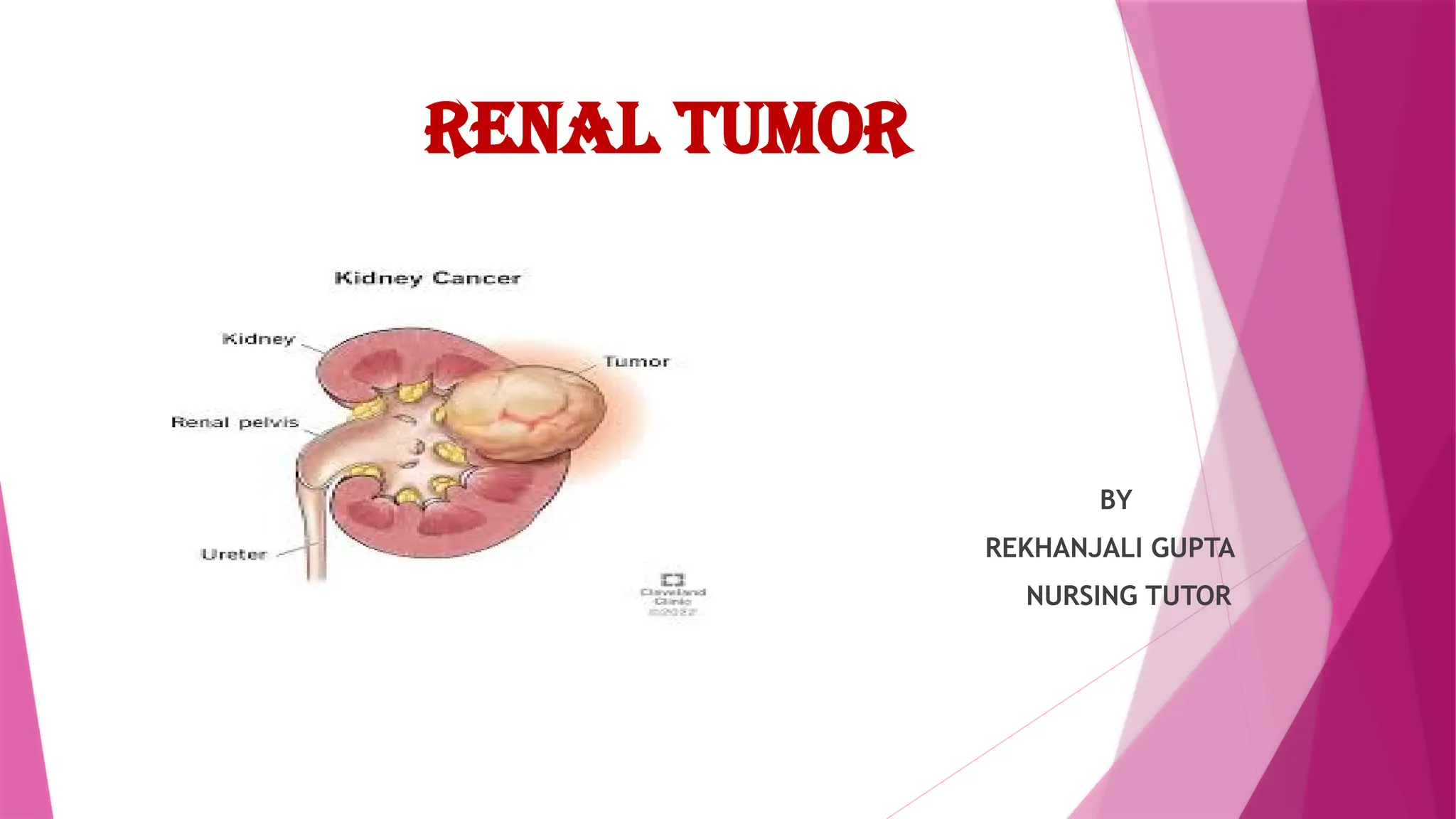
A Renal tumoris a mass or group of
abnormal cells that form on your
kidney. They may be benign (not
cancerous) or malignant (
cancerous).
4.
RISK FACTORS
Smoking
Obesity
High BloodPressure (Hypertension)
•Family History
•Occupational Exposure(chemical exposure)
•Long-term Dialysis
•Chronic Kidney Disease
•Long-term use of certain pain medicines
•Age: (increases with age. )
•Hepatitis C infection
•Kidney stones
•Family history
5.
TYPES OF RENALTUMOR
1-BENIGN TUMOR
2-MALIGNANT TUMOR
Benign tumor:
benign tumor is a non-cancerous growth that doesn't spread to other parts of
the body or invade nearby tissues.
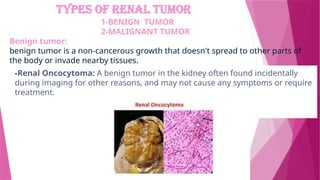
-Renal Oncocytoma: A benign tumor in the kidney often found incidentally
during imaging for other reasons, and may not cause any symptoms or require
treatment.
6.
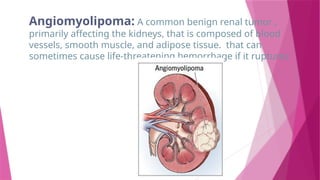
Angiomyolipoma: A commonbenign renal tumor ,
primarily affecting the kidneys, that is composed of blood
vessels, smooth muscle, and adipose tissue. that can
sometimes cause life-threatening hemorrhage if it ruptures
7.
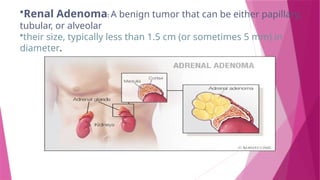
•Renal Adenoma: Abenign tumor that can be either papillary,
tubular, or alveolar
•their size, typically less than 1.5 cm (or sometimes 5 mm) in
diameter.
8.
2- MALIGNANT TUMOR
Malignantkidney tumors spread from into the fat, blood
vessels or adrenal gland around your kidneys. They may then
spread to other areas of your body through your bloodstream
or lymphatic system to form new tumors. The name of this
process is metastasis.
●Renal Cell Carcinoma(RCC) is the most common type of
kidney cancer in adults. It develops in the lining of the small
tubes (renal tubules) within the kidney. RCC often grows as a
single tumor, but it can also develop in both kidneys.
9.
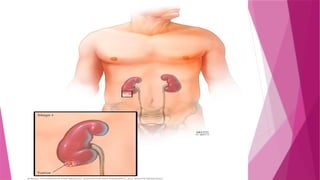
STAGE -1
Renal cell
carcinoma
Isconfined
to the
kidney
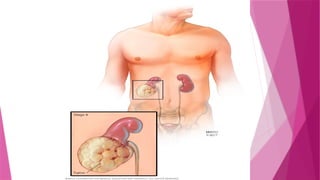
STAGE -2
RCC Extend
through the
renal Capsule
but Is confined
to Gerota’s
Fascia
a thin layer of
connective tissue
surrounding the kidneys
& adrenal glands.
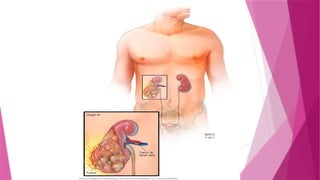
STAGE-3
Renal cell
carcinoma
Involves the
renal vein or
inferior vena
cava .
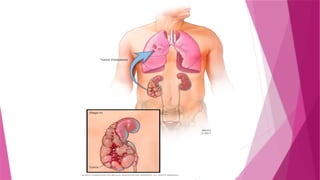
STAGE -4
Renal cell
carcinoma
Has spread to
local
adjacent
organs or to
distant sites.
STAGE OF RENAL CELL CARCINOMA
14.
CLINICAL MANIFESTATION
•Blood inthe urine (hematuria)
•Flank pain
•Palpable mass: A lump or mass in the abdomen, side, or lower back.
•Unexplained weight loss
•Fatigue: Feeling very tired or weak, even after resting.
•Fever
•Loss of appetite
•Swelling in the legs or ankles
•High blood pressure
•Anemia
•Swelling in the legs and ankles
15.
DIAGNOSTIC EVALUATION
•Medical Historyand Physical Exam
•Blood and Urine Tests:
These tests can help identify abnormalities in kidney function or indicate the
presence of blood or other substances in the urine, which might be a sign of
a tumor.
•Imaging Tests:
•Ultrasound: This non-invasive test uses sound waves to create images of
the kidneys, helping to identify masses or abnormalities.
•CT Scan: A computed tomography scan uses X-rays to create detailed
cross-sectional images of the kidneys, allowing doctors to visualize the
size, shape, and location of a tumor.
•MRI: Magnetic resonance imaging uses magnetic fields and radio waves
to create detailed images of the kidneys,
•Chest X-ray and Bone Scan: These tests may be used to check for any
spread of the cancer to other organs or bones
16.
2. Biopsy :
•Ifthe imaging tests suggest a kidney tumor, your
doctor may recommend a biopsy, which involves
taking a small sample of tissue from the tumor for
examination under a microscope.
•A biopsy can help confirm the diagnosis and
determine the type and aggressiveness of the
tumor.
17.
MANAGEMENT
- For localizedrenal tumors, the primary
treatment is surgical removal, either through
partial or radical nephrectomy, depending on
the tumor's size and location.
- For advanced or metastatic kidney cancer,
options include targeted therapies,
immunotherapy, and in some cases,
chemotherapy.
18.
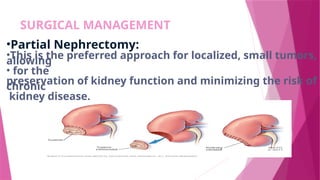
SURGICAL MANAGEMENT
•Partial Nephrectomy:
•Thisis the preferred approach for localized, small tumors,
allowing
• for the
preservation of kidney function and minimizing the risk of
chronic
kidney disease.
19.
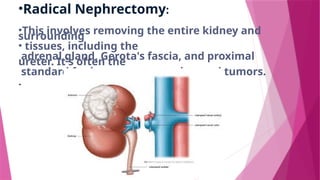
•Radical Nephrectomy:
•This involvesremoving the entire kidney and
surrounding
• tissues, including the
adrenal gland, Gerota's fascia, and proximal
ureter. It's often the
standard for larger or more advanced tumors.
.
20.
•Laparoscopic or Robotic-AssistedSurgery:
•These minimally invasive techniques offer advantages such as
smaller incisions.
shorter hospital stays, and faster recovery compared to open
surgery,
21.
ADJUVANT RADIATION
- Adjuvantradiotherapy is a type of cancer
treatment that involves using radiation therapy after
the primary treatment, such as surgery
- To help prevent cancer recurrence or spread.
- It's essentially additional treatment aimed at
reducing the risk of the cancer coming back after
the initial treatment has been completed.
23.
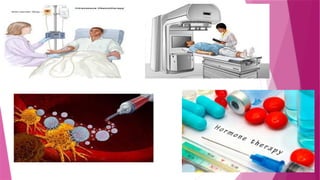
Radiation therapy
Radiation therapycan be used on the kidney to kill the cancer cells. It also can
help control or reduce symptoms of kidney cancer that has spread to other
areas of the body, such as the bones and brain.
Targeted therapy
Targeted therapy for cancer treatment.Targeted therapies identify and block
proteins or other molecules on or within cancer cells that are essential for their
growth and survival.
Immunotherapy
Immunotherapy for cancer is a treatment with medicine that helps the body's
immune system kill cancer cells. The immune system fights off cancer and other
cells that shouldn't be in the body. Cancer cells survive by hiding from the
immune system. Immunotherapy helps the immune system cells find and kill the
cancer cells.
24.
Chemotherapy
Chemotherapy treats cancerwith strong medicines. Many
chemotherapy medicines exist. Most are given through a vein. Usually,
kidney cancers are resistant to chemotherapy. However, it may be used
for certain rare types of kidney cancer.
Palliative care
Palliative care is a special type of healthcare that helps you feel better
when you have a serious illness. If you have cancer, palliative care can
help relieve pain and other symptoms. A healthcare team that may
include doctors, nurses and other specially trained health
professionals provides palliative care. The care team's goal is to
improve quality of life for you and your family.