February 25, 2025
2025
CanTrust Index
Results Report
External threats create a pivotal moment.
Building Canada's future starts with trust.
The Proof Strategies CanTrust Index , now in its tenth
year, is a made-in-Canada, made-for-Canada source of
research and insights on trust in our country. Successful
and thriving societies, democracies and economies cannot
function without trust.
Our study uses a 7-point scale with 7 being the highest
trust and 1 being the lowest. Respondents choosing 7, 6
or 5 result in the percentages of trust used in this report.
The 2025 Proof Strategies CanTrust Index tells the
unique story of trust among Canadians and who they
believe is trustworthy in this world of broken promises,
polarized politics, misinformation, and economic anxiety.
Proof Strategies Inc. is a leading Canadian-owned communications and public affairs
agency. We ask better questions to create insights, grow trust and build stronger human
relationships. Learn more at getproof.com.
Our commitment
to trust in Canada
2
2
3
This report provides a summary of findings from
the 2025 Proof Strategies CanTrust Index .
Methodology
1,515 PEOPLE SURVEYED
CONFIDENCE INTERVAL OF +/- 2.5
PERCENTAGE POINTS
• Survey of 1,515 Canadians using a national opt-in
panel administered by The Logit Group, an
independent research company operating for over
25 years and a member of the Canadian Research
Insights Council.
• Participants completed the survey instrument online
from either a mobile device or a desktop computer.
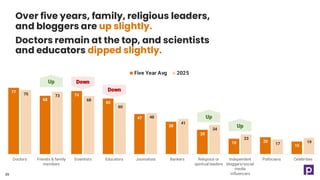
The study was completed in both official languages.
• The sample was representative of Canadian
population statistics by region, age and gender.
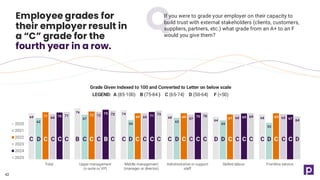
• Fieldwork was conducted from January 9 to 18,
2025.
3
EXECUTIVE SUMMARY
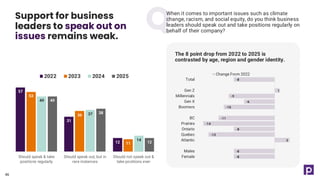
Critically low trust
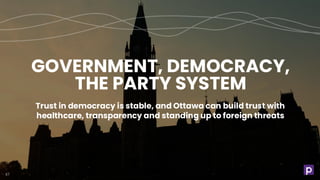
in politicians
4
• The 2025 CanTrust Index reveals a critical low in public trust in political
parties and politicians, marking a decade of decline.
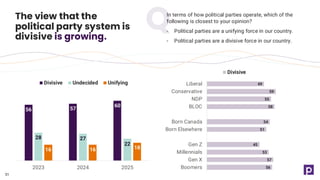
• 60 per cent of Canadians view political parties as divisive forces.
• Trust in politicians has dropped to a historic low of 17 per cent.
• There’s growing trust in Canada’s electoral system as fair, though only 40
per cent trust political parties to prevent foreign interference, indicating
concerns over transparency.
• Despite the mistrust, political collaboration in the face of threats to
Canada presents an opportunity for trust-building vital to Canada’s future.
• Peace, order and good government: Two-thirds of Canadians trust the
government’s ability to provide essential services and improve the country.
4
In the face of a hostile U.S. President, restoring trust in
politics is as important as investing in infrastructure or
building the economy for a prosperous future.
EXECUTIVE SUMMARY
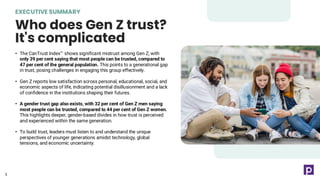
Who does Gen Z trust?
It's complicated
5
• The CanTrust Index shows significant mistrust among Gen Z, with
only 39 per cent saying that most people can be trusted, compared to
47 per cent of the general population. This points to a generational gap
in trust, posing challenges in engaging this group effectively.
• Gen Z reports low satisfaction across personal, educational, social, and
economic aspects of life, indicating potential disillusionment and a lack
of confidence in the institutions shaping their futures.
• A gender trust gap also exists, with 32 per cent of Gen Z men saying
most people can be trusted, compared to 44 per cent of Gen Z women.
This highlights deeper, gender-based divides in how trust is perceived
and experienced within the same generation.
• To build trust, leaders must listen to and understand the unique
perspectives of younger generations amidst technology, global
tensions, and economic uncertainty.
5
EXECUTIVE SUMMARY
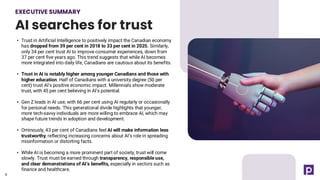
AI searches for trust
6
• Trust in Artificial Intelligence to positively impact the Canadian economy
has dropped from 39 per cent in 2018 to 33 per cent in 2025. Similarly,
only 34 per cent trust AI to improve consumer experiences, down from
37 per cent five years ago. This trend suggests that while AI becomes
more integrated into daily life, Canadians are cautious about its benefits.
• Trust in AI is notably higher among younger Canadians and those with
higher education. Half of Canadians with a university degree (50 per
cent) trust AI’s positive economic impact. Millennials show moderate
trust, with 45 per cent believing in AI’s potential.
• Gen Z leads in AI use, with 66 per cent using AI regularly or occasionally
for personal needs. This generational divide highlights that younger,
more tech-savvy individuals are more willing to embrace AI, which may
shape future trends in adoption and development.
• Ominously, 43 per cent of Canadians feel AI will make information less
trustworthy, reflecting increasing concerns about AI’s role in spreading
misinformation or distorting facts.
• While AI is becoming a more prominent part of society, trust will come
slowly. Trust must be earned through transparency, responsible use,
and clear demonstrations of AI’s benefits, especially in sectors such as
finance and healthcare.
6
2025 CANTRUST INDEX
The Canadian predisposition to trust remains stable
7
8
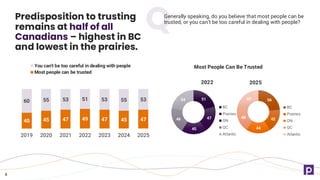
Predisposition to trusting
remains at half of all
Canadians – highest in BC
and lowest in the prairies.
Generally speaking, do you believe that most people can be
trusted, or you can’t be too careful in dealing with people?
40 45 47 49 47 45 47
60 55 53 51 53 55 53
2019 2020 2021 2022 2023 2024 2025
You can't be too careful in dealing with people
Most people can be trusted
8
56
42
44
48
49
2025
BC
Prairies
ON
QC
Atlantic
51
47
45
46
54
2022
BC
Prairies
ON
QC
Atlantic
Most People Can Be Trusted
9
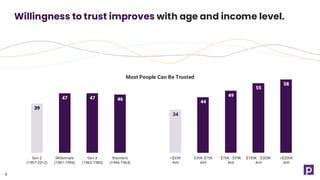
Willingness to trust improves with age and income level.
39
47 47 46
34
44
49
55
58
Gen Z
(1997-2012)
Millennials
(1981-1996)
Gen X
(1965-1980)
Boomers
(1946-1964)
<$35K
AHI
$35K-$75K
AHI
$75K - $99K
AHI
$100K - $200K
AHI
>$200K
AHI
Most People Can Be Trusted
10
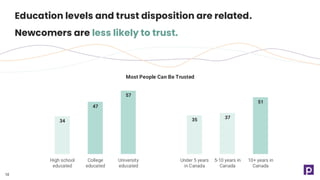
Education levels and trust disposition are related.
Newcomers are less likely to trust.
34
47
57
35 37
51
High school
educated
College
educated
University
educated
Under 5 years
in Canada
5-10 years in
Canada
10+ years in
Canada
Most People Can Be Trusted
11
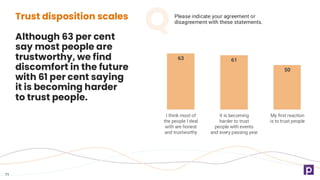
Trust disposition scales
Although 63 per cent
say most people are
trustworthy, we find
discomfort in the future
with 61 per cent saying
it is becoming harder
to trust people.
Please indicate your agreement or
disagreement with these statements.
63 61
50
I think most of
the people I deal
with are honest
and trustworthy
It is becoming
harder to trust
people with events
and every passing year
My first reaction
is to trust people
12
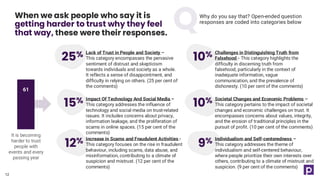
When we ask people who say it is
getting harder to trust why they feel
that way, these were their responses.
Why do you say that? Open-ended question
responses are coded into categories below
61
It is becoming
harder to trust
people with
events and every
passing year
Lack of Trust in People and Society –
This category encompasses the pervasive
sentiment of distrust and skepticism
towards individuals and society as a whole.
It reflects a sense of disappointment, and
difficulty in relying on others. (25 per cent of
the comments)
Impact Of Technology And Social Media –
This category addresses the influence of
technology and social media on trust-related
issues. It includes concerns about privacy,
information leakage, and the proliferation of
scams in online spaces. (15 per cent of the
comments)
Increase in Scams and Fraudulent Activities -
This category focuses on the rise in fraudulent
behaviour, including scams, data abuse, and
misinformation, contributing to a climate of
suspicion and mistrust. (12 per cent of the
comments)
Challenges in Distinguishing Truth from
Falsehood - This category highlights the
difficulty in discerning truth from
falsehood, particularly in the context of
inadequate information, vague
communication, and the prevalence of
dishonesty. (10 per cent of the comments)
Societal Changes and Economic Problems –
This category pertains to the impact of societal
changes and economic challenges on trust. It
encompasses concerns about values, integrity,
and the erosion of traditional principles in the
pursuit of profit. (10 per cent of the comments)
Individualism and Self-centeredness –
This category addresses the theme of
individualism and self-centered behaviour,
where people prioritize their own interests over
others, contributing to a climate of mistrust and
suspicion. (9 per cent of the comments)
25%
15%
12%
10%
10%
9%
13
THE CANTRUST INDEX
Aggregate trust scores for our key institutions of government,
business, media and non-profits/charities
Thinking again about Canada, to what extent are you
willing to trust the following organizational categories
to be competent and effective and to do the right thing?
1 means you “trust very little” and 7 means you
“trust a lot” [5-7 reported].
45 43 45
39 38 37
34
39 40 38
2016 2017 2018 2019 2020 2021 2022 2023 2024 2025
The CanTrust Index score: five institutional components of Canadian society were aggregated to create an overall aggregate trust score.
Based on trust in charities and non-profits, media, small and medium businesses, governments and large corporations.
The long COVID impact:
Aggregate trust is weakened
from pandemic stress in the
10-year average for institutions.
14
42
37
Year 1-5 Avg Year 6-10 Avg
CanTrust Index
54 54
40
44
20
53
50
39
41
27
49
40
36 36
20
48
38
32
41
27
50
43
37
42
28
53
43
38
43
30
50
37 36
40
33
Charities and
non-profits
News media Governments Small and medium
corporations
Large corporations
2016 2017 2019 2021 2023 2024 2025
Thinking again about Canada, to what extent are you
willing to trust the following organizational categories
to be competent and effective and to do the right thing?
1 means you “trust very little” and 7 means you “trust a
lot” [5-7 reported].
Ten-year trends highlight a
decline in trust in the news media,
and an increase in trust in large
corporations. Although, the news
media still ranks higher.
Rising trust in charities and non-
profits has stalled.
15
52
48
38
41
24
50
39
33
41
29
Charities and non-profits
News media
Governments
Small and medium
corporations
Large corporations
Year 1-5 Ave Year 6-10 Ave.
The ten-year review broken up by two
five-year periods show news media has
the largest decline.
GENERATION Z
A gender split within a generation apart
16
17
39
32
44
61
68
56
Gen Z - Total Gen Z - Men Gen Z - Women
Most people can be trusted You can't be too careful in dealing with people
Generally speaking, do you believe that most people can be
trusted, or you can’t be too careful in dealing with people?
Gen Z men are far less
trusting than Gen Z women.
18
While Gen Z conceded it was
getting harder to trust, results
for key institutions show that
their trust levels are higher
than older cohorts.
42
39
37
35
Gen Z
(1997-2012)
Millennials
(1981-1996)
Gen X
(1965-1980)
Boomers
(1946-1964)
37
33
40
45
47
30
50
<$35K
AHI
$35K-$75K
AHI
$75K - $99K
AHI
$100K -
$200K AHI
>$200K
AHI
HS or less University +
Aggregate trust in charities and non-profits, media, small and medium businesses, governments and large corporations.
Thinking again about Canada, to what extent are you
willing to trust the following organizational categories
to be competent and effective and to do the right thing?
1 means you “trust very little” and 7 means you
“trust a lot” [5-7 reported].
CanTrust Index
50
43
46
54
50 48 48 45
41 44 44
59
52 54
50 52
49 48 47
43 42
38
58 57 55 53 51 49 47 44
40 38
30
66 63
56 58
50 53
48 46
37
33
25
Canadian
military
RCMP Canadian
healthcare
system
The Supreme
Court
Canadian
education
system
The Bank of
Canada
Canada's
judicial system
Canadian
electoral
system
Canadian
financial
markets
Canadian
Parliament
Canada's
immigration
system
Gen Z Millennials Gen X Boomers
19
Young people are more
trusting of immigration
and less trusting of
the military and RCMP.
Thinking again about Canada, to what extent are you
willing to trust the following organizational categories
to be competent and effective and to do the right thing?
1 means you “trust very little” and 7 means you “trust a
lot” [5-7 reported].
50
43
46
54
50 48 48 45
41 44 44
48
43 45
54
39
50
42
49
43
40 43
51
44
48
53
59
46
54
42 40
48 46
Canadian
military
RCMP Canadian
healthcare
system
The Supreme
Court
Canadian
education
system
The Bank of
Canada
Canada's
judicial system
Canadian
electoral
system
Canadian
financial
markets
Canadian
Parliament
Canada's
immigration
system
Gen Z - Total Gen Z - Men Gen Z - Women
20
Gen Z women are much
more trusting of the
education system,
compared to Gen Z men.
Thinking about Canada, to what extent are you willing to
trust the following institutions to operate competently and
effectively and to do the right thing?
1 means you “trust very little” and 7 means you “trust a lot”
[5-7 reported].
Trust levels for various content
sources vary by age. Social
media, AI, blogs, and podcasts
are all much higher in the
younger cohorts and these trust
levels are closing in on parity to
other traditional sources.
21
62
59
51 49
44
42 41
39 38
26
54
51
54
48 46
36 36 34
41
28
54 53 54
47
38
30
27
24
32
19
41
46
60
48
32
16
14 13
21
9
Consumer reviews Internet searches
on search engines
like Google or Bing
News stories in
newspapers, TV, on
radio
News stories on
news media
websites
Social media posts
by people you know
Social media posts
by a brand or
company
AI searches on
LLMs and platforms
such as ChatGPT,
Gemini or Perplexity
Blogs Podcasts Sponsored (paid
for) social media
posts by celebrities
or other influencers
Gen Z Millennials Gen X Boomers
On a scale of 1 to 7, please indicate how much you
are willing to trust the following sources to provide
you with reliable information?
1 means you “trust very little” and 7 means you
“trust a lot” [5-7 reported].
41 41
39
62
59
51 49
29
38
42
44
26
43
46
38
54
41
56
59
47
44
28
41 42 43
33
38
43
44
31
38
67
60
55 54
30
35
42
45
20
47 49
Advertising
by
government
AI searches
on LLMs and
platforms
such as
ChatGPT,
Gemini or
Perplexity
Blogs Consumer
reviews
Internet
searches on
search
engines like
Google or
Bing
News stories
in
newspapers,
TV, on radio
News stories
on news
media
websites
Online
advertising by
companies
Podcasts Social media
posts by a
brand or
company
Social media
posts by
people you
know
Sponsored
(paid for)
social media
posts by
celebrities or
other
influencers
Traditional
advertising on
television,
radio, or in
print
Word of
mouth from
people you
know
Gen Z - Total Gen Z - Men Gen Z - Women
22
On a scale of 1 to 7, please indicate how much you are
willing to trust the following sources to provide you with
reliable information?
1 means you “trust very little” and 7 means you “trust a lot”
[5-7 reported].
Gen Z men are much
more likely to trust AI
searches compared to
Gen Z women.
47 47
56
49
37
53
57 54
58
41
52
57 56 53
40
58
64
60 62
46
Total Personally Educationally Socially Economically
Gen Z Millennials Gen X Boomers
Gen Z is the least satisfied.
23
Thinking about your own life in Canada,
to what extent do you feel satisfied?
1 means you “trust very little” and 7 means you
“trust a lot” [5-7 reported].
47
56
49
37
43
49 49
42
50
61
49
32
Personally Educationally Socially Economically
Gen Z - Total Gen Z - Men Gen Z - Women
24
Gen Z men are particularly
dissatisfied personally and
educationally, despite higher
economic satisfaction.
Thinking about your own life in Canada,
to what extent do you feel satisfied?
1 means you “trust very little” and 7 means you “trust a lot”
[5-7 reported].
ARTIFICIAL
INTELLIGENCE
25
No answer yet for trust
26
Trust in AI is stalled in
seven years of tracking.
Using a scale from 1-7, how much do you trust Artificial
Intelligence to improve your experience as a consumer?
1 means you “trust very little” and 7 means you “trust a lot”
[5-7 reported].
37
34 35
37
41
34
35 36 36 37 37
29
34 35
33
35
33 34
Total BC Prairies Ontario Quebec Atlantic
Trust in AI to improve the consumer experience
2018 2024 2025
As more and more information is produced with the help
of Artificial Intelligence, is content produced by AI more
or less likely to increase or decrease your trust in the
sources you read, or see?
Canadians are uncertain about
AI: 43 per cent say that AI will
make information sources less
trustworthy, with 22 per cent
saying they will be more likely to
trust.
27
22 24 24 23
20
17
30 31
20
13
28
16 14
37
14
21
34
48
38
7
43 41
45
38
50
42
45 45
40 42
38
47
50
35
48
43
35
27
30
54
More Likely To Trust Less Likely
28
Gen Z is leading the way
in adopting AI, personally
and professionally.
To what extent do you personally use AI tools in
your personal or work life?
57
28
15
Seldom/Never Occasionally Regularly
Personally
68
18
13
Seldom/Never Occasionally Regularly
Work
Use
Reg./
Occ.
Use
Seldom/
Never
Male 50 50
Female 38 62
Gen Z 66 34
Millennials 55 45
Gen X 45 55
Boomer 24 76
Use
Reg./
Occ.
Use
Seldom/
Never
Male 36 64
Female 27 73
Gen Z 50 50
Millennials 47 53
Gen X 36 65
Boomer 10 90
29
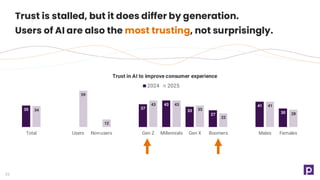
Trust is stalled, but it does differ by generation.
Users of AI are also the most trusting, not surprisingly.
35 37
43
33
27
41
30
34
59
12
43 43
35
22
41
28
Total Users Non-users Gen Z Millennials Gen X Boomers Males Females
Trust in AI to improve consumer experience
2024 2025
How much do you trust Artificial Intelligence to positively
contribute to the Canadian economy?
1 means you “trust very little” and 7 means you “trust a lot”
[5-7 reported].
About one in three
Canadians believe AI will
contribute to the economy.
30
39 37 35 37
47
37
33
29 30
34 37
31
33 31 32 35
31 30
Total BC Prairies Ontario Quebec Atlantic
Trust in AI to contribute to the economy
2018 2024 2025
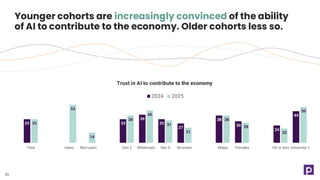
Younger cohorts are increasingly convinced of the ability
of AI to contribute to the economy. Older cohorts less so.
31
33 33
39
33
27
38
30
24
44
33
53
14
38
45
31
21
38
28
20
50
Total Users Non-users Gen Z Millennials Gen X Boomers Males Females HS or less University +
Trust in AI to contribute to the economy
2024 2025
How much do you trust Artificial Intelligence to
support the following Canadian sectors to operate
competently and effectively?
1 means you “trust very little” and 7 means you
“trust a lot” [5-7 reported].
Notable increases in
expectations of AI to
support retail, healthcare,
and travel.
32
22
27
23
29
33 32
41 39 38 37 35 35
31 29
Entertainment/
creative work
Retail Healthcare Travel Financial services Education Government
services
News media
reporting
Trust in AI to support industries
2024 2025
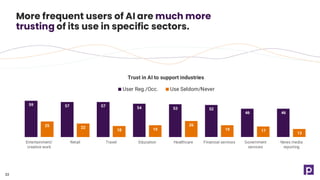
More frequent users of AI are much more
trusting of its use in specific sectors.
33
59 57 57 54 53 52
46 46
25 22
18 19
26
19 17
13
Entertainment/
creative work
Retail Travel Education Healthcare Financial services Government
services
News media
reporting
Trust in AI to support industries
User Reg./Occ. Use Seldom/Never
TRUST IN INSTITUTIONS
34
Stable or growing trust, but the
immigration system falters
Trust in most Canadian
institutions is stable.
Notable drop in trust in
Canada's immigration system.
Steady increase in trust in the
military and RCMP.
35
Thinking about Canada, to what extent are you willing
to trust the following institutions to operate
competently and effectively and to do the right thing?
1 means you “trust very little” and 7 means you
“trust a lot” [5-7 reported].
58
50
63
56
54
47
43
52
48
58
54 53
46 45
40
38
57
54
58
55 54
49
47 46
39 38 37
59
55
52
58
54
49 50
46
41
37
39
61
57
54 54
52 51
48 47
41
39
33
Canadian
military
RCMP Canadian
healthcare
system
The Supreme
Court
Canadian
education
system
The Bank of
Canada
Canada's judicial
system
Canadian
electoral system
Canadian
financial
markets
Canadian
Parliament
Canada's
immigration
system
2021 2022 2023 2024 2025
36
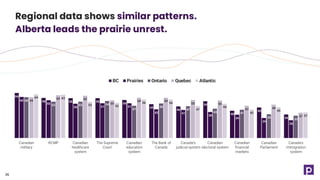
Regional data shows similar patterns.
Alberta leads the prairie unrest.
66
58 58 58
56
49
46
54
40
45
34
60
55
50 51 51
42 41
38
34
29
26
60
53 53 54
47
50
47
43 41
35
32
59
63 62
55
59 59
55 55
47 49
37
64 63
53 52
56 56
47
50
42
45
37
Canadian
military
RCMP Canadian
healthcare
system
The Supreme
Court
Canadian
education
system
The Bank of
Canada
Canada's
judicial system
Canadian
electoral system
Canadian
financial
markets
Canadian
Parliament
Canada's
immigration
system
BC Prairies Ontario Quebec Atlantic
SOURCES WE TRUST
The doctor is in, and politicians are out
37
On a scale of 1 to 7, please indicate how much you are
willing to trust each the following categories of people for
reliable information.
1 means you “trust very little” and 7 means you “trust a lot”
[5-7 reported].
Medical doctors remain
the most trusted
sources of reliable
information.
81
64
77
63
49
36
27
17
14
18
78
65
75
63
44
35
27
19
14
22
73
68 69
60
46
40
29
17
15
22
78
76
74
68
49
40
37 37
30
26
19
16 17
75
73
68
60 59
48 47
41 40
36
34
29
23
19
17
Doctors Friends &
family
members
Scientists Educators University and
college
professors
Journalists University and
college
presidents
Bankers Entrepreneurs Small or
medium sized
business
executives
Religious or
spiritual
leaders
Large
corporate
executives
Independent
bloggers/social
media
influencers
Celebrities Politicians
2021 2022 2023 2024 2025
38
77
68
74
65
47
38
28
18 20
15
75 73
68
60
48
41
34
23
17 19
Doctors Friends & family
members
Scientists Educators Journalists Bankers Religious or
spiritual leaders
Independent
bloggers/social
media
influencers
Politicians Celebrities
Five Year Avg 2025
Over five years, family, religious leaders,
and bloggers are up slightly.
Doctors remain at the top, and scientists
and educators dipped slightly.
Up Down
Down
Up
Up
39
On a scale of 1 to 7, please indicate how much you are
willing to trust the following sources to provide you with
reliable information?
1 means you “trust very little” and 7 means you “trust a lot”
[5-7 reported].
AI searches are
considered trusted
sources of reliable
information for over a
quarter of Canadians.
40
55
49
47
50 50
35
37
22
24
21
15
57
50
48
46 47 48
39
35
26 25
21 20
55
51 52 52
48
44
42
40
31
29 30
25
19
28
News on
newspaper,
TV, radio
Consumer
reviews
Internet
search
Word of
mouth from
people you
know
News on
news
websites
Advertising
by
government
Traditional
advertising on
traditional
media
Social media
posts by
people you
know
Podcasts Social media
posts by a
brand or
company
Online
advertising by
companies
Blogs Sponsored
social media
posts by
celebrities or
other
influencers
AI searches
on LLMs
2021 2023 2025
TRUST IN BUSINESS LEADERS
AND CORPORATIONS
41
Better efforts needed by CEOs and corporations
42
Grade Given Indexed to 100 and Converted to Letter on below scale
LEGEND: A (85-100) B (75-84 ) C (65-74) D (50-64) F (<50)
If you were to grade your employer on their capacity to
build trust with external stakeholders (clients, customers,
suppliers, partners, etc.) what grade from an A+ to an F
would you give them?
Employee grades for
their employer result in
a “C” grade for the
fourth year in a row.
69
76
74
68
64
68
62
67
59
62
59
55
71 72
69 69 67 69
68
72
69 67 68 68
70
75
71 70 69 67
71 73 73
70 69
64
Total Upper management
(c-suite or VP)
Middle management
(manager or director)
Administrative or support
staff
Skilled labour Frontline service
2020
2021
2022
2023
2024
2025
D C
C C C
B D C
C D C
C D C
D D C
C
C C C C C C
C B C C C C
C C C C C D
43
Trust in key business
sectors is mostly stable.
Trust in cryptocurrency
almost doubles in two years.
43
Thinking about Canada and the economy, to what extent
are you willing to trust the following industries to operate
competently and effectively and to do the right thing.
1 means you “trust very little” and 7 means you “trust a
lot” [5-7 reported].
42 41
31
26
37
43
30
12 14
48
44
36
31 30
37
44
36
16 18
54
48
45
41 41
37 39
42
39 39
46
40
36
20 20
Universities
& Colleges
Streaming
services
Nuclear
power
station
operators
Oil & gas
companies
Life &
health
insurance
companies
Banks Property
& accident
insurance
companies
Online
gambling
2023 2024 2025
E-commerce Long term care
facilities
Mining Pharmaceutical
companies
Investment
management
companies
Telecommunications
companies
Cryptocurrency
businesses
68 67
55
My co-workers My immediate manager The company CEO or
most senior leader
2025
44
Canadians in the
workforce are more
trusting of their colleagues
versus their CEOs.
44
If you need information about your workplace and your
employer, on a scale of 1 to 7, please indicate how much
you are willing to trust each of the following categories of
people for reliable information.
1 means you “trust very little” and 7 means you “trust a
lot” [5-7 reported].
68 67
64 64 63 63
60 60 59 57 57 56 53
49
39
24
66 67
60
63 61 61
53
56
59
54
50 48 46
62
56
25
Focusing on employee
safety &
wellbeing
Being endorsed by my
friends and family
Creating local
employment
opportunities
Having a clearly stated
corporate or social
purpose
Being Canadian-owned
and operated
Committing to inclusion
and diversity
Committing to
Indigenous reconciliation
Being innovative
5 Year Avg 2025
Focusing on
employee
safety &
wellbeing
Having
values that
are close
to my own
Being
endorsed
by my
friends
and family
Having a
leader that
communicates
openly
Creating local
employment
opportunities
Having
a brand,
product or
service
meet my
needs
Having a
clearly
stated
corporate
or social
purpose
Supporting
charitable
causes
Being
Canadian-
owned
and
operated
Advocating
for positive
social
change
Committing
to inclusion
and diversity
Speaking
out
international
conflicts
Committing
to Indigenous
reconciliation
Track record
to protect
personal
data
Being
innovative
Being
endorsed
by an
influencer
that I follow
On a scale of 1-7 to what extent do you think each of
the actions listed below will help make a company or
brand more trustworthy to you personally?
1 means you “trust very little” and 7 means you
“trust a lot” [5-7 reported].
Among the drivers of
corporate trust, data
security and innovation
show large increases
over five years.
45
46
Support for business
leaders to speak out on
issues remains weak.
When it comes to important issues such as climate
change, racism, and social equity, do you think business
leaders should speak out and take positions regularly on
behalf of their company?
57
31
12
53
36
11
49
37
14
49
38
12
Should speak & take
positions regularly
Should speak out, but in
rare instances
Should not speak out &
take positions ever
2022 2023 2024 2025
-8
1
-9
-6
-10
-11
-14
-8
-13
3
-8
-8
Total
Gen Z
Millennials
Gen X
Boomers
BC
Prairies
Ontario
Quebec
Atlantic
Males
Female
Change From 2022
The 8 point drop from 2022 to 2025 is
contrasted by age, region and gender identity.
GOVERNMENT, DEMOCRACY,
THE PARTY SYSTEM
47
Trust in democracy is stable, and Ottawa can build trust with
healthcare, transparency and standing up to foreign threats
Thinking about Canada, to what extent do you trust
that the current election system in Canada is a) fair;
b) represents the votes of citizens.
1 means you “trust very little” and 7 means you
“trust a lot” [5-7 reported].
More Canadians say they trust
the electoral system to be fair.
Less trust the government or
political parties to protect
against foreign interference.
48
47 48 50
55
The system is fair
2019 2023 2024 2025
44 46 47
52
The system represents
the votes of citizens
2019 2023 2024 2025
43
Trust the federal government
and Elections Canada to
prevent foreign interference
in Canadian elections
40
Trust our major Canadian political
parties to prevent foreign
interference in their own internal
operations or elections
2025
To what extent do you agree or disagree with statement below.
1 means you “do not agree at all” and 7 means you “agree
completely” [5-7 reported].
Two-thirds of Canadians
continue to believe
government plays an
important role.
49
64 62 65
I believe government plays an
important role in providing
services that help make Canada
a better country for our citizens
2023 2024 2025
59
63 64
68
60
70
50
78
88
57
65
56
This belief increases with age, income, and education level.
To what extent do you think each of the actions listed below will help
make the federal government more trustworthy to you personally.
1 means you “do not agree at all” and 7 means you “agree
completely” [5-7 reported].
How can Ottawa be
more trustworthy?
As federal government changes come
in 2025, Canadians choose healthcare
funding and government transparency
as priorities to improve trust.
50
70 70
65 63 61 60 57 55 54 53 52 52 52 50 50
46 45 45
39
Increase
access
to
healthcare
Stand up
to countries
that threaten
Canada's
prosperity
Policies that
get more
houses built
Reduce
immigration
and people
seeking
asylum
Celebrate
Canada
as a
successful
country
Mitigate the
impact of
extreme
weather
Reduce
the carbon
footprint
of Canada
Increase
defence
spending
to NATO's
2% of
GDP
level
Commit
to more laws
protecting
minority
groups
Give
subsidies
to invest
more in
Canada
2025
Be more
open
and
transparent
Support
workers
to have
more
benefits
or better
wages
Protect
natural
areas and
ecosystems
in Canada
Significant
spending
cuts
Cut the
carbon
tax
Raise
Canada's
voice on
conflicts or
human rights
issues
Cut the
number of
civil
servants
Commit
to faster
action on
Indigenous
reconciliation
A Prime
Minister
who
communicates
49
59
55
58
54
51
45
53
57
56
Liberal
Conservative
NDP
BLOC
Born Canada
Born Elsewhere
Gen Z
Millennials
Gen X
Boomers
Divisive
In terms of how political parties operate, which of the
following is closest to your opinion?
- Political parties are a unifying force in our country.
- Political parties are a divisive force in our country.
The view that the
political party system is
divisive is growing.
51
56 57
60
28 27
22
16 16 18
2023 2024 2025
Divisive Undecided Unifying
52
To what extent are you willing to trust the following
federal government services to operate competently
and effectively and to do the right thing?
1 means you “trust very little” and 7 means you
“trust a lot” [5-7 reported].
53
50 49
46 46
44
48 47 46
41
33
29
34
36
57
46 47 47
44
40
46
50
43
40
33
23
34
32
57
55
51 51 51 50 49 49 48
45
40 39 38
36
National parks Agriculture
and food
National
defence and
security
Policing and
public safety
Canada
Pension and
related old age
benefits
Healthcare
standards and
access
Managing
natural
weather
disasters and
providing relief
Passports and
border
crossings
Employment
insurance
Environmental
standards and
protection
Meeting
national
targets to
reduce causes
of climate
change
Affordable
housing
Indigenous
relations
Immigration
and refugee
management
2023 2024 2025
There has been a large
jump in trust in the federal
government to deliver
affordable housing.
46
34
50
46
33
52
39 37
45
33 32
38
27
36 38
The Prime Minister The Premier of
your province
Your community mayor
2016 2018 2020 2022 2025
When you think of these people or groups of people
to what extent do you trust each to do what is right
for Canada, Canadians and our society in general?
1 means you “trust very little” and 7 means you
“trust a lot” [5-7 reported].
Trust in community mayors
shows a five-year decline.
53
43
34
50
30
34
38
The Prime Minister The Premier of
your province
Your community
mayor
First Five Year Avg Recent Five Year Avg
VALUES PERFORMANCE
54
Canada is not living up to values for economic security
and only a minority are economically satisfied
49
63
57 59
54
47 48 50
46 46
41 41
36
51
59 59
54 53 53 55
48 48 48 47 47
39
Average of
all values
Freedom Diversity Safety Democracy Education Inclusion Health Fairness Privacy Equity Sustainability Economic
security
Prior 5 year Avg 2025
Canadians more likely to trust
that their nation is living up to
the values of equity, inclusion
and sustainability. Notable
declines in freedom and safety.
55
In thinking about Canada as a country, please rate
how well you feel our country is living up to its
values in the following areas using a scale of 1 to 7.
1 means you “not at all” and 7 means “completely”
[5-7 reported].
Up
Down
Up Up
Down
53
73
53
68
65
43
60
55
53
39 39
35
51
60 59 60
54
48
50
54
48 47
44 44 43
42
56 55
49
45 45 46
37 36
39
36 36
28
51
59 59
54 53 53
55
48 48 48 47 47
39
Average of
all values
Freedom Diversity Safety Democracy Education Inclusion Health Fairness Privacy Equity Sustainability Economic
security
2020 2022 2024 2025
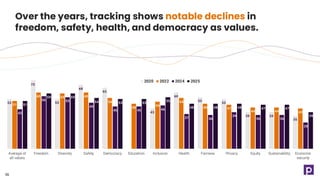
Over the years, tracking shows notable declines in
freedom, safety, health, and democracy as values.
56
60 58
60
53 53 51
49 48
42
48 47
35
57
60 58
54 54
51
46 48
50
47 47
43
58 57
52
56
47
54
44 45 45
48
45
38
61
57
50 52
54
51
49
45 46 45 46
34
Freedom Diversity Safety Democracy Education Inclusion Health Fairness Privacy Equity Sustainability Economic
security
Gen Z Millennials Gen X Boomers
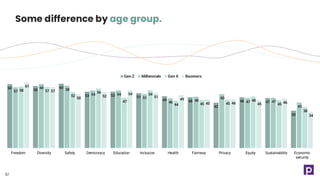
Some difference by age group.
57
51
55 54 54
40
44
49 47
44
38
50
56 56
52
38
49
56 55 53
34
52
59 57 58
43
Total Personally Educationally Socially Economically
2021 2022 2023 2024 2025
Thinking about your own life in Canada,
to what extent do you feel satisfied?
1 means you “trust very little” and 7 means you
“trust a lot” [5-7 reported].
Just over half of Canadians say
they are satisfied with their own
lives.
Economic satisfaction lags.
58
TRUST CAN BE GROWN
59
Building a plan for trust may be easier than you think
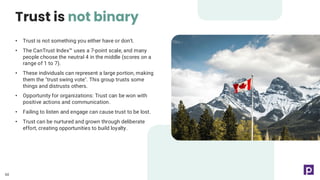
• Trust is not something you either have or don’t.
• The CanTrust Index uses a 7-point scale, and many
people choose the neutral 4 in the middle (scores on a
range of 1 to 7).
• These individuals can represent a large portion, making
them the "trust swing vote". This group trusts some
things and distrusts others.
• Opportunity for organizations: Trust can be won with
positive actions and communication.
• Failing to listen and engage can cause trust to be lost.
• Trust can be nurtured and grown through deliberate
effort, creating opportunities to build loyalty.
Trust is not binary
60
BUILDING CANADA'S FUTURE
STARTS WITH TRUST
cantrustindex.ca
61
VANESSA EATON
veaton@getproof.com
BRUCE MACLELLAN
bmaclellan@getproof.com
For more information, please contact:

Proof Strategies CanTrust Index 2025 Report

  • 1.
    February 25, 2025 2025 CanTrustIndex Results Report External threats create a pivotal moment. Building Canada's future starts with trust.
  • 2.
    The Proof StrategiesCanTrust Index , now in its tenth year, is a made-in-Canada, made-for-Canada source of research and insights on trust in our country. Successful and thriving societies, democracies and economies cannot function without trust. Our study uses a 7-point scale with 7 being the highest trust and 1 being the lowest. Respondents choosing 7, 6 or 5 result in the percentages of trust used in this report. The 2025 Proof Strategies CanTrust Index tells the unique story of trust among Canadians and who they believe is trustworthy in this world of broken promises, polarized politics, misinformation, and economic anxiety. Proof Strategies Inc. is a leading Canadian-owned communications and public affairs agency. We ask better questions to create insights, grow trust and build stronger human relationships. Learn more at getproof.com. Our commitment to trust in Canada 2 2
  • 3.
    3 This report providesa summary of findings from the 2025 Proof Strategies CanTrust Index . Methodology 1,515 PEOPLE SURVEYED CONFIDENCE INTERVAL OF +/- 2.5 PERCENTAGE POINTS • Survey of 1,515 Canadians using a national opt-in panel administered by The Logit Group, an independent research company operating for over 25 years and a member of the Canadian Research Insights Council. • Participants completed the survey instrument online from either a mobile device or a desktop computer. The study was completed in both official languages. • The sample was representative of Canadian population statistics by region, age and gender. • Fieldwork was conducted from January 9 to 18, 2025. 3
  • 4.
    EXECUTIVE SUMMARY Critically lowtrust in politicians 4 • The 2025 CanTrust Index reveals a critical low in public trust in political parties and politicians, marking a decade of decline. • 60 per cent of Canadians view political parties as divisive forces. • Trust in politicians has dropped to a historic low of 17 per cent. • There’s growing trust in Canada’s electoral system as fair, though only 40 per cent trust political parties to prevent foreign interference, indicating concerns over transparency. • Despite the mistrust, political collaboration in the face of threats to Canada presents an opportunity for trust-building vital to Canada’s future. • Peace, order and good government: Two-thirds of Canadians trust the government’s ability to provide essential services and improve the country. 4 In the face of a hostile U.S. President, restoring trust in politics is as important as investing in infrastructure or building the economy for a prosperous future.
  • 5.
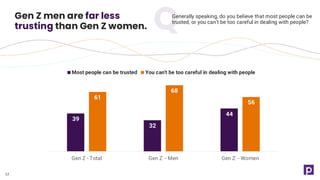
    EXECUTIVE SUMMARY Who doesGen Z trust? It's complicated 5 • The CanTrust Index shows significant mistrust among Gen Z, with only 39 per cent saying that most people can be trusted, compared to 47 per cent of the general population. This points to a generational gap in trust, posing challenges in engaging this group effectively. • Gen Z reports low satisfaction across personal, educational, social, and economic aspects of life, indicating potential disillusionment and a lack of confidence in the institutions shaping their futures. • A gender trust gap also exists, with 32 per cent of Gen Z men saying most people can be trusted, compared to 44 per cent of Gen Z women. This highlights deeper, gender-based divides in how trust is perceived and experienced within the same generation. • To build trust, leaders must listen to and understand the unique perspectives of younger generations amidst technology, global tensions, and economic uncertainty. 5
  • 6.
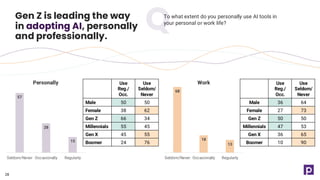
    EXECUTIVE SUMMARY AI searchesfor trust 6 • Trust in Artificial Intelligence to positively impact the Canadian economy has dropped from 39 per cent in 2018 to 33 per cent in 2025. Similarly, only 34 per cent trust AI to improve consumer experiences, down from 37 per cent five years ago. This trend suggests that while AI becomes more integrated into daily life, Canadians are cautious about its benefits. • Trust in AI is notably higher among younger Canadians and those with higher education. Half of Canadians with a university degree (50 per cent) trust AI’s positive economic impact. Millennials show moderate trust, with 45 per cent believing in AI’s potential. • Gen Z leads in AI use, with 66 per cent using AI regularly or occasionally for personal needs. This generational divide highlights that younger, more tech-savvy individuals are more willing to embrace AI, which may shape future trends in adoption and development. • Ominously, 43 per cent of Canadians feel AI will make information less trustworthy, reflecting increasing concerns about AI’s role in spreading misinformation or distorting facts. • While AI is becoming a more prominent part of society, trust will come slowly. Trust must be earned through transparency, responsible use, and clear demonstrations of AI’s benefits, especially in sectors such as finance and healthcare. 6
  • 7.
    2025 CANTRUST INDEX TheCanadian predisposition to trust remains stable 7
  • 8.
    8 Predisposition to trusting remainsat half of all Canadians – highest in BC and lowest in the prairies. Generally speaking, do you believe that most people can be trusted, or you can’t be too careful in dealing with people? 40 45 47 49 47 45 47 60 55 53 51 53 55 53 2019 2020 2021 2022 2023 2024 2025 You can't be too careful in dealing with people Most people can be trusted 8 56 42 44 48 49 2025 BC Prairies ON QC Atlantic 51 47 45 46 54 2022 BC Prairies ON QC Atlantic Most People Can Be Trusted
  • 9.
    9 Willingness to trustimproves with age and income level. 39 47 47 46 34 44 49 55 58 Gen Z (1997-2012) Millennials (1981-1996) Gen X (1965-1980) Boomers (1946-1964) <$35K AHI $35K-$75K AHI $75K - $99K AHI $100K - $200K AHI >$200K AHI Most People Can Be Trusted
  • 10.
    10 Education levels andtrust disposition are related. Newcomers are less likely to trust. 34 47 57 35 37 51 High school educated College educated University educated Under 5 years in Canada 5-10 years in Canada 10+ years in Canada Most People Can Be Trusted
  • 11.
    11 Trust disposition scales Although63 per cent say most people are trustworthy, we find discomfort in the future with 61 per cent saying it is becoming harder to trust people. Please indicate your agreement or disagreement with these statements. 63 61 50 I think most of the people I deal with are honest and trustworthy It is becoming harder to trust people with events and every passing year My first reaction is to trust people
  • 12.
    12 When we askpeople who say it is getting harder to trust why they feel that way, these were their responses. Why do you say that? Open-ended question responses are coded into categories below 61 It is becoming harder to trust people with events and every passing year Lack of Trust in People and Society – This category encompasses the pervasive sentiment of distrust and skepticism towards individuals and society as a whole. It reflects a sense of disappointment, and difficulty in relying on others. (25 per cent of the comments) Impact Of Technology And Social Media – This category addresses the influence of technology and social media on trust-related issues. It includes concerns about privacy, information leakage, and the proliferation of scams in online spaces. (15 per cent of the comments) Increase in Scams and Fraudulent Activities - This category focuses on the rise in fraudulent behaviour, including scams, data abuse, and misinformation, contributing to a climate of suspicion and mistrust. (12 per cent of the comments) Challenges in Distinguishing Truth from Falsehood - This category highlights the difficulty in discerning truth from falsehood, particularly in the context of inadequate information, vague communication, and the prevalence of dishonesty. (10 per cent of the comments) Societal Changes and Economic Problems – This category pertains to the impact of societal changes and economic challenges on trust. It encompasses concerns about values, integrity, and the erosion of traditional principles in the pursuit of profit. (10 per cent of the comments) Individualism and Self-centeredness – This category addresses the theme of individualism and self-centered behaviour, where people prioritize their own interests over others, contributing to a climate of mistrust and suspicion. (9 per cent of the comments) 25% 15% 12% 10% 10% 9%
  • 13.
    13 THE CANTRUST INDEX Aggregatetrust scores for our key institutions of government, business, media and non-profits/charities
  • 14.
    Thinking again aboutCanada, to what extent are you willing to trust the following organizational categories to be competent and effective and to do the right thing? 1 means you “trust very little” and 7 means you “trust a lot” [5-7 reported]. 45 43 45 39 38 37 34 39 40 38 2016 2017 2018 2019 2020 2021 2022 2023 2024 2025 The CanTrust Index score: five institutional components of Canadian society were aggregated to create an overall aggregate trust score. Based on trust in charities and non-profits, media, small and medium businesses, governments and large corporations. The long COVID impact: Aggregate trust is weakened from pandemic stress in the 10-year average for institutions. 14 42 37 Year 1-5 Avg Year 6-10 Avg CanTrust Index
  • 15.
    54 54 40 44 20 53 50 39 41 27 49 40 36 36 20 48 38 32 41 27 50 43 37 42 28 53 43 38 43 30 50 3736 40 33 Charities and non-profits News media Governments Small and medium corporations Large corporations 2016 2017 2019 2021 2023 2024 2025 Thinking again about Canada, to what extent are you willing to trust the following organizational categories to be competent and effective and to do the right thing? 1 means you “trust very little” and 7 means you “trust a lot” [5-7 reported]. Ten-year trends highlight a decline in trust in the news media, and an increase in trust in large corporations. Although, the news media still ranks higher. Rising trust in charities and non- profits has stalled. 15 52 48 38 41 24 50 39 33 41 29 Charities and non-profits News media Governments Small and medium corporations Large corporations Year 1-5 Ave Year 6-10 Ave. The ten-year review broken up by two five-year periods show news media has the largest decline.
  • 16.
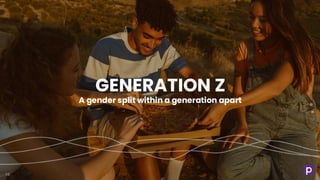
    GENERATION Z A gendersplit within a generation apart 16
  • 17.
    17 39 32 44 61 68 56 Gen Z -Total Gen Z - Men Gen Z - Women Most people can be trusted You can't be too careful in dealing with people Generally speaking, do you believe that most people can be trusted, or you can’t be too careful in dealing with people? Gen Z men are far less trusting than Gen Z women.
  • 18.
    18 While Gen Zconceded it was getting harder to trust, results for key institutions show that their trust levels are higher than older cohorts. 42 39 37 35 Gen Z (1997-2012) Millennials (1981-1996) Gen X (1965-1980) Boomers (1946-1964) 37 33 40 45 47 30 50 <$35K AHI $35K-$75K AHI $75K - $99K AHI $100K - $200K AHI >$200K AHI HS or less University + Aggregate trust in charities and non-profits, media, small and medium businesses, governments and large corporations. Thinking again about Canada, to what extent are you willing to trust the following organizational categories to be competent and effective and to do the right thing? 1 means you “trust very little” and 7 means you “trust a lot” [5-7 reported]. CanTrust Index
  • 19.
    50 43 46 54 50 48 4845 41 44 44 59 52 54 50 52 49 48 47 43 42 38 58 57 55 53 51 49 47 44 40 38 30 66 63 56 58 50 53 48 46 37 33 25 Canadian military RCMP Canadian healthcare system The Supreme Court Canadian education system The Bank of Canada Canada's judicial system Canadian electoral system Canadian financial markets Canadian Parliament Canada's immigration system Gen Z Millennials Gen X Boomers 19 Young people are more trusting of immigration and less trusting of the military and RCMP. Thinking again about Canada, to what extent are you willing to trust the following organizational categories to be competent and effective and to do the right thing? 1 means you “trust very little” and 7 means you “trust a lot” [5-7 reported].
  • 20.
    50 43 46 54 50 48 4845 41 44 44 48 43 45 54 39 50 42 49 43 40 43 51 44 48 53 59 46 54 42 40 48 46 Canadian military RCMP Canadian healthcare system The Supreme Court Canadian education system The Bank of Canada Canada's judicial system Canadian electoral system Canadian financial markets Canadian Parliament Canada's immigration system Gen Z - Total Gen Z - Men Gen Z - Women 20 Gen Z women are much more trusting of the education system, compared to Gen Z men. Thinking about Canada, to what extent are you willing to trust the following institutions to operate competently and effectively and to do the right thing? 1 means you “trust very little” and 7 means you “trust a lot” [5-7 reported].
  • 21.
    Trust levels forvarious content sources vary by age. Social media, AI, blogs, and podcasts are all much higher in the younger cohorts and these trust levels are closing in on parity to other traditional sources. 21 62 59 51 49 44 42 41 39 38 26 54 51 54 48 46 36 36 34 41 28 54 53 54 47 38 30 27 24 32 19 41 46 60 48 32 16 14 13 21 9 Consumer reviews Internet searches on search engines like Google or Bing News stories in newspapers, TV, on radio News stories on news media websites Social media posts by people you know Social media posts by a brand or company AI searches on LLMs and platforms such as ChatGPT, Gemini or Perplexity Blogs Podcasts Sponsored (paid for) social media posts by celebrities or other influencers Gen Z Millennials Gen X Boomers On a scale of 1 to 7, please indicate how much you are willing to trust the following sources to provide you with reliable information? 1 means you “trust very little” and 7 means you “trust a lot” [5-7 reported].
  • 22.
    41 41 39 62 59 51 49 29 38 42 44 26 43 46 38 54 41 56 59 47 44 28 4142 43 33 38 43 44 31 38 67 60 55 54 30 35 42 45 20 47 49 Advertising by government AI searches on LLMs and platforms such as ChatGPT, Gemini or Perplexity Blogs Consumer reviews Internet searches on search engines like Google or Bing News stories in newspapers, TV, on radio News stories on news media websites Online advertising by companies Podcasts Social media posts by a brand or company Social media posts by people you know Sponsored (paid for) social media posts by celebrities or other influencers Traditional advertising on television, radio, or in print Word of mouth from people you know Gen Z - Total Gen Z - Men Gen Z - Women 22 On a scale of 1 to 7, please indicate how much you are willing to trust the following sources to provide you with reliable information? 1 means you “trust very little” and 7 means you “trust a lot” [5-7 reported]. Gen Z men are much more likely to trust AI searches compared to Gen Z women.
  • 23.
    47 47 56 49 37 53 57 54 58 41 52 5756 53 40 58 64 60 62 46 Total Personally Educationally Socially Economically Gen Z Millennials Gen X Boomers Gen Z is the least satisfied. 23 Thinking about your own life in Canada, to what extent do you feel satisfied? 1 means you “trust very little” and 7 means you “trust a lot” [5-7 reported].
  • 24.
    47 56 49 37 43 49 49 42 50 61 49 32 Personally EducationallySocially Economically Gen Z - Total Gen Z - Men Gen Z - Women 24 Gen Z men are particularly dissatisfied personally and educationally, despite higher economic satisfaction. Thinking about your own life in Canada, to what extent do you feel satisfied? 1 means you “trust very little” and 7 means you “trust a lot” [5-7 reported].
  • 25.
  • 26.
    26 Trust in AIis stalled in seven years of tracking. Using a scale from 1-7, how much do you trust Artificial Intelligence to improve your experience as a consumer? 1 means you “trust very little” and 7 means you “trust a lot” [5-7 reported]. 37 34 35 37 41 34 35 36 36 37 37 29 34 35 33 35 33 34 Total BC Prairies Ontario Quebec Atlantic Trust in AI to improve the consumer experience 2018 2024 2025
  • 27.
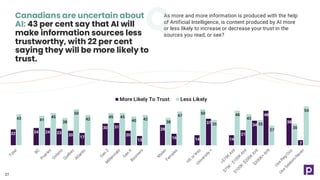
    As more andmore information is produced with the help of Artificial Intelligence, is content produced by AI more or less likely to increase or decrease your trust in the sources you read, or see? Canadians are uncertain about AI: 43 per cent say that AI will make information sources less trustworthy, with 22 per cent saying they will be more likely to trust. 27 22 24 24 23 20 17 30 31 20 13 28 16 14 37 14 21 34 48 38 7 43 41 45 38 50 42 45 45 40 42 38 47 50 35 48 43 35 27 30 54 More Likely To Trust Less Likely
  • 28.
    28 Gen Z isleading the way in adopting AI, personally and professionally. To what extent do you personally use AI tools in your personal or work life? 57 28 15 Seldom/Never Occasionally Regularly Personally 68 18 13 Seldom/Never Occasionally Regularly Work Use Reg./ Occ. Use Seldom/ Never Male 50 50 Female 38 62 Gen Z 66 34 Millennials 55 45 Gen X 45 55 Boomer 24 76 Use Reg./ Occ. Use Seldom/ Never Male 36 64 Female 27 73 Gen Z 50 50 Millennials 47 53 Gen X 36 65 Boomer 10 90
  • 29.
    29 Trust is stalled,but it does differ by generation. Users of AI are also the most trusting, not surprisingly. 35 37 43 33 27 41 30 34 59 12 43 43 35 22 41 28 Total Users Non-users Gen Z Millennials Gen X Boomers Males Females Trust in AI to improve consumer experience 2024 2025
  • 30.
    How much doyou trust Artificial Intelligence to positively contribute to the Canadian economy? 1 means you “trust very little” and 7 means you “trust a lot” [5-7 reported]. About one in three Canadians believe AI will contribute to the economy. 30 39 37 35 37 47 37 33 29 30 34 37 31 33 31 32 35 31 30 Total BC Prairies Ontario Quebec Atlantic Trust in AI to contribute to the economy 2018 2024 2025
  • 31.
    Younger cohorts areincreasingly convinced of the ability of AI to contribute to the economy. Older cohorts less so. 31 33 33 39 33 27 38 30 24 44 33 53 14 38 45 31 21 38 28 20 50 Total Users Non-users Gen Z Millennials Gen X Boomers Males Females HS or less University + Trust in AI to contribute to the economy 2024 2025
  • 32.
    How much doyou trust Artificial Intelligence to support the following Canadian sectors to operate competently and effectively? 1 means you “trust very little” and 7 means you “trust a lot” [5-7 reported]. Notable increases in expectations of AI to support retail, healthcare, and travel. 32 22 27 23 29 33 32 41 39 38 37 35 35 31 29 Entertainment/ creative work Retail Healthcare Travel Financial services Education Government services News media reporting Trust in AI to support industries 2024 2025
  • 33.
    More frequent usersof AI are much more trusting of its use in specific sectors. 33 59 57 57 54 53 52 46 46 25 22 18 19 26 19 17 13 Entertainment/ creative work Retail Travel Education Healthcare Financial services Government services News media reporting Trust in AI to support industries User Reg./Occ. Use Seldom/Never
  • 34.
    TRUST IN INSTITUTIONS 34 Stableor growing trust, but the immigration system falters
  • 35.
    Trust in mostCanadian institutions is stable. Notable drop in trust in Canada's immigration system. Steady increase in trust in the military and RCMP. 35 Thinking about Canada, to what extent are you willing to trust the following institutions to operate competently and effectively and to do the right thing? 1 means you “trust very little” and 7 means you “trust a lot” [5-7 reported]. 58 50 63 56 54 47 43 52 48 58 54 53 46 45 40 38 57 54 58 55 54 49 47 46 39 38 37 59 55 52 58 54 49 50 46 41 37 39 61 57 54 54 52 51 48 47 41 39 33 Canadian military RCMP Canadian healthcare system The Supreme Court Canadian education system The Bank of Canada Canada's judicial system Canadian electoral system Canadian financial markets Canadian Parliament Canada's immigration system 2021 2022 2023 2024 2025
  • 36.
    36 Regional data showssimilar patterns. Alberta leads the prairie unrest. 66 58 58 58 56 49 46 54 40 45 34 60 55 50 51 51 42 41 38 34 29 26 60 53 53 54 47 50 47 43 41 35 32 59 63 62 55 59 59 55 55 47 49 37 64 63 53 52 56 56 47 50 42 45 37 Canadian military RCMP Canadian healthcare system The Supreme Court Canadian education system The Bank of Canada Canada's judicial system Canadian electoral system Canadian financial markets Canadian Parliament Canada's immigration system BC Prairies Ontario Quebec Atlantic
  • 37.
    SOURCES WE TRUST Thedoctor is in, and politicians are out 37
  • 38.
    On a scaleof 1 to 7, please indicate how much you are willing to trust each the following categories of people for reliable information. 1 means you “trust very little” and 7 means you “trust a lot” [5-7 reported]. Medical doctors remain the most trusted sources of reliable information. 81 64 77 63 49 36 27 17 14 18 78 65 75 63 44 35 27 19 14 22 73 68 69 60 46 40 29 17 15 22 78 76 74 68 49 40 37 37 30 26 19 16 17 75 73 68 60 59 48 47 41 40 36 34 29 23 19 17 Doctors Friends & family members Scientists Educators University and college professors Journalists University and college presidents Bankers Entrepreneurs Small or medium sized business executives Religious or spiritual leaders Large corporate executives Independent bloggers/social media influencers Celebrities Politicians 2021 2022 2023 2024 2025 38
  • 39.
    77 68 74 65 47 38 28 18 20 15 75 73 68 60 48 41 34 23 1719 Doctors Friends & family members Scientists Educators Journalists Bankers Religious or spiritual leaders Independent bloggers/social media influencers Politicians Celebrities Five Year Avg 2025 Over five years, family, religious leaders, and bloggers are up slightly. Doctors remain at the top, and scientists and educators dipped slightly. Up Down Down Up Up 39
  • 40.
    On a scaleof 1 to 7, please indicate how much you are willing to trust the following sources to provide you with reliable information? 1 means you “trust very little” and 7 means you “trust a lot” [5-7 reported]. AI searches are considered trusted sources of reliable information for over a quarter of Canadians. 40 55 49 47 50 50 35 37 22 24 21 15 57 50 48 46 47 48 39 35 26 25 21 20 55 51 52 52 48 44 42 40 31 29 30 25 19 28 News on newspaper, TV, radio Consumer reviews Internet search Word of mouth from people you know News on news websites Advertising by government Traditional advertising on traditional media Social media posts by people you know Podcasts Social media posts by a brand or company Online advertising by companies Blogs Sponsored social media posts by celebrities or other influencers AI searches on LLMs 2021 2023 2025
  • 41.
    TRUST IN BUSINESSLEADERS AND CORPORATIONS 41 Better efforts needed by CEOs and corporations
  • 42.
    42 Grade Given Indexedto 100 and Converted to Letter on below scale LEGEND: A (85-100) B (75-84 ) C (65-74) D (50-64) F (<50) If you were to grade your employer on their capacity to build trust with external stakeholders (clients, customers, suppliers, partners, etc.) what grade from an A+ to an F would you give them? Employee grades for their employer result in a “C” grade for the fourth year in a row. 69 76 74 68 64 68 62 67 59 62 59 55 71 72 69 69 67 69 68 72 69 67 68 68 70 75 71 70 69 67 71 73 73 70 69 64 Total Upper management (c-suite or VP) Middle management (manager or director) Administrative or support staff Skilled labour Frontline service 2020 2021 2022 2023 2024 2025 D C C C C B D C C D C C D C D D C C C C C C C C C B C C C C C C C C C D
  • 43.
    43 Trust in keybusiness sectors is mostly stable. Trust in cryptocurrency almost doubles in two years. 43 Thinking about Canada and the economy, to what extent are you willing to trust the following industries to operate competently and effectively and to do the right thing. 1 means you “trust very little” and 7 means you “trust a lot” [5-7 reported]. 42 41 31 26 37 43 30 12 14 48 44 36 31 30 37 44 36 16 18 54 48 45 41 41 37 39 42 39 39 46 40 36 20 20 Universities & Colleges Streaming services Nuclear power station operators Oil & gas companies Life & health insurance companies Banks Property & accident insurance companies Online gambling 2023 2024 2025 E-commerce Long term care facilities Mining Pharmaceutical companies Investment management companies Telecommunications companies Cryptocurrency businesses
  • 44.
    68 67 55 My co-workersMy immediate manager The company CEO or most senior leader 2025 44 Canadians in the workforce are more trusting of their colleagues versus their CEOs. 44 If you need information about your workplace and your employer, on a scale of 1 to 7, please indicate how much you are willing to trust each of the following categories of people for reliable information. 1 means you “trust very little” and 7 means you “trust a lot” [5-7 reported].
  • 45.
    68 67 64 6463 63 60 60 59 57 57 56 53 49 39 24 66 67 60 63 61 61 53 56 59 54 50 48 46 62 56 25 Focusing on employee safety & wellbeing Being endorsed by my friends and family Creating local employment opportunities Having a clearly stated corporate or social purpose Being Canadian-owned and operated Committing to inclusion and diversity Committing to Indigenous reconciliation Being innovative 5 Year Avg 2025 Focusing on employee safety & wellbeing Having values that are close to my own Being endorsed by my friends and family Having a leader that communicates openly Creating local employment opportunities Having a brand, product or service meet my needs Having a clearly stated corporate or social purpose Supporting charitable causes Being Canadian- owned and operated Advocating for positive social change Committing to inclusion and diversity Speaking out international conflicts Committing to Indigenous reconciliation Track record to protect personal data Being innovative Being endorsed by an influencer that I follow On a scale of 1-7 to what extent do you think each of the actions listed below will help make a company or brand more trustworthy to you personally? 1 means you “trust very little” and 7 means you “trust a lot” [5-7 reported]. Among the drivers of corporate trust, data security and innovation show large increases over five years. 45
  • 46.
    46 Support for business leadersto speak out on issues remains weak. When it comes to important issues such as climate change, racism, and social equity, do you think business leaders should speak out and take positions regularly on behalf of their company? 57 31 12 53 36 11 49 37 14 49 38 12 Should speak & take positions regularly Should speak out, but in rare instances Should not speak out & take positions ever 2022 2023 2024 2025 -8 1 -9 -6 -10 -11 -14 -8 -13 3 -8 -8 Total Gen Z Millennials Gen X Boomers BC Prairies Ontario Quebec Atlantic Males Female Change From 2022 The 8 point drop from 2022 to 2025 is contrasted by age, region and gender identity.
  • 47.
    GOVERNMENT, DEMOCRACY, THE PARTYSYSTEM 47 Trust in democracy is stable, and Ottawa can build trust with healthcare, transparency and standing up to foreign threats
  • 48.
    Thinking about Canada,to what extent do you trust that the current election system in Canada is a) fair; b) represents the votes of citizens. 1 means you “trust very little” and 7 means you “trust a lot” [5-7 reported]. More Canadians say they trust the electoral system to be fair. Less trust the government or political parties to protect against foreign interference. 48 47 48 50 55 The system is fair 2019 2023 2024 2025 44 46 47 52 The system represents the votes of citizens 2019 2023 2024 2025 43 Trust the federal government and Elections Canada to prevent foreign interference in Canadian elections 40 Trust our major Canadian political parties to prevent foreign interference in their own internal operations or elections 2025
  • 49.
    To what extentdo you agree or disagree with statement below. 1 means you “do not agree at all” and 7 means you “agree completely” [5-7 reported]. Two-thirds of Canadians continue to believe government plays an important role. 49 64 62 65 I believe government plays an important role in providing services that help make Canada a better country for our citizens 2023 2024 2025 59 63 64 68 60 70 50 78 88 57 65 56 This belief increases with age, income, and education level.
  • 50.
    To what extentdo you think each of the actions listed below will help make the federal government more trustworthy to you personally. 1 means you “do not agree at all” and 7 means you “agree completely” [5-7 reported]. How can Ottawa be more trustworthy? As federal government changes come in 2025, Canadians choose healthcare funding and government transparency as priorities to improve trust. 50 70 70 65 63 61 60 57 55 54 53 52 52 52 50 50 46 45 45 39 Increase access to healthcare Stand up to countries that threaten Canada's prosperity Policies that get more houses built Reduce immigration and people seeking asylum Celebrate Canada as a successful country Mitigate the impact of extreme weather Reduce the carbon footprint of Canada Increase defence spending to NATO's 2% of GDP level Commit to more laws protecting minority groups Give subsidies to invest more in Canada 2025 Be more open and transparent Support workers to have more benefits or better wages Protect natural areas and ecosystems in Canada Significant spending cuts Cut the carbon tax Raise Canada's voice on conflicts or human rights issues Cut the number of civil servants Commit to faster action on Indigenous reconciliation A Prime Minister who communicates
  • 51.
    49 59 55 58 54 51 45 53 57 56 Liberal Conservative NDP BLOC Born Canada Born Elsewhere GenZ Millennials Gen X Boomers Divisive In terms of how political parties operate, which of the following is closest to your opinion? - Political parties are a unifying force in our country. - Political parties are a divisive force in our country. The view that the political party system is divisive is growing. 51 56 57 60 28 27 22 16 16 18 2023 2024 2025 Divisive Undecided Unifying
  • 52.
    52 To what extentare you willing to trust the following federal government services to operate competently and effectively and to do the right thing? 1 means you “trust very little” and 7 means you “trust a lot” [5-7 reported]. 53 50 49 46 46 44 48 47 46 41 33 29 34 36 57 46 47 47 44 40 46 50 43 40 33 23 34 32 57 55 51 51 51 50 49 49 48 45 40 39 38 36 National parks Agriculture and food National defence and security Policing and public safety Canada Pension and related old age benefits Healthcare standards and access Managing natural weather disasters and providing relief Passports and border crossings Employment insurance Environmental standards and protection Meeting national targets to reduce causes of climate change Affordable housing Indigenous relations Immigration and refugee management 2023 2024 2025 There has been a large jump in trust in the federal government to deliver affordable housing.
  • 53.
    46 34 50 46 33 52 39 37 45 33 32 38 27 3638 The Prime Minister The Premier of your province Your community mayor 2016 2018 2020 2022 2025 When you think of these people or groups of people to what extent do you trust each to do what is right for Canada, Canadians and our society in general? 1 means you “trust very little” and 7 means you “trust a lot” [5-7 reported]. Trust in community mayors shows a five-year decline. 53 43 34 50 30 34 38 The Prime Minister The Premier of your province Your community mayor First Five Year Avg Recent Five Year Avg
  • 54.
    VALUES PERFORMANCE 54 Canada isnot living up to values for economic security and only a minority are economically satisfied
  • 55.
    49 63 57 59 54 47 4850 46 46 41 41 36 51 59 59 54 53 53 55 48 48 48 47 47 39 Average of all values Freedom Diversity Safety Democracy Education Inclusion Health Fairness Privacy Equity Sustainability Economic security Prior 5 year Avg 2025 Canadians more likely to trust that their nation is living up to the values of equity, inclusion and sustainability. Notable declines in freedom and safety. 55 In thinking about Canada as a country, please rate how well you feel our country is living up to its values in the following areas using a scale of 1 to 7. 1 means you “not at all” and 7 means “completely” [5-7 reported]. Up Down Up Up Down
  • 56.
    53 73 53 68 65 43 60 55 53 39 39 35 51 60 5960 54 48 50 54 48 47 44 44 43 42 56 55 49 45 45 46 37 36 39 36 36 28 51 59 59 54 53 53 55 48 48 48 47 47 39 Average of all values Freedom Diversity Safety Democracy Education Inclusion Health Fairness Privacy Equity Sustainability Economic security 2020 2022 2024 2025 Over the years, tracking shows notable declines in freedom, safety, health, and democracy as values. 56
  • 57.
    60 58 60 53 5351 49 48 42 48 47 35 57 60 58 54 54 51 46 48 50 47 47 43 58 57 52 56 47 54 44 45 45 48 45 38 61 57 50 52 54 51 49 45 46 45 46 34 Freedom Diversity Safety Democracy Education Inclusion Health Fairness Privacy Equity Sustainability Economic security Gen Z Millennials Gen X Boomers Some difference by age group. 57
  • 58.
    51 55 54 54 40 44 4947 44 38 50 56 56 52 38 49 56 55 53 34 52 59 57 58 43 Total Personally Educationally Socially Economically 2021 2022 2023 2024 2025 Thinking about your own life in Canada, to what extent do you feel satisfied? 1 means you “trust very little” and 7 means you “trust a lot” [5-7 reported]. Just over half of Canadians say they are satisfied with their own lives. Economic satisfaction lags. 58
  • 59.
    TRUST CAN BEGROWN 59 Building a plan for trust may be easier than you think
  • 60.
    • Trust isnot something you either have or don’t. • The CanTrust Index uses a 7-point scale, and many people choose the neutral 4 in the middle (scores on a range of 1 to 7). • These individuals can represent a large portion, making them the "trust swing vote". This group trusts some things and distrusts others. • Opportunity for organizations: Trust can be won with positive actions and communication. • Failing to listen and engage can cause trust to be lost. • Trust can be nurtured and grown through deliberate effort, creating opportunities to build loyalty. Trust is not binary 60
  • 61.
    BUILDING CANADA'S FUTURE STARTSWITH TRUST cantrustindex.ca 61 VANESSA EATON veaton@getproof.com BRUCE MACLELLAN bmaclellan@getproof.com For more information, please contact: