MANAGEMEN RESIKO KEAMANAN INFORMASI (english).pptx
1.
Information Security RiskManagement
Information Security
Presented by
Muhammad Najib DS, S.Kom.,MT
Sistem Pembelajaran Dalam Jaringan (Online)
Universitas Teknokrat Indonesia
najibmuhammadd MuhammadNajibDS
2.
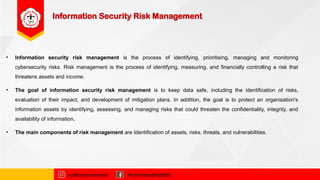
Information Security RiskManagement
• Information security risk management is the process of identifying, prioritising, managing and monitoring
cybersecurity risks. Risk management is the process of identifying, measuring, and financially controlling a risk that
threatens assets and income.
• The goal of information security risk management is to keep data safe, including the identification of risks,
evaluation of their impact, and development of mitigation plans. In addition, the goal is to protect an organisation's
information assets by identifying, assessing, and managing risks that could threaten the confidentiality, integrity, and
availability of information.
• The main components of risk management are Identification of assets, risks, threats, and vulnerabilities.
najibmuhammadd MuhammadNajibDS
3.
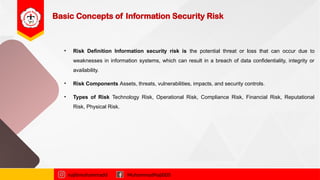
Basic Concepts ofInformation Security Risk
• Risk Definition Information security risk is the potential threat or loss that can occur due to
weaknesses in information systems, which can result in a breach of data confidentiality, integrity or
availability.
• Risk Components Assets, threats, vulnerabilities, impacts, and security controls.
• Types of Risk Technology Risk, Operational Risk, Compliance Risk, Financial Risk, Reputational
Risk, Physical Risk.
najibmuhammadd MuhammadNajibDS
4.
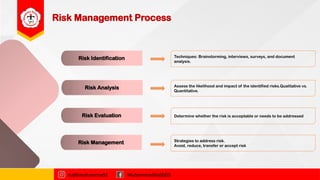
Risk Management Process
Techniques:Brainstorming, interviews, surveys, and document
analysis.
Assess the likelihood and impact of the identified risks.Qualitative vs.
Quantitative.
Determine whether the risk is acceptable or needs to be addressed
Strategies to address risk.
Avoid, reduce, transfer or accept risk
Risk Identification
najibmuhammadd MuhammadNajibDS
Risk Analysis
Risk Evaluation
Risk Management
5.
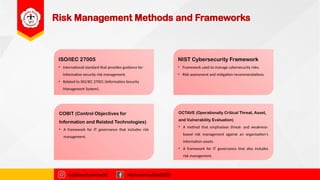
Risk Management Methodsand Frameworks
ISO/IEC 27005
• International standard that provides guidance for
information security risk management.
• Related to ISO/IEC 27001 (Information Security
Management System).
najibmuhammadd MuhammadNajibDS
NIST Cybersecurity Framework
• Framework used to manage cybersecurity risks.
• Risk assessment and mitigation recommendations.
COBIT (Control Objectives for
Information and Related Technologies)
• A framework for IT governance that includes risk
management.
OCTAVE (Operationally Critical Threat, Asset,
and Vulnerability Evaluation)
• A method that emphasises threat- and weakness-
based risk management against an organisation's
information assets.
• A framework for IT governance that also includes
risk management.
6.
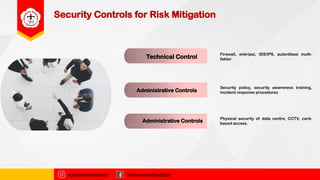
Security Controls forRisk Mitigation
Administrative Controls
Technical Control
najibmuhammadd MuhammadNajibDS
Administrative Controls
Firewall, enkripsi, IDS/IPS, autentikasi multi-
faktor
Security policy, security awareness training,
incident response procedures
Physical security of data centre, CCTV, card-
based access.
7.
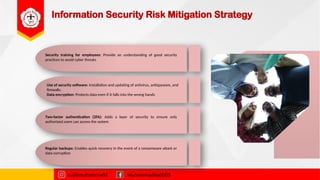
Information Security RiskMitigation Strategy
Security training for employees: Provide an understanding of good security
practices to avoid cyber threats
najibmuhammadd MuhammadNajibDS
Use of security software: Installation and updating of antivirus, antispyware, and
firewalls.
Data encryption: Protects data even if it falls into the wrong hands
Two-factor authentication (2FA): Adds a layer of security to ensure only
authorised users can access the system
Regular backups: Enables quick recovery in the event of a ransomware attack or
data corruption
8.
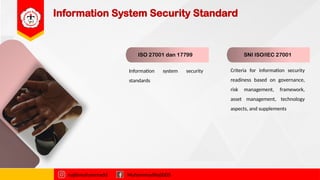
Information System SecurityStandard
ISO 27001 dan 17799 SNI ISO/IEC 27001
Information system security
standards
Criteria for information security
readiness based on governance,
risk management, framework,
asset management, technology
aspects, and supplements
najibmuhammadd MuhammadNajibDS
9.
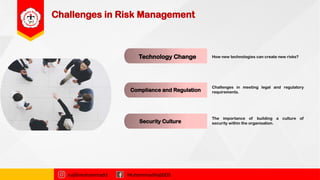
Challenges in RiskManagement
Compliance and Regulation
Technology Change
najibmuhammadd MuhammadNajibDS
Security Culture
How new technologies can create new risks?
Challenges in meeting legal and regulatory
requirements.
The importance of building a culture of
security within the organisation.