PERFORMING ARTS /VISUALARTS
Southeast Asian Performing and Visual Art Forms/Festivals
● Musical Plays: Komedya (Philippines) and Hát B i (Vietnam)
ộ
● Traditional Epics: Biag Ni Lam Ang (Philippines) and Ramakien
(Thailand)
● Shadow Puppetry: Carillo (Philippines) and Wayang Kulit
(Indonesia)
● Festivals: Sinulog Festival (Philippines) and Thingyan Festival
(Myanmar)
Theme: “Integrative Creative Works
of Selected Philippine/ Southeast
Asian Music and Arts”
2.
Picture Analysis
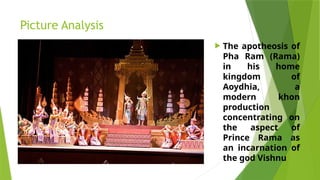
Theapotheosis of
Pha Ram (Rama)
in his home
kingdom of
Aoydhia, a
modern khon
production
concentrating on
the aspect of
Prince Rama as
an incarnation of
the god Vishnu
Unlocking Content Vocabulary
a. Dance – to move your body in a way that goes with the rhythm and style of music
that is being played. (Britannica, 2023).
b. Ensemble – a group of people or things that make up a complete unit (such as a
musical group, a group of actors or dancers, or a set of clothes). (Britannica, 2023)
c. Festival - a special time or event when people gather to celebrate something.
(Britannica, 2023).
d. Musical Play – Also called musical comedy, musical theatre, or musical.) A play in
which *music, usually in the form of songs, is essential to the narrative. (Oxford
reference, 2023).
e. Puppetry – the skill or activity of using puppets in performances. (Britannica,
2023).
f. Theater - a collaborative form of fine art that uses live performers before a live
audience in a specific place. (Music & Arts - Learner's Manual DepEd Valenzuela
Learning Packets)
5.
Matching Type (3- 5 minutes)
1. Briefly explain the objective of the activity. Objective: Define key terms related to
features and characteristics of integrative arts.
2. Match the words in column A with the definition in column B.
Column A
Column B
3. medium a.
These are the building blocks of
communication, such as
line, shape, color,
texture, space, and light.
2. performance styles b. It refers to the
social, historical, and
political environment in which a work of art
or
performance is created and experienced.
3. visual elements c. the
material or channel through which an
artist or performer communicates their ideas
6.
SUB-TOPIC 1: ExploringPerforming Arts
and Visual Arts of Selected Southeast
Asian Countries
7.
Integrative art, alsoreferred to as interdisciplinary
art, is a form of artistic expression that blends two
or more traditionally separate art forms to create a
unified whole. This can involve combining mediums
like painting, sculpture, and architecture, or
performance art forms like dance, music, and
theater. For instance, an environmental art
installation might incorporate elements of
sculpture, sound design, and lighting to create an
immersive experience for viewers.
8.
Type of integrativeart:
a. Musical plays
Musical plays are seen as a fun and engaging way to tell a story, combining
music, singing, dancing, and acting.
Example
● "Miss Saigon" - a Filipino adaptation of the international musical with a local
twist.
● "Ang Huling El Bimbo" (The Last El Bimbo) - a rock opera based on the
Eraserheads' music.
● Contemporary productions of Broadway musicals like "Les Misérables" or
"The Lion King"
9.
b. Traditional epics
Filipinoshave a rich tradition of oral epics passed down through
generations. These epics often tell stories of heroes, creation
myths, and cultural values.
Example
● "Biag ni Lam-Ang" (The Life of Lam-Ang) - an Ilocano epic about
a young hero with extraordinary powers.
● "Hudhud ni Aliguyon" (The Chant of Aliguyon) - an Ifugao epic
about a conflict between two tribes.
● "Darangen" (The Maranao Epic) - a Maranao epic about a series
of adventures of a royal family
10.
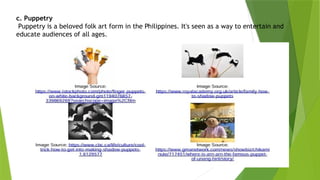
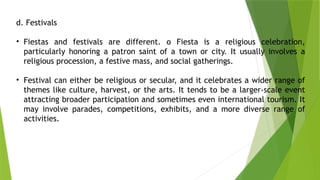
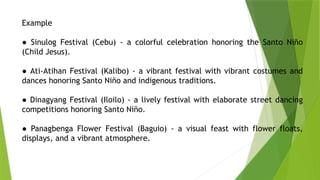
c. Puppetry
Puppetry isa beloved folk art form in the Philippines. It's seen as a way to entertain and
educate audiences of all ages.
11.
d. Festivals
• Fiestasand festivals are different. o Fiesta is a religious celebration,
particularly honoring a patron saint of a town or city. It usually involves a
religious procession, a festive mass, and social gatherings.
• Festival can either be religious or secular, and it celebrates a wider range of
themes like culture, harvest, or the arts. It tends to be a larger-scale event
attracting broader participation and sometimes even international tourism. It
may involve parades, competitions, exhibits, and a more diverse range of
activities.
12.
Example
● Sinulog Festival(Cebu) - a colorful celebration honoring the Santo Niño
(Child Jesus).
● Ati-Atihan Festival (Kalibo) - a vibrant festival with vibrant costumes and
dances honoring Santo Niño and indigenous traditions.
● Dinagyang Festival (Iloilo) - a lively festival with elaborate street dancing
competitions honoring Santo Niño.
● Panagbenga Flower Festival (Baguio) - a visual feast with flower floats,
displays, and a vibrant atmosphere.
Editor's Notes
#2 Start with close observation. Allow students to describe the picture in detail, including colors, shapes, figures, objects, and any other notable elements and principles of the arts. ● End with the question: What is an integrative art?
The apotheosis of Pha Ram (Rama) in his home kingdom of Aoydhia, a modern khon production concentrating on the aspect of Prince Rama as an incarnation of the god Vishnu
How does the picture visually represent the sounds, emotions, or themes of the music or art form?
#3 Whisper a term related to integrative arts (see list below) to one student in each group. 3. This student will act out the term without speaking, while their group tries to guess the word. 4. Rotate terms and students act them out.
#8 ● Have you watched a show where it combined music, singing, dancing, and acting?
● What was the title of the show? What was the story of the show?
● Where did you watch it? Who are you with?
● What did you feel after watching the show?
#9 Have you read stories about heroes? Myths about creation? Stories about cultural values?
● What was the title of the story? What was the story about?
● Who shared the story to you?
● What did you feel after reading the story?
#10 Are you familiar with this? What is the name of this form of puppetry?
#11 Are you familiar with the word ‘fiesta’?
● What do you usually experience during a ‘fiesta’?
● Can you give me an example of a fiesta?
● (If the class has a misconception between fiesta and festival)