BAYUGAN II NATIONAL HIGH SCHOOL SBM ROOM
FEB. 21, 2025
2:00 – 5:00 PM
“Empowering Educators: Teacher
Orientation on the 2025 Performance
Management Evaluation System
(PMES)Through Learning Action Cell”
Legal Basis: DM no. 017 s. 2025
Performance Management Evaluation
System (PMES) 2025
INTERIM GUIDELINES FOR THE DEPARTMENT OF
EDUCATION PERFORMANCE MANAGEMENT AND
EVALUATION SYSTEM FOR TEACHERS IN THE
SCHOOL YEAR 2024-2025
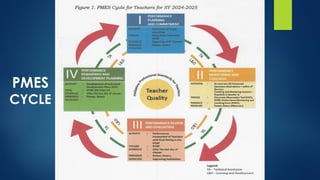
PMES
CYCLE
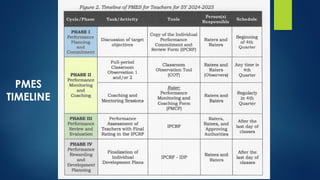
PMES
TIMELINE
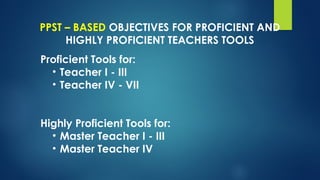
PPST – BASED OBJECTIVES FOR PROFICIENT AND
HIGHLY PROFICIENT TEACHERS TOOLS
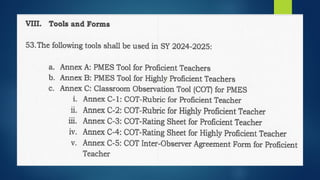
Proficient Tools for:
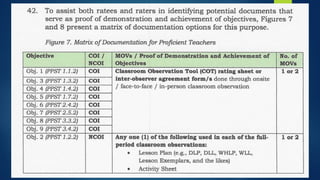
• Teacher I - III
• Teacher IV - VII
Highly Proficient Tools for:
• Master Teacher I - III
• Master Teacher IV
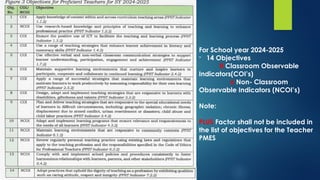
For School year 2024-2025
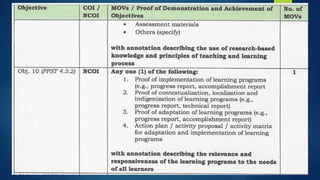
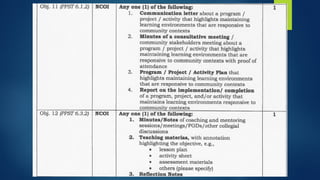
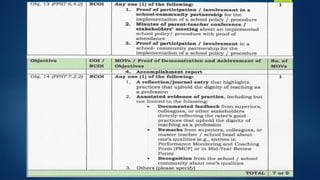
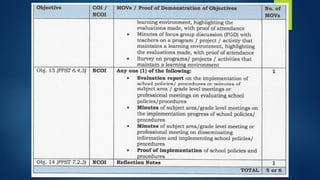
- 14 Objectives
8 Classroom Observable
Indicators(COI’s)
6 Non- Classroom
Observable Indicators (NCOI’s)
Note:
PLUS Factor shall not be included in
the list of objectives for the Teacher
PMES
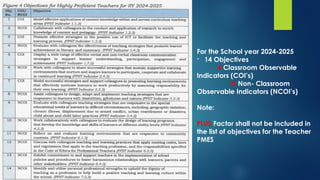
For the School year 2024-2025
- 14 Objectives
4 Classroom Observable
Indicators (COI’s)
10 Non- Classroom
Observable Indicators (NCOI’s)
Note:
PLUS Factor shall not be included in
the list of objectives for the Teacher
PMES
III. Assessing PPST-based Objectives
1. The performance assessment shall focus on the demonstration
and achievement of the PPST COIs and NCOIs, which are
translated as Objectives in the performance management and
evaluation of teachers.
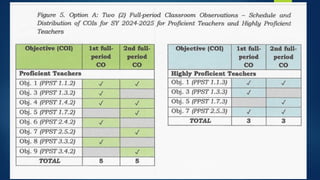
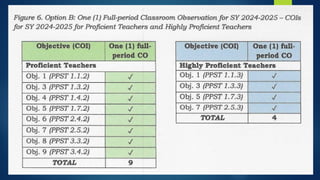
2. One (1) or two (2) full-period classroom observations shall be
required to be conducted in assessing the performance of
teachers for classroom observable objectives. These
observations shall be conducted at any time during the 4th
Quarter of SY 2024-2025, with the schedule agreed upon by the
teacher and the rater (observer).
III. Assessing PPST-based Objectives
3. There shall be two (2) scheduling options for the full-period
classroom observation.
• Option A: Two (2) full-period observations in 4th
quarter with
objectives (COI) distributed across observations.
• Option B: One (1) full-period observation the 4th
quarter
covering all objectives (COI)
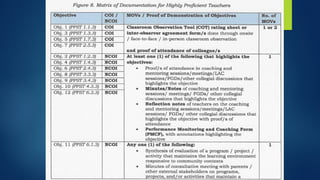
4. Figure 5 outlines the Option A schedule, detailing the
distribution of the objectives/COI that shall be observed in the
first and second full-period classroom observations for both
proficient and highly proficient teachers; while figure 6 present
the option B, specifying the COIs to be observed in the single
full-period classroom observation for Proficient and Highly
Proficient Teachers.
III. Assessing PPST-based Objectives
5. Pre-requisite and consequential teaching-learning materials
and documents, such as lesson plans, instructional materials,
assessment materials, assessment results, and other teaching
materials shall be used as bases for assessing non-classroom
observable objectives during the pre- and post-classroom
observation conference.
6. Documents considered as means of verification or proof of
demonstration and achievement of the objectives shall not be
required to be organized in a physical portfolio for submission at
the end of the school year. However, teachers are encouraged
to have their own repository of teaching-learning
materials/documents to facilitate accessibility and resource
sharing.
III. Assessing PPST-based Objectives
a. Pre-Observation
7. The ratee (teacher) and rater (observer) shall agree on the
schedule of classroom observations. The schedule must be set at
least three (3) working days before the classroom observation. In
the event that the agreed observation did not push through due to
conflicting schedules, they must reschedule the soonest possible
time.
8. In case of unforeseen circumstances and fortuitous events that are
outside the control of the schools (such as natural or man-made
calamities or disasters, lockdowns, etc.), concerned schools may
be allowed to deviate from the prescribed timeline of conducting
classroom observations, provided that the adjusted schedule is
approved by the Schools Division Superintendent (SDS); provided
further, that all applicable classroom observation modes are
exhausted prior to submitting the request.
III. Assessing PPST-based Objectives
a. Pre-Observation
9. The default mode of classroom observation shall be
in-person/Face-to-Face observation. In case of any national or
local pronouncements that may affect the operations of the
school (e.g. extended period of work suspensions, community
quarantines, implementation of blended learning, etc.), the
following modes of alternative classroom observation may be
considered, subject to internal guidelines issued by the
Department:
a. Online Synchronous Classroom Observation
b. Online Asynchronous Classroom Observation
c. Classroom Observation via Learning Action Cells LAC)
III. Assessing PPST-based Objectives
a. Pre-Observation
10. Pre-observation Conference. Before the conduct of the classroom
observation, ratees (teachers) and raters (observers) shall conduct a
pre-observation conference to review the Classroom Observation
Too1 (COT) Rubric appropriate to the level of the ratee to be
observed. They shall refer to the list of classroom observable indicators
to be observed in the particular classroom observation period (see
Figures 5 and 6).
11. Submission of lesson plans. Ratees (teachers) to be observed shall
submit their lesson plan to the rater (observers) at least one (1) day
before the scheduled classroom observation for review and
assessment. For Proficient Teachers, their lesson plans, activity sheets,
or assessment materials shall be given appropriate ratings in the IPCRF
using the PMES Proficient Teacher Tool as the basis for its
demonstration and achievement of Objective 2 (PPST Indicator 1.2.2).
III. Assessing PPST-based Objectives
a. Pre-Observation
12.Ratees (Teachers) and raters (observers) shall ensure that lesson
plans, instructional materials, assessment tools, and other
teaching and learning resources to be used during classroom
observations reflect those usually employed during regular class
days. This ensures that the demonstration of teaching in
classroom observations represents the teaching-learning
dynamics that learners and teachers experience on a daily
basis.
III. Assessing PPST-based Objectives
b. Actual Observation
13.During the actual classroom observation, the ratee (teacher)
shall deliver the lesson. For purposes of rating the performance,
classroom observations shall be done for the entire class period.
c. Post-observation
14.Individual Rating. The raters rate the performance of the
teacher using the COT appropriate to the teacher's level. Only
those indicators expected to be observed in an observation
period, as specified in Figures 5 and 6, shall be given a rating.
If there are multiple observers, only the subject specialist is
expected to rate Objective 1. If there is only one rater
(observer), he or she rates Objective 1. Elementary teachers are
generalists; all observers are expected to rate Objective 1.
III. Assessing PPST-based Objectives
c. Post-observation
15. Individual Rating. The raters rate the performance of the teacher
using the COT appropriate to the teacher's level. Only those
indicators expected to be observed in an observation period, as
specified in Figures 5 and 6, shall be given a rating.
16. Inter-Observer Agreement exercise (in case of multiple observers.
Raters (Observers) shall meet to discuss the individual ratings given.
In case of different ratings, they shall come up with a final rating. The
final rating shall not be an average but a final rating based on
reasoned and consensual judgment.
17. Post-Observation Conference. The rater/s shall conduct a post-
observation conference with the ratee to discuss his or her
experience and performance during the classroom observation,
allowing the ratee to reflect on his or her strengths and areas for
improvement and enhancement.
III. Assessing PPST-based Objectives
c. Post-observation
18.It is recommended that the Post-Observation Conference is
conducted in a supportive and friendly environment.
19.During the post-classroom observation conference, teaching
materials and documents, such as activity sheets, assessment
materials, assessment results, and other materials shall be given
appropriate ratings in the IPCRF for non-classroom observable
objectives, when applicable, using the PMES Tool appropriate
to the level of the teacher.
III. Assessing PPST-based Objectives
d. Assessment of Non-Classroom Observation-related
objectives
20. The ratee shall consistently demonstrate achievement of non-
classroom observable objectives throughout the school year, as
teaching and learning activities such as Learning Action Cell (LAC}
sessions, coaching and mentoring sessions, learning programs, and
others are conducted.
21. Ratees are expected to provide evidence and documentation of
demonstration and achievement of the objectives promptly, rather
than waiting for the end-of-year assessment. Such evidence and
documents are crosscutting and targeting multiple Objectives,
which means that there is no need to reproduce or duplicate copies
of the documents per objective. The rater shall then assess this
evidence and provide ratings using the tool appropriate to the level
of the teacher. No portfolio for performance assessment shall be
IV. Strengthening the coaching, mentoring, and Performance
Monitoring
a. Frequent short-period and walkthrough observations
• To provide continuous support to teachers in enhancing their
effectiveness in instruction and to address gaps identified
during full-period classroom observations, frequent short-period
and walkthrough (i.e., monitoring by walking around strategy)
observations, approximately 10-15 minutes, shall be conducted
as a non-rated, formative, and developmental approach. These
brief and informal observations will allow for timely feedback
and targeted support, fostering continuous improvement and
enhancement in teaching strategies.
“FLASH VISIT”
IV. Strengthening the coaching, mentoring, and Performance
Monitoring
b. Regular monitoring and provision of technical assistance on
teaching and learning processes and learning materials
• To ensure the effective design and implementation of teaching
and learning processes and materials, including lesson plans,
instructional materials (IMs), and assessment tools, among
others, regular monitoring and targeted technical assistance
shall be conducted, complemented with immediate and
constructive feedback. This feedback will allow teachers to
make timely improvements and enhancements on teaching
strategies and material development.
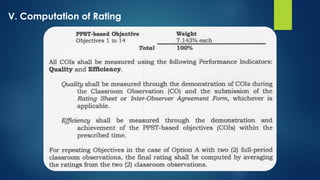
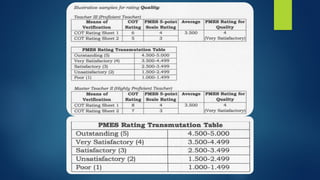
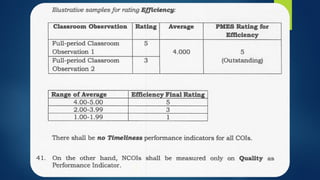
V. Computation of Rating
PMES Orientation.pptx INTERIM GUIDELINES FOR THE DEPARTMENT OF EDUCATION PERFORMANCE MANAGEMENT AND EVALUATION SYSTEM FOR TEACHERS IN THE SCHOOL YEAR 2024-2025

PMES Orientation.pptx INTERIM GUIDELINES FOR THE DEPARTMENT OF EDUCATION PERFORMANCE MANAGEMENT AND EVALUATION SYSTEM FOR TEACHERS IN THE SCHOOL YEAR 2024-2025

  • 1.
    BAYUGAN II NATIONALHIGH SCHOOL SBM ROOM FEB. 21, 2025 2:00 – 5:00 PM “Empowering Educators: Teacher Orientation on the 2025 Performance Management Evaluation System (PMES)Through Learning Action Cell”
  • 2.
    Legal Basis: DMno. 017 s. 2025 Performance Management Evaluation System (PMES) 2025 INTERIM GUIDELINES FOR THE DEPARTMENT OF EDUCATION PERFORMANCE MANAGEMENT AND EVALUATION SYSTEM FOR TEACHERS IN THE SCHOOL YEAR 2024-2025
  • 3.
  • 4.
  • 5.
    PPST – BASEDOBJECTIVES FOR PROFICIENT AND HIGHLY PROFICIENT TEACHERS TOOLS Proficient Tools for: • Teacher I - III • Teacher IV - VII Highly Proficient Tools for: • Master Teacher I - III • Master Teacher IV
  • 6.
    For School year2024-2025 - 14 Objectives 8 Classroom Observable Indicators(COI’s) 6 Non- Classroom Observable Indicators (NCOI’s) Note: PLUS Factor shall not be included in the list of objectives for the Teacher PMES
  • 7.
    For the Schoolyear 2024-2025 - 14 Objectives 4 Classroom Observable Indicators (COI’s) 10 Non- Classroom Observable Indicators (NCOI’s) Note: PLUS Factor shall not be included in the list of objectives for the Teacher PMES
  • 8.
    III. Assessing PPST-basedObjectives 1. The performance assessment shall focus on the demonstration and achievement of the PPST COIs and NCOIs, which are translated as Objectives in the performance management and evaluation of teachers. 2. One (1) or two (2) full-period classroom observations shall be required to be conducted in assessing the performance of teachers for classroom observable objectives. These observations shall be conducted at any time during the 4th Quarter of SY 2024-2025, with the schedule agreed upon by the teacher and the rater (observer).
  • 9.
    III. Assessing PPST-basedObjectives 3. There shall be two (2) scheduling options for the full-period classroom observation. • Option A: Two (2) full-period observations in 4th quarter with objectives (COI) distributed across observations. • Option B: One (1) full-period observation the 4th quarter covering all objectives (COI) 4. Figure 5 outlines the Option A schedule, detailing the distribution of the objectives/COI that shall be observed in the first and second full-period classroom observations for both proficient and highly proficient teachers; while figure 6 present the option B, specifying the COIs to be observed in the single full-period classroom observation for Proficient and Highly Proficient Teachers.
  • 12.
    III. Assessing PPST-basedObjectives 5. Pre-requisite and consequential teaching-learning materials and documents, such as lesson plans, instructional materials, assessment materials, assessment results, and other teaching materials shall be used as bases for assessing non-classroom observable objectives during the pre- and post-classroom observation conference. 6. Documents considered as means of verification or proof of demonstration and achievement of the objectives shall not be required to be organized in a physical portfolio for submission at the end of the school year. However, teachers are encouraged to have their own repository of teaching-learning materials/documents to facilitate accessibility and resource sharing.
  • 13.
    III. Assessing PPST-basedObjectives a. Pre-Observation 7. The ratee (teacher) and rater (observer) shall agree on the schedule of classroom observations. The schedule must be set at least three (3) working days before the classroom observation. In the event that the agreed observation did not push through due to conflicting schedules, they must reschedule the soonest possible time. 8. In case of unforeseen circumstances and fortuitous events that are outside the control of the schools (such as natural or man-made calamities or disasters, lockdowns, etc.), concerned schools may be allowed to deviate from the prescribed timeline of conducting classroom observations, provided that the adjusted schedule is approved by the Schools Division Superintendent (SDS); provided further, that all applicable classroom observation modes are exhausted prior to submitting the request.
  • 14.
    III. Assessing PPST-basedObjectives a. Pre-Observation 9. The default mode of classroom observation shall be in-person/Face-to-Face observation. In case of any national or local pronouncements that may affect the operations of the school (e.g. extended period of work suspensions, community quarantines, implementation of blended learning, etc.), the following modes of alternative classroom observation may be considered, subject to internal guidelines issued by the Department: a. Online Synchronous Classroom Observation b. Online Asynchronous Classroom Observation c. Classroom Observation via Learning Action Cells LAC)
  • 15.
    III. Assessing PPST-basedObjectives a. Pre-Observation 10. Pre-observation Conference. Before the conduct of the classroom observation, ratees (teachers) and raters (observers) shall conduct a pre-observation conference to review the Classroom Observation Too1 (COT) Rubric appropriate to the level of the ratee to be observed. They shall refer to the list of classroom observable indicators to be observed in the particular classroom observation period (see Figures 5 and 6). 11. Submission of lesson plans. Ratees (teachers) to be observed shall submit their lesson plan to the rater (observers) at least one (1) day before the scheduled classroom observation for review and assessment. For Proficient Teachers, their lesson plans, activity sheets, or assessment materials shall be given appropriate ratings in the IPCRF using the PMES Proficient Teacher Tool as the basis for its demonstration and achievement of Objective 2 (PPST Indicator 1.2.2).
  • 16.
    III. Assessing PPST-basedObjectives a. Pre-Observation 12.Ratees (Teachers) and raters (observers) shall ensure that lesson plans, instructional materials, assessment tools, and other teaching and learning resources to be used during classroom observations reflect those usually employed during regular class days. This ensures that the demonstration of teaching in classroom observations represents the teaching-learning dynamics that learners and teachers experience on a daily basis.
  • 17.
    III. Assessing PPST-basedObjectives b. Actual Observation 13.During the actual classroom observation, the ratee (teacher) shall deliver the lesson. For purposes of rating the performance, classroom observations shall be done for the entire class period. c. Post-observation 14.Individual Rating. The raters rate the performance of the teacher using the COT appropriate to the teacher's level. Only those indicators expected to be observed in an observation period, as specified in Figures 5 and 6, shall be given a rating. If there are multiple observers, only the subject specialist is expected to rate Objective 1. If there is only one rater (observer), he or she rates Objective 1. Elementary teachers are generalists; all observers are expected to rate Objective 1.
  • 18.
    III. Assessing PPST-basedObjectives c. Post-observation 15. Individual Rating. The raters rate the performance of the teacher using the COT appropriate to the teacher's level. Only those indicators expected to be observed in an observation period, as specified in Figures 5 and 6, shall be given a rating. 16. Inter-Observer Agreement exercise (in case of multiple observers. Raters (Observers) shall meet to discuss the individual ratings given. In case of different ratings, they shall come up with a final rating. The final rating shall not be an average but a final rating based on reasoned and consensual judgment. 17. Post-Observation Conference. The rater/s shall conduct a post- observation conference with the ratee to discuss his or her experience and performance during the classroom observation, allowing the ratee to reflect on his or her strengths and areas for improvement and enhancement.
  • 19.
    III. Assessing PPST-basedObjectives c. Post-observation 18.It is recommended that the Post-Observation Conference is conducted in a supportive and friendly environment. 19.During the post-classroom observation conference, teaching materials and documents, such as activity sheets, assessment materials, assessment results, and other materials shall be given appropriate ratings in the IPCRF for non-classroom observable objectives, when applicable, using the PMES Tool appropriate to the level of the teacher.
  • 20.
    III. Assessing PPST-basedObjectives d. Assessment of Non-Classroom Observation-related objectives 20. The ratee shall consistently demonstrate achievement of non- classroom observable objectives throughout the school year, as teaching and learning activities such as Learning Action Cell (LAC} sessions, coaching and mentoring sessions, learning programs, and others are conducted. 21. Ratees are expected to provide evidence and documentation of demonstration and achievement of the objectives promptly, rather than waiting for the end-of-year assessment. Such evidence and documents are crosscutting and targeting multiple Objectives, which means that there is no need to reproduce or duplicate copies of the documents per objective. The rater shall then assess this evidence and provide ratings using the tool appropriate to the level of the teacher. No portfolio for performance assessment shall be
  • 21.
    IV. Strengthening thecoaching, mentoring, and Performance Monitoring a. Frequent short-period and walkthrough observations • To provide continuous support to teachers in enhancing their effectiveness in instruction and to address gaps identified during full-period classroom observations, frequent short-period and walkthrough (i.e., monitoring by walking around strategy) observations, approximately 10-15 minutes, shall be conducted as a non-rated, formative, and developmental approach. These brief and informal observations will allow for timely feedback and targeted support, fostering continuous improvement and enhancement in teaching strategies. “FLASH VISIT”
  • 22.
    IV. Strengthening thecoaching, mentoring, and Performance Monitoring b. Regular monitoring and provision of technical assistance on teaching and learning processes and learning materials • To ensure the effective design and implementation of teaching and learning processes and materials, including lesson plans, instructional materials (IMs), and assessment tools, among others, regular monitoring and targeted technical assistance shall be conducted, complemented with immediate and constructive feedback. This feedback will allow teachers to make timely improvements and enhancements on teaching strategies and material development.
  • 23.